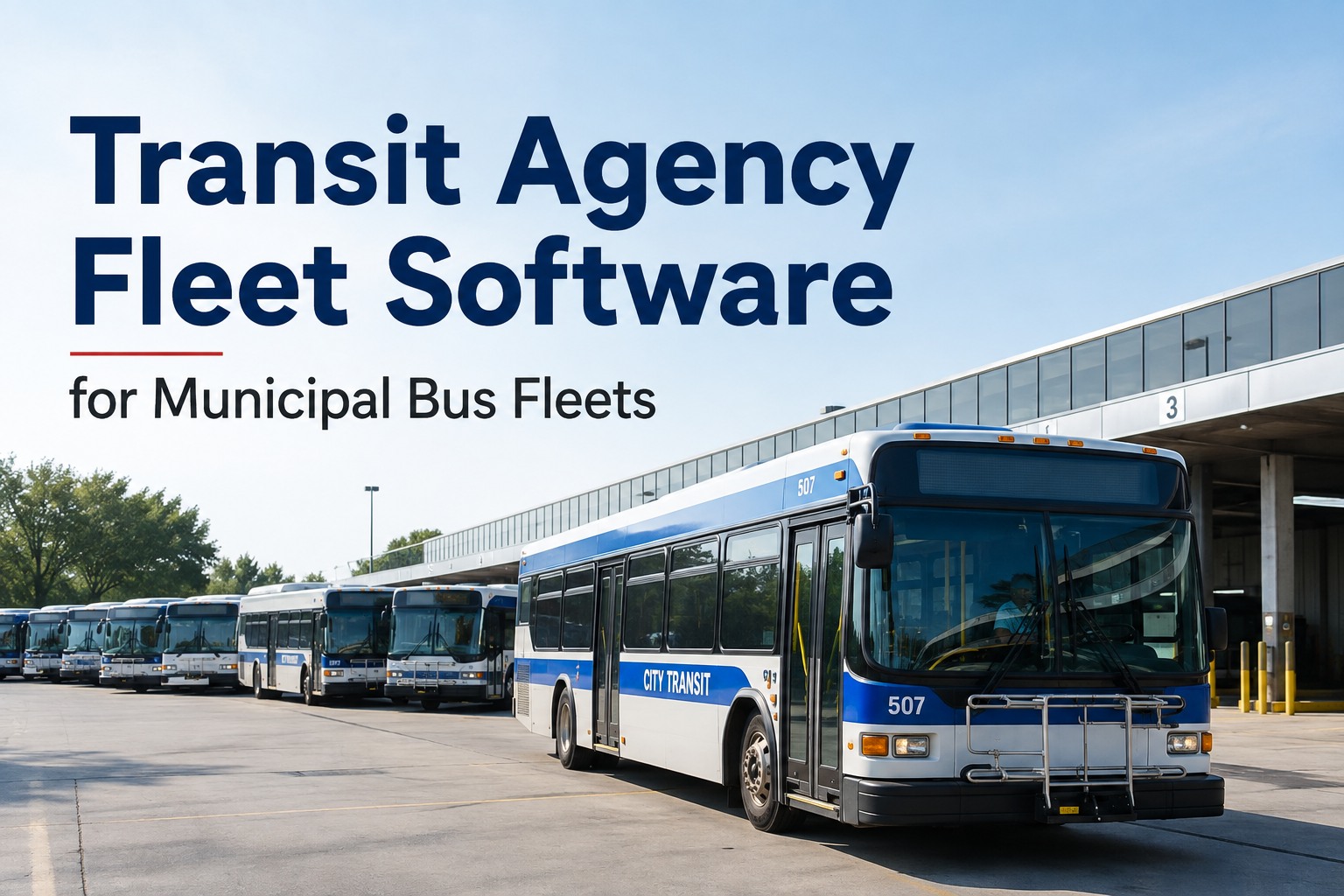
Your dispatcher pulls up the AM board and two buses on the 15 route already have defect flags from last night’s pull-ins. The camera system logged fourteen events overnight, none reviewed. Your maintenance manager is on a spreadsheet trying to figure out which of 180 buses goes into the shop today, and operations is scrambling to cover routes. That’s a Tuesday morning at almost every municipal transit agency in the country — and it’s the exact workflow the right transit agency fleet software fixes. Book a 20-minute demo to see it running on a fleet the size of yours.
Fleet Software Built for Municipal Transit Agencies
BusCMMS is a bus-first operations platform. It surfaces the defects and camera events that matter most, converts them into prioritized work orders, and gives your maintenance and operations teams one system for buses, routes, operators and PTASP-aligned safety workflows.
- DVIR
- Camera Event
- Telematics Fault
- PM Trigger
Why Municipal Transit Needs Bus-First Fleet Software
A municipal transit agency isn’t running trucks from A to B once a day. It’s running scheduled service — a bus that misses pull-out at 5:40 AM breaks the 6:04 trip on the 42 route, which cascades into a service alert, an OTP miss, and a call to the GM. Every maintenance decision, defect log, and camera event ultimately touches service reliability. Generic trucking-style fleet software was never designed for that reality.
- DVIRs you build yourself — no pre-loaded bus items
- Single PM logic — no diesel, CNG, electric separation
- Camera events sit in a separate video portal
- Recurring defects across shifts not auto-grouped
- No records structured for PTASP or NTD workflows
- Bus DVIRs pre-loaded — stop arms, lifts, kneelers, exits
- Separate PM logic per fuel type on one dashboard
- Video events triaged and routed to work orders
- Recurring-defect clustering across shifts and operators
- Records structured for PTASP and NTD-adjacent reporting
The gap isn’t marketing — it’s hours per week your maintenance manager and dispatcher spend either working the system or fighting it. Book a demo to see the pre-loaded bus DVIR library on day one.
A Bus Event Becomes a Closed Work Order
Here’s where the AI-first differentiator actually lives. An agency runs 180 buses on 22 fixed routes. Overnight, cameras log 63 events. In a generic setup, those events sit in a video portal and get reviewed next week — maybe. In BusCMMS, AI triage groups and scores them before anyone opens a laptop. Follow one bus.
Bus 4118 · Recurring Hard-Braking
- 01
Detection
4 hard-braking events on Bus 4118 across 3 shifts. Same operator absent from pattern — AI flags this as a vehicle-signal cluster.
- 02
Correlation
Cross-referenced with recent DVIRs: driver noted “grabby brakes at low speed” twice in 14 days. Recurring-defect flag triggered.
- 03
Prioritization
Bus 4118 assigned to Route 15 — high-ridership, elderly passenger load. Priority elevated. Bus flagged for pull-in inspection tonight.
- 04
Closure
Auto-generated WO. Parts pre-staged. Rear caliper replaced. Bus 4118 cleared for morning pull-out. Event cluster to service-ready: under 18 hours.
Every step is a place a generic system leaks — events unreviewed, DVIR notes disconnected from camera data, priority stuck in a manager’s head, work orders typed manually. BusCMMS closes the loop from signal to safety file. Book a demo to walk this exact workflow on your fleet.
PTASP and Safety Risk Management Support
Under 49 CFR Part 673, applicable transit agencies run a Public Transportation Agency Safety Plan with a documented Safety Management System, and § 673.25 specifically requires a safety risk management process — identify hazards, assess risk, mitigate it. That’s the agency’s responsibility. Software doesn’t create compliance. But the maintenance records, defect trends, corrective actions, and event history your team documents every day are the raw material risk management actually runs on.
BusCMMS Provides Data For
- Documented defect history per bus
- Corrective action work orders and closures
- Recurring failure identification
- Detected safety-related events
- PM completion records
The Agency Owns
- The written PTASP, signed by the accountable executive
- Hazard identification and risk assessment
- Mitigation strategies and execution
- Safety Committee review (large urbanized providers)
- Annual FTA certification and board approval
Put simply: BusCMMS is the operational file cabinet feeding your PTASP process, not the plan itself. When your CSO or the state SSO asks for corrective action history on visibility-impairment defects over the last 12 months, you have a query — not a spreadsheet excavation. Book a demo to see how PTASP-supporting records export in one click.
Fleet Reliability Is Service Reliability
Every transit GM reports on OTP. Every maintenance director knows most OTP misses trace back to a bus that missed pull-out or came off route mid-service. Fleet reliability is service reliability one layer below the surface — and this is where a bus-first platform actually moves the numbers your board sees.
- 01
Fewer surprise pull-outs
PM completion visibility per bus catches the 8 buses that are overdue before dispatch assigns them to service.
- 02
Faster in-service response
A defect logged mid-route pushes to shop dispatch with the bus record and last camera event context attached — not a phone call and a hunt.
- 03
Recurring failure elimination
Recurring-defect clustering tells you which 4 buses consume a disproportionate share of shop hours — the real capital-replacement conversation.
This is where a maintenance director stops fielding “why is my OTP down?” and starts showing exactly which two buses cost the GM Tuesday morning — and what’s already been done about them. Sign up free to see the fleet availability dashboard on your own data.
A Maintenance Director’s View
That’s the specific reason a bus-first platform pays back on a public-sector budget — a generic tool asks your team to do the correlation in their heads, and heads have limited hours in a shift. Book a demo to see the unified bus record and camera-to-work-order flow live.
Evaluation Checklist for Municipal Transit Buyers
Procurement teams evaluate fleet software on a scored rubric. Here’s the one a maintenance director would actually build, focused on what matters when the software is in production on Tuesday morning — not on the demo call.
Bus DVIRs pre-loaded
Stop arms, lifts, kneelers, exits — ready day one, not built by your team.
Fuel-type PM logic
Diesel, CNG, and electric schedules on one dashboard, not three systems.
Camera event integration
Video events surface by priority and route to work orders — not a separate portal.
Recurring defect clustering
Automatic grouping of the same failure across shifts, operators, or routes.
PTASP-supporting records
Defect and corrective-action history structured to feed 49 CFR Part 673 workflows.
2 to 4 week rollout
Public-sector budgets don’t survive 9-month implementations. Weeks, not quarters.
Run any transit fleet software conversation through those six items. Most generic tools score two or three. BusCMMS is built to score six.
What is transit agency fleet software?
Transit agency fleet software is the operational platform a municipal bus agency uses to manage vehicle maintenance, defects and DVIRs, work orders, parts and inventory, safety events, and the records that feed PTASP and NTD-adjacent reporting. Unlike generic trucking fleet software, transit fleet software is organized around bus-specific workflows — routes, stops, operators, scheduled service, and passenger safety — and includes bus-specific inspection items like stop arms, wheelchair lifts, and kneeling functions on day one.
How does fleet software help municipal bus agencies?
Fleet software centralizes maintenance and operational data that would otherwise live across paper DVIRs, video portals, telematics dashboards, and spreadsheets. It surfaces high-priority defects and events first, connects camera and telematics signals to maintenance work orders, tracks recurring failures per bus, and produces documented records that support PTASP safety risk management and audit readiness. The result: fewer avoidable in-service breakdowns, faster corrective response, and better visibility into fleet availability for route coverage.
Can transit fleet software manage bus maintenance and work orders?
Yes. BusCMMS handles preventive maintenance scheduling (by mileage or calendar, separate logic per fuel type), corrective work orders auto-generated from failed DVIRs or telematics fault codes, technician assignment, parts and inventory, labor time capture, and full maintenance history per bus. Everything ties to specific buses so a shop foreman can pull complete work order history, recurring defect patterns, and cost data at the vehicle level.
Can BusCMMS connect bus camera events with maintenance workflows?
Yes. BusCMMS uses AI to triage camera and telematics events by significance instead of leaving managers to scroll through raw video. When events cluster on a specific bus in a way that suggests a vehicle condition — recurring hard-braking, unusual vibration signatures, warning lights — the system surfaces the pattern, cross-references DVIR history, and can auto-generate or recommend a work order.
What should a transit agency look for when choosing fleet maintenance software?
Look for bus-specific DVIRs pre-loaded, separate PM logic for diesel, CNG, and electric buses on one dashboard, camera event integration into maintenance workflows, recurring-defect clustering, connections to common telematics platforms, records structured to support PTASP and NTD-adjacent workflows, and a go-live measured in weeks rather than months at public-sector pricing. Software alone doesn’t create regulatory compliance — the agency owns its safety plan — but the right platform provides the documented data safety risk management actually runs on.