Last September, a driver reported that Bus #18's steering "felt loose" at highway speed. It wasn't in the DVIR — he mentioned it at the coffee machine. Nobody wrote it down. Three weeks later, Bus #18's tie rod end separated on Route 7 with 34 students aboard. The bus veered into oncoming traffic. No fatalities — but 6 injuries, a $120,000 lawsuit, and a career-ending investigation for the transportation director who couldn't produce any documentation that the steering complaint was ever reported, investigated, or addressed. That coffee-machine conversation was a near-miss. If it had been captured, documented and routed to the shop, the $14 tie rod end replacement would have happened in 20 minutes. Instead, it became a $120,000 failure. For every serious bus accident, there are 300 near-misses that predicted it. Capture those 300 and the accident never happens .
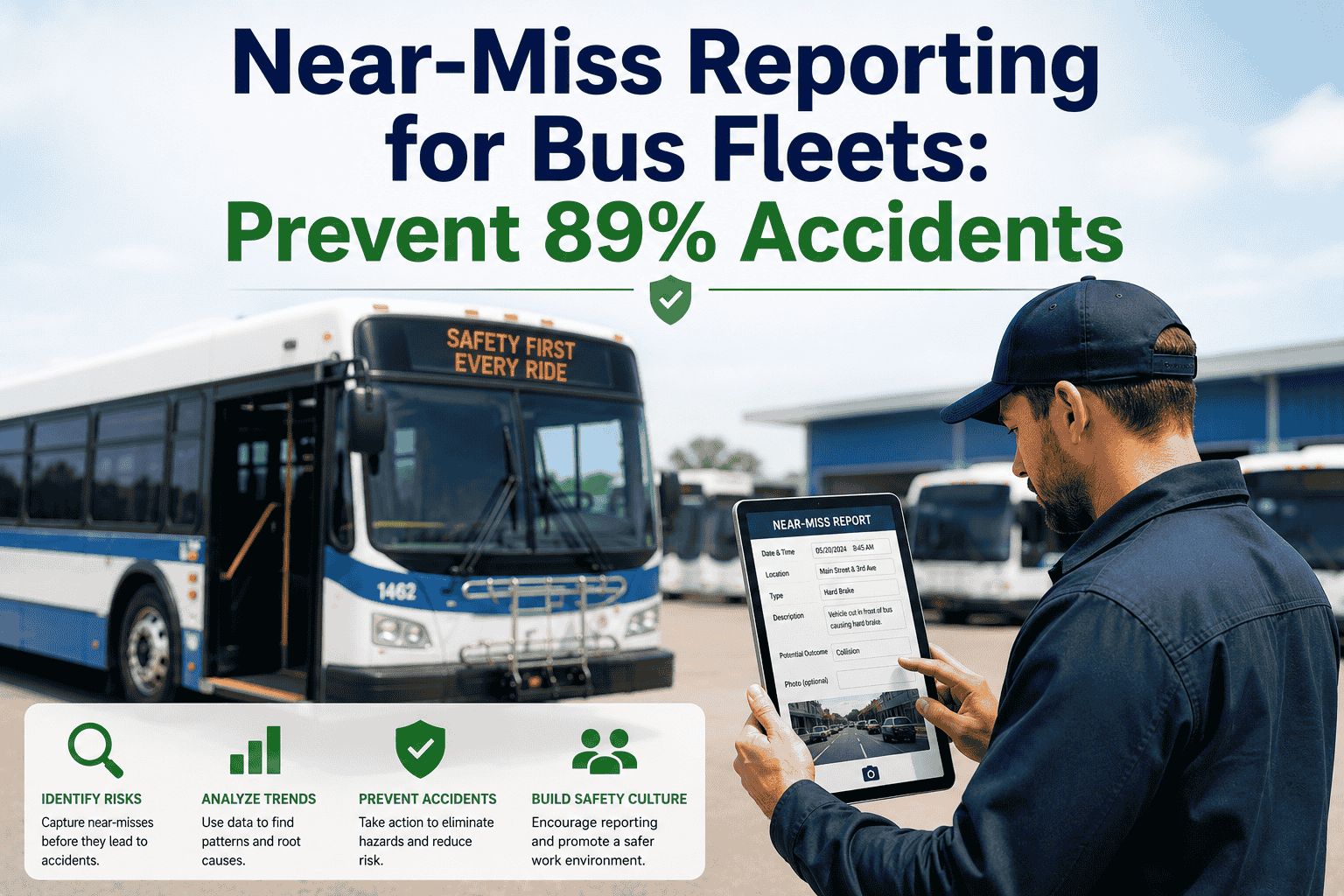
Near-Miss Reporting for Bus Fleets: Prevent 89% of Accidents
For every serious accident, 300 near-misses predicted it. Capture them and the accident never happens. Here's how to build the reporting culture that makes it automatic.
Heinrich's Safety Pyramid
The Math: Why Near-Misses Are Your Best Safety Investment
Heinrich's research across 75,000 accidents established the ratio that still drives safety programs worldwide. For bus fleets, the numbers are stark:
1
Serious Accident
$85,000–$250,000+
Injuries, lawsuits, insurance spikes, driver loss, vehicle damage, reputation
29
Minor Incidents
$500–$5,000 each
Fender benders, near-collisions reported, minor vehicle damage, close calls with documentation
300
Near-Misses
$0 — if captured
Loose steering, soft brakes, close calls, "that felt weird" moments. Fix here = prevent everything above.
Organizations with formal near-miss programs report 25% fewer serious accidents within two to three years. In a bus fleet, that's the difference between zero incidents per year and one career-ending, budget-destroying accident. See how BusCMMS captures near-misses digitally — book a demo.
Why Drivers Don't Report Near-Misses (And How to Fix Each Reason)
Near-misses happen every day. They don't get reported because of 5 structural barriers. Fix the barriers and reports flow automatically:
Give your drivers a 3-tap near-miss report button — sign up free
What a Near-Miss Report Should Capture
A near-miss report that says "something felt off" is useless. A report that captures the right data turns into a preventive work order. Here's what BusCMMS captures in every near-miss submission:
The critical difference from a complaint box: every near-miss in BusCMMS generates a tracked follow-up. The fleet manager must acknowledge, investigate, or create a work order. The driver sees the status change. The loop closes. See the complete near-miss → investigation → action workflow — book a demo.
"In the first 90 days of near-miss reporting through BusCMMS, our drivers submitted 47 reports. Before that? Zero — because there was no way to report them. Of those 47, 12 were mechanical — including a tie rod with visible play that we replaced for $38. Three months later a neighboring district had the exact same tie rod failure at highway speed. Their bus crossed the center line. Our bus had been fixed for 11 weeks because a driver reported what 'felt off.' That's not a coincidence. That's what near-miss reporting does."
Every near-miss your fleet experiences today is either captured — or ignored until it becomes the accident that ends a career, triggers a lawsuit, and makes the news. The reporting system costs nothing to set up. The accident it prevents is incalculable. Start capturing near-misses today — sign up free.
The Accident You Prevent Is the One You Never Have to Explain.
3-tap near-miss reporting on every driver's phone. GPS-stamped. Auto-routed. Tracked to resolution. Mechanical reports create work orders. Zero near-misses ignored. Free 14-day trial.
Frequently Asked Questions
What is a near-miss in a bus fleet?
Any event where an accident almost happened but didn't — due to luck, quick reaction, or circumstance. Examples: steering felt loose at speed, brakes grabbed left, almost hit a car backing up, child ran in front with 3-foot margin, grinding noise on a turn. If the driver thought "that could have been bad" — it's a near-miss that should be captured.
How does near-miss reporting prevent accidents?
Heinrich's Safety Pyramid (75,000+ accidents studied) found that for every serious accident, there are 29 minor incidents and 300 near-misses. The near-misses predict the accident. Capture and address them — fix the loose tie rod, investigate the brake issue, address the intersection hazard — and the serious accident at the top of the pyramid never occurs. Organizations with formal programs report 25% fewer serious accidents within 2–3 years.
Why don't drivers report near-misses?
Five barriers: (1) "Nothing happened, why bother?" (2) Fear of punishment. (3) No easy way to report — paper forms, walking to the office. (4) Previous reports were ignored — no follow-up. (5) Don't know what qualifies. Fix all 5: non-punitive policy, 3-tap mobile reporting, tracked follow-up, and clear examples of what to report.
How does BusCMMS handle near-miss reporting?
3-tap report button on the driver's phone. Category → description (text or voice) → submit. GPS auto-captures location. Bus number and driver auto-fill. Mechanical near-misses route to the shop and can auto-create work orders. Driving near-misses route to the safety manager. Every report tracked to resolution — the driver sees their report was received and acted on.
How many ne ar-miss reports should I expect per month?
A healthy reporting culture generates 5–15 near-miss reports per month per 50 buses. If you're getting zero, it's not because nothing happens — it's because the barriers to reporting are too high. If you're getting 50+, celebrate — your culture is working. The goal isn't fewer reports. It's fewer accidents because the reports led to fixes.