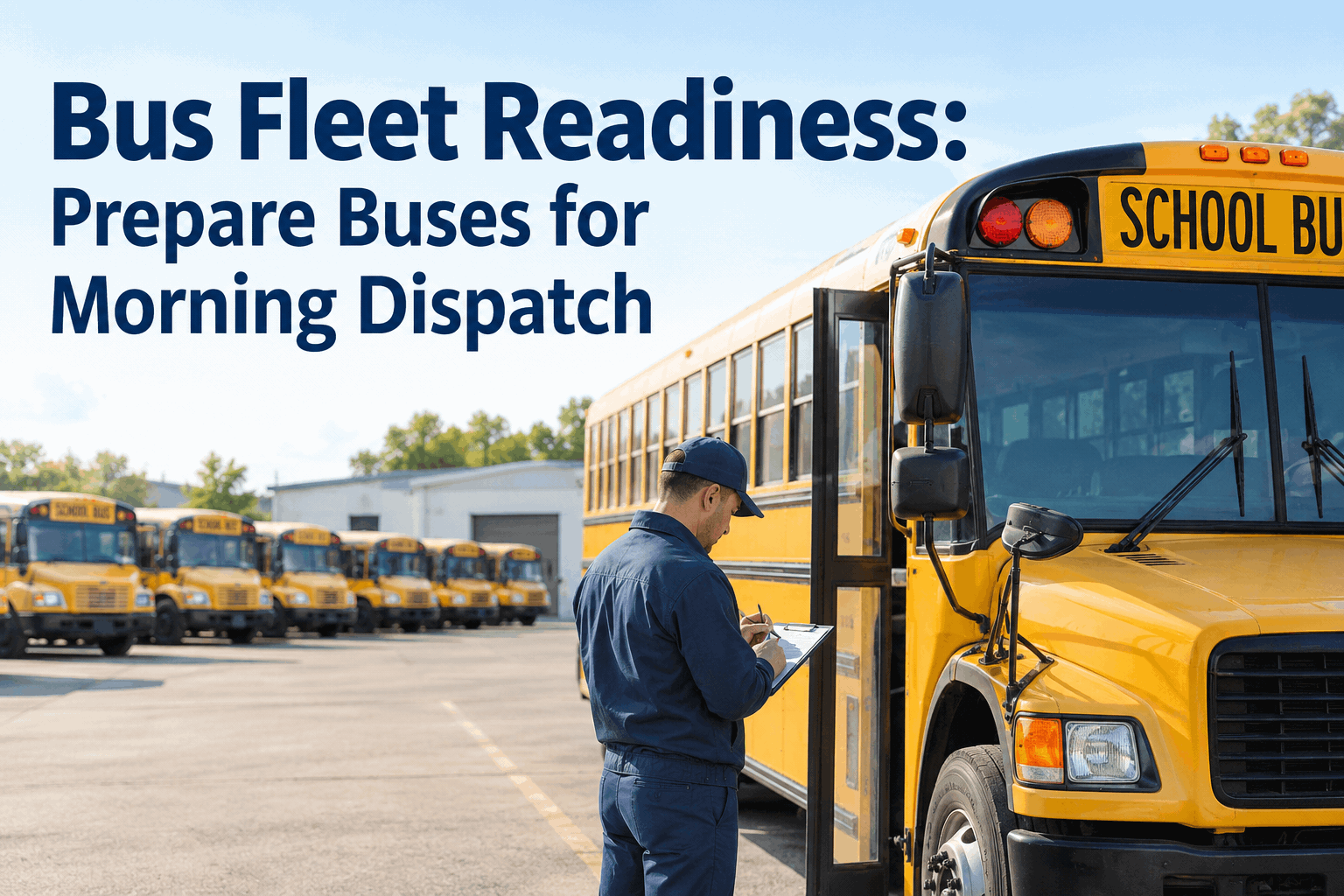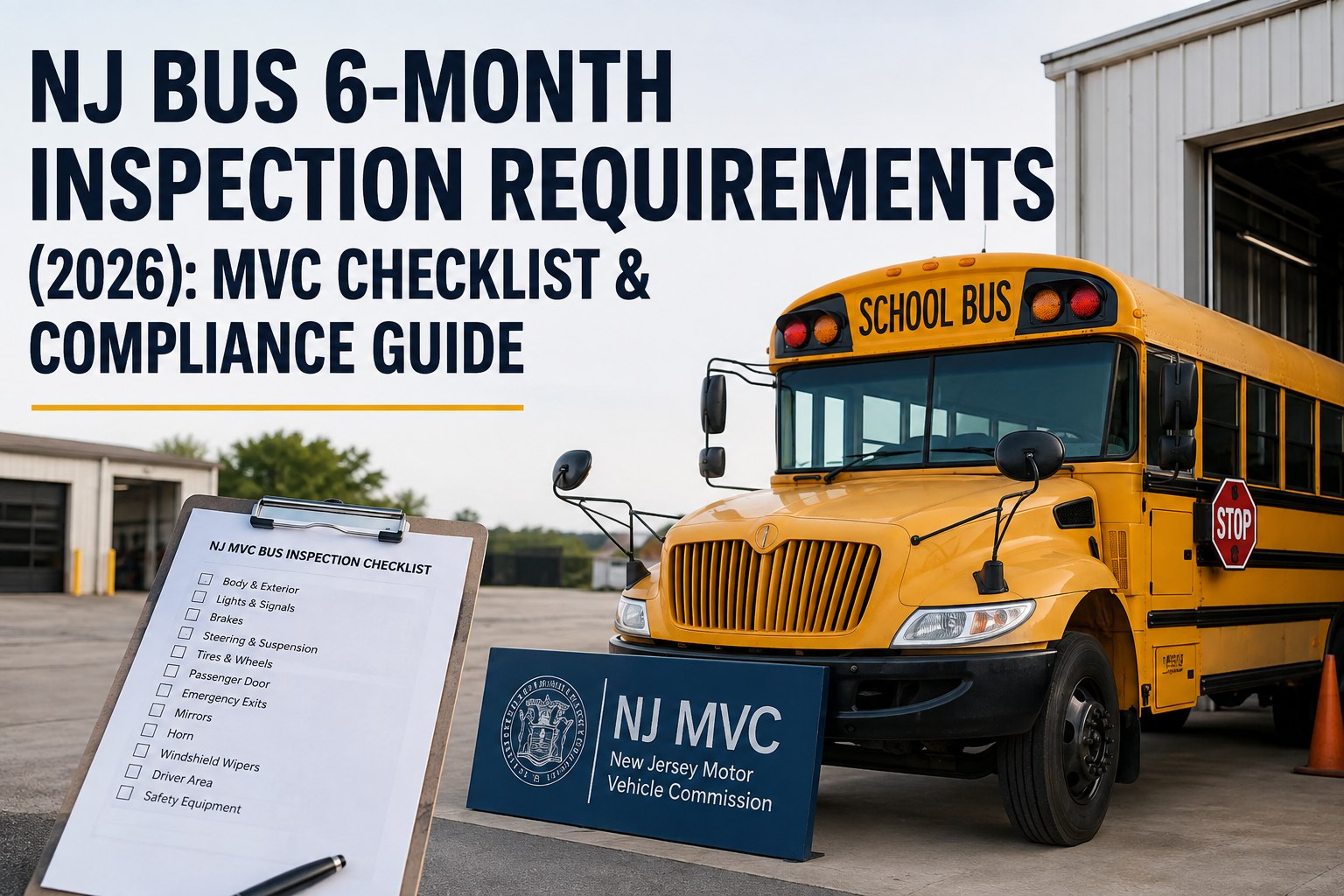
Every six months, every school bus in New Jersey goes under the NJ MVC's 150-point inspection -- and 40% fail the first time. Not because operators are careless, but because a 180-item checklist across 78,000 buses statewide leaves no room for paper-based recordkeeping to survive an inspector's morning visit. This is the practical 2026 walkthrough of what the NJ 6-month inspection actually covers, why buses fail and how the top-performing terminals in the state prepare. See how BusCMMS keeps NJ terminals audit-ready 24/7 → book a 20-min demo.
NJ Bus 6-Month Inspection Requirements
The 150-point MVC checklist, the 4 stickers, the 40% first-time failure rate, and the prep playbook top terminals actually use.
The 4 Stickers You Can Get
Every NJ inspection ends with one of these on your windshield.
Approved
Green sticker. Bus passed all 150 inspection points and can operate normally until the next biannual cycle. Expiration date printed on center of decal.
30-Day Rejection
Yellow sticker. Bus can still transport passengers but must be repaired and re-inspected within 30 days. ~30% of NJ buses land here on first pass.
Out-of-Service
Red sticker. Bus cannot transport passengers until repairs are made and a full re-inspection completed after 30 days. Federal OOS fines can reach $23,048 per incident.
Pending / Initial
White temporary. Required before S1 (Type I) or S2 (Type II) license plates can be issued for a new or newly acquired bus. Schedule via SBIU at (609) 633-9473.
Monthly surprise inspections: On top of the scheduled 6-month cycle, the Governor's School Bus Task Force performs unannounced monthly inspections at NJ terminals. There is no "off month" -- readiness has to be a state, not an event.
Digital CMMS makes 24/7 readiness practical for NJ terminals. See BusCMMS keep NJ terminals audit-ready every day → book a demo.
What the 150-Point Inspection Actually Covers
180+ items across 8 systems. Every one is a potential fail line.
Brake System
- Service brake stroke & adjustment
- Air pressure build-up test
- Parking brake holding capacity
- ABS warning lamp function
- Brake hose & line condition
Lights & Signals
- 8-light warning system (amber + red)
- Stop arm operation & light sync
- Crossing gate function
- Headlights, taillights, turn signals
- Interior dome and step-well lights
Emergency Exits
- Rear emergency door latch & buzzer
- Roof escape hatches
- Side emergency exits
- Push-out window function
- Emergency exit signage & instructions
Steering & Suspension
- Steering wheel free play < specification
- Kingpins, tie rod ends, drag link
- Leaf springs, U-bolts, shackles
- Shock absorber condition
- Axle alignment, wheel bearings
Body & Frame
- Frame rust-through / cracks
- Body mounts, floor pans
- Body panel damage & sharp edges
- Bumper mounting integrity
- Wheelchair lift ADA function
Tires & Wheels
- Tread depth (min 4/32 steer, 2/32 drive)
- Sidewall damage, exposed cord
- Retread separation (drive tires only)
- Wheel/rim cracks, lug nut torque
- Air pressure & valve stem condition
Interior & Safety Equipment
- Seat mounting, cushion condition
- First aid kit, body fluid cleanup kit
- Fire extinguisher charge & tag
- Reflective triangles, flares
- Student mirror alignment (crossover)
Records & Documentation
- Driver employment records
- Prior DVIRs (last 3 months)
- Maintenance history (1 yr + 6 mo)
- Annual inspection reports (14 months)
- CDL, medical cert, S-endorsement
System #8 is where paper-based fleets lose the inspection they thought they were going to pass. See NJ-specific inspection records auto-generated in BusCMMS → book a demo.
Why 40% Fail on the First Pass
The failure pattern is remarkably consistent year over year.
- 01Brake adjustment out of specHIGH
- 02Missing/expired driver documentationHIGH
- 038-light warning system malfunctionHIGH
- 04Emergency exit buzzer or latch failureHIGH
- 05DVIR records incomplete or missingHIGH
- 06Steering play beyond specificationMED
- 07Tire tread depth below minimumMED
- 08Fire extinguisher expired or missing tagMED
- 09Frame corrosion around body mountsMED
- 10Stop-arm timing / sync failureMED
4 of the top 5 are documentation-preventable
Brakes and 8-lights need physical repair. But driver docs, DVIRs, and emergency-exit maintenance history are all failures that happen because paper records went missing between inspections. Terminals running a digital CMMS eliminate roughly 60% of first-pass rejections on records-based line items alone. The bus was fine. The paper trail wasn't.
The paperwork is the fix -- and the paperwork is where BusCMMS lives. See NJ terminals jump first-pass rates from 60% to 90%+ → book a demo.
The Documentation Binder the Inspector Opens First
Not the bus. The paperwork. Every record with its retention window.
DVIR Records
49 CFR 396.11 · retain 3 monthsDaily Driver Vehicle Inspection Reports for every bus that operated in the last quarter. Missing days trigger a records-based fail. NJ inspectors will spot-check specific dates.
Annual Inspection Reports
49 CFR 396.21 · retain 14 monthsFederal annual inspection results per bus. Even though NJ requires biannual, the federal 14-month retention rule still applies. Keep both cycles' worth.
Maintenance History
49 CFR 396.3 · retain 1 yr + 6 moEvery work order, PM, and repair per bus for the retention window. The bus VIN and mileage at time of service must both be recorded. Loose paper does not survive an inspection.
Driver Documentation
Per driver · current onlyCDL with S-endorsement (school bus) and P-endorsement (passenger), current medical certificate, motor vehicle record on file, and criminal background check. All must be current on inspection day.
Emergency Exit & Safety Records
49 CFR 396.3 · 90-day cycleEmergency exit inspection every 90 days per federal rule. Fire extinguisher tag current. First aid + body fluid kits stocked and dated. Reflective triangles present.
Accident Reports
72-hour reporting rule · SBIUAny accident involving a school bus must be reported within 72 hours to SBIU at (609) 633-9473 or SBIU@mvc.nj.gov. Prior accident reports and their follow-ups must be on file.
The 30-Day Prep Countdown
What top-performing NJ terminals do in the month before their inspection.
Pull records & schedule pre-inspection PM
Print or export the past 3 months of DVIRs per bus. Confirm 90-day emergency exit records are current. Schedule any PM or corrective work now -- shop capacity fills up in the final 2 weeks.
Brake adjustment audit & 8-light test
Top 2 fail categories. Take every bus through a formal brake stroke measurement and complete 8-light warning system cycle test. Log results with tech signature.
Emergency exit + safety equipment sweep
Every rear door buzzer, roof hatch, push-out window. Fire extinguisher tags current. First aid, body fluid, reflectors stocked and dated. Photograph each item for the file.
Driver documentation audit
Every driver: CDL current, S & P endorsements, medical cert unexpired, MVR pulled within the past 12 months. Missing one document = a records-based fail even if the bus is perfect.
Final walkaround + binder assembly
Physical walkaround per bus: tires, lights, mirrors, stop-arm, crossing gate. Assemble the records binder in the same order the inspector opens it. Have the shop foreman sign off.
Terminals running this countdown digitally see first-pass rates jump from 60% to 90%+. See the countdown automated inside BusCMMS → book a demo.
How BusCMMS Turns Every NJ Inspection Into a First-Pass
Six ways the checklist and the records stop being two separate problems.
NJ-Specific Digital DVIRs
Pre-loaded with all NJ-critical items: stop arms, crossing gates, 8-light warning, student mirrors, wheelchair lifts, emergency exits. No custom setup.
90-Day Emergency Exit Tracker
Auto-scheduled per federal 49 CFR 396.3. Alerts before window closes. Photo evidence attached to each cycle log.
Records Retention Automation
DVIR 3 mo, annual reports 14 mo, maintenance 1 yr + 6 mo. Auto-retained, auto-purged. No filing cabinet.
Driver Documentation Alerts
CDL, medical cert, endorsements, MVR pull dates. Alerts 60 days before expiration per driver. Missing docs never surprise you on inspection day.
Pre-Inspection Report Export
One-click export of the exact binder the NJ MVC inspector opens: DVIRs, work orders, PM history, driver docs. Ready in minutes, not days.
Accident 72-Hour Compliance
Accident event triggers a workflow that captures the report format SBIU requires. Emailed to SBIU@mvc.nj.gov inside the 72-hour window.
Our fall inspection cycle used to be a three-week fire drill. Techs on overtime, admins pulling driver files, paper DVIRs missing pages. Two years ago we ran a 47% first-pass rate -- basically at the state average. Then we moved everything digital. Fall 2024 first-pass was 91%. Same 68 buses. Same techs. Same inspector. What changed was the documentation binder was ready before he opened his laptop, and every DVIR from the past 90 days was one search away with a driver signature and a bus VIN attached. That's the entire game in New Jersey.
Inspection cycle coming up? The 30-day countdown starts today. Sign up free and start with the NJ prep sheet →
Frequently Asked Questions
How often does New Jersey require a school bus inspection?
Every six months. The NJ Motor Vehicle Commission School Bus Inspection Unit (SBIU) requires biannual inspections for all vehicles registered for school transportation, including full-size school buses, small school vehicles, dual-purpose vehicles, and summer camp vehicles registered in New Jersey. On top of the scheduled 6-month cycle, the Governor's School Bus Task Force performs monthly unannounced inspections at NJ terminals. That means there is no genuinely "off" period -- readiness is a permanent operational state, not a twice-a-year push. Contact SBIU at (609) 633-9473 or SBIU@mvc.nj.gov to schedule.
What does the NJ MVC 150-point school bus inspection cover?
The inspection is a 150-point process that checks 180+ items across 8 major systems: brakes, lights and signals (including the 8-light warning system, stop arm, and crossing gate), emergency exits, steering and suspension, body and frame, tires and wheels, interior and safety equipment (fire extinguisher, first aid, mirrors), and records and documentation. Documentation covers driver employment records, prior DVIRs, maintenance history, and annual inspection reports. Physical items include the door buzzer, catalytic converter, seat mounting, wheelchair lift function, and more. The full sample checklist is published by NJ MVC on nj.gov/mvc/inspection/schoolbus.htm.
What are the different inspection sticker colors in NJ?
Four possible outcomes. Green Approval sticker means the bus passed and is valid for 6 months, with the expiration printed in the center. Yellow 30-day rejection means the bus can still transport passengers but must be repaired and re-inspected within 30 days. Red Out-of-Service means the bus cannot transport passengers until repairs are complete and a full re-inspection is performed after 30 days -- federal OOS operating violations can carry fines up to $23,048 per incident under FMCSA rules. A white temporary is issued for buses pending their initial pre-registration inspection before S1 or S2 license plates can be issued. Stickers are posted in the lower-left corner of the windshield.
Why do 40% of NJ school buses fail their initial inspection?
The failure pattern is remarkably consistent year over year: 40% initially fail, 30% get 30-day rejections, and after repairs an average of 91% pass on re-inspection. The top reject items are brake adjustment out of specification, missing or expired driver documentation, 8-light warning system malfunction, emergency exit buzzer or latch failure, and incomplete DVIR records. Notably, 4 of the top 5 failure categories are documentation-preventable -- they happen because paper records went missing between inspections, not because the bus wasn't roadworthy. Terminals running digital CMMS-based recordkeeping typically eliminate 60% of records-based rejections and see first-pass rates jump toward 90%+.
What documentation must be ready for the NJ MVC inspector?
Six categories, each with a specific retention window. DVIRs for the past 3 months per bus (49 CFR 396.11). Annual inspection reports for 14 months (49 CFR 396.21). Maintenance history for 1 year plus 6 months (49 CFR 396.3). Current driver documentation: CDL with S-endorsement (school bus) and P-endorsement (passenger), unexpired medical certificate, MVR pulled within 12 months, and background check. Emergency exit and safety records including the federal 90-day emergency exit inspection cycle. And any accident reports -- accidents involving a school bus must be reported within 72 hours to SBIU at (609) 633-9473 or SBIU@mvc.nj.gov. The inspector opens the documentation binder before touching the bus.