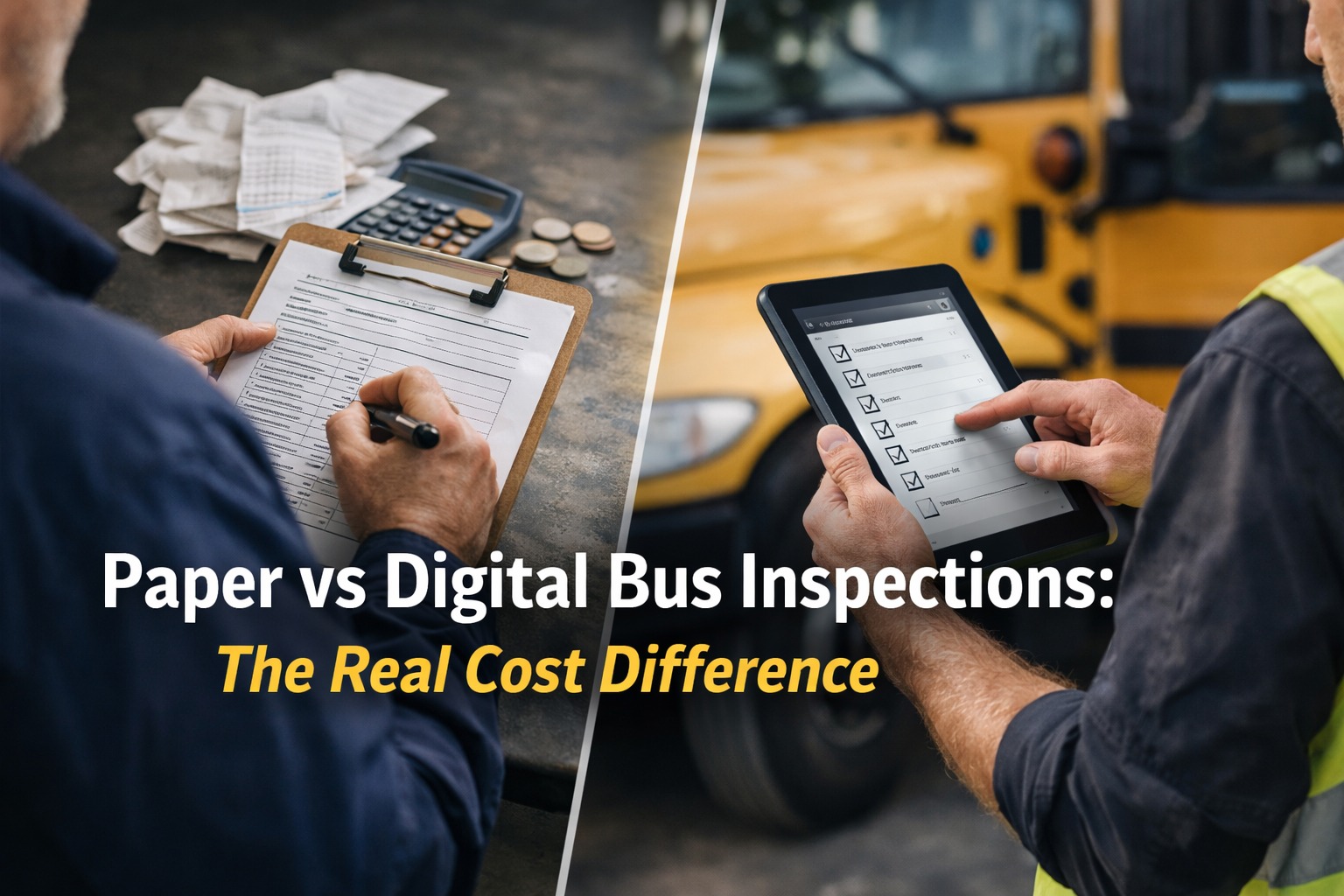
A paper DVIR book costs about $4. Digital inspection software costs $15-50 per vehicle monthly. On paper, the choice seems obviouspaper is cheaper by a factor of ten.
Except that calculation misses everything that actually costs money: the 7 minutes drivers spend filling out forms by hand, the 3 additional minutes someone spends transferring that data into a spreadsheet, the hours hunting for records during audits, the defects that sat in a filing cabinet for two weeks before anyone saw them, and the $500-850 per day it costs when those missed defects turn into breakdowns.
The real cost of inspections isn't the formit's the labor, the delays, the errors, and the consequences. When you calculate those costs, digital inspections don't just pay for themselves. They're often cheaper than free paper forms.
The True Cost of Paper Inspections
Paper inspection systems create costs in four categories that rarely appear on budget spreadsheets: direct materials, labor time, error consequences, and opportunity costs.
Annual Paper Inspection Costs by Fleet Size
25 Buses
$1,143
Form books only
50 Buses
$2,286
Form books only
100 Buses
$4,572
Form books only
Based on $3.81 average logbook cost, replaced monthly per vehicle (Fleetio/J.J. Keller data)
That's just the paper. The real costs hide in what happens after drivers fill out those forms.
Driver Time: Drivers spend 7-10 minutes on proper pre-trip inspections. With paper forms, they spend an additional 2-3 minutes writing descriptions, sketching defect locations, and ensuring legibility. For a 50-bus fleet running 180 school days, that's 300-450 hours annually in driver labor just on the writing portion—not the inspection itself.
Administrative Processing: Someone has to do something with those paper forms. According to Fleetio research, transferring one paper DVIR into a digital system takes about 3 minutes. For a 50-bus fleet completing daily inspections, that's over 450 hours of data entry annually—or roughly 2.5 hours every single day.
Document Management: Federal regulations require 3-month DVIR retention and 14-month annual inspection retention. Paper systems require filing, storage space, and retrieval systems. A 2025 Fleetio study found fleet managers spend over 4 hours weekly on administrative documentation tasks, with 18% spending more than 8 hours—a full workday—managing paperwork.
Audit Preparation: When DOT auditors arrive, paper-based fleets scramble. Locating specific inspection records involves time-consuming manual searches through filing cabinets. Digital systems make the same records available in seconds.
What Digital Inspection Systems Actually Cost
Digital vehicle inspection software typically costs $15-150 per vehicle monthly, depending on features and fleet size. Basic digital inspection tools start at $15-30 per vehicle, while comprehensive solutions with compliance tracking and predictive maintenance reach $75-150.
For a 50-bus fleet, that translates to $9,000-90,000 annually—substantially more than $2,286 in paper forms. So why would anyone pay 4-40x more for digital?
Because the software eliminates most of the hidden labor costs while adding capabilities paper can't match.
What Digital Systems Eliminate
Manual Data Entry
Inspection data uploads automatically—no transcription needed
Document Filing
Records stored automatically with required retention periods
Audit Preparation
Complete inspection history searchable in seconds
Defect Communication Delays
Maintenance sees defects immediately, not days later
Incomplete Inspections
Enforced checklists require completion of all items
Illegible Records
Digital entries are always readable and timestamped
The Labor Math: Where Digital Wins
Let's calculate actual labor costs for a 50-bus fleet operating 180 days annually:
| Task | Paper System | Digital System | Annual Savings |
|---|---|---|---|
| Driver inspection time | 10 min/day | 7 min/day | 450 hours |
| Data entry/transfer | 3 min/inspection | 0 min | 450 hours |
| Document filing | 2 min/form | 0 min | 300 hours |
| Record retrieval | 15 min/search | 30 sec/search | ~100 hours |
| Audit preparation | 40+ hours/audit | 2-4 hours/audit | 36+ hours |
Total annual labor savings: 1,300+ hours
At $25/hour fully loaded labor cost, that's $32,500 in annual labor savings for a 50-bus fleet. At $30/hour, it's $39,000. The digital system pays for itself in labor savings alone—before considering any other benefits.
This aligns with industry research. Fleetio found that fleets report 30-50% time savings on inspection processes after implementing digital solutions. One Alabama trucking company reduced 80 hours of weekly paperwork across eight shops to 10 minutes daily after switching to digital—a 99% reduction in administrative time.
Ready to eliminate inspection paperwork and recover thousands of labor hours? BusCMMS provides digital DVIRs with automatic compliance tracking, instant defect routing, and audit-ready documentation.
Start Free Trial Book a DemoThe Defect Detection Gap
Paper inspection systems have a fundamental problem: the time between when a driver identifies a defect and when maintenance can act on it.
With paper DVIRs, defects follow this path: Driver writes defect on paper → Paper sits in vehicle until end of shift → Driver turns in paper to dispatcher → Dispatcher reviews form (maybe) → Form reaches maintenance shop → Someone reads and interprets handwritten notes → Work order created → Parts ordered if needed → Repair scheduled.
That process typically takes 2-5 days. For "minor" defects that don't prevent operation, it can take weeks—or the paper can disappear entirely.
Digital inspection systems collapse this timeline: Driver flags defect in app → Maintenance receives instant notification → Photo documentation shows exact condition → Work order generates automatically → Parts can be ordered immediately.
The difference isn't just convenience. It's the difference between fixing a $200 brake adjustment and replacing a $3,000 brake system. It's the difference between catching a tire at 5/32" tread and dealing with a blowout at 2/32".
$500-$850
Average daily cost of unplanned vehicle downtime (ATRI 2024)
According to the American Transportation Research Institute's 2024 Operational Costs Report, unplanned downtime now averages $500-850 per vehicle per day—up 12% from 2023. Vehicles participating in scheduled preventive maintenance programs experience about 20% fewer maintenance-related downtime days than those that aren't.
Digital inspection systems enable that preventive maintenance by ensuring defects reach technicians while they're still minor. Paper systems create the delays that turn minor defects into major failures.
Compliance Risk: Paper's Hidden Liability
Paper inspection records create compliance vulnerabilities that digital systems eliminate.
Missing Records: Paper gets lost. Forms fall behind seats, get coffee-stained, or simply disappear between the bus and the filing cabinet. Each missing DVIR represents potential daily penalties up to $1,270.
Incomplete Inspections: Paper forms let drivers skip sections or check boxes without actually inspecting. The average paper DVIR takes 2-3 minutes—too fast to properly check brakes, tires, and steering systems. Digital systems can enforce completion requirements and flag suspiciously fast inspections.
Unverifiable Timestamps: Paper forms have dates written by hand. There's no way to prove when an inspection actually occurred versus when someone wrote a date on a form. Digital systems record exact timestamps and GPS locations automatically.
No Audit Trail: If someone modifies a paper form, there's no record of the change. Digital systems maintain complete audit trails showing who recorded what, when, and any modifications made.
DVIR Violation Penalties
$1,270/day — Failing to complete required DVIR
$12,700 — Falsifying a DVIR to hide safety defect
$15,420 — Failing to repair reported safety defect
Digital inspection records often exceed DOT compliance requirements by providing timestamps, GPS verification, and photo documentation that paper can't match. FMCSA accepts electronic DVIRs that meet content requirements, and auditors increasingly expect the verification capabilities that only digital systems provide.
ROI Calculation: A 50-Bus Fleet Example
Let's build a complete cost comparison for a 50-bus school transportation fleet:
Paper System Annual Costs
Form books (monthly replacement): $2,286
Driver time (writing): $11,250 (450 hrs @ $25/hr)
Data entry labor: $11,250 (450 hrs @ $25/hr)
Filing/storage: $3,750 (150 hrs @ $25/hr)
Audit preparation: $1,500 (60 hrs @ $25/hr)
Record retrieval: $2,500 (100 hrs @ $25/hr)
Total: $32,536
Digital System Annual Costs
Software ($25/vehicle/month): $15,000
Driver time (digital): $7,875 (315 hrs @ $25/hr)
Data entry labor: $0
Filing/storage: $0
Audit preparation: $250 (10 hrs @ $25/hr)
Record retrieval: $125 (5 hrs @ $25/hr)
Total: $23,250
Annual savings: $9,286 — and this excludes the biggest benefit: reduced downtime from faster defect resolution.
If digital inspections prevent even one breakdown that would have cost $600/day for two days of downtime plus $1,500 in emergency repairs, that's $2,700 saved. Two prevented breakdowns per year covers a significant portion of the software cost.
Industry data supports this. Research indicates fleets using digital inspection systems reduce maintenance costs by 20-30% and equipment downtime by up to 62%. The vehicle inspection software market grew to $761 million in 2024 and is projected to reach $2.3 billion by 2033—a 13.2% annual growth rate driven by documented ROI.
Making the Transition
Switching from paper to digital inspections doesn't require a complete overhaul. Most fleets implement digital systems in 4-12 weeks with a phased approach:
Week 1-2: Configure digital checklists to match your current paper forms. Ensure all required DVIR elements are captured and customize for your specific vehicle types.
Week 3-4: Train drivers on the mobile app. Most drivers adapt quickly—smartphones are familiar, and digital forms are often faster than writing. Focus training on photo documentation and defect flagging.
Week 5-8: Run parallel systems. Have drivers complete both paper and digital inspections initially. This builds confidence and identifies any gaps in the digital workflow.
Week 9-12: Transition fully to digital. Phase out paper forms as drivers and maintenance staff become comfortable with the new system.
The key success factor: ensure maintenance staff can act on digital defect reports immediately. The value of instant defect notification disappears if no one is watching for alerts.
Stop paying hidden costs for paper inspections. BusCMMS digital inspection software pays for itself in labor savings while improving compliance, reducing downtime, and giving you audit-ready documentation.
Get Started Free Schedule a DemoFrequently Asked Questions
Q: Are digital DVIRs DOT compliant?
A: Yes. FMCSA accepts electronic DVIRs as long as they meet content requirements under 49 CFR 396.11 and 396.13: vehicle identification, date, defects noted, driver signature, and repair certification. Digital records often exceed compliance requirements by providing timestamps, GPS location verification, and photo documentation that auditors value.
Q: How much does digital inspection software cost?
A: Digital vehicle inspection software typically costs $15-150 per vehicle monthly depending on features. Basic inspection tools start at $15-30 per vehicle, while comprehensive CMMS solutions with maintenance scheduling, compliance tracking, and analytics range from $50-150. Most vendors offer volume discounts for larger fleets.
Q: What's the ROI timeline for digital inspection systems?
A: Most fleets achieve positive ROI within 3-6 months. Cloud-based inspection platforms with simple deployment see faster returns. The ROI comes from labor savings (30-50% reduction in inspection processing time), reduced downtime from faster defect resolution, and eliminated costs for paper forms, filing, and storage.
Q: How long does it take to implement digital inspections?
A: Implementation typically takes 4-12 weeks depending on fleet size and complexity. Cloud-based solutions deploy faster than on-premise systems. The process includes checklist configuration, driver training, parallel operation with paper systems, and full transition. Most vendors provide training and onboarding support.
Q: Will drivers resist switching from paper to digital?
A: Initial resistance is common but typically fades quickly. Digital inspections are often faster than handwriting—drivers tap checkboxes rather than writing descriptions. Photo documentation replaces sketching defects. Most drivers prefer the convenience of smartphone-based inspections once they're familiar with the app.
The Bottom Line
Paper inspections aren't free—they're just hiding their costs in labor hours, filing cabinets, and delayed defect repairs. When you calculate the true cost of processing, storing, and acting on paper inspection data, digital systems often cost less than the "free" paper forms they replace.
The vehicle inspection software market is growing at 13% annually because fleets are discovering this math. The question isn't whether digital inspections make financial sense—the data clearly shows they do. The question is how long you'll continue paying hidden costs for a paper system that's more expensive than the alternative.