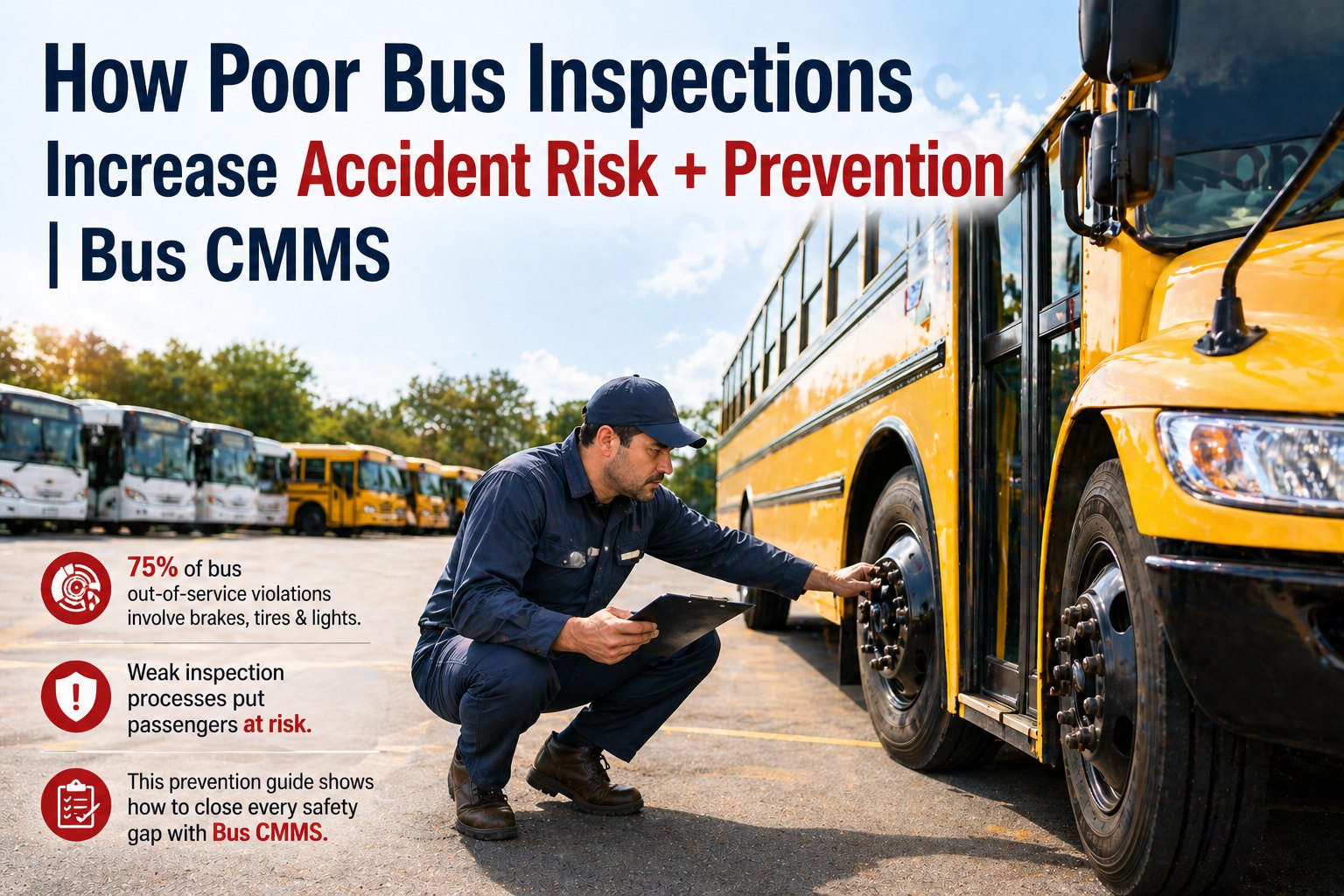
In 2025, the CVSA placed 22.6% of inspected commercial vehicles out of service on the spot — nearly one in four. Brakes, tires, and lights accounted for 61% of those violations. Every one of those buses had a driver who ran an inspection that morning. The inspection didn't fail — the process behind it did.
How Poor Bus Inspection Processes Increase Accident Risk — And How to Close Every Gap
The data is clear: most preventable bus accidents trace back to an inspection process that looked complete but wasn't
Fleet Safety Risk Index
LOW
MED
HIGH
The Inspection Process Gap Nobody Talks About
Every fleet manager I have worked with believes their drivers are running real inspections. Most are wrong — not because the drivers are skipping the walk-around, but because the inspection process has no mechanism to catch what a driver misses, overlooks under time pressure, or doesn't know to look for.
A paper checklist doesn't tell you which items were physically checked versus which boxes got ticked from the cab. A verbal handoff doesn't create a record. And a defect that gets written down but never routed to the shop is the same as a defect that was never found.
Bus inspection safety risk lives in the gaps between what the form shows and what actually happened. start tracking those gaps for free in BusCMMS before your next audit catches them first.
Gap Type 1
Documentation Gap
Defect found. Not written down clearly. No work order created. Bus dispatched.
Gap Type 2
Routing Delay Gap
Defect documented. Paper form sits on a desk. Mechanic sees it 3 hours later. Bus already ran two routes.
Gap Type 3
Repeat Defect Gap
Same brake issue flagged three times in 60 days. Fixed each time. Root cause never addressed. Accident waiting to happen.
The Three Systems That Cause Most Preventable Bus Accidents
CVSA data from 2024–2025 covering 50,000+ bus inspections is unambiguous about where bus inspection safety failures concentrate. Three systems account for 61% of all out-of-service violations — and each one has a direct line to accident risk.
Critical
What inspections miss:
Visual pad check instead of measured thickness
Air leak test skipped when running late
Drum cracks hidden behind wheels, not walked
High
What inspections miss:
Sidewall damage on inside wall, not visible from outside
Tread measured by eye instead of gauge
Inflation checked once, not trended over time
Elevated
What inspections miss:
Brake lights checked solo — no one watching from rear
Intermittent failures — works at start, fails on route
School bus stop arm and amber/red sequence not fully tested
What Most Bus Fleets Get Wrong About Inspection Safety
The most dangerous inspection problem is not the driver who skips the walk-around. It is the fleet that has a complete-looking process that breaks down in four specific, predictable places.
01
Treating inspection as a checkbox, not a measurement activity
A visual brake check and a measured brake check are not the same thing. Most paper inspection processes prompt drivers to "check brakes" — which gets interpreted as looking at them. Brake pads can look fine at 1/3" and be below the 1/4" OOS threshold in 3 weeks. If your process doesn't specify how to check each item, drivers fill in the gap with whatever is fastest.
02
No hard stop between defect discovery and dispatch
A defect written on a paper DVIR does not prevent that bus from leaving the yard. Nothing does — except a fleet manager physically reviewing the form before dispatch. That review doesn't happen at 6:15 AM with 12 buses queuing up. Digital inspection systems that flag defects and block dispatch authorization close this gap automatically. Paper never will.
03
Repairing repeat defects without identifying root cause
The same brake adjuster flagged three times in 90 days is not bad luck. It is a system failure — worn hardware, wrong spec parts, or an underlying alignment issue. Fleets that repair without analyzing patterns are running up repair costs and accident risk simultaneously. You need trend data per bus, per component, to see the pattern before it becomes a liability.
04
Confusing compliance paperwork with actual safety
A complete DVIR binder does not mean a safe fleet. It means drivers completed forms. Inspection safety requires a closed loop: defect found → documented → work order created → repair completed → certified → next driver acknowledged. Break any link — even with complete paperwork everywhere else — and the safety chain fails. Most paper processes break at the work order creation and mechanic certification steps.
Find Out Exactly Where Your Inspection Process Breaks
BusCMMS maps every step of your current process and shows you where defects fall through the cracks — before an auditor or an accident does. Most fleets find their first gap in the first 10 minutes.
The Real Consequences of Weak Bus Inspection Processes
Fleet managers think about fines. Courts and plaintiffs think bigger. Here is the full consequence stack — from a roadside inspection to a civil trial — when an inspection process fails.
Stage 1 — Roadside Inspection
Out-of-Service Order
Bus pulled from service immediately. Route disrupted. Substitute required. Fine up to $29,980 per day for operating in violation of an OOS order. CSA score hit affects all future enforcement scrutiny across your entire fleet.
Cost range: $500–$30,000+
Stage 2 — FMCSA Compliance Review
Safety Rating Downgrade
FMCSA investigators pull 12 months of DVIRs, maintenance records, and driver files. Missing records, incomplete signature chains, and undocumented repairs generate additional violations — each a separate fine. An Unsatisfactory Safety Rating can trigger suspension of operating authority.
Cost range: $15,000–$100,000+
Stage 3 — Accident Involving Unrepaired Defect
Civil Liability + Legal Exposure
If a crash occurs and investigation finds the defect was reported on a previous DVIR but went unrepaired, the fleet faces negligence liability. The district, the carrier, and individual fleet managers can all be named. Plaintiffs argue the carrier was aware of the hazard and dispatched the vehicle anyway. Documented repeat defects that were never root-cause analyzed become exhibit A.
Cost range: $500,000–unlimited civil exposure
Stage 4 — Reputational & Operational
District Trust + Contract Consequences
Transportation directors who lose parent and board trust after a preventable accident rarely recover it. Districts with poor safety records face pressure to restructure contracts, change vendors, or eliminate programs. This is the consequence that doesn't appear on any balance sheet — and is often the one that ends careers.
Cost: Immeasurable
The 5-Point Bus Inspection Safety Framework That Prevents Accidents
Here is the prevention framework that the safest bus fleets share — not as abstract goals, but as specific operational controls. see how BusCMMS implements all five controls automatically in a 20-minute walkthrough.
1
Standardize — One inspection format, every bus, every driver
Different forms across different drivers produce different results — and gaps that look random but are actually structural. One standardized, bus-specific checklist — including all 11 FMCSA items plus bus-specific stop arm, emergency exit, and crossing arm fields — creates a consistent baseline you can actually trend over time.
Result: Defect detection becomes consistent, not driver-dependent
2
Automate — Defect found must equal work order created, instantly
The most dangerous point in your inspection process is the gap between a driver writing down a defect and a mechanic seeing it. That gap — paper to binder to manager to shop — is where safety failures live. Eliminate it. When a driver flags a defect, a work order must exist in the system within seconds, assigned and prioritized.
Result: Zero defects die in transit between driver and mechanic
3
Block — No dispatch authorization for unresolved critical defects
Your inspection process has no safety value if a bus with a flagged brake defect can still leave the yard. Build a hard stop: defects affecting safe operation require certified repair before dispatch authorization is granted. This is the single biggest operational change that separates high-risk fleets from compliant ones.
Result: Unsafe buses cannot leave the yard — operationally and procedurally
4
Trend — Track defects per bus, per system, over time
A single defect is a maintenance event. The same defect three times in 90 days is a systemic failure. You cannot see patterns in paper binders sorted by date. You need defect history sorted by bus number and component — so the repeat brake adjuster issue on Bus 47 is visible before it becomes a road call or a lawsuit exhibit.
Result: Root causes caught before they cause accidents or litigation
5
Retain — 90-day DVIR records, instantly retrievable, always complete
When an auditor or attorney asks for any bus's last 90 days of inspection records, you have 60 seconds to produce them — not 60 minutes of binder searching. Every record must be complete, with all three signatures present. A missing mechanic certification on a defect report in the middle of a 90-day file is a violation even if all the other records are perfect.
Result: Audit-ready in seconds, not hours — every time
Expert Perspective: Why "Good Enough" Inspection Processes Are the Most Dangerous
Fleet Operations Expert — 10+ Years Managing School Bus & Transit Fleets
The fleets I am most concerned about are not the ones running no inspection process. Those know they have a problem. The highest-risk fleets are the ones running a process that looks complete from the outside — paper DVIRs filed every day, binders on the shelf, drivers signing off — but that breaks down systematically at the same two points: defect routing and mechanic certification.
In court, a partial inspection is often worse than no inspection. It proves the carrier had a process, had the opportunity to catch the defect, and still let the bus leave the yard. That is the definition of negligence — and juries understand it immediately when a plaintiff's attorney shows them a DVIR with a brake defect flagged two weeks before the accident with no repair certification on file.
My position on digital inspection: it is not optional anymore. The 2026 FMCSA eDVIR rule removed the last legal hesitation. The safety case was already closed. start running digital inspections free in BusCMMS and measure what your completion and certification rates actually are — most fleets are surprised by the gap between what they think is happening and what the data shows.
Poor bus inspection processes don't announce themselves. They look like compliance right up until they don't — until an auditor pulls the wrong file, or a brake that passed visual inspection fails on a route, or a plaintiff's attorney asks to see the repair certification on a defect that was reported three weeks before the accident.
The five-point framework above is not complicated. Standardize the form. Auto-route defects. Block unsafe dispatch. Trend the data. Retain everything. What is complicated is doing all five simultaneously on paper. It is not complicated with the right system.
The fleets that eliminate preventable accident risk are not the ones with the best drivers or the newest buses. They are the ones with the tightest closed loop between inspection, repair, and documentation. see what that loop looks like when it's fully automated in your fleet — it takes 20 minutes to walk through and might be the most valuable meeting your shop has this year.
Close Your Inspection Safety Gaps Starting Today
BusCMMS gives your fleet standardized bus inspection checklists, instant defect-to-work-order routing, GPS-stamped signatures, dispatch blocking for critical defects, and 90-day auto-retention — all in one platform built exclusively for bus fleets.