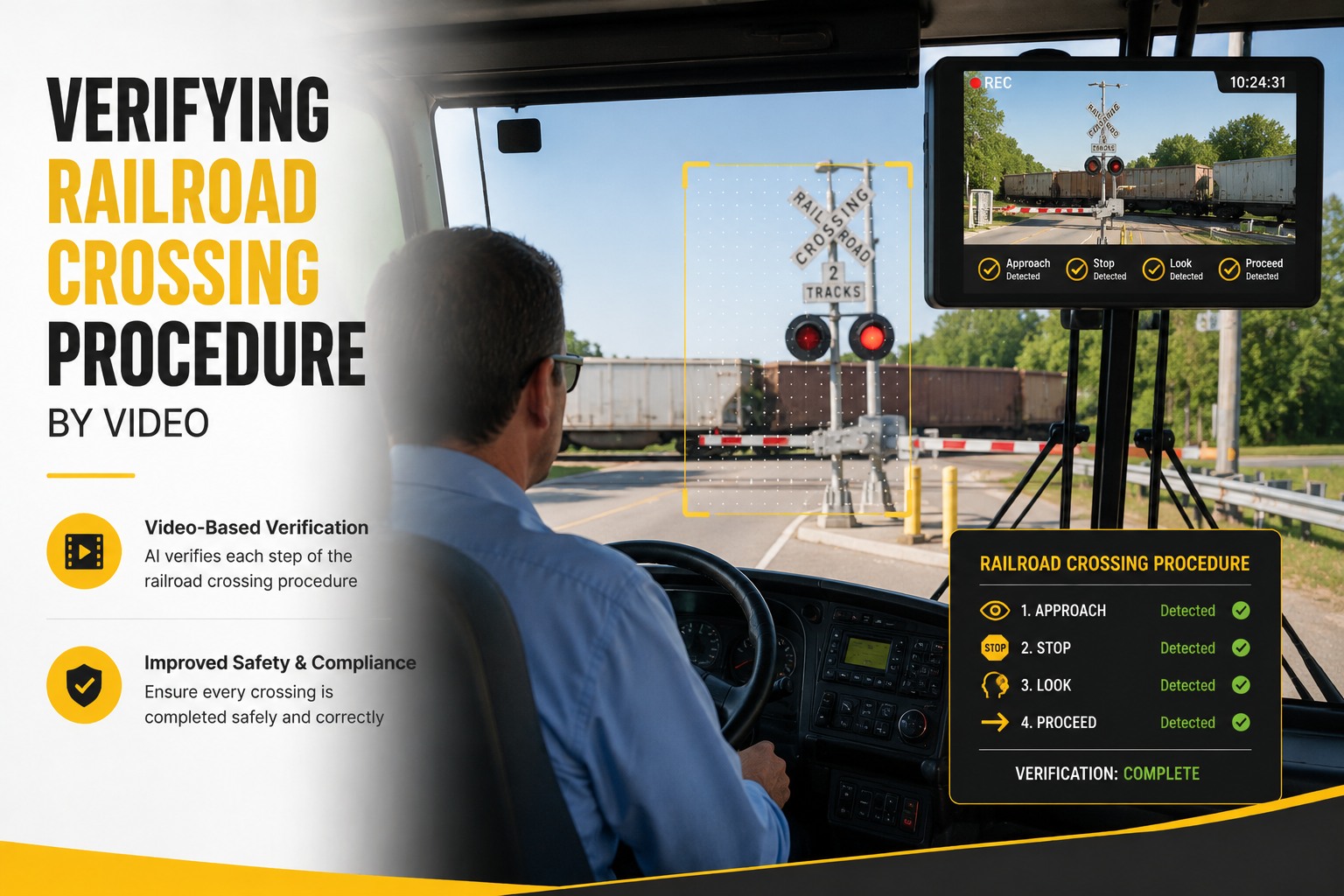
Verifying railroad crossing procedure by video means reviewing whether a driver actually executed the required stop, door-open, and listen sequence at every crossing — not assuming compliance because nothing went wrong. A ride-along can only sample a handful of crossings a year; video lets a safety office check every crossing, every day. See how a crossing procedure check becomes a coaching record in BusCMMS.
Verifying Railroad Crossing Procedure by Video
The required sequence at every crossing, why video verification catches what a ride-along never sees, and how to sample enough crossings to actually trust the number.
The Required Stop, Open-Door, and Listen Sequence
The standard procedure at a railroad crossing requires a bus to come to a complete stop at a defined distance before the tracks, open the driver's door and window, look and listen in both directions for an approaching train, and only then proceed once it's clear. This isn't a suggestion drivers can streamline when they're confident the tracks are clear — it's a fixed sequence precisely because the moments it exists to catch are the ones where a driver's own judgment about "probably clear" turns out to be wrong. Every step matters: a stop without an opened door and a genuine listen isn't the same procedure, even if the bus did technically come to a stop.
Why Video Verification Catches What a Ride-Along Misses
A supervisor doing an occasional ride-along observes one driver on one route on one day — a tiny, non-random sample that a driver may unconsciously perform better on simply because they know they're being watched. Video removes that observer effect entirely: every crossing on every route gets recorded the same way, whether or not anyone is riding along that day. This is the difference between an annual spot-check that captures a handful of crossings and a system that can, in principle, verify every single crossing a fleet makes across an entire year.
A Sampling Strategy That Actually Holds Up
Reviewing footage from every crossing every day isn't necessary to get a trustworthy number — but reviewing one crossing once a quarter isn't enough either. A workable middle ground is a rolling sample: a defined percentage of crossing events reviewed weekly, spread across all routes and all drivers, large enough that a single bad week doesn't skew the picture but small enough that a safety office can actually keep up with it. The specific percentage that works depends on fleet size, but the principle holds regardless of scale: consistent, ongoing sampling beats an exhaustive one-time audit that nobody has time to repeat.
The Objection Worth Naming: Alert Volume Kills the Program
Here's the failure that quietly defeats a crossing verification program: reviewing every single crossing event as a flagged alert generates far more volume than any safety office can sustain, and staff quietly stop reviewing consistently, letting real procedure failures blend into a pile of routine, compliant crossings that never needed a second look. The fix isn't reviewing less — it's flagging smarter: surfacing only crossings where the sequence appears incomplete (no door-open detected, no stop detected, or an unusually short dwell time) rather than routing every single crossing through a human reviewer regardless of outcome.
Not sure which crossings on your routes have the weakest procedure compliance? That's worth checking. Talk to the team about a crossing audit →
One Crossing Explained Most of the Fleet's Failures
A transit agency running school-tripper routes began sampling railroad crossing footage weekly across its fleet rather than relying on an annual ride-along audit. Within the first month, one specific crossing showed a full-sequence completion rate well below every other crossing on the system, driven by an unusually short stop-to-departure window across several different drivers. Reviewing the clips showed the issue wasn't driver attitude — a nearby traffic signal created pressure to clear the crossing quickly once the gate lifted. The agency added a specific note to that route's procedure card reminding drivers the sequence takes priority over signal timing, and follow-up sampling the next month showed the crossing's completion rate back in line with the rest of the system.
"We assumed if there was a problem crossing, it would be obvious from a complaint or a near-miss. It wasn't — it only showed up once we started sampling every crossing every week instead of hoping a ride-along would happen to catch it."
Safety Director · Transit agency running school routesCrossings and Routes as First-Class Objects
BusCMMS is an AI-native bus fleet operations platform built for buses from the ground up, not a trucking fleet tool with bus features added on. Routes, stop arms, danger zones, wheelchair lifts, crossing gates, and student riders are first-class objects in the platform, which is exactly why a railroad crossing can be tracked as its own entity with its own compliance history, rather than as a generic GPS waypoint with no procedural meaning attached.
Frequently Asked Questions
Updated August 2026What is the required procedure for a bus at a railroad crossing?
The standard sequence requires the bus to stop at a defined distance before the tracks, open the driver's door and window, look and listen in both directions for an approaching train, and only proceed once it's clear — all four steps, not just the stop itself.
Why is video verification better than a ride-along for checking crossing compliance?
A ride-along only samples one driver on one day, and drivers may unconsciously perform better when they know they're being observed. Video removes that observer effect and can, in principle, verify every crossing a fleet makes rather than a handful of spot-checked ones.
How much crossing footage should actually be reviewed?
A rolling weekly sample spread across all routes and drivers tends to work better than either reviewing everything, which is unsustainable, or an annual audit, which is too infrequent to catch a developing pattern. The exact percentage depends on fleet size, but consistency matters more than volume.
Why do some crossing verification programs stop being effective?
Flagging every single crossing event as an alert generates more volume than a safety office can sustain, causing staff to stop reviewing consistently. Filtering to surface only crossings with an apparently incomplete sequence keeps the review queue small enough to actually act on.
Is railroad crossing procedure verification required by law?
Requirements are generally set at the state level through state pupil-transportation inspection rules and state stop-arm enforcement statutes, rather than a single federal mandate specific to video verification technology, so specific expectations vary by state.