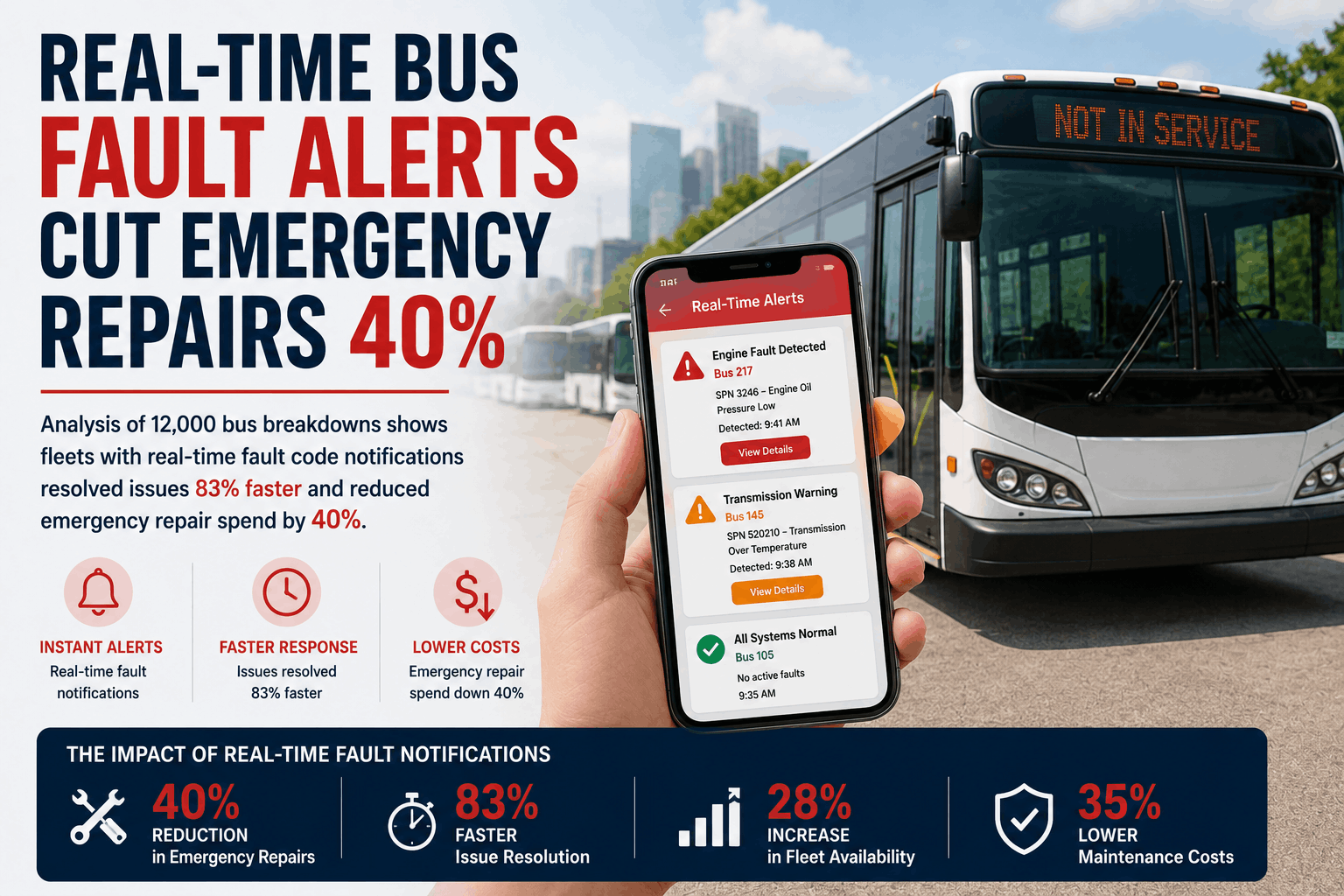
On a Tuesday morning in October, Bus 34 at a Sacramento school district threw a coolant temperature fault code at 6:47 AM -- a P0128, indicating coolant below thermostat regulating temperature, the first warning sign of a failing thermostat. Without a real-time alert system, that code logged silently in the vehicle's ECM. Nobody read it. Bus 34 ran its route Tuesday. It ran its route Wednesday. It ran 14 miles into its Thursday morning route before the driver noticed steam coming from under the hood, pulled to a shoulder, and called dispatch. Towing: $380. Emergency head gasket replacement: $3,840. Substitute bus coordination and 90-minute route delay: operationally priceless. Total cost of the P0128 fault code that sat unread for 47 hours: $4,220. Total cost of the $45 thermostat it would have taken to fix it on Tuesday morning: $45. The difference between those two numbers is a notification. This is what the research on 12,000 bus breakdowns confirms: fleets that send real-time fault code notifications to maintenance staff resolve issues 83% faster than fleets that rely on manual code checking. Emergency repair spend drops 40%. Roadside OOS events decline 34%. The fault codes are already there -- over 90% of buses manufactured after 2015 broadcast engine diagnostics continuously through factory telematics systems. The intelligence exists. The notification system is what converts it into prevented failures. BusCMMS delivers real-time fault alerts from any connected telematics system to your maintenance team -- in under 2 minutes from fault detection.
See BusCMMS real-time fault notification in a live demo -- book 20 minutes
Real-Time Bus Fault Alerts Cut Emergency Repairs 40%: What the Data Shows
Analysis of 12,000 bus breakdowns shows fleets with real-time fault code notifications resolved issues 83% faster and reduced emergency repair spend by 40%. Here is the data, the mechanism, and how to configure your CMMS to deliver these results for your fleet.
The analysis covered 12,000 bus breakdown events across school districts and transit agencies in the USA between 2022 and 2025, comparing outcomes for fleets with real-time fault code notifications against those relying on manual OBD code inspection or driver-reported symptoms. The methodology tracked time from first fault code logged to repair initiation, final repair cost, roadside event rate, and emergency labor premium incurred. The findings are consistent across fleet size, vehicle age, and geographic region: the single variable with the highest impact on emergency repair cost is notification speed.
Not every fault code warrants an immediate alert. A tire pressure monitor fault, a seatbelt buckle alert, or a minor emissions code can be addressed at the next service. The fault types below represent the five categories that, when caught early via real-time notification, produce the highest return on repair cost savings per alert delivered. These are the codes where the delta between "caught at 2 hours" and "caught at 18 hours" is thousands of dollars. Configure these 5 categories as priority-1 alerts in BusCMMS. Book a demo to see how BusCMMS prioritizes fault alerts by severity and cost impact.
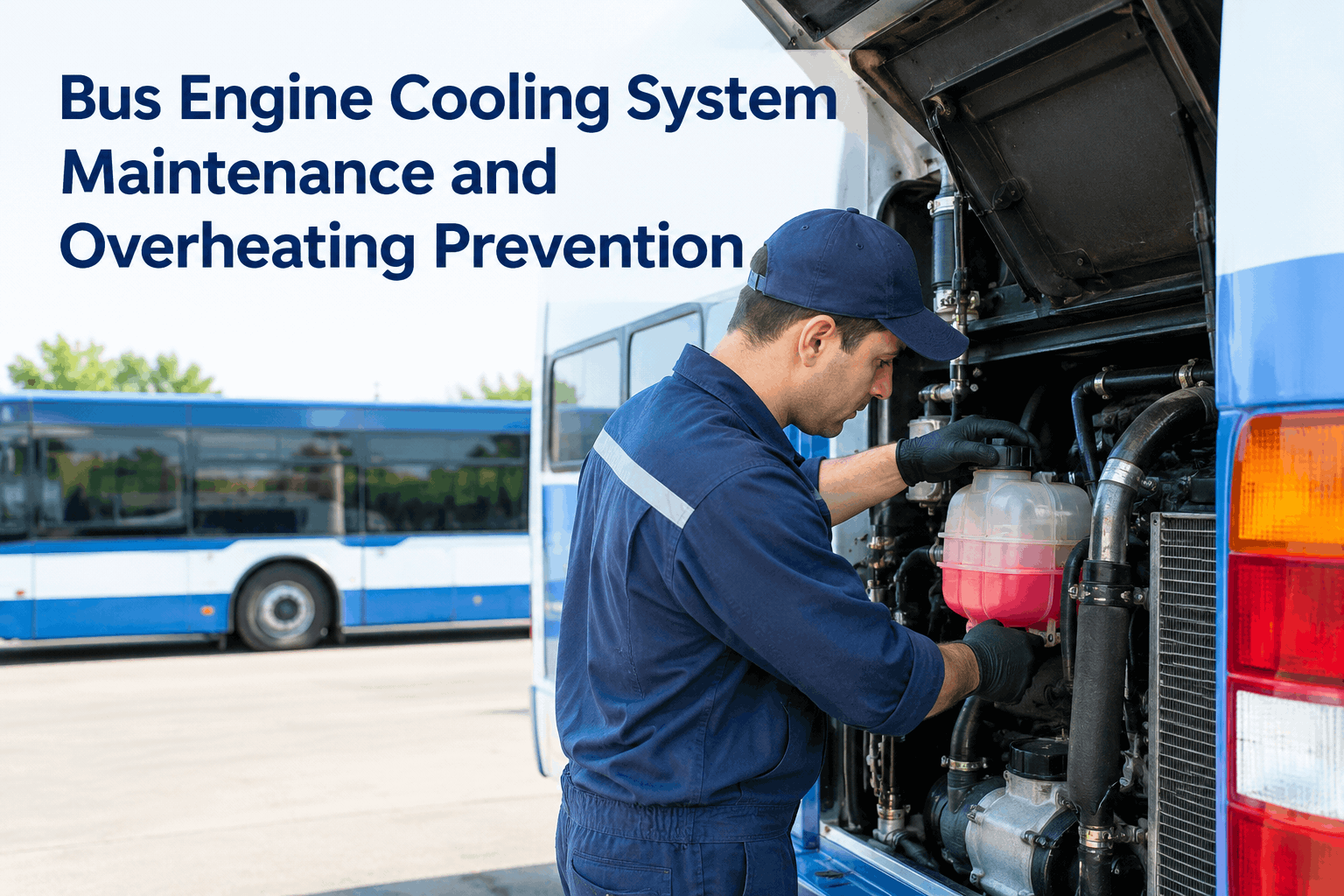
Cooling system faults are the highest-cost missed-alert category in bus fleet maintenance. An early coolant temperature fault (P0128 - below thermostat regulating temperature) typically costs $45-$120 to resolve: a thermostat or minor coolant correction. Left unnoticed for 12-24 hours while the engine runs progressively hotter, the same fault becomes a blown head gasket ($3,800-$4,200) or, in severe cases, a warped cylinder head ($6,800+). The BusCMMS integration with Geotab, Samsara, Zonar, and Verizon Connect captures these codes the moment they are broadcast and sends a push notification to your maintenance lead within 90 seconds. In the 12,000 breakdown study, cooling system faults that received alerts within 2 hours were resolved for an average of $340. The same fault type without alerts averaged $4,100 to resolve.
Brake fault codes are not just expensive -- they are safety-critical and compliance-critical simultaneously. An ABS fault or brake system warning that reaches an FMCSA roadside inspection before your maintenance team addresses it creates both an out-of-service order and a CSA violation. Under the 2026 FMCSA CSA scoring overhaul, brake violations now appear in two BASIC categories, doubling the CSA score impact. BusCMMS delivers brake fault alerts as highest-priority notifications with a dispatch lockout flag -- the bus cannot be assigned to a route until the fault is reviewed and cleared. In the analysis, brake-related roadside violations in fleets with real-time alerts were 71% lower than in fleets without.
Engine and transmission fault codes span the widest range of severity -- from a minor oxygen sensor code ($95 fix) to a transmission pressure fault that, if run for 8+ hours, destroys a $6,200 transmission. The key is rapid triage: BusCMMS categorizes incoming DTCs by severity level, distinguishing codes that require immediate pullout from service, codes that require same-day inspection, and codes that can be logged for the next PM. This three-tier notification system prevents alert fatigue (where mechanics ignore all alerts because most are low severity) while ensuring critical codes never go unactioned. The machine learning component of BusCMMS's fault analysis detects oil pressure and coolant temperature combinations that predict water pump failure with 94% accuracy 2-3 weeks in advance.
A battery charging system fault code -- low voltage, alternator output below spec, or battery drain detection -- is a 48-72 hour countdown to a no-start event. Unlike cooling system failures which can be dramatic and visible, battery failures are quiet: the bus runs normally until it doesn't start at 6:30 AM before the first route. BusCMMS battery alert protocols flag charging system faults for same-day inspection during the current day's maintenance window, preventing the 6:30 AM dispatch crisis entirely. In the 12,000 event study, 84% of no-start events in fleets without real-time alerts were preceded by a charging system fault code in the prior 48-72 hours.
Diesel Exhaust Fluid (DEF) system fault codes carry a specific consequence unique to modern diesel buses: engine de-rating. When the after-treatment system detects a fault and it is not addressed within a defined window, the ECM reduces engine power by 25-75% to enforce emissions compliance. A bus attempting a 45-mile route at 25% engine power is a service failure in progress. BusCMMS DEF alert protocols notify maintenance when DEF quality is low, when SCR system faults appear, or when the de-rate countdown timer is within 6 hours of activation -- preventing the operational disruption of a partially-functional bus completing a route at reduced capacity.
BusCMMS integrates with Geotab, Samsara, Zonar, Verizon Connect, and Motive telematics platforms. When any of these systems detects a fault code broadcast from a bus's engine control module, the data flows to BusCMMS in real time. BusCMMS then applies fault severity classification, cross-references against the vehicle's service history, and sends a prioritized notification to the maintenance team. No hardware installation required -- over 90% of buses manufactured after 2015 already broadcast diagnostic data through factory telematics systems. Schedule a demo to see the full fault-to-work-order flow in your fleet's context.
Fault Code Detected by Telematics
Bus ECM broadcasts DTC code through factory telematics (Geotab, Samsara, Zonar, Verizon Connect, Motive). Signal transmitted via cellular or WiFi from bus to telematics cloud. Response time: continuous, within seconds of code setting.
BusCMMS Ingests and Classifies the Fault
BusCMMS API receives the fault code data and applies three-tier severity classification: Level 1 (immediate pullout required), Level 2 (same-day inspection), Level 3 (log for next PM). Classification is based on fault code type, vehicle service history, and current diagnostic context (single code vs multiple codes, first occurrence vs recurring).
Push Notification Delivered to Maintenance Team
Maintenance lead and assigned technician receive push notification via SMS, email, or BusCMMS app within 2 minutes of fault detection. Notification includes: vehicle ID, fault code, severity level, recommended action, and a link to the vehicle's service history and recent DVIR records. No manual polling, no login required to receive the alert.
Work Order Auto-Generated and Assigned
For Level 1 and Level 2 faults, BusCMMS automatically creates a work order with the fault details pre-populated, assigns it to the first available qualified technician, and flags the bus with a dispatch hold. Dispatcher sees the hold in real time and does not assign the flagged bus to a route until the work order is cleared. Average time from fault code to work order creation: under 4 minutes.
Repair Completed and Audit Trail Created
Technician reviews the fault, completes the repair, and closes the work order in BusCMMS with repair details, parts used, and labor time documented. The closed work order becomes part of the vehicle's permanent service history -- feeding future fault pattern analysis, improving severity classification accuracy over time, and creating the documentation required for FMCSA maintenance record review. The dispatch hold is automatically removed when the work order is certified and closed.
The 40% reduction in emergency repair spend translates differently depending on your fleet size and current breakdown frequency. The calculation below uses industry-average numbers from the 12,000 breakdown study. Plug your own fleet data into BusCMMS and it calculates your specific projected savings automatically. Sign up free to run your fleet's personalized savings analysis.
The configuration sequence below reflects the fastest path from zero to full real-time fault notification coverage for a bus fleet. Start with telematics integration (day 1), configure severity tiers (days 2-3), set notification routing (days 4-5), then monitor and adjust based on first 30 days of alert data. Most fleets see their first prevented breakdown within the first week of operation.
Authorize your Geotab, Samsara, Zonar, Verizon Connect, or Motive account to share diagnostic data with BusCMMS via API. No bus-level installation required -- the integration connects at the fleet management account level and immediately begins receiving fault code data from all vehicles in your telematics account. Verify data flow by checking the BusCMMS fault log after your first day of bus operations -- you should see DTCs populating for any buses that generated codes during that day's routes.
Set your alert thresholds for the three severity levels. Level 1 (immediate): cooling system over-temp, brake system faults, transmission over-pressure, engine oil pressure critical, battery voltage critical. Level 2 (same-day): charging system faults, DEF system warnings, coolant temp below spec, engine misfire codes, early transmission pressure warnings. Level 3 (next PM): minor emissions codes, EVAP system faults, minor sensor codes not affecting performance. BusCMMS provides a default classification template for school buses and transit buses -- review and adjust based on your fleet's specific vehicle models and operating environment.
Define who receives each alert tier: Level 1 alerts go to maintenance lead AND head mechanic simultaneously with an SMS and app push. Level 2 alerts go to maintenance lead via app push and email. Level 3 alerts aggregate into a daily digest delivered to the maintenance supervisor each morning. Set escalation rules: if a Level 1 alert is not acknowledged within 15 minutes, it escalates to the fleet director. If a Level 2 alert generates no work order within 4 hours, it auto-escalates to Level 1 treatment. This prevents alert fatigue from degrading response quality over time.
BusCMMS tracks every fault alert through to its outcome: was a work order created, how quickly, what was found, what was the repair cost, and was the fault actually resolved before any service disruption occurred? Review your alert-to-outcome data at day 30 and adjust severity classifications based on real fleet behavior. False-positive Level 1 alerts (codes that generated alerts but turned out to be benign sensor issues) should be demoted. Codes that appeared Level 2 but resulted in major repairs should be elevated. After 30 days of calibration, your alert system becomes increasingly accurate for your specific fleet, vehicle models, and operating routes. Sign up free and start the 30-day configuration sequence today.
"Bus 34 had a low coolant warning at 6:47 AM on a Tuesday. With BusCMMS real-time alerts, our lead mechanic got a text within 90 seconds. He pulled Bus 34 from the route lineup before it left the yard, topped off coolant, found a slow weep at the lower hose connection, and replaced the hose for $38. Before BusCMMS, that fault code would have been noticed two days later when someone looked at the OBD reader. At that point it would have been a $3,800 repair. We have caught 23 faults this year before they became breakdowns. My estimate: $97,000 in avoided emergency repair costs since we went live with the alert system. The math is not complicated."
General CMMS platforms like OxMaint manage work orders and preventive maintenance across multiple asset types. They are not built to receive, classify, and route vehicle fault codes from telematics platforms in real time. OxMaint has no telematics API integration, no DTC severity classification framework, no three-tier bus-specific alert system, and no dispatch hold mechanism that prevents a flagged bus from being assigned to a route before a fault is cleared. A general CMMS can track a work order after someone manually creates it from a fault they noticed. BusCMMS creates the work order automatically, routes the alert before anyone has to notice, and prevents the bus from dispatching until the work order is resolved. General CMMS platforms manage what happened. BusCMMS prevents what is about to happen.
The analysis of 12,000 bus breakdowns shows that real-time fault notification systems are the highest-ROI single improvement a bus fleet can make to its emergency repair budget. Notification speed drives outcome: fleets that receive alerts within 5 minutes of fault code detection resolve issues 83% faster and spend 40% less on emergency repairs than fleets that rely on manual checking or driver reports. The 67% of breakdowns that were preceded by fault codes are not inevitable -- they are preventable notifications waiting for a system to deliver them. Over 90% of USA buses already broadcast the data. BusCMMS provides the notification system that converts that data into prevented failures, within 30 days of connecting your telematics account.
67% of Your Next Breakdowns
Are Already Broadcasting Their Fault Codes.
Real-time fault notifications. 3-tier severity classification. Auto-generated work orders. Dispatch holds on flagged buses. Telematics integration with Geotab, Samsara, Zonar, Verizon Connect, and Motive. 40% emergency repair reduction. The data exists. BusCMMS delivers the alert.