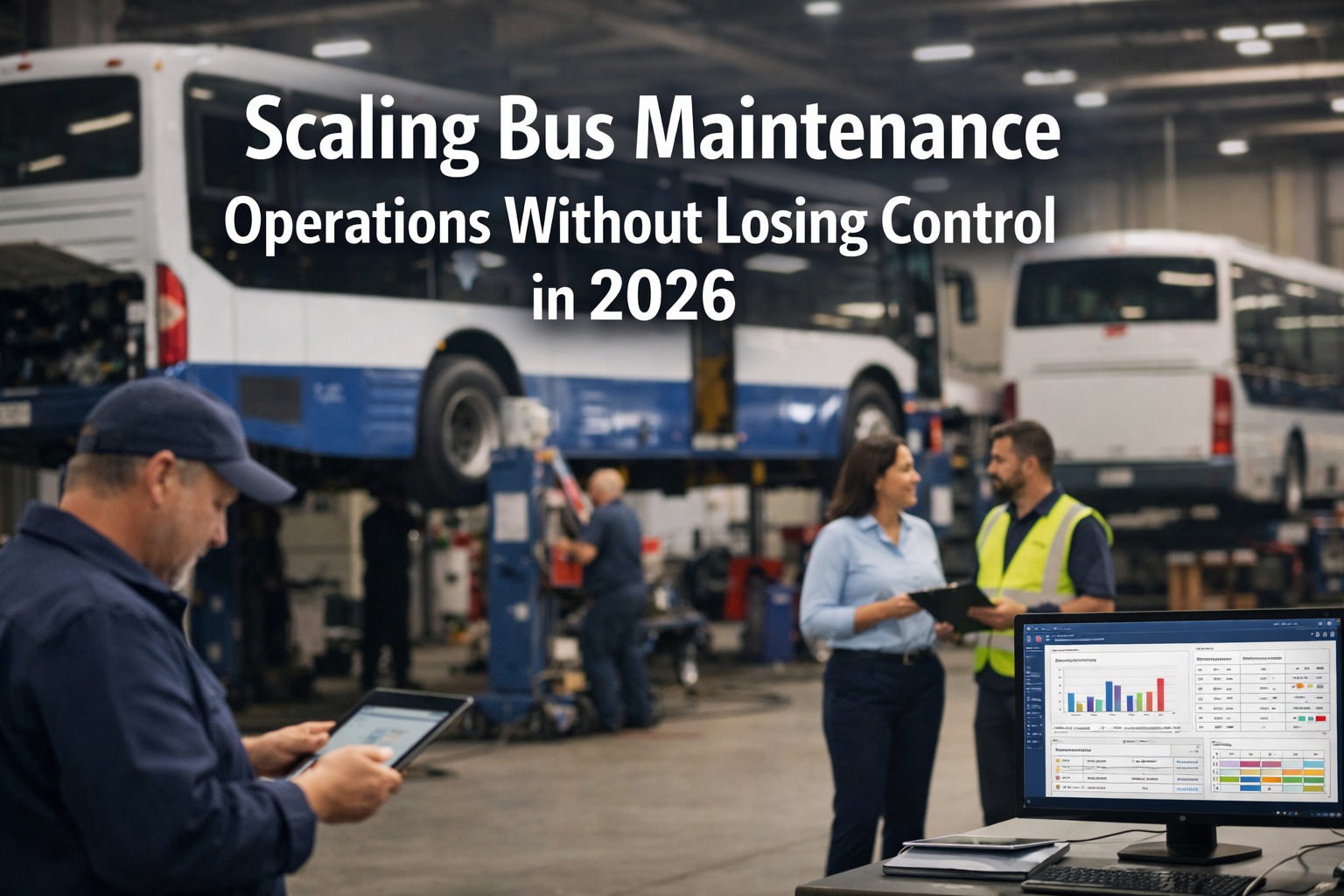
Every fleet leader who has managed growth knows the feeling: that moment when you realize the spreadsheets aren't working anymore, when the processes that served you well at 30 buses are failing at 60, when you're spending more time managing chaos than managing maintenance.
The statistics are sobering. According to the American Transportation Research Institute, downtime costs for commercial vehicles exceed $74 billion annually across the US—and growing fleets face disproportionate risk. Without scalable maintenance systems that grow with your operation, each new vehicle added increases complexity exponentially rather than linearly. What should be a growth asset becomes a liability.
But here's what successful fleet leaders understand: scaling isn't about doing more of what you're already doing. It's about fundamentally redesigning how maintenance operations work so that adding 20 buses doesn't require adding 20 units of administrative burden. The fleets that scale successfully in 2026 are those building systems today that will support tomorrow's growth.
$74B
Annual downtime costs for commercial vehicles in the US
72%
Of fleets use dedicated maintenance software
35%
Reduction in vehicle downtime with proper CMMS
30%
Decrease in maintenance costs with scalable systems
The Hidden Costs of Unscalable Maintenance
Before addressing solutions, it's essential to understand what unscalable maintenance actually costs growing organizations. These costs extend far beyond the obvious—they create cascading failures that compound as fleets expand.
What Unscalable Systems Cost Growing Fleets
Visibility Loss
$15,000-$40,000/year per location
When fleet assets spread across multiple sites, decentralized processes create major operational burdens. Managers can't see which vehicles need service, which PMs are overdue, or where maintenance dollars are actually going.
Compliance Drift
$500-$14,490 per violation
DOT violations multiply as oversight spreads thin. A single missed inspection across multiple locations becomes a pattern of non-compliance that threatens operating authority and insurance rates.
Duplicate Effort
10+ hours weekly wasted
Without centralized systems, supervisors at each location develop their own processes. Data entry happens multiple times. Reports require manual consolidation. Communication gaps create redundant work.
Knowledge Fragmentation
3-6 month productivity loss per new hire
When maintenance knowledge lives in individual heads rather than systems, every personnel change creates disruption. New supervisors struggle to understand what's been done and what needs attention.
Inventory Chaos
25-40% excess inventory cost
Each location stockpiles its own parts "just in case." No visibility into what's available across the organization. Emergency orders become routine. Capital sits idle on shelves.
Decision Latency
2-3 week delays on critical decisions
Without real-time visibility, leadership makes decisions based on stale data. By the time reports are compiled and analyzed, the situation has changed—or the opportunity has passed.
The Scaling Trap
Many growing fleets fall into a dangerous pattern: they add vehicles and locations faster than they add administrative capacity, assuming they'll "figure it out later." By the time control starts slipping, the operational debt is already significant. The organizations that scale successfully address infrastructure before it becomes critical.
The Scalability Framework: 5 Pillars of Controlled Growth
Scaling bus maintenance without losing control requires intentional architecture across five interconnected pillars. Weakness in any single pillar creates vulnerabilities that compound as the fleet grows.
1
Centralized Visibility
One system of record that provides real-time status across all vehicles, all locations, and all maintenance activities. Leadership sees the same data as frontline supervisors—just aggregated differently.
Enables: Consistent oversight regardless of fleet size or geographic distribution
2
Standardized Processes
Documented procedures that work the same way at every location. Whether a bus is serviced at the main facility or a satellite yard, the same inspection checklist, the same documentation standards, the same quality expectations apply.
Enables: Consistent quality and compliance across distributed operations
3
Automated Workflows
Systems that trigger actions without human intervention. PM schedules that generate work orders automatically. Fault codes that create service tickets. Compliance deadlines that send alerts before they become problems.
Enables: Growth without proportional administrative overhead increase
4
Scalable Technology
Cloud-based platforms designed to handle increasing complexity—more assets, more locations, more data—without degrading performance or requiring expensive upgrades.
Enables: Technology that grows with the fleet rather than constraining it
5
Data-Driven Decision Making
Metrics and dashboards that surface insights automatically. Leadership doesn't need to request reports—critical information surfaces proactively. Exceptions are highlighted; everything else runs without intervention.
Enables: Management attention focused on strategic decisions, not operational details
Ready to build maintenance infrastructure that scales with your growth? Discover how modern CMMS platforms provide the visibility and automation growing fleets need.
Scale Without Chaos — See Scalable System Start Building Your FoundationCentralized Visibility: Seeing Everything from Everywhere
The foundation of scalable maintenance is centralized visibility—the ability to see the complete operational picture regardless of how many vehicles you operate or where they're located. Without this foundation, every other scaling effort builds on unstable ground.
What Centralized Visibility Delivers
Fleet-Wide Status Dashboard
Real-time view of every vehicle: in service, in maintenance, awaiting parts, or scheduled for service. Click from fleet summary to individual vehicle to specific work order without leaving the system.
Cross-Location Reporting
Compare maintenance costs, PM compliance, and vehicle availability across all facilities. Identify which locations operate efficiently and which need attention—before small problems become large ones.
Unified Asset Records
Complete maintenance history travels with the vehicle. When a bus moves between locations, its service records, open issues, and upcoming requirements move with it automatically.
Consolidated Inventory View
See parts availability across all locations. Before ordering emergency parts at premium prices, check if another facility has the component in stock. Reduce duplicate inventory and stockouts simultaneously.
Real-Time Compliance Tracking
Monitor inspection status, certification deadlines, and regulatory requirements across the entire fleet. Automated alerts flag approaching deadlines before they become violations.
Mobile Access Everywhere
Supervisors, technicians, and leadership access the same information from any device. Whether at the main office, satellite facility, or en route between locations, visibility remains complete.
Scaling Success: Multi-Site Visibility in Action
In a 2025 fleet survey, organizations using digital fleet solutions reported saving more than 10 hours weekly in data entry while achieving 75-90% on-time maintenance compliance rates and improved visibility across 10+ sites. The key differentiator wasn't the technology itself—it was the centralized approach that eliminated information silos between locations.
Process Standardization: The Consistency Multiplier
Standardized processes are what allow organizations to replicate success across locations. When maintenance procedures are documented, consistent, and enforced through systems rather than supervisory attention, quality becomes sustainable at scale.
Critical Processes to Standardize
Preventive Maintenance Protocols
Standardize: PM intervals, inspection checklists, documentation requirements, quality verification steps
Ensures every bus receives the same level of care regardless of which location performs service
Work Order Workflows
Standardize: Request submission, approval routing, priority assignment, completion documentation, closure criteria
Creates predictable processes that new staff can follow immediately without location-specific training
Inspection Procedures
Standardize: Pre-trip/post-trip checklists, defect reporting, escalation triggers, repair verification
Maintains compliance consistency and creates comparable data across the organization
Parts Procurement
Standardize: Approved vendors, ordering procedures, authorization levels, receiving documentation
Controls costs, ensures quality parts, and creates leverage for volume purchasing
Technician Certifications
Standardize: Required certifications, training completion tracking, skill verification, recertification timelines
Ensures qualified technicians perform work regardless of location staffing variations
Emergency Response
Standardize: Breakdown procedures, decision trees, escalation contacts, documentation requirements
Ensures consistent handling of emergencies even when regular supervisors aren't available
Implementation Strategy
Start by documenting how your best-performing location operates. Capture the procedures that drive their success, then adapt those procedures for organization-wide deployment. Standardization should elevate all locations to your highest performer's level, not average down to the lowest common denominator.
Automation: Scaling Without Adding Headcount
The mathematics of scaling are brutal: if every new vehicle requires proportional administrative time, growth quickly outpaces capacity. Automation breaks this equation by handling routine tasks without human intervention, freeing staff to focus on work that requires judgment and expertise.
High-Impact Automation Opportunities
Automated PM Scheduling
Triggers: Mileage thresholds, engine hours, calendar intervals
System automatically generates work orders with correct procedures, parts lists, and labor estimates. No manual scheduling required.
Impact: 60-70% reduction in scheduling administrative time
Telematics-Driven Work Orders
Triggers: Fault codes, diagnostic alerts, abnormal sensor readings
System creates service tickets automatically when vehicles report issues. Includes fault details, severity assessment, and recommended actions.
Impact: 40-50% faster response to emerging issues
Compliance Deadline Alerts
Triggers: Approaching inspection deadlines, expiring certifications, license renewals
System sends escalating notifications to responsible parties. Includes direct links to required actions and documentation.
Impact: Near-zero compliance violations from missed deadlines
Parts Reorder Automation
Triggers: Inventory falling below minimum thresholds, upcoming PM requirements
System generates purchase requisitions or orders directly with approved vendors. Maintains optimal stock levels automatically.
Impact: 90% reduction in stockouts, 25% lower inventory carrying costs
Report Generation
Triggers: Scheduled intervals, exception thresholds, executive requests
System compiles and distributes reports automatically. Leadership receives insights without requesting them.
Impact: 3-5 hours weekly saved on manual report creation
Warranty Tracking
Triggers: Component installations, service completions, warranty expiration dates
System flags warranty-covered repairs, prevents out-of-pocket payments for covered work, and tracks warranty recovery opportunities.
Impact: 15-20% improvement in warranty cost recovery
Technology Selection: Building for Tomorrow's Scale
The CMMS that works for 30 buses may become a bottleneck at 100. Technology decisions made during growth phases create either foundations for continued expansion or constraints that eventually require painful migrations. Choosing scalable technology from the start prevents expensive course corrections later.
Scalability Requirements Checklist
Cloud-Native Architecture
Why it matters: Cloud systems scale automatically as data and users increase. No server upgrades, no capacity planning, no performance degradation as the fleet grows.
Check for: Automatic scaling, 99.9%+ uptime guarantees, mobile accessibility from any location
Multi-Location Support
Why it matters: Growing organizations need systems that handle multiple facilities natively, with appropriate access controls and consolidated reporting.
Check for: Hierarchical asset structures, location-based permissions, cross-location visibility for leadership
Integration Capabilities
Why it matters: Maintenance systems must connect with telematics, accounting, fuel management, and other operational tools. Data silos multiply as organizations grow.
Check for: Open APIs, pre-built integrations with major platforms, documented data exchange standards
Flexible Reporting
Why it matters: Reporting needs evolve as organizations mature. Systems must support custom reports, automated distribution, and drill-down analysis.
Check for: Custom report builders, scheduled report delivery, export capabilities, executive dashboards
Transparent Pricing
Why it matters: Some platforms charge prohibitive premiums for additional users or features as fleets grow. Predictable pricing enables confident budget planning.
Check for: Per-vehicle pricing, included user licenses, no hidden fees for features you'll need at scale
Vendor Stability
Why it matters: CMMS implementations are multi-year investments. Vendors must have financial stability and product roadmaps aligned with industry direction.
Check for: Years in business, customer retention rates, ongoing product development, responsive support
Explore how purpose-built fleet maintenance platforms deliver the scalability growing operations require. See how centralized visibility and automation transform fleet management.
Scale Without Chaos — See Scalable System Explore Platform CapabilitiesThe Multi-Location Challenge: Maintaining Control Across Sites
Geographic expansion creates unique challenges that single-location operations never face. Maintaining consistent quality, communication, and control across multiple facilities requires deliberate strategies that go beyond simply deploying the same software everywhere.
Challenge: Inconsistent Practices
Solution: Deploy standardized digital checklists and procedures through CMMS. Technicians follow the same workflows at every location because the system guides them through each step.
Challenge: Communication Gaps
Solution: Centralized work order system with real-time updates. When a bus at Location A needs attention at Location B, the receiving facility sees the issue immediately with full context.
Challenge: Resource Imbalances
Solution: Consolidated visibility into workload and capacity across all facilities. Dispatch vehicles for service to the location with available capacity rather than overwhelming busy shops.
Challenge: Inventory Duplication
Solution: Shared parts inventory with cross-location visibility. Before ordering, check system-wide availability. Transfer between locations costs less than emergency orders.
Challenge: Performance Comparison
Solution: Standardized KPIs calculated automatically for each location. Identify best practices at high-performing sites and replicate them elsewhere.
Challenge: Leadership Oversight
Solution: Exception-based dashboards that surface issues requiring attention. Leadership doesn't review routine operations—systems highlight only the situations needing intervention.
Building Your Scaling Roadmap: A Phased Approach
Successful scaling isn't an overnight transformation—it's a deliberate progression through defined phases. This roadmap provides a framework for growing fleets to build capacity ahead of expansion.
Phase 1: Foundation (Months 1-3)
Focus: Establish core systems and standardized processes at primary location
Deploy centralized CMMS with complete asset records
Document current maintenance procedures and identify best practices
Integrate telematics for automated mileage and fault code capture
Train core team on new workflows and establish adoption metrics
Establish baseline KPIs: PM compliance, vehicle availability, cost per mile
Outcome: Proven system operating successfully at one location with measurable results
Phase 2: Optimization (Months 4-6)
Focus: Refine processes and enable automation before expansion
Activate automated PM scheduling and work order generation
Implement parts inventory management with reorder automation
Deploy mobile access for technicians and supervisors
Refine reporting to deliver actionable insights automatically
Document procedures for replication to additional locations
Outcome: Automated, documented processes ready for multi-location deployment
Phase 3: Expansion (Months 7-12)
Focus: Roll out proven systems to additional locations
Deploy CMMS to new locations with standardized configuration
Train new site personnel using documented procedures
Establish cross-location visibility and consolidated reporting
Implement parts sharing and workload balancing between sites
Monitor location-specific KPIs and address variances
Outcome: Multiple locations operating on unified platform with consistent performance
Phase 4: Excellence (Ongoing)
Focus: Continuous improvement and advanced capabilities
Activate predictive maintenance using accumulated data
Optimize inventory across all locations using demand forecasting
Implement advanced analytics for lifecycle cost optimization
Refine processes based on cross-location performance comparisons
Scale additional locations using established playbook
Outcome: Mature, optimized operation capable of scaling indefinitely
Metrics That Matter: Tracking Scalability Success
Scaling successfully requires metrics that indicate whether growth is being managed or merely tolerated. These KPIs reveal whether your maintenance operation is scaling efficiently or accumulating hidden operational debt.
Administrative Hours per Vehicle
Total admin hours ÷ Fleet size
Target: Decreasing as fleet grows
The ultimate scalability indicator. If this ratio stays flat or decreases, your systems are scaling. If it increases, growth is outpacing capacity.
Cross-Location Variance
Standard deviation of KPIs between locations
Target: Decreasing variance over time
Measures consistency of operations. Wide variance indicates standardization gaps; tight clustering indicates effective process deployment.
PM Compliance Rate
Completed PMs ÷ Scheduled PMs × 100
Target: 95%+ across all locations
Compliance shouldn't degrade as fleet expands. Dropping rates signal visibility or capacity issues.
Time to Visibility
Hours from issue occurrence to management awareness
Target: Same-day for all locations
Growing organizations often see visibility lag increase. Real-time systems maintain awareness regardless of scale.
New Location Ramp Time
Days from deployment to operational KPI parity
Target: Decreasing with each new location
Measures effectiveness of standardized processes. Well-documented procedures accelerate new location performance.
System Integration Completeness
Data sources integrated ÷ Total data sources × 100
Target: 90%+ integration
Unintegrated systems create manual work that scales poorly. Higher integration means more automation.
Common Scaling Mistakes—And How to Avoid Them
Organizations that struggle to scale often fall into predictable traps. Understanding these patterns helps growing fleets avoid costly mistakes that become harder to correct as operations expand.
Mistake: Scaling Before Standardizing
Each location develops its own procedures, creating inconsistency that becomes harder to correct as more locations join.
Establish and document standards at your primary location first. Only expand once processes are proven and repeatable.
Mistake: Technology Afterthought
Selecting CMMS based on current needs rather than growth trajectory. Systems that work today become constraints tomorrow.
Evaluate technology based on where you'll be in 3-5 years, not where you are today. Scalability requirements should drive selection.
Mistake: Hiring Before Automating
Adding administrative staff to handle growing workload rather than automating routine tasks first.
Automate every repeatable process before adding headcount. New staff should handle work that requires judgment, not data entry.
Mistake: Maintaining Siloed Data
Locations operate with separate spreadsheets, databases, or processes. Leadership lacks consolidated visibility.
Centralized systems from day one. Even if you have only one location, build the infrastructure that will support ten.
Mistake: Underinvesting in Training
Staff at new locations struggle to adopt systems because training was inadequate. Each location reinvents adoption.
Develop standardized training materials and onboarding processes. New location success should be predictable, not dependent on individual initiative.
Mistake: Ignoring Change Management
New systems are deployed but adoption lags. Staff revert to familiar (unscalable) processes.
Budget time and resources for change management. System deployment is the beginning of adoption, not the end.
Scaling as Strategic Advantage
The organizations that will lead student transportation in the coming years are those building maintenance infrastructure today that supports tomorrow's growth. While competitors struggle with scaling challenges, forward-thinking fleet leaders are deploying systems that turn growth from a source of chaos into a competitive advantage.
The technology exists. The frameworks are proven. The question isn't whether your fleet can scale successfully—it's whether you're building the foundation now or waiting until growth forces painful corrections.
Every bus you add, every location you open, every route you expand should strengthen your operation rather than strain it. That's the promise of scalable maintenance—and it's within reach for any fleet willing to invest in the systems and processes that make controlled growth possible.
Ready to build maintenance infrastructure that scales with your ambitions? Discover how growing fleets maintain visibility and control through every stage of expansion.
Scale Without Chaos — See Scalable System Start Your Growth JourneyFrequently Asked Questions
Q: At what fleet size do we need to worry about scalability?
A: Scalability planning should begin before you need it—ideally when your fleet reaches 25-30 vehicles or when you're considering a second location. Organizations that wait until they're struggling typically face more expensive and disruptive transitions. The systems and processes you implement at 30 buses should be capable of supporting 100+ with minimal modification.
Q: How much does scalable maintenance infrastructure typically cost?
A: Modern cloud-based CMMS platforms typically cost $15-50 per vehicle monthly, depending on features. This investment typically pays for itself through 10-30% reduction in maintenance costs, fewer compliance violations, and administrative time savings. The cost of not scaling—emergency repairs, lost visibility, duplicated effort—far exceeds the investment in proper systems.
Q: How long does it take to implement scalable maintenance systems?
A: Initial deployment typically takes 2-4 weeks for basic functionality. Full optimization including process standardization, automation configuration, and team training usually requires 3-6 months. Each subsequent location can be deployed faster using established procedures—often 1-2 weeks for full operational capability.
Q: Can we scale maintenance without adding administrative staff?
A: Yes—that's precisely what scalable systems enable. Through automation of routine tasks like PM scheduling, work order generation, and reporting, many organizations double or triple fleet size without proportional administrative growth. Staff focus shifts from data entry and manual tracking to exception handling and strategic decision-making.
Q: What's the biggest mistake growing fleets make with maintenance?
A: The most common mistake is scaling before standardizing. Organizations add vehicles and locations while still running on inconsistent processes and siloed data. By the time they recognize the problem, operational debt has accumulated across multiple sites. Successful fleets establish standardized, documented processes at their primary location before expanding.