Your Scania city buses run 18+ hours daily through stop-and-go traffic, tight schedules, and demanding passenger loads. The 100-hour PM interval is your first line of defense—catching wear patterns before they become service disruptions. With CMMS-driven job plans and AI prioritization, you transform routine checks into predictive insights that keep your fleet moving.
Why 100-Hour PM Matters for City Transit
City transit operations push Scania buses harder than any other application. With 250+ stops per 100 km, constant door cycles, and HVAC running non-stop, components wear faster than highway coaches. The 100-hour interval catches issues at the earliest stage—before they cascade into roadcalls or missed service.
High-Frequency Stops
250+ stops per 100 km accelerates brake, door, and suspension wear exponentially compared to intercity routes.
Passenger Load Cycles
Constant loading/unloading stresses air suspension, kneeling systems, and accessibility equipment daily.
Thermal Stress
Engine idling at stops while HVAC runs full blast creates unique cooling system demands year-round.
Safety Critical
Public transit means zero tolerance for failures. Early detection protects passengers and your agency's reputation.
Ready to standardize your 100-hour PM? Create a free Bus CMMS account and access Scania-specific job plans.
100-Hour PM Inspection Checklist
The 100-hour service focuses on fluid levels, visual inspections, and operational checks. These items form the foundation of Scania's recommended maintenance sequence (SMSL) adapted for city transit duty cycles.
Engine System
Check engine oil level — top up if below minimum mark
Inspect for oil leaks around turbocharger and oil pan
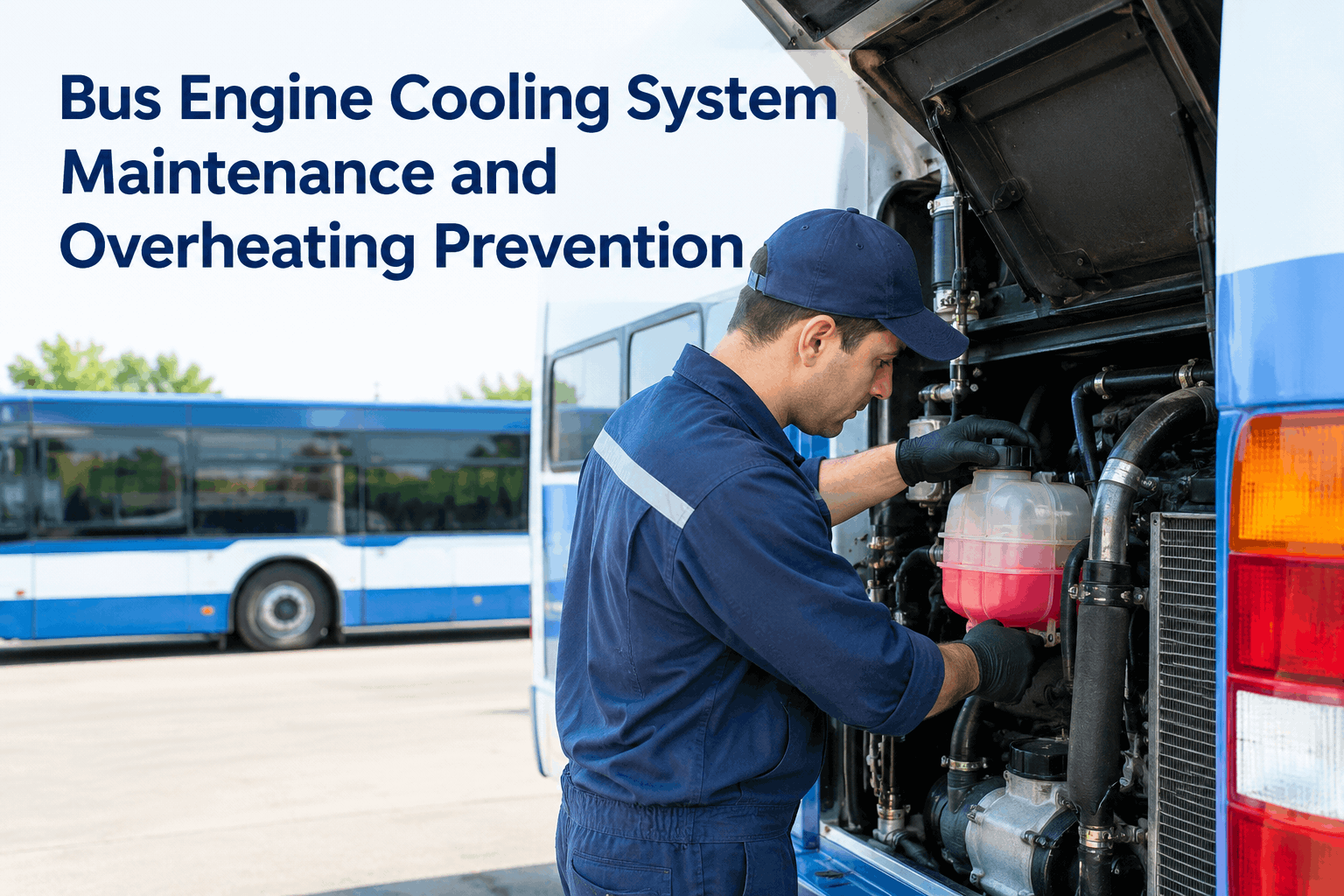
Check coolant level in expansion tank — verify concentration
Drain fuel system water separator
Inspect air cleaner service indicator — note restriction level
Check drive belt tension and condition
Brake System
Check brake pad thickness — minimum 3mm service limit
Inspect brake drums/discs for scoring or heat damage
Test air system pressure build-up and leak-down rate
Verify parking brake operation and adjustment
Check ABS/EBS warning lights and fault codes
Transmission & Drivetrain
Check automatic transmission fluid level (Allison/ZF)
Inspect for transmission fluid leaks at seals
Check rear axle fluid level — top up as needed
Inspect driveshaft U-joints for play or damage
Suspension & Steering
Inspect air bags for cracks, abrasion, or leaks
Test kneeling system operation — full cycle test
Check power steering fluid level
Inspect tie rod ends and drag link for wear
Verify shock absorbers — no leaks or excessive bounce
Get Digital Inspection Checklists
Pre-built Scania 100-hour PM templates with pass/fail criteria, photo capture, and automatic work order generation.
Additional 100-Hour Inspection Points
Beyond powertrain basics, city transit buses require attention to passenger systems and safety equipment that highway vehicles don't have.
Door Systems
Test all passenger door operation — open/close cycles
Check sensitive edge function and interlock
Lubricate door tracks and pivot points
Verify wheelchair ramp deployment
Climate Control
Check A/C refrigerant pressure
Inspect evaporator drain for blockage
Test heater output and controls
Check cabin air filter condition
Electrical Systems
Test all exterior lighting — headlights to markers
Verify destination sign operation
Check battery terminals and connections
Test stop request and ADA announcement systems
Safety Equipment
Verify fire extinguisher charge and mount
Check emergency exit operation and signage
Test emergency engine shutdown
Inspect first aid kit contents
CMMS Job Plan Workflow
Transform paper checklists into digital workflows. Bus CMMS creates work orders automatically based on engine hours, assigns tasks to qualified technicians, and tracks parts usage in real-time.
Trigger
Engine hours hit 100 — CMMS auto-generates PM work order
Assign
Route to qualified tech based on skill matrix and availability
Execute
Digital checklist on tablet — photo capture, pass/fail entries
Complete
Defects auto-create follow-up work orders with AI priority
100%
Digital Records
0
Paper Forms
AI
Priority Scoring
AI Maintenance Prioritization
Not all defects are equal. AI analyzes inspection findings, historical failure patterns, and route criticality to prioritize repairs. Safety issues escalate immediately while cosmetic items queue for scheduled downtime.
AI Engine
Safety vs. operational vs. cosmetic classification
Past failure patterns for this bus and component
High-ridership routes get priority attention
Stock availability affects repair scheduling
See AI Prioritization in Action
Watch how Bus CMMS analyzes your inspection data and recommends the optimal repair sequence.
Parts Readiness for 100-Hour PM
Nothing derails a PM faster than missing parts. CMMS tracks consumption patterns and maintains optimal stock levels for common 100-hour service items.
Extended PM Intervals
The 100-hour service is just the beginning. Scania's maintenance sequence builds toward more comprehensive inspections at longer intervals.
100 Hrs
Basic PM
Fluid checks, visual inspection, operational tests
300 Hrs
Standard PM
Oil change, filter replacement, brake adjustment
600 Hrs
Full PM
Comprehensive inspection, all filters, fluid analysis
1200 Hrs
Major PM
Transmission service, cooling system, injectors
Frequently Asked Questions
Why 100 hours instead of mileage for city transit?
City buses spend significant time idling at stops and in traffic. Engine hours capture actual operating time more accurately than odometer readings. A bus might log 100 engine hours while covering only 1,500-2,000 km in heavy urban service.
How does Bus CMMS track engine hours automatically?
Bus CMMS integrates with Scania's Fleet Management System (FMS) via telematics. Engine hours sync automatically, triggering PM work orders when thresholds are reached. No manual meter readings required.
What if a defect is found during 100-hour PM?
Technicians document defects directly in the digital checklist with photos. CMMS automatically generates a follow-up work order, assigns AI-based priority, checks parts availability, and schedules the repair based on severity and bus availability.
Can we customize the 100-hour checklist for our fleet?
Absolutely. Bus CMMS provides Scania-specific templates as a starting point, but you can add, remove, or modify inspection items to match your operating conditions, local regulations, or agency standards.
How does AI prioritization work?
AI analyzes multiple factors: defect severity (safety/operational/cosmetic), historical failure data for that component and bus, route importance, parts availability, and technician workload. It produces a priority score that helps maintenance managers sequence repairs optimally.