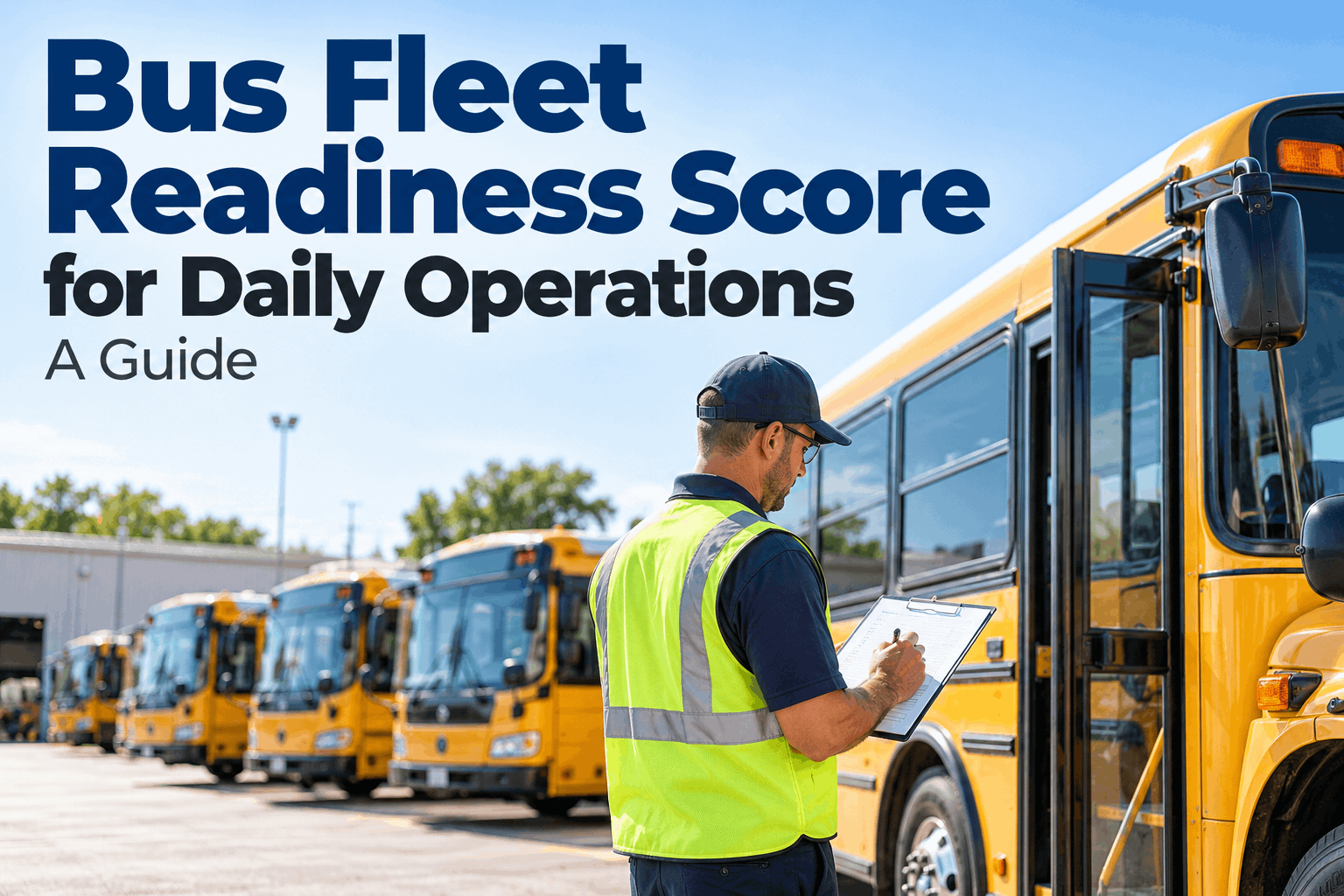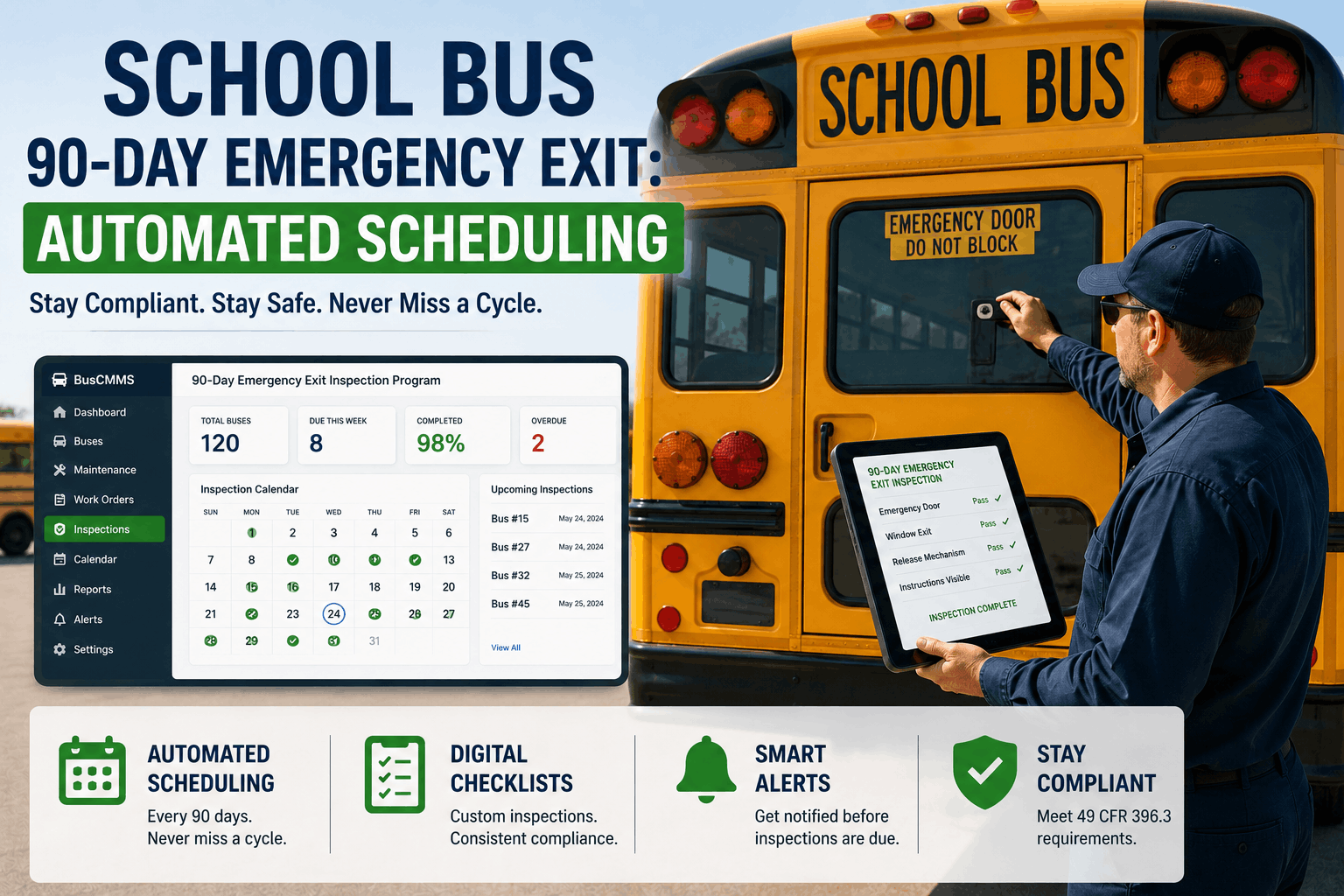
Federal law requires every school bus emergency exit to be inspected every 90 days. It's the law. 49 CFR 396.3. In a 50-bus fleet, that's 200 exit inspections annually. Yet 68% of fleets miss at least one cycle. Not because they're negligent. Because they use spreadsheets to track when inspections are due, and spreadsheets don't send reminders. A maintenance coordinator looks at the list and forgets it's due. A month later, nobody notices. By the time the DOT audit comes around, there's a gap: three buses' emergency exits were last inspected 95 days ago, five days past the deadline. It's a compliance violation. It's a safety liability. It's avoidable through automation. Here's how to build a 90-day emergency exit inspection program that never misses a cycle, automatically schedules maintenance, and documents everything for compliance audits.
School Bus 90-Day Emergency Exit Inspection: Automated Scheduling
Federal law (49 CFR 396.3) requires bus emergency exits inspected every 90 days — yet 68% of fleets miss at least one cycle annually. How to build an automated 90-day program that never misses a cycle. Complete inspection scheduling system that ensures compliance, documents proof, and eliminates manual coordination.
The 49 CFR 396.3 Requirement: What Exactly Must Be Inspected?
The regulation requires "emergency exits" be inspected every 90 days, but it's not always clear to operators what "emergency exits" means. A school bus has multiple emergency exits: rear door (required), roof hatches (if equipped), side windows (push-outs). Each one must be functional: the door must open freely from inside and outside, the latch must hold securely, the alarm must sound, the window must push out without excessive force. The 90-day inspection verifies every exit is safe and operational.
What the inspection must document: Date of inspection, which exits were tested (list them specifically: rear door, roof hatch north side, roof hatch south side, driver side window, passenger side window, etc.), pass/fail status of each exit, name of person who performed the inspection, and signature or digital authentication. If any exit fails, the bus must be taken out of service until the defect is repaired and the exit is re-inspected and passes. This is non-negotiable for safety reasons.
Why 68% of fleets miss cycles: The regulation is clear, but enforcement is invisible until the audit. If you miss a 90-day cycle, nothing happens the day you miss it. Nobody calls you. You don't get a warning. The penalty only appears if a DOT auditor asks to see your exit inspection records and discovers a gap. By then, it's too late to fix retroactively. You either document that the inspection happened (which is legally problematic if it didn't) or you admit the gap (which is a compliance violation). Neither option is good.
The Spreadsheet Problem: Why Manual Tracking Fails
A typical fleet's 90-day program looks like this: A spreadsheet has a list of all 50 buses with columns for Q1, Q2, Q3, Q4 inspection dates. The maintenance coordinator is supposed to check the spreadsheet quarterly and assign someone to do the inspections. In reality: (1) The coordinator forgets to check the spreadsheet (they're busy with other work). (2) They check it but miss one quarter because they get distracted. (3) An inspection is scheduled but the mechanic is on vacation or sick, so it gets postponed. (4) It gets postponed to "next week," then next week comes and the mechanic is busy with other repair work. (5) Nobody tracks whether the rescheduled inspection actually happened. (6) By the time anyone notices, two months have passed since the last documented inspection. The next one is now 30 days overdue.
The consequences: If a bus is involved in an accident where a child is injured and an emergency exit doesn't function (because it was never properly maintained or inspected), the fleet's liability is severe. A missing inspection record in a compliance audit is a violation that carries fines of $1,000-$5,000 per bus per violation. For a 50-bus fleet missing one cycle, that's $50,000-$250,000 in exposure. And the reputational damage is worse: "School District Failed to Inspect Bus Emergency Exits" is a headline that damages public trust.
The Automated Solution: Smart 90-Day Scheduling That Can't Be Missed
A CMMS (Computerized Maintenance Management System) solves the coordination problem through automation. Here's how: On Day 1, the system is configured with all 50 buses. For each bus, the system records the last date an emergency exit inspection was completed. Let's say Bus 1 was last inspected on January 15. The system automatically calculates: next inspection due = January 15 + 90 days = April 15. 75 days before April 15 (around March 1), the system sends an automated reminder to the maintenance coordinator: "Bus 1 emergency exit inspection is due in 14 days (April 15). Schedule this inspection this week to avoid last-minute rush."
What happens next: The coordinator receives the reminder and assigns the inspection to Mechanic A on April 10 (5 days before due date, to avoid deadline panic). Mechanic A is automatically notified of their assignment. On April 10, Mechanic A performs the inspection. They use a digital inspection checklist in the CMMS app: Rear door opens from inside? Yes/No. Rear door opens from outside? Yes/No. Latch functions? Yes/No. Alarm sounds? Yes/No. Roof hatch north side opens? Yes/No. Etc. For each item, the mechanic marks pass or fail. If any item fails, they take a photo of the defect. Once all items are marked, the mechanic signs the inspection digitally (timestamp + mechanic ID embedded in the record). The system automatically records the inspection as complete on April 10. The next inspection is automatically due April 10 + 90 days = July 9. The system adds this to the calendar and will send a reminder around May 26.
What makes this different from a spreadsheet: (1) Automation sends reminders; spreadsheets require manual checking. (2) Assignment creates accountability; spreadsheets create ambiguity about who should do the work. (3) Digital signature is tamper-proof; spreadsheet checkmarks are not. (4) Automatic calculation eliminates date arithmetic errors; spreadsheets are prone to miscalculation. (5) Real-time tracking shows current status; spreadsheets only show what was last manually updated.
Handling Exceptions: What Happens When Inspections are Late or Fail
Scenario 1: Inspection Falls Behind Schedule Bus 5 was due for exit inspection on May 1. Today is May 7 and the inspection hasn't happened yet. The system automatically escalates: (1) On May 5, it sends a yellow flag to the maintenance director: "Bus 5 exit inspection is 4 days overdue." (2) On May 7, it sends a red flag: "Bus 5 exit inspection is 6 days overdue — this is a compliance violation. Bus must be taken out of service until inspection is completed." Taking the bus out of service is not optional — it's the legal requirement if an inspection is overdue. The director can make an exception, but the system forces a manual decision (confirmation that the exception is intentional and documented) rather than letting the compliance gap happen silently.
Scenario 2: Inspection Fails (Exit Doesn't Function) Mechanic A inspects Bus 23's rear door and discovers the latch doesn't hold. The door opens but doesn't latch securely. This is a failed inspection. The system automatically: (1) Marks Bus 23 as out of service (cannot be dispatched with students). (2) Generates a work order: "Repair rear door latch on Bus 23." (3) Assigns the work order to the appropriate mechanic. (4) Schedules a follow-up re-inspection within 72 hours (after repair). (5) Prevents the bus from being put back in service until the re-inspection is completed and passes. This creates a closed loop: failure is detected, repair is triggered, repair is verified, bus is re-enabled.
Scenario 3: Mass Failure (Multiple Buses Need Repairs) The 90-day inspection cycle results in 8 buses needing repairs (latches broken, hinges loose, alarms non-functional, etc.). The maintenance team cannot repair all 8 in a single day. The system automatically prioritizes: buses with more severe defects (door won't open at all) are repaired first. Buses with less severe defects (alarm doesn't sound, but door functions) are repaired next. The maintenance coordinator can see the queue and adjust workload: do we have capacity to repair all 8 this week? If not, which buses can be kept out of service (not assigned routes) until they're repaired?
Audit Readiness: Documentation That Proves Compliance
When a DOT auditor asks to see your bus emergency exit inspection records, you need to produce evidence that every bus was inspected every 90 days, on time, by qualified personnel, with results documented. With a CMMS, you can produce this in minutes:
Report 1: Inspection Compliance Summary Shows, for each bus: Last inspection date, days since last inspection, next inspection due date. Status indicator: green (compliant, on schedule), yellow (approaching due date), red (overdue). If the auditor sees all green, you're compliant. If the auditor sees any red, you have a violation.
Report 2: Detailed Inspection Log For each inspection: Date performed, bus number, mechanic who performed inspection, specific items tested (rear door, roof hatches, windows), pass/fail status for each item, photos of any failures, mechanic's digital signature, timestamp. This is the evidence that inspections actually happened, not just checkmarks on a spreadsheet.
Report 3: Defect Resolution Log Every defect found in an inspection, the repair action taken, the date repaired, the re-inspection date confirming repair was successful. This shows that you didn't just detect failures; you actually fixed them and verified the fix.
Report 4: Personnel Qualification Log Who performed each inspection? Are they qualified? The system can require that emergency exit inspections be performed by certified mechanics (if your state has such requirements) or at least by authorized personnel with documented training.
Configuration: How to Set Up Your 90-Day Program in One Hour
Step 1: Enter Your Bus Fleet (10 minutes) List all buses with unique identifiers (Bus 1, Bus 2, etc.). For each bus, record: last emergency exit inspection date (if known). If you don't know the date, use today's date and assume the cycle starts now.
Step 2: Define the Inspection Checklist (15 minutes) Create a digital checklist that mechanics will use: Rear door opens from inside (yes/no). Rear door opens from outside (yes/no). Rear door latch holds (yes/no). Rear door alarm sounds (yes/no). [Repeat for each additional exit]. Add fields for photos and notes if a defect is found. The system can provide a template based on FMCSA recommendations; you customize it for your fleet.
Step 3: Configure Automation Rules (15 minutes) Set up: Reminder timing (send reminders 14 days before due date). Escalation timing (flag as overdue if not completed by due date). Assignment rules (automatically assign inspections to rotating mechanics to distribute workload). Notification channels (email, SMS, mobile app).
Step 4: Train Mechanics (20 minutes) Show mechanics how to use the mobile app to perform the inspection and sign off on results. Make sure they understand: if any exit fails, they mark it as failed and take photos; the bus cannot be put back in service until the repair is made and the exit is re-inspected and passes.
We were using a spreadsheet to track the 90-day exit inspections. We missed a cycle — Bus 8 was 12 days overdue by the time we noticed. We got lucky the auditor didn't hit that bus in their sample. That's when we decided this was too important to leave to manual tracking. We implemented an automated scheduling system that sends reminders, assigns inspections automatically, and tracks completion. Three years later, we've never missed a cycle. Every bus is inspected on time. Every defect is documented and repaired. When the auditor comes, we generate one report and we're done. No anxiety. No guessing. The system handles it.
90-Day Compliance Questions
What's the penalty for missing a 90-day inspection cycle?
FMCSA citations for missing an emergency exit inspection: $1,000-$5,000 per bus per violation. For a 50-bus fleet missing one cycle, that's $50,000-$250,000 in potential fines. More damaging: a gap in inspection records is evidence of negligence if an accident occurs and an emergency exit doesn't function properly.
Can one person inspect all 50 buses in a quarter?
Theoretically yes. If each inspection takes 15 minutes, 50 buses = 12.5 hours. One person could do it in 2-3 working days. But distributing inspections across multiple mechanics prevents burnout and creates backup redundancy. Most fleets assign 2-3 mechanics to share the workload.
What if a bus is in the repair shop during its 90-day inspection date?
The bus cannot be dispatched with students until the exit inspection is current. Either: (1) Inspect the bus while it's in the shop (take it off the lift for 15 minutes, do the inspection, put it back), or (2) Reschedule the inspection to within a few days of when the bus returns to service. The inspection cannot be skipped.
Do we need different checklists for different bus models?
Potentially yes. A 35-passenger bus has different exit configurations than a 72-passenger coach. The core checklist (rear door, roof hatches, windows) is the same, but the specific exits to inspect might vary. The system allows different checklists for different bus models.
How do we document that we're preventing misuse of the exit inspection compliance?
The digital signature on each inspection (mechanic ID + timestamp) is the documentation. Combined with the checklist results and photos of any defects, this creates an audit trail that can't be falsified. An auditor can verify that inspections actually happened, not just that someone filled out a form.
What if a bus fails its 90-day inspection and repair takes 30 days?
The bus is out of service for 30 days (cannot be dispatched with students). This is the correct outcome — a bus with a non-functional emergency exit is a safety liability. The alternative (continuing to dispatch the bus) is a far bigger liability. The system prevents this by blocking dispatch of out-of-service buses.
Can the system integrate with existing CMMS platforms?
Yes. If you already use a maintenance platform (generic CMMS), most platforms have emergency exit inspection modules or can be configured to include them. If you use BusCMMS, emergency exit inspections are already built-in and pre-configured with 90-day automation. Integration depends on your current system's API maturity.
Never Miss a 90-Day Bus Exit Inspection Again
Automated scheduling. Digital checklists. Automatic reminders. Mandatory follow-up on failures. Audit-ready documentation. The complete 90-day emergency exit inspection program that ensures compliance, documents proof, and eliminates manual coordination. Build your program in under one hour.