School bus contractor software has to manage what generic fleet tools don’t: multiple yards, multiple district contracts, layered compliance, and a fleet where one underlying record has to feed a corporate cost roll-up, a district monthly report, and a yard-level tech assignment — without three separate spreadsheets. Contractors need a bus-first platform holding the records every district, every state, and every applicable FMCSA provision actually asks for. Book a 20-minute demo to see BusCMMS running on a multi-yard contractor operation the size of yours.
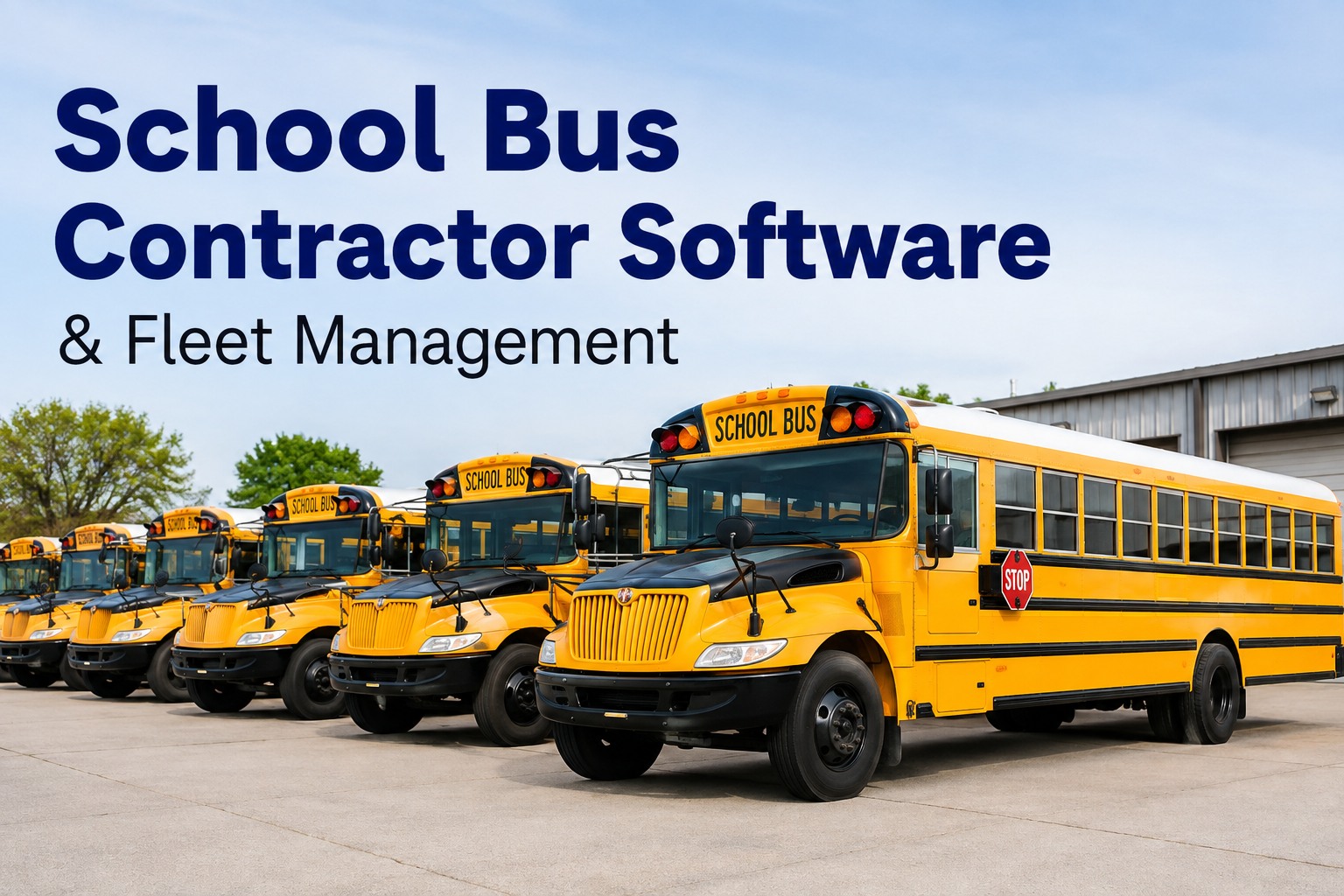
School Bus Contractor Software & Fleet Management
BusCMMS gives multi-yard school bus contractors one platform for inspections, PM, defect closure, camera events, contract-compliance records, cost-per-bus tracking, and the district-facing reports that renewal decisions turn on.
- District 1
- District 2
- District 3
- District 4
- District 5
When Do the FMCSRs Actually Apply to Your Fleet?
There’s a persistent myth that school bus work is “exempt from FMCSA.” The reality is more layered, and getting it wrong is expensive. Under 49 CFR §390.3(f)(1), school bus operations — defined narrowly as home-to-school and school-to-home transport — are generally exempted from most Federal Motor Carrier Safety Regulations. But contractors are for-hire motor carriers, and several categories of work fall outside that exemption.
- ALWAYS APPLIES
Parts 382 & 383
CDL requirements and drug/alcohol testing for every driver of a CMV school bus, regardless of route type or exemption.
- CONDITIONAL
Athletic, Activity & Charter Trips
Work outside the “home-to-school-and-back” definition can trigger the full FMCSRs when the vehicle meets CMV thresholds and the operation is interstate. State rules apply either way.
- MOSTLY EXEMPT
Home-to-School “School Bus Operation”
Under §390.3(f)(1), most FMCSRs (hours of service, driver qualification files, annual inspection) don’t apply — but state pupil-transportation rules and the district contract almost always do.
Applicability is fact-specific — it depends on the vehicle’s GVWR and passenger capacity, whether the operation crosses state lines, and whether the trip is a home-to-school run or something else. This page is fleet-management and software guidance, not legal advice. Verify current federal and state applicability with counsel. Book a demo to see how BusCMMS holds records across all three applicability categories.
Multi-Yard Fleet Visibility, One Corporate Dashboard
A three-yard contractor with five district contracts is essentially running five smaller fleet operations at once — but corporate leadership needs one comparable view. The right software model gives each yard its own operating scope (buses, techs, inventory, defects, work orders), while rolling every yard’s numbers into a corporate view where uptime, defect closure time, and cost-per-bus compare across the whole organization.
- Uptime96.4%
- PM on time94%
- Cost/bus$1.18/mi
- Uptime92.1%
- PM on time78%
- Cost/bus$1.42/mi
- Uptime95.8%
- PM on time91%
- Cost/bus$1.24/mi
This is where corporate visibility pays back. Without a shared platform, Yard B’s PM slippage doesn’t surface at HQ until a district complaint arrives — typically 2-3 months after the trend started. With one platform, operations sees the divergence the same month and can act before it becomes a contract conversation. Book a demo to see the corporate roll-up view live.
One Bus Record, District-Specific Compliance Views
Every district contract asks for slightly different evidence. District 1 wants monthly PM completion and defect closure times. District 3 wants stop-arm camera event summaries and driver-safety metrics. District 5 wants annual safety inspection copies and out-of-service history. The trap most contractors fall into is a separate spreadsheet per district, hoping the numbers agree. They rarely do. Better model: one underlying bus record, filtered into whatever the specific contract requires.
- DISTRICT 2Monthly PM report · Out-of-service log · State inspection copy
- DISTRICT 3Stop-arm event summary · Driver-safety metrics · Incident file
- CORPORATECost-per-mile · Uptime · Renewal evidence package
Same source data, three completely different reports — each formatted the way the specific contract expects. No reconciliation, no risk of the district monthly showing a different number than the corporate KPI deck, no analyst spending Fridays building the same report five times. Book a demo to see contract-specific report generation on a live bus.
A Yard-A Inspection Failure Becomes a Clean District Record
Here’s the workflow the whole platform exists to support. A pre-trip inspection at Yard A catches a brake defect on Bus 22 — a bus that serves District 1’s morning elementary route. The clock is running: District 1’s contract requires immediate defect notification, corrective action inside 24 hours, and route coverage without service interruption.
Bus 22 · Yard A · Brake Defect, AM Pre-Trip
- 01
Detection
Pre-trip DVIR flags spongy brake pedal on Bus 22. Photo captured, defect logged safety-critical against the coach.
- 02
Contract Trigger
Bus 22 assigned to District 1 route 4. System auto-flags the District 1 compliance queue and Yard A supervisor notified.
- 03
Response
Spare Bus 34 pulled from Yard A pool. Route covered without delay. Bus 22 to shop for master cylinder replacement.
- 04
Closure
Work order closed same day. Corrective action documented. Bus 22 back on District 1 route by PM run. Monthly report shows defect caught, resolved, zero service impact.
The district sees a contractor that catches defects before they become incidents. Corporate cost view sees one master cylinder plus shop labor attributed to the right yard and contract. And when District 1’s contract comes up for renewal, the event history exports as evidence without three days of chart-building. Sign up free to run the same defect-to-close workflow on your fleet.
A School Bus Contractor Owner’s View
Contractor economics get punishing fast at scale. Every yard on its own paper system is one where corporate can’t see cost drift until it lands in the P&L. Every district contract in a separate spreadsheet is one where renewal evidence gets reconstructed from scratch. Neither is a labor problem — both are records problems. Book a demo to see the multi-yard corporate view that fixes both.
Contractor Fleet Software Evaluation Checklist
Here’s the rubric a working contractor operations director would build for evaluating fleet software — focused on what matters at the district review meeting and the corporate renewal decision.
Multi-yard scope model
Each yard operates its own buses, techs, inventory, and defects — corporate rolls it all up in one view.
Contract-specific reporting
One bus record produces District-1-shaped and District-3-shaped reports without spreadsheet reconciliation.
Cost tracked to yard & contract
Every work order’s labor and parts assign to the right yard and district for contract-level profitability.
Bus-specific DVIRs pre-loaded
Stop arms, crossing gates, lifts, student mirrors — ready day one, not built by your team.
Camera event integration
Stop-arm, incident, and driver-safety events tied to bus, route, and yard — works with existing MDVR or AI hardware.
Renewal-ready exports
Contract compliance and safety history export as evidence packages before the RFP lands.
Most generic fleet tools score two of six. BusCMMS is built for all six — because contractor operations were designed into the platform. Book a demo to walk the contractor evaluation live.
What is school bus contractor software?
School bus contractor software is the platform pupil-transportation contractors use to manage running buses under district contracts — inspections and PM, defects and work orders, parts and labor cost tracking, camera events, driver and vehicle records, contract-specific compliance reporting, and the corporate roll-up view that compares performance across yards. Unlike generic trucking software, it models school-bus assets (stop arms, crossing gates, lifts, student mirrors), routes, and district-facing reporting that contract renewals depend on.
Are school bus contractors exempt from FMCSA regulations?
Not categorically. Under 49 CFR §390.3(f)(1), “school bus operations” — defined narrowly as home-to-school and school-to-home transport — are generally exempted from most FMCSRs, and contractors performing that work benefit from the exemption. But CDL requirements (Part 383) and drug/alcohol testing (Part 382) always apply to school bus drivers, and non-school-bus operations like athletic trips, charters, and other for-hire work can trigger the full FMCSRs depending on interstate travel and CMV thresholds. State pupil-transportation rules apply regardless. Verify applicability for your operation with counsel.
How does contractor software manage multiple district contracts?
The right model uses a single underlying bus record and filters it into whatever the specific district contract requires. District 1 might want monthly PM completion and defect closure times. District 3 might want stop-arm event summaries and incident logs. The bus record is the same; the report shape changes per contract. That eliminates the reconciliation problem of maintaining separate spreadsheets per district, where numbers rarely agree and renewal evidence gets rebuilt from scratch each cycle.
Can BusCMMS give corporate visibility across multiple yards?
Yes. BusCMMS uses a multi-yard scope model where each yard operates its own buses, techs, inventory, defects, and work orders, while corporate sees a comparable roll-up across every yard. KPIs like uptime, PM completion, defect closure time, and cost-per-bus compare side by side, so a Yard B PM backlog surfaces at HQ in the current month instead of waiting for a district complaint. Cost data ties back to yards and contracts, giving contract-level profitability visibility that spreadsheet-based operations cannot produce.
What should a contractor look for in fleet management software?
Look for pre-loaded bus-specific DVIR templates (stop arms, crossing gates, lifts, student mirrors), a multi-yard scope model with corporate roll-up, contract-specific reporting that generates different district-facing reports from one bus record, cost tracking that assigns labor and parts to the right yard and contract, camera event integration that works with existing MDVR or AI hardware, and renewal-ready exports that package compliance and safety history for RFPs and district audits. Verify current federal, state, and contract-specific requirements for your operation alongside these capabilities.