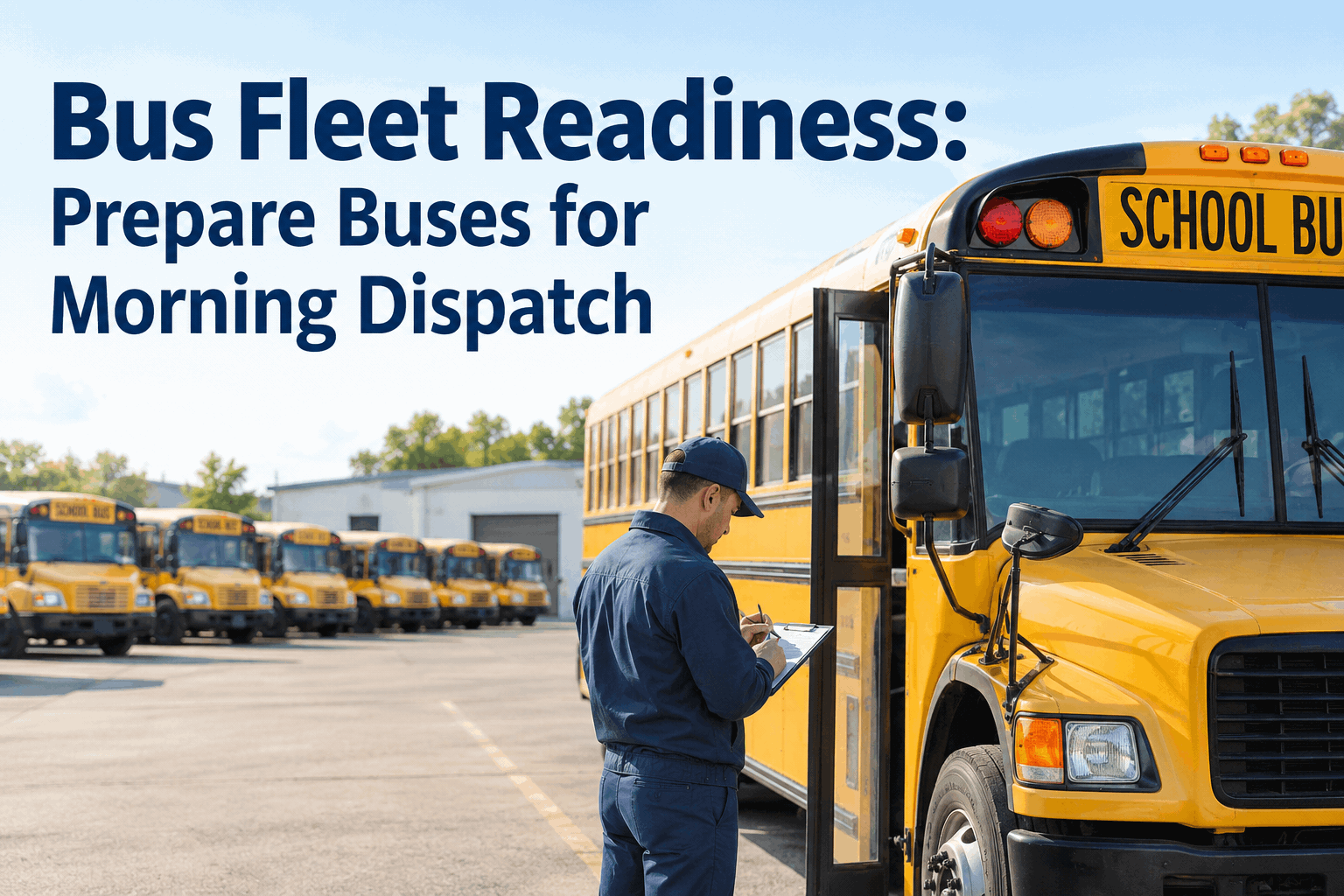
Federal law requires every school bus driver to inspect their vehicle before operating it (49 CFR 392.7) and file a written DVIR at the end of each workday (49 CFR 396.11). During the 2025 CVSA International Roadcheck, 18.1% of vehicles inspected were placed out of service — mostly for brake defects (41% of violations) and tire issues (21.4%) that a proper pre-trip inspection would have caught before the bus left the yard. Only 7% of motor carriers pass a focused compliance review without a single violation. As of March 23, 2026, FMCSA rule FMCSA-2025-0115 explicitly authorizes electronic DVIRs — making digital inspection the officially endorsed standard. Below is the complete daily DVIR inspection checklist for school buses, organized by the 7-point walkaround method. Use it on paper or switch to digital inspection in BusCMMS where every checked item auto-generates work orders for defects and builds audit-ready records your DOT inspector will love.
The Complete 7-Zone Walkaround Checklist
Click each checkbox as you inspect. This checklist covers the 11 FMCSA-required DVIR components plus school-bus-specific safety items that DOT auditors expect to see documented.
Lighting defects are the fastest items to check — and among the most common audit citations. A single burned-out marker light is a citable violation. See how BusCMMS tracks every light check with timestamp and photo—book a demo.
That's 42 inspection points across 7 zones. On paper, this takes 15–30 minutes. With a digital DVIR in BusCMMS, drivers complete it in under 10 minutes — with GPS verification, photo capture and automatic work order generation for any defect. See the digital DVIR in action—book a demo.
Expert Review: Paper vs. Digital DVIR
FMCSA officially authorized electronic DVIRs on March 23, 2026. Here's why the switch eliminates the compliance gaps that cause audit failures.
FMCSA estimates proper DVIRs prevent approximately 14,000 accidents every year. Yet DVIR violations remain among the most frequent audit citations — and only 7% of carriers pass a focused review without a single violation. The gap isn't drivers skipping inspections. It's paper forms that can't prove the inspection happened, can't route defects to the shop, and can't survive an auditor's scrutiny. Digital DVIRs close every one of those gaps.
The 2026 CSA overhaul splits Vehicle Maintenance into two categories — including "Driver Observed" violations. The quality of your daily DVIR now directly impacts your carrier safety score. Protect your CSA score with digital inspections—request a demo.
Frequently Asked Questions
When is a DVIR legally required?
Under 49 CFR 396.11, drivers of passenger-carrying commercial motor vehicles (including school buses) must complete a written DVIR at the end of each day's work. The pre-trip inspection (49 CFR 392.7) is required before each driving shift. Both cover the same 11 FMCSA-mandated components. Reports must be retained for a minimum of 3 months. Automate DVIR retention and compliance—book a demo.
Are electronic DVIRs legal?
Yes. Electronic DVIRs have been permissible under 49 CFR 390.32 since 2018. As of March 23, 2026, FMCSA rule FMCSA-2025-0115 explicitly authorizes eDVIRs, removing any remaining ambiguity. Digital platforms with electronic signatures, GPS verification, and timestamped records are fully compliant.
What are the most common DVIR audit violations?
"Rubber stamping" (checking OK without inspecting), missing repair certifications on defect reports, incomplete reports missing required components, and failure to review the previous driver's DVIR before operating the vehicle (49 CFR 396.13). Digital DVIRs with GPS verification and required photo fields eliminate all four. See how digital DVIRs prevent violations—schedule a demo.
What school-bus-specific items should be on the DVIR?
Beyond the 11 FMCSA components, school buses require: stop arm operation, crossing gate deployment, emergency exit functionality (doors, windows, roof hatches), student warning lights (amber and red), child safety restraint systems, wheelchair lift/ramp operation, and post-trip child check verification. These items aren't on generic DVIR forms. Get school-bus-specific DVIR templates—book a demo.
How long do I need to keep DVIR records?
DVIRs and repair certifications must be retained for 3 months (49 CFR 396.11). Annual inspection reports require 14 months. Roadside inspection reports require 12 months. General maintenance records must be kept for the entire time the vehicle is under your control plus 6 months. Digital systems store records indefinitely with instant retrieval. Never worry about record retention—book a demo.