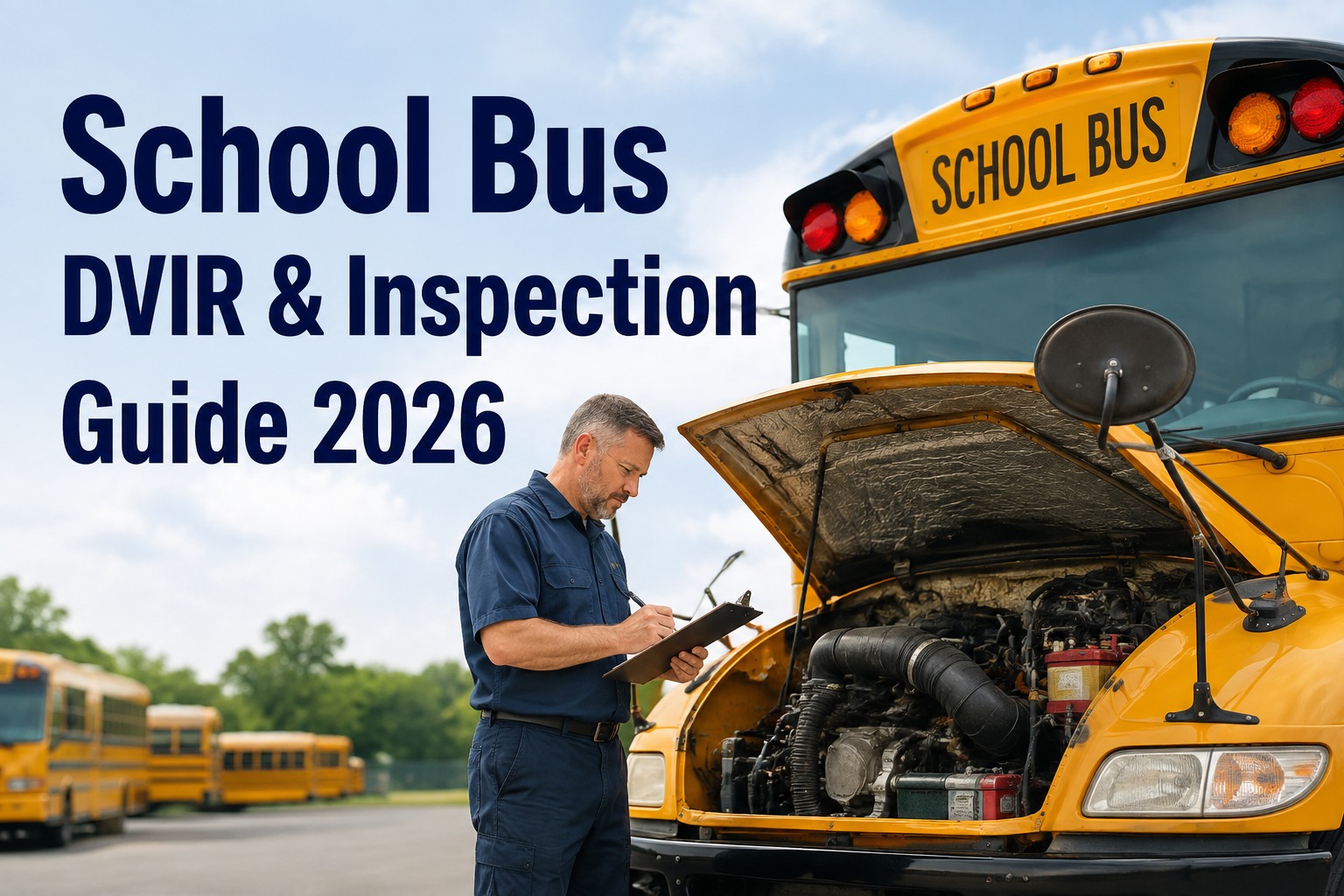
A school bus DVIR, or Driver Vehicle Inspection Report, is the daily record a driver creates documenting the safety condition of the bus and any defects found on a pre-trip or post-trip inspection. For school buses, one question comes before the checklist: which of your trips are federally covered and which are not. Home-to-school routes run by a district are exempt from most Federal Motor Carrier Safety Regulations; field trips, interstate travel and contractor operations often are not, and nearly every state layers its own pupil-transportation rules on top. This 2026 guide sorts out what actually applies to your buses, gives you a pre-trip workflow and a checklist that account for stop arms, crossing gates and the four bus types, and shows how a digital DVIR turns a reported defect into a closed work order instead of a note on a clipboard. If you would rather see the workflow than build it from scratch, book a demo and we will map it to your own district.
School Bus DVIR & Inspection Guide 2026
Pre-trip and post-trip inspections, FMCSA applicability, Type A/B/C/D differences, and the digital DVIR workflow that connects a driver's finding straight to a repair.
- District home-to-school routeLargely FMCSA-exempt
- Field trip crossing state linesFMCSRs often apply
- For-hire contractor routeGenerally covered
- Every bus, most statesAnnual state inspection
What a School Bus DVIR Is, and What It Is Not
In a school transportation shop, four things get called an inspection, and treating them as interchangeable is where confusion starts. A school bus DVIR is the driver's daily safety record, not the same as the routines around it.
DVIR
The driver's daily report of the bus's safety condition and any observed defects, tied to a pre-trip or post-trip inspection. Driver-owned, defect-focused.
Pre-trip checklist
The walk-around the driver performs before pull-out. The DVIR is the record it produces; the checklist is the routine.
Preventive maintenance inspection
A scheduled, technician-led inspection on a mileage or time interval. Deeper than a DVIR, and not the driver's job.
District safety checklist
Your district's own required items, often stricter than any federal floor and specific to pupil transportation.
The driver's role on a DVIR is narrow and important: report what you can observe, not what you cannot. "Stop arm deploys slowly and sometimes stalls halfway" is a good entry. "Stop-arm motor is burning out" is not, because the driver cannot see that, and a guess sends the technician after the wrong part. Observable symptoms in, diagnoses out, and the shop takes it from there. Book a demo to see driver-reported symptoms route straight to a technician.
Do School Buses Require DVIRs? The Honest Answer
This is the question that trips up more school fleets than any other, because the honest answer is "it depends on the trip." Copying a trucking DVIR policy wholesale gets it wrong both ways, over-burdening exempt routes or missing coverage on trips that are federally regulated. Here is how it breaks down.
- LARGELY EXEMPT
District home-to-school routes. Transportation of students between home and school by a state or local government entity is statutorily exempt from most FMCSA safety rules, even across state lines when the district operates it. Under 49 CFR 390.3T(f).
- OFTEN COVERED
Field trips & extracurricular travel, especially interstate. A Friday-night game across a state line does not lean on the daily-route exemption. FMCSRs, including DVIR obligations, often apply.
- GENERALLY COVERED
For-hire contractors. A company operating buses under contract as an interstate carrier is generally subject to the FMCSRs, and must keep the inspection and maintenance records the rules require.
- STATE LAYER
State pupil-transportation rules. Most states require an annual state safety inspection and set their own daily-inspection expectations, which frequently exceed the federal floor regardless of exemption.
Two practical takeaways. First, do not assume "it's a school bus, so it's covered" or "we're a district, so we're exempt"; classify each trip type and verify your own state's requirements, because state pupil-transportation rules are often the standard that actually governs your day. Second, even where a daily DVIR is not federally required, most districts file one anyway, because a consistent record is the only thing that proves the inspection happened when a parent, a board, or a state reviewer asks. Book a demo to see inspection records kept audit-ready for a state review.
The School Bus Pre-Trip Inspection Workflow
A school bus pre-trip covers everything a standard vehicle check requires, plus the warning and student-protection systems that exist on no other vehicle on the road. Walk the bus the same way every day, and group the items so the child-safety systems, the highest-stakes ones, never get skipped in the rush before the first route.
Control & chassis
- Service & parking brakes
- Steering
- Tires & wheels
- Suspension
- Horn
Visibility & lights
- Headlights & tail lights
- Mirrors
- Windshield & wipers
- Destination signs
- Cameras
Child-safety systems
- 8-light warning system
- Stop arm
- Crossing gate
- Service & emergency doors
- Emergency exits
Required equipment
- Fire extinguisher
- Reflective triangles
- First-aid kit
- District-required items
The child-safety group is what makes a school bus pre-trip different from anything a trucking DVIR knows about. A stop arm that stalls, a crossing gate that will not swing, or a warning lamp out on a dark morning is not cosmetic, it is the exact system that protects a child stepping into the road. Those items deserve real attention every day, not a glance. Book a demo to see stop-arm and warning-system checks built into the daily form.
Post-Trip Inspections and Out-of-Service Defects
The post-trip is where the real defects surface, because the bus has just worked a full day of routes and the driver knows what changed. Capture anything different from the morning: a brake that started grabbing, a door that got balky, a warning lamp on mid-route. Those entries drive the next morning's decision about whether the bus rolls, and on a school bus that decision carries a full load of children.
Not every defect is equal, and a school fleet needs a clear, consistent rule for what pulls a bus now versus what waits. A simple three-tier scheme keeps the response proportional and defensible: safety-critical defects go out of service immediately (brakes, steering, a stop arm or warning system that fails, a door that will not secure, a jammed emergency exit); maintenance-required defects get a scheduled work order before they worsen (a slow door, a marginal wiper, a minor leak); and observations get logged and trended. On a school bus, the child-safety systems bias hard toward safety-critical: a stop arm that works four times out of five is not something you schedule for next week; it is the system that stands between a child and traffic, and it comes out of service now. Book a demo to see defects triaged and routed by severity, or sign up free to set the rules yourself.
Type A, B, C and D: What Changes on Inspection
The four school bus types are configuration differences, not four separate federal DVIR rulebooks. The inspection obligation is driven by the operation and the applicable rules, not by whether the bus is a cutaway or a flat-nose. What the type changes is where the driver looks, because the engine placement, entry door and size differ.
Smallest, van-based, left-side driver door. Watch the cutaway chassis integration and the lift on special-needs builds.
Body on a front-section chassis, engine partly behind the windshield, door behind the front wheels. Less common today.
The traditional hood-forward yellow bus, engine ahead of the windshield. The fleet workhorse.
Largest, flat front, engine front, mid or rear. A rear engine changes where you check for leaks and heat.
One generic checklist for every bus in the yard misses the point. A Type D rear-engine and a Type A cutaway do not share a walk-around path, and a form that ignores that trains drivers to check boxes rather than inspect. The stop-arm, crossing-gate and warning items are common to all four; the mechanical emphasis shifts by configuration. Book a demo to see inspection forms tailored by bus configuration.
The Digital DVIR Lifecycle, End to End
A DVIR only protects children if the defect it records actually gets fixed and verified. On paper that chain breaks constantly: the form lands in a binder, the defect never becomes a work order, the repair never gets certified, and the next driver rolls a route on a bus nobody confirmed is safe. A digital lifecycle closes every link, because the system will not advance until each step is done.
- 1
Inspection assigned
The right form for that bus type and district lands on the driver's device.
- 2
Driver inspects & captures defect
Each item confirmed; any defect logged as an observable symptom, with a photo or short video.
- 3
Supervisor review
Severity confirmed and triaged into safety-critical, maintenance-required or observation.
- 4
Work order created
The defect becomes a task with the bus, the symptom and the evidence already attached.
- 5
Technician diagnoses & repairs
The shop turns the symptom into a diagnosis, pulls parts, and does the work.
- 6
Verify & return to service
Repair certified, verified, and the record retained. The next driver sees a closed defect, not an open question.
The whole value is traceability. When a brake, tire, door, stop-arm, crossing-gate, lighting or electrical defect is reported, it should connect directly to the maintenance action instead of sitting on a form, leaving a retained record ready for an audit or incident review. Book a demo to see a defect become a work order in one click.
Worked Example: A Recurring Stop-Arm Fault
The most instructive school bus defect is the child-safety system that fails intermittently, because paper loses it and a child pays for the gap. A stop arm that deploys slowly and sometimes stalls is exactly that fault. Here is the same defect through the lifecycle. Data is illustrative.
- 1
DVIR defect
Driver logs: "Stop arm deploys slowly, stalled halfway twice this morning." Short video attached.
- 2
Severity assessed
Supervisor tags it safety-critical: this is the system that stops traffic for crossing students. Bus held.
- 3
Work order
Auto-generated with the video and the bus's stop-arm history attached for the technician.
- 4
Technician diagnosis
History shows two stop-arm entries in 45 days. Tech finds a failing actuator, not the wiring guessed last time.
- 5
Repair & verify
Actuator replaced, arm cycled repeatedly under test, repair certified. Closure requires the verification step.
- 6
Closed with a trail
The recurring pattern is now on record, so any repeat flags for deeper review, not another quick guess.
The value was in step 4. On paper the separate reports never sat side by side, so each got a quick guess and the real cause hid. Connected history turned a recurring, dangerous intermittent into a root-cause fix. Book a demo to see repeat-defect history surface on the work order.
The School Bus DVIR Checklist Table
This working reference ties each item to what the driver verifies, the observable defect and a severity default. Child-safety rows are marked. Items that vary by bus type, state or district are noted; use it as the backbone of your own form, not a national one-size checklist.
- ItemVerifyObservable defectSeverity
- Service brakesFirm pedal, no pullSoft pedal, grabbing, warningCritical
- SteeringResponsive, no playExcess free play, wanderCritical
- Tires & wheelsTread, inflation, lugsLow tread, damage, loose lugCritical
- Stop armFull deploy & retractSlow, stalls, no deployCritical
- 8-light warning systemAmber then red cycleLamp out, wrong sequenceCritical
- Crossing gateSwings out fullyStuck, slow, will not extendCritical
- Service & emergency doorsOpen, close, secureBalky, no seal, will not latchCritical
- Emergency exitsOpen, alarm worksStuck, alarm silentCritical
- Exterior lightsAll functioningOut, dim, flickeringMaint.
- Mirrors & camerasClean, aligned, liveCracked, loose, no feedMaint.
- Wipers & washerClear sweep, sprayStreaking, no sprayMaint.
- Fire extinguisherCharged, securedDischarged, missing, looseMaint.
Severity defaults are a starting point; your supervisor confirms the real severity at review. But note how many child-safety rows default to critical, that is the point, not an accident. Book a demo to see this checklist as an interactive digital form with evidence capture.
The School Bus DVIR KPIs That Matter
A DVIR program you cannot measure is one you cannot improve. These metrics tell a director whether inspections are happening, whether defects get fixed, and where the fleet is quietly failing. The last is the metric paper can never show, and the one that matters most for child safety.
- Inspection completion rateShare of assigned inspections actually done. Gaps are safety and audit exposure.
- Defect rateDefects per inspection. Sudden shifts flag a bus or a training issue.
- Repeat / recurring defectsThe same fault returning. The clearest sign of a quick fix that missed the cause.
- Overdue defectsOpen defects past their target date. Where risk quietly accumulates.
- Time to repairDefect to closure. Long times mean buses running on known issues.
- Defect-to-work-order ratePercentage of defects that became completed maintenance actions. The whole game.
That last metric exposes a broken program better than any other. A district can post a 98% inspection completion rate and still put unsafe buses on routes if half its reported defects never turn into work orders. Measuring the conversion is what surfaces that gap. Book a demo to see defect-to-work-order conversion on a live dashboard, or sign up free and track it from your first inspection.
Common School Bus DVIR Failures to Avoid
- Copying a trucking DVIR into pupil transportation. A freight form has no stop arm, no crossing gate, no 8-light system.
- Treating every defect as equally urgent. It trains everyone to tune out the report, including the stop-arm entries.
- One checklist for every bus type. A Type D rear-engine and a Type A cutaway do not share a walk-around.
- Ignoring state-specific requirements. The state rule is often the standard that actually governs your day.
- Not capturing evidence. A defect with no photo or video is one the technician has to rediscover.
- Closing defects without verification. "Fixed" without a verified repair puts an unconfirmed bus back on a route full of kids.
- Not connecting findings to work orders. The failure that undoes all the others: the defect never becomes a repair.
Every one is a process or tooling gap, not a driver problem, and the last is the root of most of them. Compare the options: paper loses defects, a spreadsheet is searchable but disconnected from the shop, a standalone app still leaves the defect hopping a gap, and only an integrated workflow keeps inspection, work order, parts and asset history in one place so the defect never leaves the loop. Book a demo to see the inspection-to-work-order link that closes these gaps.
When to Move to an Integrated DVIR Workflow
Paper and disconnected tools work while a fleet is small and one person knows every bus. The switch point arrives with the same signs: mixed bus types needing different forms, defects falling through the handoff, state audit prep that eats a week, and a director who cannot answer "has this stop arm failed before" without digging through binders.
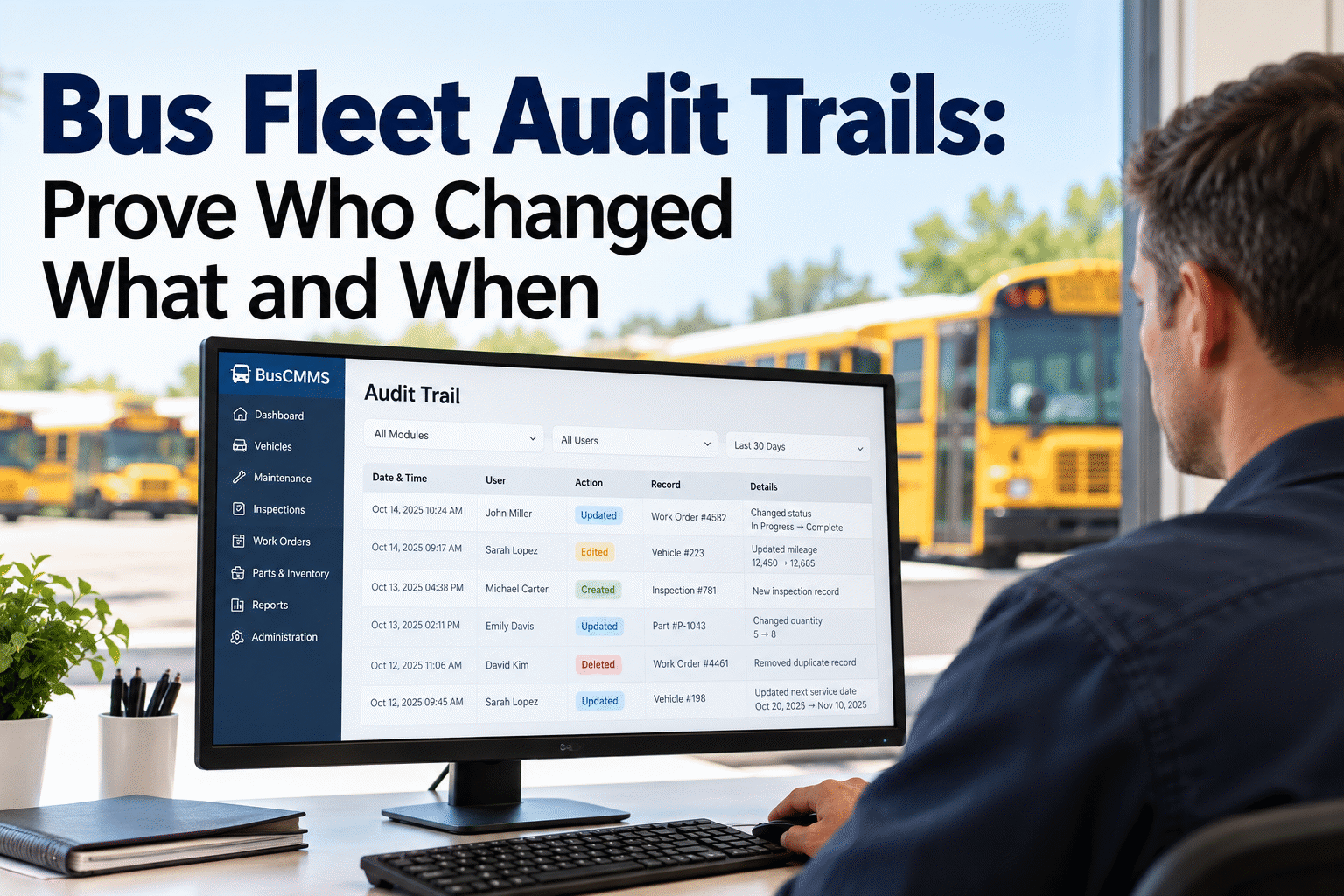
That is where a purpose-built platform earns its place. In BusCMMS, which you can see in a demo, digital school bus inspections and DVIRs, defect tracking, work orders, preventive maintenance, parts, technician records and full asset history live on one bus-specific timeline. A defect becomes a work order without a handoff, the right form loads per bus type and district policy, and every record is one search away for a state review. BusCMMS reports customer results averaging around $2,800 in savings per bus annually alongside 95+% fleet availability, figures published from its own customers rather than independent audit. The distinction that matters: this is built for buses from day one, not a trucking or manufacturing CMMS with a bus label on it.
A school bus DVIR does its job when the daily inspection, the defect, the work order and the verified repair are one continuous chain instead of four disconnected steps. Classify the trip so you know which rules apply, match the form to the bus type and your state's requirements, give the child-safety systems the weight they deserve, capture evidence, and never close a defect without verification. Do that, and the DVIR stops being a form you file and becomes the front end of a program that keeps kids safe on every route. Sign up free and run your next inspection as a connected workflow, or book a demo to see digital school bus DVIRs on your own fleet.
What is a school bus DVIR?
A school bus DVIR, or Driver Vehicle Inspection Report, is the daily record a driver creates documenting the safety condition of the bus and any defects found on a pre-trip or post-trip inspection. It differs from a general vehicle check by covering child-safety systems like the stop arm, crossing gate, 8-light warning system and service and emergency doors, alongside the standard brake, tire, steering and lighting items. Its real purpose is to connect a driver's observed defect to a maintenance action so the issue gets fixed and verified, rather than left on a paper form.
Do school buses require DVIRs?
It depends on the trip, not the vehicle. Home-to-school routes operated by a school district are statutorily exempt from most FMCSA safety rules under 49 CFR 390.3T(f), even across state lines when the district operates them. But field trips and extracurricular travel, especially interstate, and for-hire contractor operations are often subject to the FMCSRs, including DVIR obligations. Separately, most states require an annual state safety inspection and set their own daily-inspection expectations regardless of the federal exemption. Classify each trip type and verify your state's rules rather than assuming one answer covers everything.
Do FMCSA DVIR requirements apply to school buses?
Not universally. Transportation of students between home and school by a state or local government entity is statutorily exempt from most FMCSA safety regulations, including the DVIR rules, even for interstate operation by the district. However, school buses used for field trips, extracurricular activities and sporting events, particularly across state lines, are frequently subject to the FMCSRs, and for-hire contractors operating as interstate carriers are generally covered. Because the exemption turns on who operates the bus and for what trip, districts should classify each operation and confirm both federal applicability and their state's pupil-transportation requirements.
What defects should take a school bus out of service?
Safety-critical defects take a bus out of service immediately: brake or steering problems, a stop arm that fails or stalls, a warning system with a lamp out or wrong sequence, a crossing gate that will not deploy, a service or emergency door that will not secure, and a jammed emergency exit. On a school bus, the child-safety systems bias strongly toward out-of-service, because a stop arm that works most of the time is still the system standing between a child and traffic. Maintenance-required defects get a scheduled work order, and minor observations are logged and trended, but child-safety failures do not wait.
How does digital DVIR software improve school bus fleet maintenance?
It closes the loop between a reported defect and a completed repair. A digital DVIR loads the correct form per bus type and district policy, forces interaction with each item, captures photo or video evidence, and turns a defect into a work order automatically instead of relying on someone to carry a paper form to the shop. It enforces the repair-and-verify steps so a defect cannot be closed unconfirmed, preserves full inspection history so recurring stop-arm or door faults get caught, and keeps records audit-ready for a state review. The key metric it unlocks is the share of reported defects that actually become completed maintenance actions.