Federal regulations (49 CFR 571.208) and state transportation codes mandate specific emergency equipment on every school bus carrying pupils. A single missing fire extinguisher, an inoperable emergency exit alarm, or expired first aid supplies can result in out-of-service orders at roadside inspections and liability exposure during genuine emergencies. This comprehensive checklist covers all federally required emergency equipment, state-specific additions, inspection frequencies, compliance documentation, FAQ answers, and digital enforcement strategies that prevent equipment failures before they become life-safety incidents.
NFPA 1901 Compliant · 49 CFR 571.208
School Bus Emergency Equipment Checklist (Complete Federal & State Requirements)
Every item federally mandated. Every state-specific requirement. Inspection sequence designed for compliance audits. Digital or paper — catch missing equipment before your next safety inspection.
Federal Requirements: 49 CFR 571.208 & NFPA 1901 Standards
The National Highway Traffic Safety Administration (NHTSA) and National Fire Protection Association (NFPA) establish minimum emergency equipment standards for all school buses operating in the United States. These requirements apply to every public and private school bus regardless of fleet size, geographic location, or student enrollment. Federal regulations mandate emergency equipment not as optional safety enhancements, but as non-negotiable life-safety infrastructure that must be present, functional, and accessible before the bus departs the transportation yard for any route.
49 CFR 571.208 specifies the technical requirements for emergency exit systems, including emergency door operation, emergency window operation, emergency roof hatches, and emergency lighting. NFPA 1901 (Standard for Automotive Fire Apparatus) extends federal minimums by requiring enhanced safety equipment on school buses carrying children, including fire extinguisher specifications, first aid kit contents, seat belt systems, and hazard warning equipment. State transportation departments layer additional requirements on top of federal standards — some states mandate child check reminder systems, others require backup cameras, and several states specify emergency contact information placards in multiple languages.
Non-compliance with federal emergency equipment requirements exposes school districts to three simultaneous liabilities: safety-critical exposure (equipment not available during genuine emergencies), regulatory penalties (out-of-service orders at roadside inspections), and tort liability (inadequate equipment during student evacuation scenarios). A single missing fire extinguisher discovered during a state inspection can ground an entire 72-bus fleet until documentation of fleet-wide compliance is provided. Digital compliance tracking eliminates this vulnerability by monitoring equipment status across every vehicle continuously.
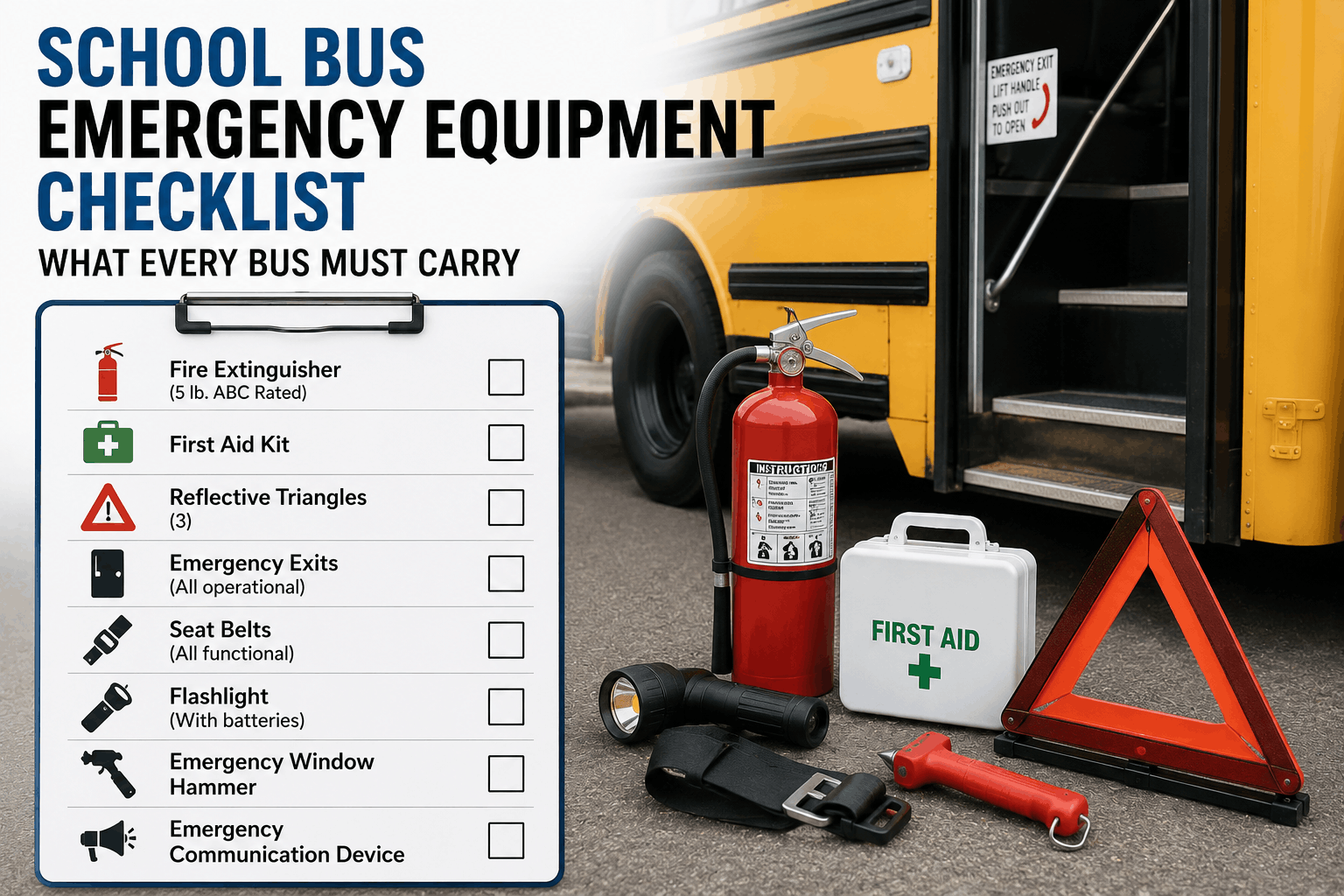
Complete Emergency Equipment Checklist: 18 Categories
This checklist follows the physical inspection sequence: enter the bus → front → driver side → rear → passenger side → return to front. Every item is organized by equipment category with federal requirement references and state-specific variations noted.
Fire Extinguisher (Mounted) — 49 CFR 571.208(e). Minimum 2.2 lb (1kg) powder or gaseous type. Mounted on driver-side wall, accessible within 3 feet of driver. Pressure gauge in green zone. Inspection tag current (within 12 months). No cracks in discharge hose. Secure in mounting bracket — cannot move when bus is in motion.
First Aid Kit (Stocked & Sealed) — NFPA 1901. Minimum contents per ANSI Z535.1: sterile gauze pads, elastic bandages, antiseptic wipes, adhesive bandages (assorted), triangular bandages, latex gloves, eye wash, antibiotic ointment. Kit must be sealed, labeled with content list, and stored in accessible cabinet. Expiration dates checked quarterly. Missing or expired items result in automatic out-of-service status.
Reflective Warning Triangles (3 Units) — 49 CFR 571.208(d). Three identical triangles minimum, 14" × 14" dimension, red reflective material on all sides, folding stands secure. Required for roadside breakdown scenarios. Stored in accessible compartment behind driver seat or on dashboard. Not to be used as driver aids or route markers.
Emergency Exit Door (Rear) — 49 CFR 571.208(a). Door must open outward (push-out operation), clear of obstructions, hinges functioning, locks release with 50 lb force maximum. Audible alarm sounds when opened (85 dB minimum). Exit marking light illuminates with engine running. Emergency exit placard visible and legible. Door must pass annual mechanical test.
Emergency Exit Windows (2 Minimum) — 49 CFR 571.208(b). One on driver side, one on passenger side, mid-bus location. Push-out or sliding operation (vehicle-specific). Marking stickers present and visible ("EMERGENCY EXIT"). Alarm sounds when opened (85 dB minimum). Cannot be obstructed by seat backs, storage, or signage. Tested quarterly for full operation.
Roof Emergency Hatch (If Equipped) — 49 CFR 571.208(c). If bus is equipped with roof hatch, must open freely, release mechanism accessible from inside, audible alarm sounds (85 dB), emergency markings visible. Not all buses require roof hatches — dependent on state specifications and bus model. If present, must be functional and unobstructed.
Emergency Lighting System — NFPA 1901. Minimum 6 emergency lights: 4 on interior ceiling, 2 on exterior (front + rear). Lights illuminate automatically when main power fails. Battery backup system functional (tested monthly). Interior lights provide minimum 10 foot-candles illumination for evacuation visibility.
Seating and Seat Belt Systems — 49 CFR 571.208. Seats must be securely mounted to bus frame (no loose connections). Seat backs must support 1,500 lbs forward force without failing. Seat belt systems (if equipped) must buckle securely, latch without slipping, and retract properly. Child booster seats (if used) must be properly installed per manufacturer specifications and federal LATCH standards.
Emergency Communication System — NFPA 1901. Two-way radio operational and tested daily. Emergency contact numbers posted on driver-side dashboard (state police, local dispatch, school district emergency coordinator). Cell phone charger in vehicle. Emergency information card with GPS coordinates of common routes in driver's possession.
First Aid Training Certification — State DOT requirement. At least one crew member (driver + aide) must hold current First Aid/CPR certification. Certification card on file in transportation office. Recertification completed before expiration. Drivers without current certification cannot operate bus carrying students.
Body Fluid Cleanup Kit (School Buses Only) — State health code requirement. Sealed kit containing absorbent materials, biohazard bags, gloves, disinfectant, and disposal instructions. Must be accessible to driver and aide. Used for illness incidents during transport. Kit replaced after every use. Expiration dates checked quarterly.
Stop Arm Safety Inspection (School Buses) — NFPA 1901. Mechanical stop arm must extend fully from driver side and retract fully when not deployed. Stop lights (red) function when arm is extended. No damaged or missing bolts. Arm operates smoothly without hesitation. Tested daily before first route.
Crossing Gate System (If Equipped) — NFPA 1901. If bus is equipped with front crossing gate, must extend fully and retract fully when activated. Gate lights illuminate when extended. No obstructions preventing full deployment. Gate operates within 5 seconds of driver activation. Tested daily before first route.
Child Check Reminder System (School Buses) — Federal and state mandate. Automatic or driver-activated system that reminds driver to check entire bus before departure. System must activate audible alarm if driver attempts to exit cab without checking rear seating area. Mandatory on all school buses manufactured after 2015.
Emergency Contact Information Placard — State requirement. Placard posted in driver-side window showing: school district name, emergency phone number, bus number, route number, and emergency contact procedures. Must be visible from outside vehicle. Updated annually. Provided in English and Spanish (California, Texas, New York requirements).
Interior/Exterior Condition (Safety-Critical) — NFPA 1901. Interior clean and free of debris that could impede evacuation. No sharp objects, loose wiring, or chemical spills. Exterior free of dents that expose metal (corrosion risk). Windows clear and unobstructed. Aisles minimum 7.5 inches wide (accessibility standard). Equipment mounting secure — nothing can fall during emergency braking.
Backup Camera System (State-Specific) — Emerging requirement in California, New York, and Texas (effective 2024-2025). If equipped, must display clear rear view on driver-side monitor. Camera lens clean and free of obstructions. System tested before each route. Audible warning sounds when in reverse (even if camera operational).
Annual Safety Inspection Certification — 49 CFR 396.17. School bus must pass annual state safety inspection covering all emergency equipment items on this checklist. Inspection certificate posted on driver-side window or inside cab. Certificate valid for 12 months. Out-of-service status if inspection expired or failed items not corrected.
Compliance Impact: Paper vs. Digital Equipment Tracking
Equipment Defects Found: Paper Checklists vs. Digital Inspections
Out-of-Service Orders at Roadside Inspections (per 150-Bus Fleet Annually)
Equipment Compliance Maintenance Rate (% of Fleet At 100% Compliance)
61%
Manual Tracking
97%
Digital System
Time to Resolve Equipment Defects (Business Days)
Customer Success: Emergency Equipment Compliance
Our school district was cited for missing fire extinguishers on 7 buses during a state inspection — buses that had passed our internal checks. We discovered the problem was spot-checking; nobody was systematically verifying all 18 equipment items on every bus before every route. We implemented BusCMMS digital checklists with photo requirements. In the first 90 days, we found 34 equipment defects that had been invisible to paper checklists: expired first aid kits, inoperable emergency exits, missing spare reflective triangles. Now every bus starts every route at 100% equipment compliance. Our next state inspection: zero findings. Zero downtime. Zero liability exposure.
— Director of Transportation, 85-bus school district, Ohio
State-Specific Equipment Requirements Summary
While federal standards (49 CFR 571.208 and NFPA 1901) establish baseline requirements applicable to all U.S. school buses, state transportation departments layer additional mandates. California requires backup cameras on all buses manufactured after 2024. Texas mandates audible alarms on all emergency exits and windows, plus backup cameras on routes through urban areas. New York requires multilingual emergency contact placards (English and Spanish). Florida requires air-cooled emergency lighting backup systems. Ohio requires biohazard cleanup kits stocked with specific hospital-grade disinfectants. Pennsylvania requires child check reminder systems activated daily. These state variations mean a 72-bus fleet operating routes across three states may require 54-72 unique equipment configurations — impossible to track manually, trivial with digital compliance systems that auto-adjust requirements by vehicle location and route assignment.
Frequently Asked Questions: School Bus Emergency Equipment
What is the minimum fire extinguisher requirement on a school bus?
49 CFR 571.208(e) mandates minimum 2.2 lb (1 kg) dry powder or gaseous extinguisher mounted on driver-side wall within 3 feet of driver seat. Pressure gauge must be in green zone, inspection tag current within 12 months, and discharge hose free of cracks or leaks.
How often must emergency exit systems be tested for compliance?
Federal standards require daily operational testing before the first route departs. Emergency doors must open with maximum 50 lbs force, emergency windows must slide or push freely, and audible alarms must sound at minimum 85 dB when activated. Annual certified inspection required per 49 CFR 396.17.
Are digital emergency equipment checklists legally compliant for state inspections?
Yes. Digital inspection records with photo documentation and timestamps satisfy 49 CFR 396.11 and NFPA 1901 requirements. Many state transportation departments prefer digital records because they provide objective evidence of compliance with automatic audit trails. BusCMMS digital checklists are used by 180+ U.S. school districts for state inspection compliance.
What happens if a school bus fails inspection due to missing or inoperable emergency equipment?
The bus is placed out-of-service immediately and cannot carry students until defects are corrected and re-certified by state inspector. In emergency situations, school districts may face liability exposure if students are injured due to inoperable emergency equipment. Digital compliance tracking prevents this by flagging defects within hours of discovery.
Do all emergency equipment items need photo documentation?
Best practice requires photos of any item marked as defective or requiring corrective action. BusCMMS allows optional photo capture for all items and requires photos when defects are logged. Emergency exit door testing, fire extinguisher pressure gauge readings, and first aid kit seals often require visual confirmation for audit compliance.
How do school districts manage equipment requirements across multiple states?
BusCMMS automatically adjusts equipment requirements based on vehicle location and state assignment. A bus routed in California automatically loads backup camera requirements. A bus in Pennsylvania loads child-check reminder system requirements. One platform manages all state variations without manual intervention.
What training is required for drivers to comply with emergency equipment regulations?
Drivers must complete annual safety training covering emergency exit procedures, equipment operation, evacuation protocols, and emergency communication procedures per state DOT requirements. At least one crew member must hold current First Aid/CPR certification. Digital checklists can track training completion and certification status automatically.
Can school buses operate during winter months with emergency exit systems covered in ice or snow?
No. Emergency exits must remain accessible and operational at all times regardless of weather. Drivers must clear ice and snow from emergency exit doors and windows before operating the bus. BusCMMS checklists include seasonal weather-specific items for winter/summer compliance variations.
18 Equipment Categories. Federal Compliance. Zero Violations.
Every Route Starts Safe.
This exact emergency equipment checklist — guided on mobile, photo-verified, automatically compliance-checked against your state requirements. Out-of-service defects caught before they ground your fleet. Audit-ready documentation from day one. Free 14-day trial.