Your district just got 3 CMMS demos. All three showed work orders. All three showed dashboards. All three said "DOT compliant." But when you asked "does it have wheelchair lift inspection templates?" — two went quiet. When you asked "can it track fuel type per bus for mixed diesel/propane fleets?" — one said "we can custom ize that for you." Translation: it doesn't exist yet and you'll be the beta tester. The features that actually matter for school bus fleets aren't the ones vendors demo first. They're the ones you discover are missing after you've already signed the contract.
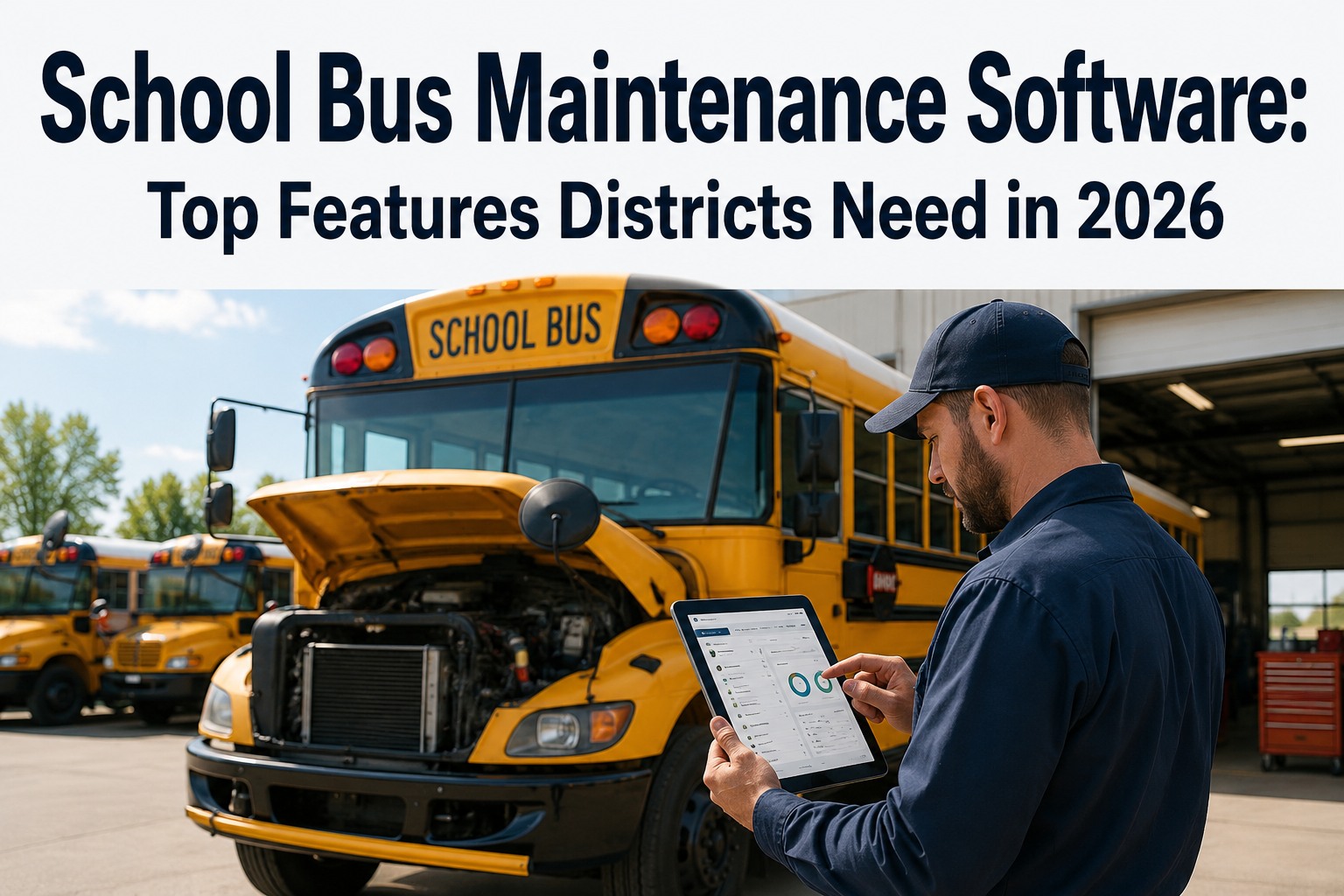
School Bus Maintenance Software: Top Features Districts Need in 2026
12 features every school district should require — scored by what they cost you when missing. Stop evaluating vendors on demos. Start evaluating them on this checklist.
Feature Scorecard: Does Your Software Have It?
Digital DVIRs with photo capture
Multi-trigger PM scheduling
Wheelchair lift tracking
Per-bus cost tracking
+ 8 more features below
Tier 1: Non-Negotiables — Walk Away If These Are Missing
These four features are the difference between a real bus CMMS and generic fleet software wearing a school bus costume. If your vendor doesn't have them built-in — not "customizable" — you'll spend the first 6 months building what should have been included.
Digital DVIRs with Photo Capture
Without it: $2,000+ per DOT audit violation
Drivers complete pre-trip and post-trip inspections on their phone. Every item has a pass/fail gate — they can't skip it. Photos document defects with timestamps. Failed items auto-generate work orders for your mechanic. FMCSA 2026 eDVIR compliant. Paper DVIRs are a compliance liability — missing forms, illegible handwriting, no proof the inspection happened.
BusCMMS: Pre-loaded school bus DVIR templates — stop arms, crossing gates, emergency exits, student mirrors, wheelchair lifts. Your driver opens the app and starts tapping. No setup required.
Multi-Trigger PM Scheduling
Without it: 12–18% budget waste on over-maintenance
Mileage + calendar + engine hours trigger PM work orders — whichever threshold the bus hits first. A bus that sits all summer doesn't get unnecessary oil changes. A bus running hard gets serviced when mileage demands it. Rigid 90-day schedules waste $28K–$48K/year on a 50-bus fleet.
BusCMMS: Multi-trigger is the default PM setting. Separate schedules for diesel, propane, and electric buses run simultaneously on one dashboard. Work orders auto-generate with parts lists and time estimates.
DOT Compliance Automation
Without it: 2-day audit scramble, $7,155 avg fine
Annual inspections auto-scheduled. DVIRs retained 90+ days. Maintenance records kept 14+ months. Driver qualification files tracked with expiration alerts. One-click audit-ready reports. The 2026 eDVIR rule and CSA scoring overhaul make manual compliance tracking a losing game.
BusCMMS: Compliance calendar auto-schedules every required inspection. 30/60/90-day driver cert alerts. Complete audit report generates in under 30 seconds. Zero paper, zero scramble.
School Bus-Specific Inspection Templates
Without it: 2–4 weeks of manual template creation
Stop arms, crossing gates, 8-light flasher systems, emergency exits, student mirrors, wheelchair lifts, child check systems — these don't exist in generic fleet CMMS. If your vendor says "we can build that for you," you're paying for development time and being the beta tester.
BusCMMS: Every school bus inspection template is pre-loaded on day one. Type A, B, C, D buses. Regular and special needs. ADA-equipped. Zero configuration needed to match school bus workflows.
Tier 2: High-Impact — These Separate Good From Great
Per-Bus Cost Tracking
Parts, labor, fuel, vendor costs — per bus, per month. Know which buses are bleeding money. Make repair-vs-replace decisions with data, not politics.
BusCMMS: Lifetime cost per bus with cost-per-mile trending. Automatic replacement alerts when a bus crosses the threshold.
GPS/Telematics Integration
Odometer auto-syncs PM triggers. Fault codes auto-create work orders. Idle time feeds fuel reports. No manual entry. No missed PM cycles.
BusCMMS: Native Samsara + Geotab connectors. Zero custom development. Plug and play.
Work Order Management
Create, assign, prioritize, track. Parts and labor documented per job. Safety-critical items always first in queue. Defects from DVIRs flow straight to work orders.
BusCMMS: Priority-ranked queues. Photo attachments. Vendor work order tracking. Complete per-bus repair history.
Wheelchair Lift & ADA Tracking
Separate inspection schedules for lifts, ramps, and securement systems. Most generic CMMS doesn't even have a field for this. One missed lift inspection = ADA violation + lawsuit risk.
BusCMMS: Pre-loaded ADA equipment templates. 30-day cycle/operational checks auto-scheduled. Compliance history per lift.
See per-bus cost tracking and wheelchair lift templates — book a demo
Tier 3: Force Multipliers — The Features That 10× Your ROI
Fuel Type-Specific PM
Diesel, propane, CNG, and electric buses have different service intervals, different fluids, and different components. One PM schedule doesn't fit all fuel types.
Parts Inventory Alerts
Low-stock alerts before your mechanic discovers an empty shelf. PM work orders show parts needed so staging happens the night before.
Mobile-First Mechanic App
Work orders, time logging, parts usage, and photo documentation from a phone in the bay. No walking back to a desktop computer between every job.
Fleet Analytics Dashboard
PM compliance rates, cost-per-mile trends, fleet availability, breakdown frequency — the numbers you need for budget justification and board presentations.
Every one of these 12 features is included in BusCMMS — not as add-ons, not as premium tiers, not as "coming soon." Pre-loaded templates, multi-trigger scheduling, DOT automation, wheelchair lift tracking, fuel-type PM, GPS integration, per-bus cost analytics — all included from the free trial forward. That's the difference between software built for school buses and software adapted from trucking.
Stop Asking "Can It Do This?" Start Using Software That Already Does.
12 features. All included. Pre-loaded school bus templates, multi-trigger PM, DOT compliance, wheelchair lift tracking, per-bus cost analytics, GPS integration. Purpose-built for school districts.
"We demoed Fleetio, Samsara, and BusCMMS. Fleetio had great work orders but no school bus templates — our team spent the first demo asking 'where are the emergency exit checks?' Samsara had incredible GPS but maintenance felt like an afterthought. BusCMMS had everything pre-loaded on day one — stop arms, crossing gates, wheelchair lifts, fuel-type PM schedules. We were running real inspections within an hour of signing up."
Every month on spreadsheets or generic fleet software is a month of missed PMs, compliance gaps, and per-bus costs you can't see. The 2026 eDVIR rule takes effect March 23. The CSA scoring overhaul splits vehicle maintenance into two categories. Paper isn't going to cut it anymore.
Get ahead of the 2026 compliance changes — book a demo this week
The biggest mistake districts make when evaluating maintenance software is judging by the demo instead of the feature checklist. Every vendor demos work orders and dashboards — those are table stakes. The features that actually determine whether the software works for your school bus fleet are the ones you won't see unless you ask: wheelchair lift inspection templates, fuel-type-specific PM schedules, school bus DVIR items like crossing gates and 8-light systems, and per-bus cost tracking that feeds repair-vs-replace decisions.
Generic fleet CMMS platforms require 2–4 weeks of setup because they don't include any of these. Bus-specific platforms like BusCMMS include all of them out of the box. The total cost difference — including the setup time, the customization hours, and the delayed compliance — typically makes the "cheaper" generic option $5,000–$15,000 more expensive in year one. Always evaluate on the checklist, not the demo.
In 2026, school bus maintenance software needs 12 specific features to handle DOT compliance, mixed fuel fleets, ADA equipment, understaffed shops, and board-level reporting. Four are non-negotiable — digital DVIRs, multi-trigger PM, DOT automation, and bus-specific templates. Four separate good from great — per-bus cost tracking, GPS integration, work orders, and wheelchair lift tracking. Four multiply your ROI — fuel-type PM, parts alerts, mobile app, and analytics.
BusCMMS includes all 12. Pre-loaded. No setup. No add-ons. No "we can customize that." Purpose-built for the way school bus fleets actually operate. Try it free and run a real inspection on your first bus in under 10 minutes.
12 Features. All Included. Built for School Buses.
Digital DVIRs, multi-trigger PM, DOT automation, wheelchair lift tracking, per-bus cost analytics, GPS integration — every feature a school district needs. Zero setup. Free trial.
What's the difference between generic fleet CMMS and bus-specific software?
Generic fleet CMMS (Fleetio, UpKeep, Fiix) handles work orders and PM scheduling for any vehicle type — trucks, cars, construction equipment. Bus-specific CMMS adds pre-loaded school bus DVIR templates (stop arms, crossing gates, emergency exits), wheelchair lift inspection schedules, fuel-type-specific PM, DOT compliance automation, and district-friendly pricing. Generic platforms require 2–4 weeks of custom setup to approximate these features. Bus-specific platforms include them out of the box.
How much does school bus maintenance software cost?
BusCMMS starts at $30/bus/month with no fleet minimums. A 50-bus district: $18,000/year. No per-user charges, no implementation fees, no hardware required. The typical ROI is 4–8 months — the first prevented breakdown ($1,700) and first avoided compliance fine ($2,000+) usually cover the first quarter of software cost. Free trial lets you validate before committing budget.
Does school bus software handle electric and propane buses?
BusCMMS supports diesel, propane, CNG, and electric buses with fuel-type-specific PM schedules running simultaneously. Electric bus PM differs significantly from diesel — no oil changes, no exhaust system, but battery health monitoring, HV connector inspections, and coolant system checks for thermal management. Each fuel type gets its own PM template and intervals. Most generic CMMS platforms treat all vehicles the same.
What compliance changes are coming in 2026?
Three major changes: the FMCSA eDVIR rule (effective March 23, 2026) requires electronic inspection records with specific data fields. The CSA scoring overhaul splits the Vehicle Maintenance BASIC into two categories, making maintenance-specific violations more visible. And the medical certification mandate (effective January 10, 2026) requires certified medical examiners for CDL driver physicals. BusCMMS is already compliant with all three.
How quickly can our district get started?
Most districts are fully operational within 1 week. Day 1: add buses (VIN, mileage, fuel type). Day 2: PM schedules auto-configured. Day 3: driver profiles and cert dates loaded. Day 4: drivers run first digital DVIR. Everything is pre-loaded — no template building, no custom configuration, no IT department required. Your first real inspection runs in under 10 minutes from signup.







