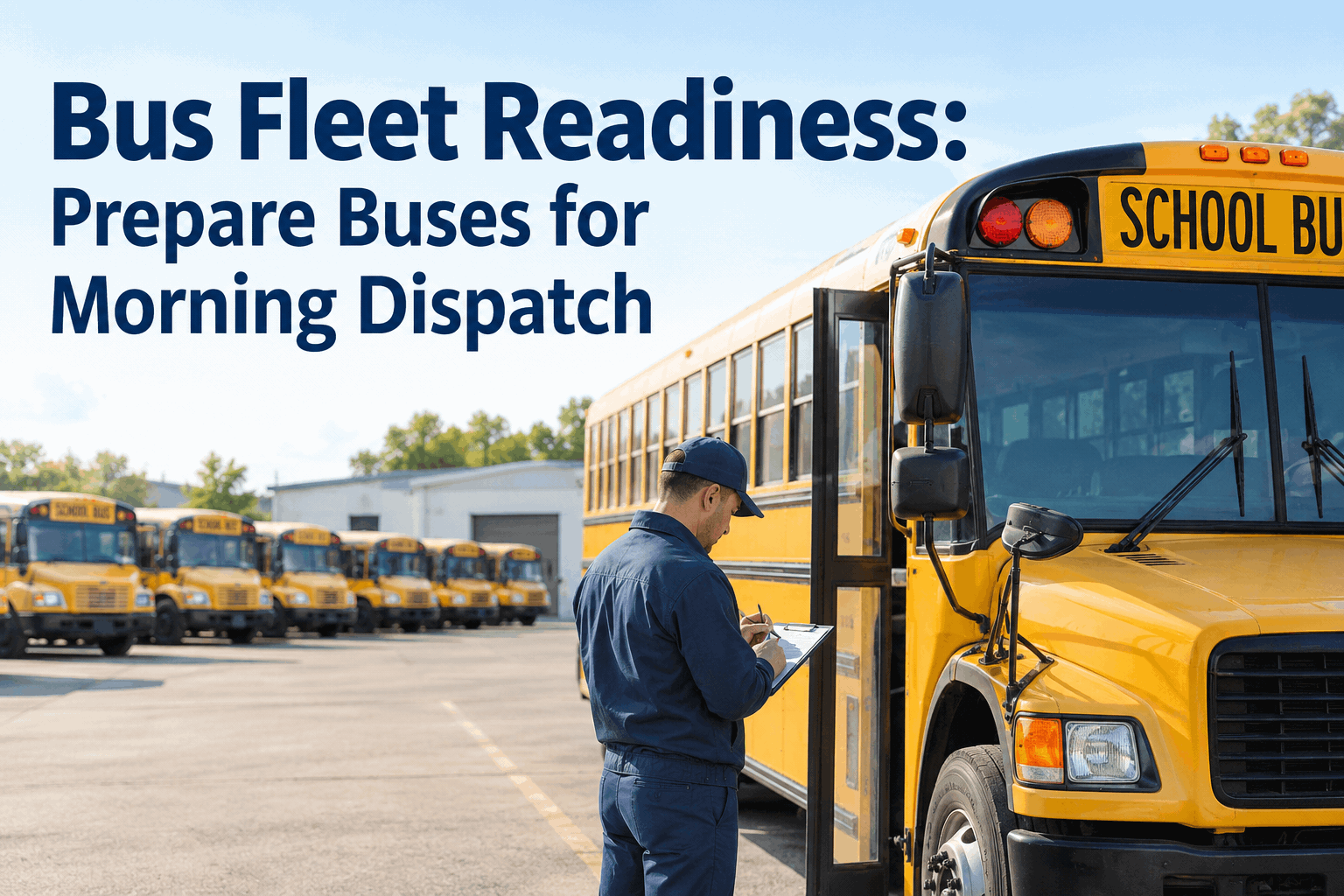
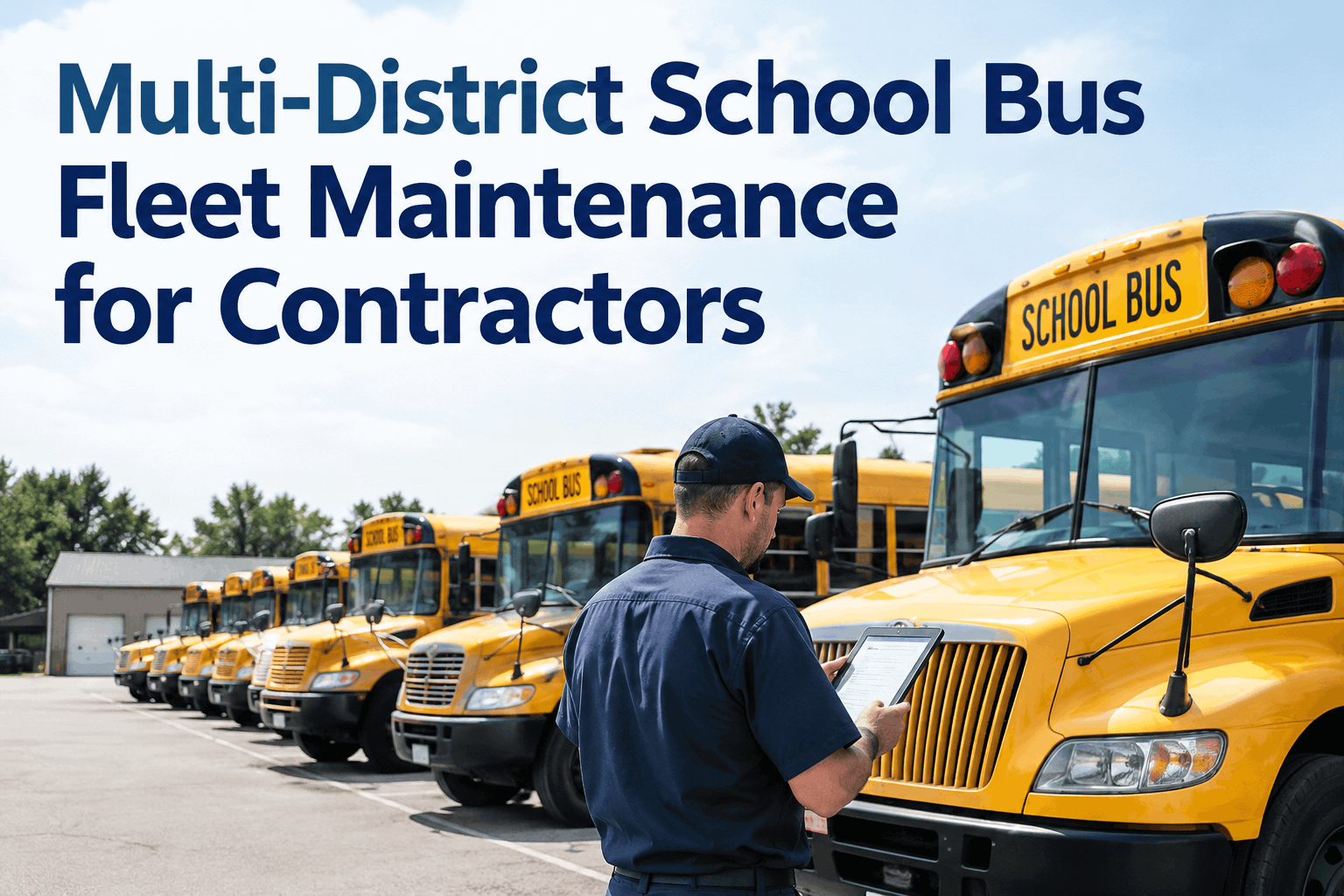
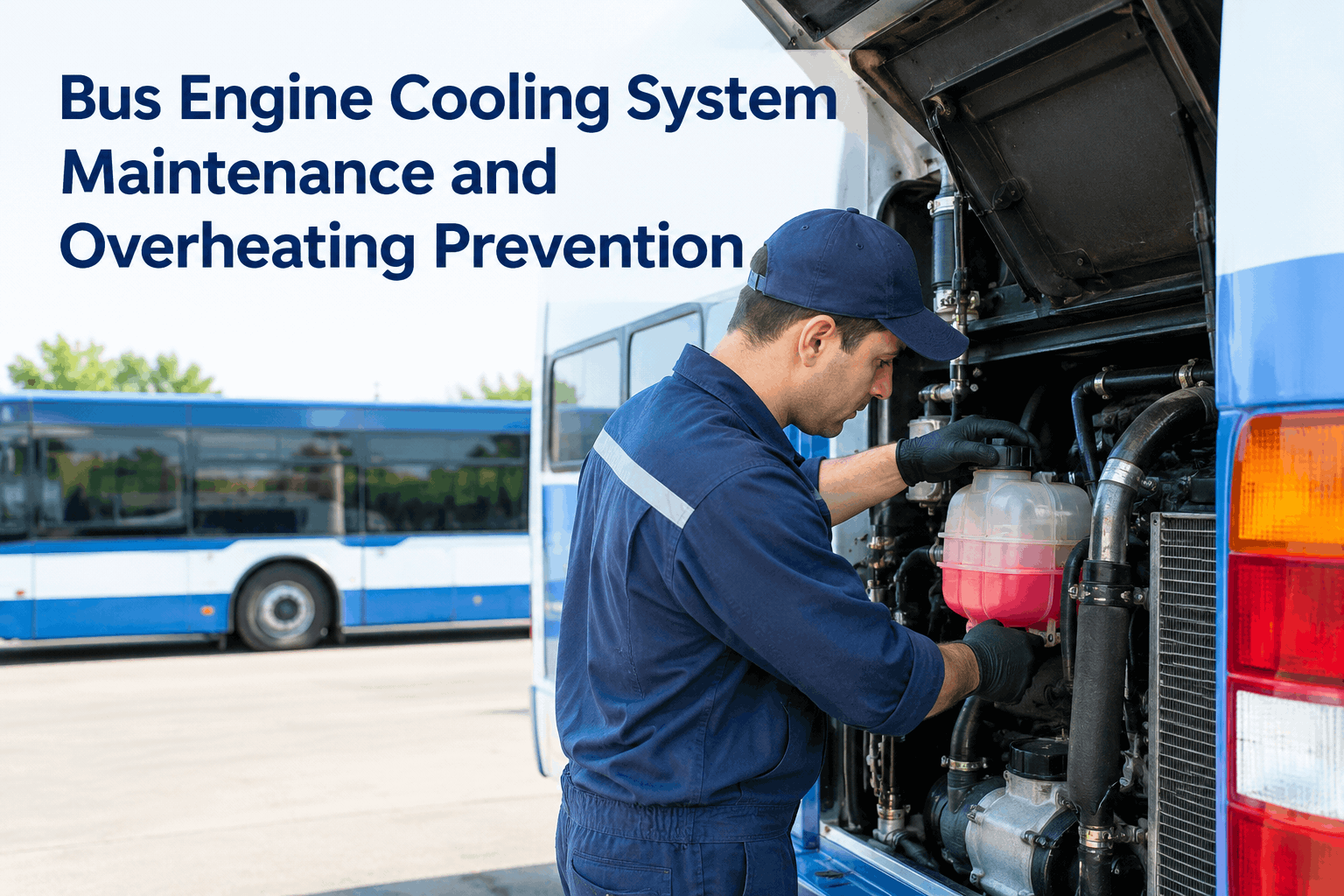
Every morning before a single student boards your bus, federal law requires a certified pre-trip inspection. It's not a suggestion — FMCSR Section 396.13 mandates that every CDL driver complete and sign a Driver Vehicle Inspection Report before operating any school bus. Miss a stop arm failure, low air pressure, or cracked mirror — and you're either pulling a bus mid-route or facing a DOT out-of-service order that grounds your entire fleet. This free 2026 checklist covers all 62 inspection points in the exact DOT walk-around sequence, used by 500+ school districts across the US.
School Bus Pre-Trip Inspection Checklist 2026 — Free Printable Template
All 62 DOT-required inspection points, organized in the clockwise walk-around sequence inspectors use — printable and digital versions included
62 Inspection Points
DOT & FMCSA Compliant
500+ Districts Using This
Why Pre-Trip Inspections Matter More Than Most Drivers Realize
A pre-trip inspection is the most important safety act a school bus driver performs every single day. The consequences of skipping or rushing through it go far beyond a fine — they affect the 26 million students who board school buses across America every morning.
#1
Cause of DOT out-of-service orders: brake defects caught during inspection
3 mo
Federal DVIR retention period required under FMCSR 396.13
90 days
Emergency exit re-inspection frequency under 49 CFR 396.3
15–20 min
Time required for a thorough, complete pre-trip inspection
The 7-Zone Walk-Around Sequence (DOT Order)
Follow this exact sequence every time. DOT inspectors score on consistency and completeness — not just whether items pass. A clockwise walk-around starting from the driver's door is the industry standard. Allow 15–20 minutes minimum.
~2 min
Vehicle Overview — Approach & General Condition
Before touching the bus, stand back and scan for obvious body damage, vehicle leaning (indicating flat tires or broken suspension), fluid puddles beneath, and confirm the bus number matches your assignment. Look for anything out of place.
~4 min
Engine Compartment
Check oil, coolant, power steering fluid, washer fluid, and transmission fluid levels. Inspect belts and hoses for cracks or fraying. Check battery connections and look for any fluid leaks on the engine block. Close hood fully before proceeding.
~3 min
Driver-Side Exterior Walk
Inspect left front tire (tread, sidewall, inflation), left front wheel and lug nuts, left mirror condition and mounting, left side body panels for structural damage, and left rear wheels and tires. Check the fuel cap is secure.
~3 min
Rear of Vehicle & Emergency Exit
Check the rear emergency exit — must open freely from inside and outside. Inspect rear marker lights, brake lights, turn signals, and license plate. Check rear tires and undercarriage for leaks. Verify the rear bumper is secure with no sharp edges.
~3 min
Passenger-Side Exterior + Stop Arm & Crossing Gate
Inspect right rear and front tires, right-side mirrors, body panels, and wheel lug nuts. Test the stop arm — must deploy fully with all red lamps lit and retract properly. Test the crossing control arm — extends fully, retracts securely. Check student loading lights (amber/red flashers).
~3 min
Interior & Emergency Equipment
Check all passenger seats for secure mounting. Verify fire extinguisher is fully charged and accessible. Confirm the first aid kit and body fluid cleanup kit are present and sealed. Test push-out windows operate correctly. Inspect the student rear-view mirror for full cabin view.
~3 min
In-Cab Systems & Air Brake Test
Start engine. Build air pressure to governor cutoff (120–140 psi). Turn engine off, apply service brake — pressure drop must not exceed 3 psi per minute. Verify low-air warning activates before 60 psi. Test spring brake activation at 20–45 psi. Check horn, wipers, defroster, heater, and all dashboard warning lights.
Full 2026 Pre-Trip Inspection Checklist — All 6 Zones
Items with ⚠️ Critical are the most common causes of DOT out-of-service orders. These must pass before the bus moves — no exceptions.
Engine oil level — within safe operating range on dipstick
Coolant/antifreeze — at fill line, no leaks on block
Power steering fluid — at operating level
Windshield washer fluid — filled
Transmission fluid (auto) — at operating level
⚠️ Belts — no cracks, fraying, or excessive wear; proper tension
Hoses — no cracks, soft spots, or leaking connections
Battery — secure mounting, clean terminals, no corrosion
⚠️ No fluid leaks (oil, coolant, fuel) under or around vehicle
Exhaust — no leaks forward of rear exit point
Headlights — high and low beam functional, clean lenses
⚠️ Brake lights — all positions operational
Turn signals — front and rear, both sides functional
Hazard lights — all 4 corners flashing properly
Marker/clearance lights — side and roof markers lit
⚠️ Stop arm lights — all red lamps functional when deployed
Student loading lights (amber/red flashers) — front and rear
License plate light — illuminated; plate visible and current
Windshield — no cracks in wiper sweep area; clear visibility
Body panels — no damage affecting structural integrity
Mirrors — all properly mounted, clean, and adjusted
Bumpers — secure, no sharp or protruding edges
⚠️ Steer axle tread depth — minimum 4/32" (49 CFR 393.75)
⚠️ All other tires — minimum 2/32" tread depth
No exposed belt or ply material on any tire
No flat or audibly leaking tires
Sidewalls — no bulges, cuts, or weathering cracks
⚠️ No recapped tires on steer axle — federally prohibited on front wheels
⚠️ Wheel fasteners (lug nuts) — all present, tight, no rust streaks
Rims — no cracks, welds, or visible damage
⚠️ Air pressure buildup — reaches 120–140 psi at governor cutoff
⚠️ Pressure drop test — less than 3 psi/min with engine off and brakes applied
⚠️ Low-air warning — activates before 60 psi
⚠️ Spring brake activation — engages at 20–45 psi
Parking brake — holds vehicle stationary on grade
Brake hoses and lines — no leaks, cracks, or chafing
Brake lining thickness — above minimum wear indicator
⚠️ Steering wheel free play — max 2" for power steering systems
Steering column — securely mounted, no excessive play
Tie rods and drag links — no excessive wear or movement
⚠️ Stop arm — deploys fully, all red lamps lit, retracts properly
⚠️ Crossing control arm — extends fully, retracts securely, no damage
⚠️ Rear emergency exit — opens freely inside and outside; door alarm sounds
Emergency door marking lights — functional
Push-out windows — operate correctly, latches secure
⚠️ Fire extinguisher — fully charged, properly mounted, accessible to driver
First aid kit — stocked and accessible
Body fluid cleanup kit — present and sealed
Student rear-view mirror — properly mounted, full view of passenger area
Passenger seats — all securely mounted, no broken frames
Fuses and reflectors — complete set in proper container
Interior lighting — all overhead and stepwell lights functional
All dashboard warning lights — clear at normal operating temperature
Horn — operational
Windshield wipers — both speeds functional, blades in good condition
Defroster — clears windshield efficiently
Heater and air conditioning — operational per season
Driver seat belt — latches and retracts properly
Seat adjustment — driver seat moves and locks into position
⚠️ CDL & medical certificate — valid, on driver's person
⚠️ Registration & insurance — current, in vehicle at all times
⚠️ Previous DVIR reviewed — defects certified repaired or none noted
Stop Using Paper DVIRs — Run Your First Digital Inspection Free
BusCMMS ships with all 6 inspection zones pre-loaded as school bus DVIR templates — stop arms, crossing gates, emergency exits, student mirrors — ready on day one. No custom setup required.
Key DOT Regulations Every Driver & Fleet Manager Must Know
These federal regulations govern school bus inspection requirements. State-level DOT rules may be stricter — always verify your state supplement for additional requirements such as annual inspection schedules and pre-trip form formats.
| Regulation | What It Requires | Frequency | Record Retention |
|---|---|---|---|
| FMCSR 396.13 | Driver pre- and post-trip DVIR — certify vehicle condition every day of operation | Daily | 3 months |
| 49 CFR 396.17 | Annual periodic inspection of all commercial motor vehicles including school buses | Yearly | 14 months |
| 49 CFR 396.3 | Emergency exits, push-out windows, and emergency door marking lights | Every 90 Days | 14 months |
| 49 CFR 393.95 | Emergency equipment — fire extinguisher, reflectors, first aid kit on every bus | Daily (verify present) | Part of DVIR |
| 49 CFR 393.75 | Tire standards — tread depth minimums, no recaps on steer axle, no exposed cords | Daily | Part of DVIR |
| FMCSA eDVIR 2026 | Electronic DVIR compliance — digital inspection records now accepted and encouraged | 2026 Requirement | 3 months (digital) |
What Happens When a Defect Is Found — The Correct Process
Most paper-based districts lose the defect-to-repair chain. A driver flags an issue, the form reaches the office two days later, and the bus ran three routes in between. Here is exactly how federal regulations require it to work — and where digital platforms eliminate the gap.
What Fleet Managers Say After Going Digital
"We ran on paper DVIRs for 11 years. Drivers did their inspections diligently — but half the defect forms never made it to the shop the same day. The moment we went digital, our shop manager said it felt like he'd hired two extra people who reported instantly. Our DOT first-pass rate went from 78% to 96% in one school year."
"The pre-loaded school bus templates were the difference. Other platforms required us to build every inspection form from scratch — stop arms, crossing gates, emergency exits. BusCMMS had everything ready on day one. We went live across 60 buses in under a week."
The inspection itself is almost never the problem — drivers know their buses. The breakdown is in the pipeline from defect to repair. Paper forms create delay, and delay creates risk. A digital inspection system like BusCMMS eliminates that gap entirely: the defect is logged, the work order is created, the mechanic is notified, and the transportation director can see fleet-wide inspection status in real time. Districts that make this shift consistently report higher DOT audit pass rates, fewer unexpected breakdowns, and significantly lower maintenance costs — because small defects get caught and fixed before they become expensive failures.
Book a demo and walk through a real digital pre-trip inspection with your fleet size and bus types.
Your District Deserves Better Than a Clipboard
BusCMMS is the only platform built exclusively for school bus fleets — pre-loaded DVIR templates, defect-to-work-order automation, and FMCSA 2026 eDVIR compliance out of the box. Join 500+ districts that have eliminated paper inspections.
How long should a school bus pre-trip inspection take?
A thorough pre-trip inspection should take 15–20 minutes. The FMCSA does not specify a minimum time, but inspectors evaluate completeness — not speed. Drivers who rush through in 5 minutes typically miss critical safety items like brake pressure tests and stop arm verification. Budget the full 15–20 minutes before every route, and build that time into your morning schedule.
Is a pre-trip inspection legally required for school bus drivers?
Yes. FMCSR Section 396.13 mandates that every CDL driver must complete and certify a Driver Vehicle Inspection Report (DVIR) before operating any commercial passenger vehicle, including school buses. The driver must also review the previous day's DVIR and certify that any noted defects have been repaired. Failure to complete a DVIR is a federal violation and can result in driver disqualification, civil penalties, and carrier enforcement actions.
What is the difference between a daily pre-trip DVIR and an annual DOT inspection?
A pre-trip inspection (DVIR) is performed by the driver before each day of operation — it is a driver-level safety certification. An annual DOT inspection under 49 CFR 396.17 is a comprehensive mechanical inspection performed by a qualified inspector against 49 CFR 396 Appendix A standards and is required at least once every 12 months per vehicle. School buses also require separate emergency exit inspections every 90 days under 49 CFR 396.3. All three are independent legal requirements and must be documented separately.
What should a driver do when a defect is found during a pre-trip inspection?
The defect must be documented on the DVIR and reported to the fleet supervisor or maintenance team before the bus operates. Safety-critical defects — brake failures, inoperative stop arm, major lighting failures, steering problems — require the bus to be taken out of service immediately. Non-critical defects must be tracked and repaired in a reasonable timeframe. In all cases, the DVIR must be signed by a qualified mechanic certifying that defects were either repaired or are not affecting safe operation before the bus returns to service.
Can a school district use a digital app instead of paper pre-trip inspection forms?
Yes — and the FMCSA's 2026 eDVIR framework actively supports electronic inspection records. Digital DVIRs are fully legally compliant when they include timestamped driver signatures, itemized defect documentation, and supervisor certification of repairs. Platforms like BusCMMS offer pre-loaded school bus DVIR templates that meet all FMCSA requirements, automatically route defects to work orders, and store records for the required 3-month retention period. Districts using digital inspections consistently report faster defect resolution and higher DOT audit first-pass rates.
A thorough pre-trip inspection is the most important daily safety act in student transportation. The 15–20 minutes a driver spends verifying brakes, tires, lights, stop arms, emergency equipment, and documentation directly determines whether students arrive safely — or whether your district faces an out-of-service order, a failed audit, or a preventable incident.
The checklist above covers every required point under FMCSR 396.13 and 49 CFR 396, organized in the clockwise DOT walk-around sequence. Print it, laminate it, or load it into your fleet management system — but use it, consistently, every route, every driver.
If your district is still relying on paper DVIRs, the gap between a driver flagging a defect and a mechanic acting on it is costing you in breakdowns, liability, and failed audits. BusCMMS closes that gap with digital pre-trip inspections built specifically for school bus fleets — try it free with your first bus today.