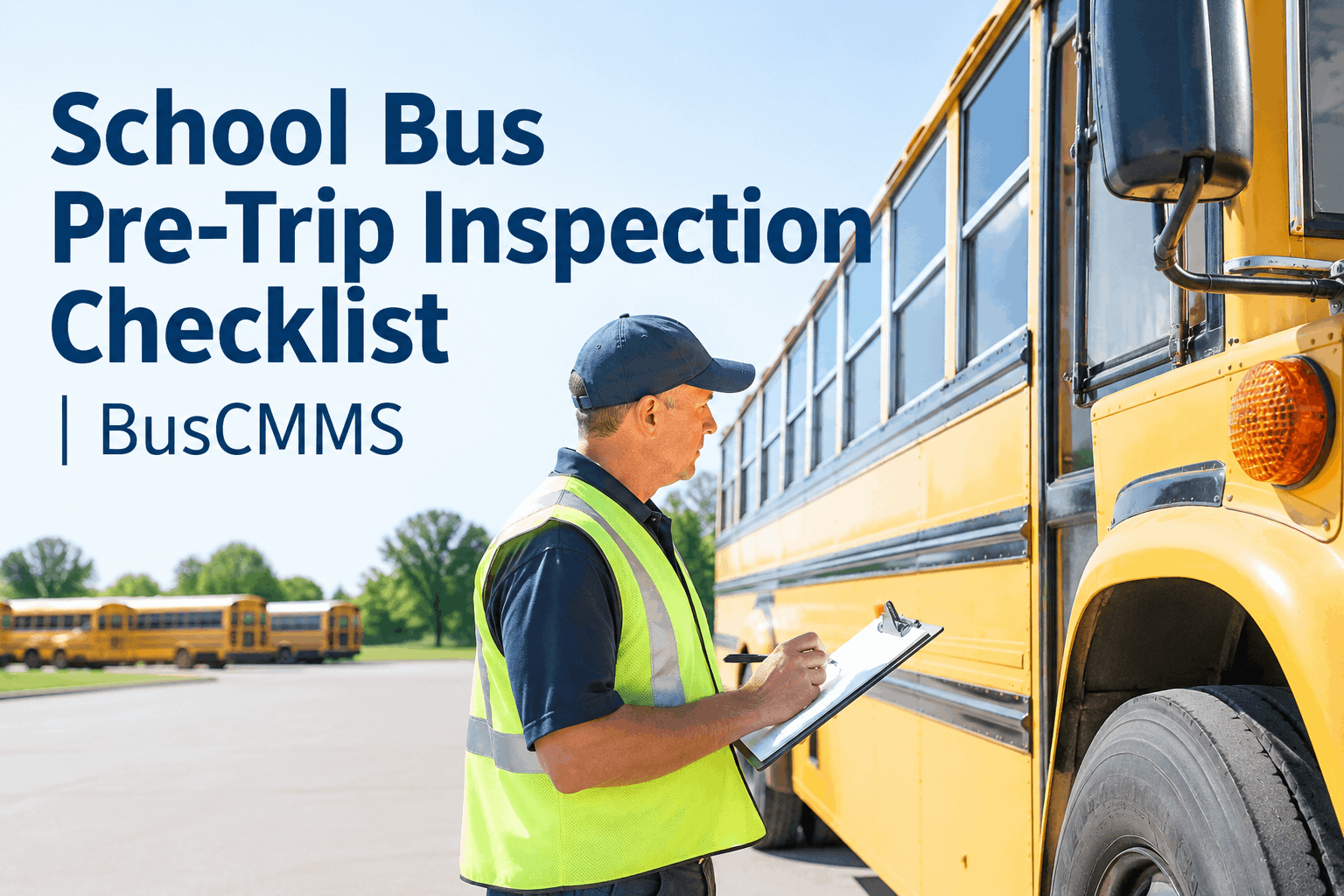
It is 5:40 on a cold morning, the driver is already a few minutes behind, and the pre-trip turns into a lap around the bus with a clipboard. That is exactly when a school bus pre-trip inspection misses the items that matter most — and you can see how a guided digital pre-trip stops that in a quick demo.
School Bus Pre-Trip Inspection: The Most Missed Items
Most defects that make it onto a route were visible that morning — the driver just didn't get to them. These are the pre-trip items that get skipped most, and how to make sure they never are.
Why School Bus Pre-Trip Items Get Missed
Nobody skips a pre-trip item on purpose. It happens because the morning is working against the driver: it is dark, it is cold, the route is tight, and there are not enough drivers to cover a late start. A paper checklist makes it worse — the items blur together, the hard-to-reach ones get a glance instead of a check, and a signature at the bottom covers all of it. The school bus pre-trip inspection becomes a formality instead of the last line of defense it is supposed to be.
Time pressure
A late start or a tight route turns a thorough walk-around into a lap. The items that take the longest to check are the first to go.
Paper that blurs
A dense paper form invites a quick scan and one signature. There is no record that each item was actually looked at.
Hard-to-reach items
Roof hatches, the rear of the bus, under-hood belts — anything that takes a second trip or a bend is the easiest to wave past.
The fix is not more pressure on the driver — it is a pre-trip that can't be skimmed, where each item has to be checked and recorded before the bus is cleared. You can sign up free and set up a guided pre-trip for your drivers.
The Most Missed School Bus Pre-Trip Items
These are the items that get skipped most on a rushed morning — grouped by where they sit on the bus, with why each one gets missed and why it matters. Run this list against your own drivers' pre-trips.
Why missed: they only deploy when the door opens, so a static walk-around skips them. Why it matters: a stop arm that won't extend is the item that protects kids crossing the road.
Why missed: checking all eight amber and red lamps cycle takes a helper or a walk-and-look. Why it matters: a dead loading light is both a safety gap and a citation waiting to happen.
Why missed: the inner dual and rear tires need a bend and a look. Why it matters: low tread or a cut on a loaded bus is a roadside out-of-service item.
Why missed: push-out windows and roof hatches need a reach and a cycle, not a glance. Why it matters: an exit that sticks is the one that fails when it is needed most.
Why missed: they look fine from the seat, so adjustment goes unchecked. Why it matters: a misaimed crossover mirror is a blind spot right where a child stands.
Why missed: on a run with no lift rider that day, it gets skipped entirely. Why it matters: a lift that won't cycle strands a student the morning it is needed.
Why missed: opening the hood is the extra step a rushed driver drops first. Why it matters: a glazed belt or a slow coolant leak becomes a mid-route breakdown with kids aboard.
Why missed: “it was there yesterday” replaces an actual check of charge and seal. Why it matters: an expired or discharged extinguisher is a failed inspection and a real safety gap.
Why missed: both work until they don't, so they get assumed rather than tested. Why it matters: a silent backup alarm in a crowded lot is exactly the failure you can't afford.
Notice the pattern: almost every missed item is one that takes an extra step — a bend, a cycle, a second trip. You can see how a guided digital DVIR makes each of these a required check in a demo.
The Driver Pre-Trip Checklist That Catches Them
Hand your drivers this school bus inspection checklist and the most-missed items stop slipping through. Any line that gets skimmed is a defect heading out on a route — so every one has to be an actual check, not a glance.
- Stop arm & crossing gate deploy and retractOpen the door and watch them cycle fully — don't assume.CRITICAL
- All 8 warning lamps cycleAmber and red, front and rear, every lamp lit.CRITICAL
- Emergency exits open and resealDoor, push-out windows, roof hatches — cycle each one.CRITICAL
- Crossover mirrors aimed correctlyFull view of the danger zone in front of and beside the bus.CHECK
- Inner duals and rear tires checkedTread, pressure, cuts — the tires you can't see from standing.CHECK
- Emergency gear present and in dateExtinguisher charged and sealed, first-aid stocked, triangles on board.CHECK
- Under-hood: belts, hoses, leaksOpen it every time — a glazed belt is cheaper to catch here than on a route.CHECK
The three critical lines protect kids directly — start there. You can load this checklist as a guided driver pre-trip in a demo.
How BusCMMS Stops Items From Being Missed
Every missed item traces back to the same thing: a driver was trusted to remember a step on a bad morning. BusCMMS builds the remembering into the pre-trip, so a thorough inspection is the only way to clear the bus.
Guided, item-by-item DVIR
Pre-loaded bus pre-trips walk the driver through every item — stop arm, exits, lift, mirrors, under-hood — so none can be skipped or skimmed.
Timestamped, real inspections
Each item logged with a time, so a 90-second lap is visible for what it is — and a real pre-trip is on the record.
Defects become work orders
A flagged item routes straight to the shop as a work order, so a caught defect is fixed and documented — not forgotten by lunch.
That turns the pre-trip back into a real safety check, and gives you a record that proves it. You can sign up free and set up your first guided bus pre-trip today.
A Transportation Trainer's Take
Key Takeaways on School Bus Pre-Trip Inspections
A school bus pre-trip inspection misses items not because drivers don't care, but because the morning works against them. Four things to carry out of this.
Extra-step items get skipped
Roof hatches, inner duals, under-hood — anything needing a bend or a cycle is first to go.
Safety signals protect kids
Stop arm, warning lamps, crossover mirrors — the items that guard a crossing child.
Paper invites the skim
A dense form and one signature hide what was never looked at. A guided pre-trip can't.
A caught defect must reach the shop
Flagging an item only helps if it becomes a tracked work order, not a note.
Make the school bus pre-trip inspection one the morning can't rush — each item a required check — and the defects that used to ride out on a route get caught in the yard instead.