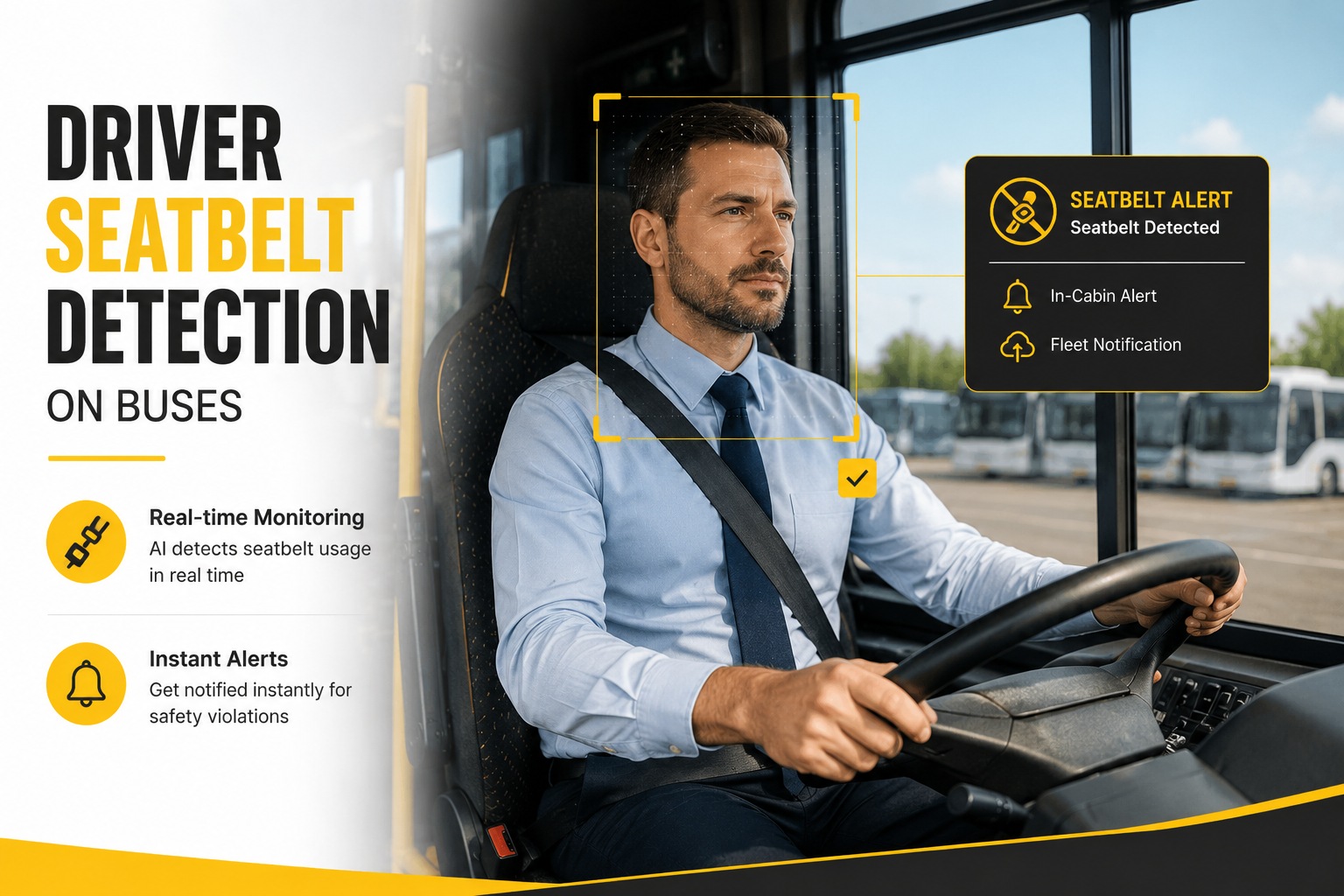
A driver who isn't belted is unprotected in exactly the scenario a bus's size and weight make survivable for everyone else on board. Seatbelt detection bus systems use AI to spot an unbelted driver in real time, and unlike passenger belt policy — which varies by bus type and state — driver belt use is something every fleet can monitor and act on immediately. See how a seatbelt event reaches a work order in BusCMMS.
Driver Seatbelt Detection on Buses
Why driver belt policy is simpler than passenger policy, how compliance rate works as a leading indicator, and why review without coaching leaves the number flat.
Why One Prevented Crash Justifies the Program
The math behind treating this as a budget line, not a courtesy reminder.
An average injury crash is widely cited at $148,279 using FMCSA crash-cost figures, as referenced across 2026 industry sources — worth re-verifying against FMCSA directly before publishing externally. A belted driver has a meaningfully better chance of remaining in control or avoiding serious injury in exactly the kind of sudden-stop or collision scenario that camera systems are also designed to catch. Against that cost figure, one avoided injury or one driver who stays functional enough to manage a bus full of students after an incident easily justifies a monitoring program across dozens of vehicles.
Driver Belt Policy vs Passenger Belt Policy: Not the Same Question
One is simple and universal; the other varies by bus type and state.
Passenger belt requirements on buses vary considerably — by bus type, by state, and by whether the vehicle has lap-only or lap-shoulder belts installed at all, and large traditional school buses rely on a different occupant protection design than passenger vehicles by federal standard. Driver belt use doesn't carry that same complexity: a driver's seat has a belt, and whether it's worn is a straightforward yes-or-no that every fleet can monitor consistently regardless of bus type. Keeping these two policy questions separate matters, because conflating them tends to stall action on the simpler, universally applicable one.
The Objection Worth Naming: Review Without Coaching Changes Nothing
A logged event that never reaches the driver is just a file.
The most common failure in a seatbelt monitoring program isn't detection accuracy — it's what happens after an event is flagged. Events get reviewed and filed, but never converted into an actual conversation with the driver, so the underlying habit never forms and the compliance number sits flat month after month. Left unaddressed long enough, the program starts to feel like surveillance instead of a safety habit-builder, which erodes driver buy-in. A short, consistent loop — flagged event, brief conversation, done within days — is what actually moves the number, not a quarterly summary nobody outside the safety office reads.
A Scenario From a Real Bus Operation
A flat compliance rate turned around once coaching started.
A public transit agency running 45 buses installed seatbelt detection fleet-wide and tracked a baseline driver compliance rate of 81 percent over the first month — meaning nearly one in five monitored trips involved an unbelted driver at some point. The safety office had been logging events but not acting on them individually. After introducing a rule that any driver with two or more flagged trips in a week received a brief same-week conversation referencing the specific trips, compliance climbed steadily and held at 98 percent by the fourth month, with the improvement visible almost immediately after coaching began.
We had the data sitting there for a month before anyone acted on it, and the number didn't move at all. The second we started actually calling drivers in and pointing to specific flagged trips, compliance started climbing within the same week. It wasn't a technology problem, it was a follow-through problem.
Not sure what your current driver seatbelt compliance rate actually is? That's worth measuring. Talk to the team about a compliance baseline →
An Audit Packet That Assembles Itself
The wedge BusCMMS solves that a standalone camera vendor can't.
BusCMMS is an AI-native bus fleet operations platform, and the wedge here is where seatbelt event evidence actually lands. A flagged event attaches directly to that bus's DVIR, the relevant work order, and the driver record — all on the same asset timeline, not scattered across a separate camera vendor's export tool. When a board member or auditor asks for the compliance trend over the last quarter, the packet is already assembled rather than built the night before the meeting.
Frequently Asked Questions
How does AI seatbelt detection actually work for a bus driver?
Driver-facing camera systems use AI to identify the visual signature of a fastened seatbelt across the driver's torso, flagging an event when the belt is absent for a meaningful portion of a trip rather than a single momentary gap while adjusting position.
Is driver seatbelt policy the same as passenger seatbelt policy on a bus?
No. Passenger belt requirements vary by bus type, state, and whether the vehicle has lap-only or lap-shoulder belts installed, while driver belt use is a straightforward yes-or-no question that applies consistently regardless of bus type.
What makes seatbelt compliance rate a useful safety metric?
Compliance rate is a leading indicator because it reflects a forming habit rather than a prevented incident after the fact — a rising rate shows the behavior is changing before it's ever tested by an actual crash.
Why do some seatbelt monitoring programs fail to improve compliance?
The most common failure is a process gap, not a detection gap: events get logged and filed but never converted into an actual coaching conversation with the driver, so the compliance rate stays flat instead of climbing.
Is driver seatbelt monitoring required by federal regulation for buses?
No single federal mandate governs seatbelt detection technology for buses. 49 CFR 396 maintenance records and district or agency policy set the general compliance bar, leaving adoption of monitoring systems to each operation's own safety program.