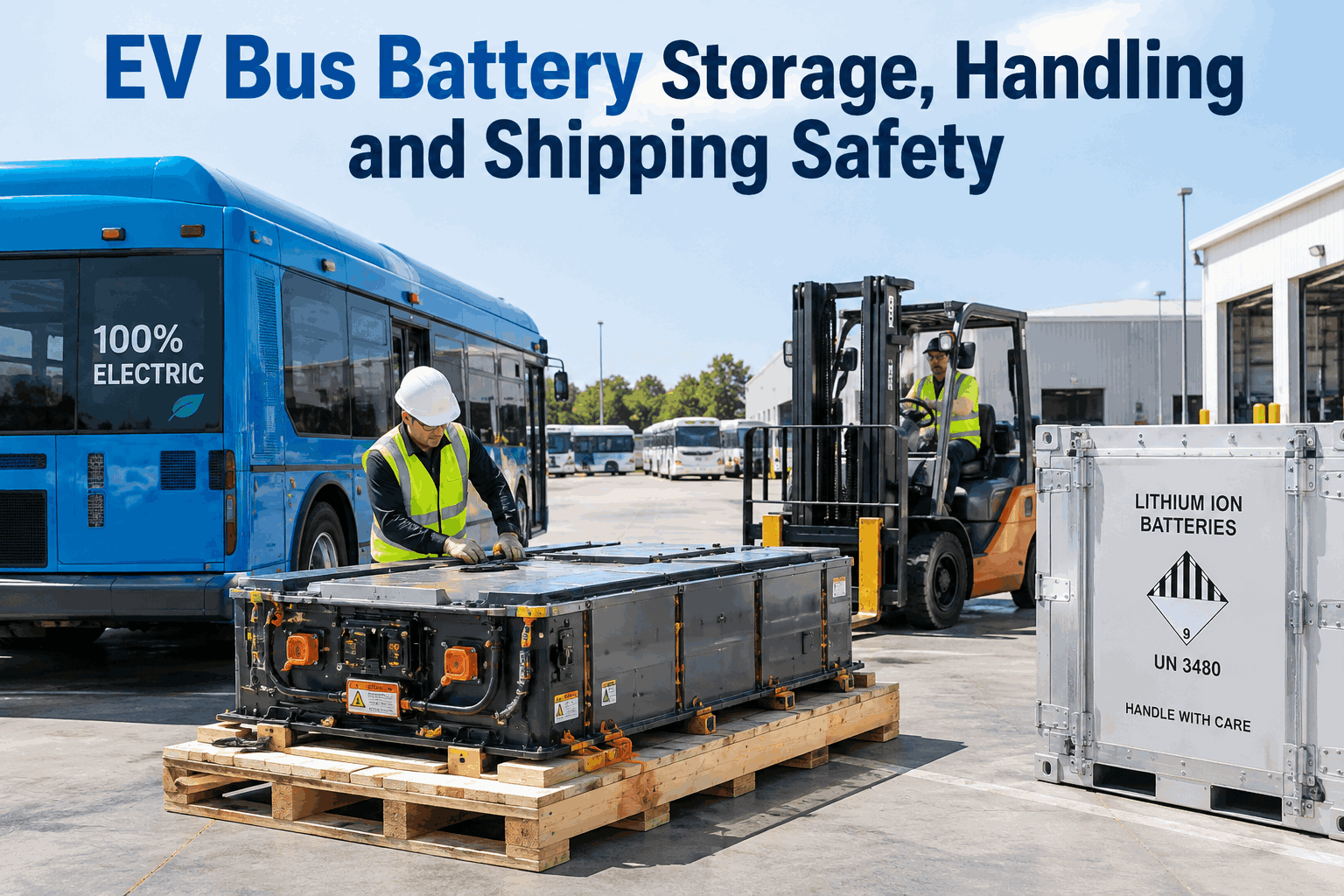
A traction battery comes out of a crashed electric bus and now it is sitting on the shop floor. Nobody is sure if it is damaged, where it can be stored, or how it gets shipped back to the OEM. That uncertainty is a real hazard. Safe EV bus battery storage, handling, and shipping is a compliance and safety discipline — and a lithium traction pack is regulated hazardous material the moment it leaves the bus.
EV Bus Battery Storage, Handling and Shipping Safety
A traction pack is Class 9 hazardous material the moment it leaves the bus. Store it right, document its condition, and ship it through the right channel — every time.
Why EV Bus Battery Storage Is a Compliance Problem, Not Just a Shelf
A diesel bus part that comes off for service goes on a shelf. A lithium-ion traction battery does not work that way. Once removed from the bus — for service, at end of life, or after a collision — it is a large-format energy storage device that can enter thermal runaway if damaged, short-circuited, or stored improperly. And under U.S. Department of Transportation rules, it is regulated hazardous material: lithium-ion batteries ship under UN3480 (or UN3481 when contained in equipment), Hazard Class 9, governed by 49 CFR 173.185.
That changes the job for the parts and safety team. It is no longer "put the old battery in the corner until the vendor picks it up." It is: assess the battery's condition, store it under the right conditions with proper isolation and fire separation, document what it is and what state it is in, and ship it through a channel that meets hazmat requirements. Get any of those wrong and the exposure ranges from a shop fire to a DOT violation. The stakes are real, and they are exactly the kind of thing a safety-and-compliance system exists to manage. Book a walkthrough to see traction-battery condition and handling records tracked per unit.
Classify the Battery First: Condition Determines Everything
Before storage or shipping, the battery's condition has to be established — because a healthy pack removed for a planned swap is a completely different risk than a battery that took impact damage in a crash. The four states below drive every handling decision that follows.
Healthy / Serviceable
Removed for a planned swap, upgrade, or to access another component. No damage, normal voltage. Standard storage and standard (still Class 9) shipping channels apply.
Removed for Service / EOL
End-of-life or being returned for warranty/refurbishment. Not visibly damaged, but capacity-degraded. Needs documentation of state of charge and health before it moves.
Damaged / Defective
Impact damage, swelling, leaking, thermal event history, or a fault the BMS flagged. Highest risk. Requires special handling and special packaging — standard transport is not authorized.
Recalled
Subject to an OEM safety recall. Treated with damaged/defective-level caution because the recall itself implies a known defect risk. Shipping follows the recall program's instructions.
The critical line runs between the first two states and the last two. A healthy or simply end-of-life battery follows normal (still regulated) handling. A damaged, defective, or recalled battery moves into a far stricter regime — DOT rules under 49 CFR 173.185(f) address damaged/defective lithium batteries specifically, and shipping them typically requires specialized packaging authorized under a PHMSA special permit. Misclassifying a damaged battery as healthy is the single most dangerous mistake in this whole process. Sign up free and start logging each traction battery's condition on its own record.
Safe Storage Conditions for a Traction Battery
A removed traction pack awaiting service or shipment needs a defined storage environment — not a random corner of the shop. The parameters below reflect widely-recommended practice for interim lithium-ion storage. Always follow the specific OEM guidance for the exact pack, but these are the dimensions that matter.
State of Charge
Store at a moderate SOC per OEM guidance — not fully charged, not fully depleted. A partial charge reduces stored energy and cell stress during storage.
Temperature
Cool, dry, climate-controlled space. Avoid heat, direct sun, and freezing. Temperature extremes accelerate degradation and raise thermal-event risk.
Isolation & Spacing
Terminals protected against short circuit; packs spaced apart, not stacked or crammed. Physical separation limits any single-cell event from cascading.
Fire Separation
Stored away from combustibles and ignition sources, ideally in a dedicated area with appropriate fire detection and suppression suited to lithium chemistry.
A damaged or suspect battery raises the bar further: it should be isolated from healthy packs, monitored for signs of a developing thermal event (heat, swelling, off-gassing, unusual smell), and quarantined until it can be moved by qualified personnel. The reason quarantine matters is reignition — a compromised cell can go into thermal runaway hours or days after the initial damage, which is why a damaged pack is never simply set on a shelf next to good inventory. Book a demo to see quarantine status and storage location tracked per battery.
Shipping a Traction Battery: The Class 9 Reality
This is where fleets most often get into trouble — because shipping a large-format lithium traction battery is not like shipping a spare part. It is hazardous-materials transport, and the rules are strict about who can do it and how.
It Is Class 9 Hazmat
Lithium-ion batteries ship as UN3480 (Class 9), or UN3481 when installed in or packed with equipment. Governed by 49 CFR 173.185. This classification applies even to a healthy pack.
Damaged Changes the Rules
Damaged, defective, or recalled batteries fall under 49 CFR 173.185(f). Standard transport is not authorized — they typically require specialized packaging under a PHMSA special permit (DOT-SP).
Size Puts It Beyond DIY
Consumer-cell special permits carry small watt-hour limits. A bus traction pack is vastly larger, so it almost always moves via the OEM's take-back program or a certified hazmat carrier — not a fleet's own truck.
Training Is Required
Anyone who prepares a hazmat shipment must be hazmat-trained per DOT rules. Shipping papers, marking, labeling, and emergency response information all apply unless a permit specifically relieves them.
The honest, practical takeaway for a bus fleet: in almost every case, a traction battery ships back through the manufacturer's arranged logistics or a specialized lithium-battery hazmat carrier — not on the agency's own vehicle with a shop employee who thinks they can just box it up. The fleet's responsibility is to have the battery correctly classified, safely stored, and fully documented so the certified shipper can do their part without delay or risk. Trying to self-ship a large damaged lithium pack is where agencies create genuine legal and physical danger. Sign up free and keep every battery's shipping documentation attached to its record.
The Documentation a Battery Needs Before It Moves
Whether a battery is stored, transferred, or shipped, a documentation trail travels with it. Incomplete records are what turn a routine return into a delayed, non-compliant, or dangerous shipment. Six elements make the record complete.
- 01Serial / part number & source bus · which pack, from which VIN, removed when and why
- 02Condition classification · healthy, end-of-life, damaged, defective, or recalled — dated and by whom
- 03State of charge & health data · BMS readout or measured values at removal
- 04Chemistry & specifications · cell chemistry, voltage, capacity — what the shipper needs to classify it
- 05Storage & quarantine log · where it has been held, for how long, under what conditions
- 06Chain of custody · who handled it, transfer records, and the eventual shipper handoff
The chain-of-custody piece matters more than fleets expect. When a battery is involved in a warranty claim, a recall, an insurance matter after a crash, or a recycler's intake, the question "what happened to this battery between the bus and here" needs an answer. A record that lives on the battery's own asset entry — not in someone's memory or a loose folder — is what answers it. And it is what lets the certified hazmat shipper classify and package correctly the first time. Book a walkthrough to see the full battery documentation record in one place.
How BusCMMS Manages Battery Safety and Compliance Records
Because BusCMMS already tracks every asset and every work order, a removed traction battery becomes a tracked item the moment it comes off the bus — with all the safety and compliance data attached to it, not floating loose. The features below turn a hazardous-material liability into a managed record.
-
Battery Asset Tracking
Each removed pack tracked by serial number with source bus, removal date and reason — a real asset record, not a note on a shelf.
-
Condition Classification
Log each battery as healthy, EOL, damaged, defective, or recalled — the classification that drives every handling and shipping decision.
-
Quarantine & Storage Status
Storage location and quarantine flag per battery, so a damaged pack is never mistaken for good inventory or lost track of.
-
Compliance Documentation
Chemistry, SOC, specs, and shipping paperwork attached to the battery record — ready for the certified hazmat shipper.
-
Chain of Custody
Every handler and transfer logged from bus removal to shipper handoff — the trail warranty, recall, and insurance all ask for.
-
Recall & Safety Alerts
Tie a battery to an active OEM recall so recalled packs are flagged and handled with the required caution, not shelved as normal.
Because the battery record sits on the same platform that tracks the bus it came out of and the work order that removed it, the safety and compliance data is a byproduct of normal operations rather than a separate manual burden. When the certified shipper arrives, the packet is ready. When an auditor or insurer asks, the chain of custody is intact. That linkage is what a loose folder or a spreadsheet can never reliably provide. Sign up free and put your removed batteries on tracked records this week.
The Safety Manager's View
That story captures the whole discipline. The danger was not the battery itself — it was the three days of uncertainty, the missing classification, and the pack sitting next to combustible inventory with no record. The fix is a system that turns a removed battery into a tracked, classified, documented asset from the moment it leaves the bus. Book a walkthrough to see the battery safety and compliance workflow end to end.
The Bottom Line on EV Bus Battery Storage and Shipping
Safe EV bus battery storage, handling, and shipping comes down to a disciplined sequence: classify the battery's condition, store it under the right conditions with isolation and fire separation, document it completely, and ship it through a certified hazmat channel — usually the OEM's program, never a shop employee with a box. A traction pack is Class 9 hazardous material under 49 CFR 173.185 the moment it leaves the bus, and a damaged one carries far stricter rules. Manage all of it on a live per-battery record instead of a corner of the shop, and the hazard becomes a controlled process. That is what protects your people, your facility, and your compliance standing. Sign up free and start tracking your traction batteries as managed assets today.