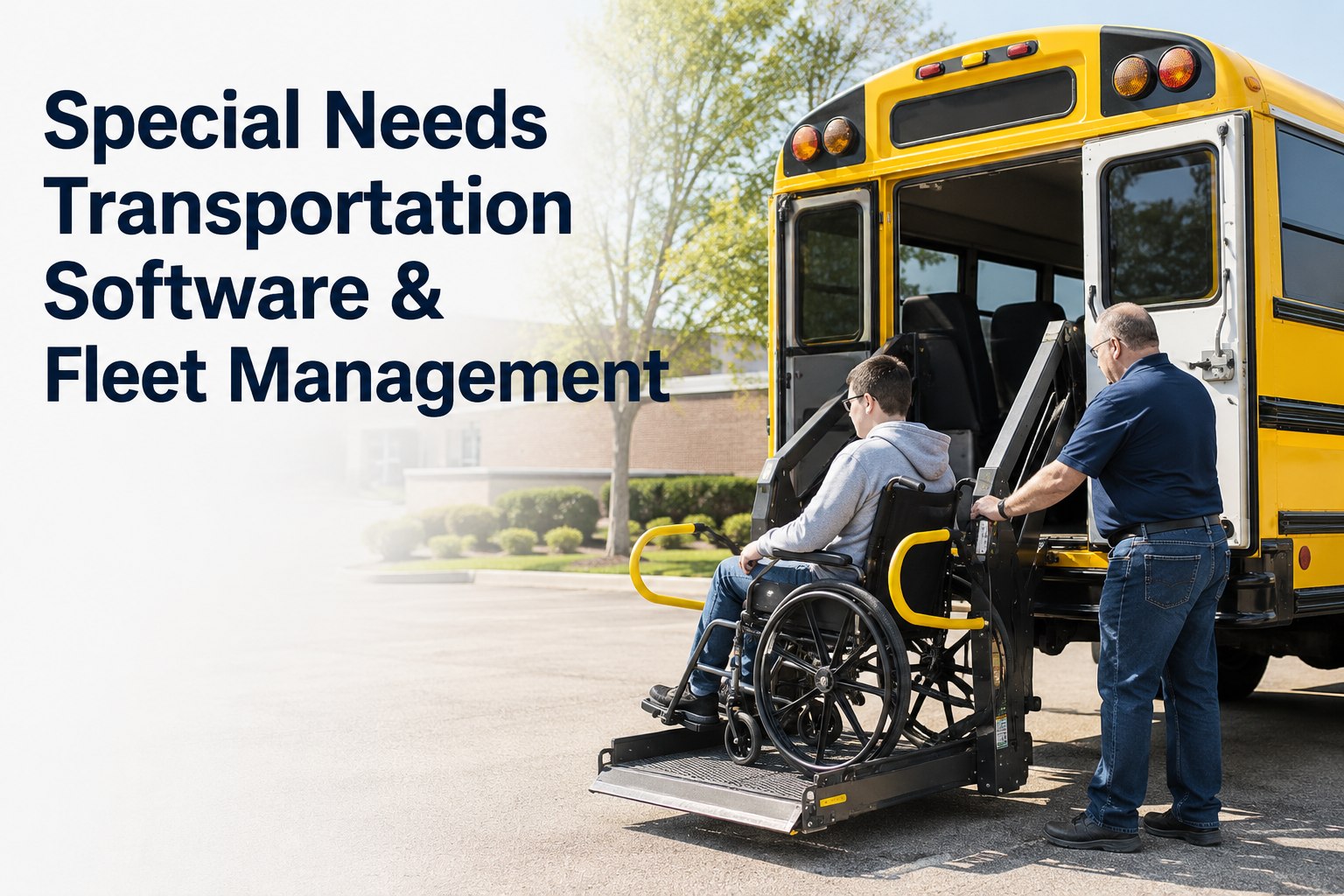
Special needs transportation software has to model what a regular fleet system doesn’t — the wheelchair lift on Bus 12, the 4-point securement stations, the occupant restraint that goes on the passenger and not the chair, and the pre-trip check that says all of it works before the bus rolls to pick up a student who depends on it. Get any of that wrong and a student may not get to school. Book a 20-minute demo to see BusCMMS running on an accessible bus fleet the size of yours.
Special Needs Transportation Software & Fleet Management
BusCMMS gives special-education transportation teams one platform for lift inspections, wheelchair securement checks, defects, preventive maintenance, camera evidence, and accessible-vehicle readiness — without forcing a trucking workflow onto student transportation.
- 4-point tie-down (WC19)
- Forward-facing position
- Occupant lap + shoulder belt
- Lift cycle test completed
The Regulatory Patchwork You Actually Operate Under
There is no single federal regulation that governs every special-needs transportation operation. What applies to your bus, your student, and your route is a network of overlapping requirements from federal education law, disability law, state pupil-transportation rules, manufacturer specs, and district policy. Fleet software should hold records that support the whole network.
Every layer can shape what your team documents. IDEA may make transportation a related service for a student. State rules may set the lift inspection cycle. Manufacturer specs govern tie-down installation and maintenance. District policy sets out-of-service thresholds and monitor training. This page is operational guidance and software evaluation — not legal advice. Verify current federal, state, manufacturer, and district requirements for your operation. Book a demo to see how BusCMMS holds records across the compliance network.
Wheelchair Lifts, Ramps & Securement: The Asset-Level View
An accessible school bus isn’t a bus with a ramp bolted on the side. It’s a system of specialized equipment — each with its own inspection cycle, defect profile, and out-of-service condition. A digital DVIR pre-loaded for a special-needs bus checks every component and routes any failure to the shop before dispatch.
- 01
Wheelchair Lift or Ramp
Cycle test to full deploy and stow. Platform surface, handrails, safety barriers, interlocks, backup power operation.
- 02
Securement Stations
Floor anchors, retractor housings, and rail systems checked for corrosion, damage, or missing hardware. Every station verified.
- 03
Tie-Down Straps & Retractors
WC18-compliant retractors and straps checked for fraying, cuts, buckle function, and full extension/retraction.
- 04
Occupant Restraints
Lap and shoulder belts inspected for webbing wear, buckle latch, and correct anchoring — secures the passenger, not the chair.
- 05
Accessible Seating & Aisles
Aisle clearance for a mobility device, priority seating condition, grab rails, and boarding-area lighting.
Each of those five can trigger a bus-out-of-service defect on its own. A lift that doesn’t fully cycle, a retractor that won’t extend, an occupant belt with cut webbing — none of these are findings you want the driver discovering at the student’s home in front of a parent. Pre-trip is where those get caught. Book a demo to see per-component inspection templates for accessible buses.
The 4-Point Securement Standard, Documented on the Bus
RESNA WC18 and WC19 are the reference standards for wheelchair securement on modern school buses. WC18 covers wheelchair tie-down and occupant restraint systems (WTORS). WC19 covers wheelchairs designed and tested for use as a seat in a motor vehicle. The practical field standard is a 4-point strap-type tie-down with the wheelchair forward-facing, plus a lap-and-shoulder occupant restraint securing the passenger. Manufacturer instructions govern installation and use.
- 1–2 Front tie-downs, angled forward from chair frame
- 3–4 Rear tie-downs, straight back from chair frame
- BELT Occupant lap + shoulder restraint (independent of chair)
Every one of those four straps and the occupant belt is an inspection item that can fail. BusCMMS logs the securement check in the pre-trip DVIR, and any failure routes to shop with a photo and the specific bus and station identified — not a vague “strap issue on the accessible bus.” Consult manufacturer instructions for authoritative installation and use requirements. Book a demo to see securement-station inspection on a live fleet.
A Lift Defect Becomes a Cleared Bus
Here’s the workflow the whole platform exists to support. A morning pre-trip on Bus 12 catches a wheelchair lift that stops mid-cycle on the deploy. On an accessible route with a student who depends on that lift, the bus is out of service until the lift is fixed or a substitute is dispatched.
Bus 12 · Lift Fails Cycle, AM Pre-Trip
- 01
Detection
Driver’s pre-trip DVIR flags lift stops mid-deploy at approximately 30 inches. Photo captured of platform position, defect logged safety-critical.
- 02
Route Impact
Bus 12’s AM route includes one student with a wheelchair boarding. System flags: bus cannot serve this route as-is. Substitute needed.
- 03
Response
Spare accessible Bus 19 pulled from pool. Lift cycle verified. Securement stations match student’s IEP transportation notes. Monitor briefed.
- 04
Closure
Bus 12 lift diagnosed — deploy limit sensor. Sensor replaced, lift re-cycled 5 times to verify. Bus 12 back in accessible service by PM route.
Every step lives on the bus record. The student’s ride happened on schedule. The lift got fixed. The maintenance history is queryable. No protected student information had to leave the transportation office — the accessible-station configuration routed the substitute, not the student’s file. Sign up free to try the accessible-bus workflow on your own fleet.
A Special-Education Transportation Director’s View
That’s why a bus-first, accessible-aware platform pays back. When lift and securement data live on the same coach record as brakes, tires, and PM, a transportation director sees the whole fleet the way it actually operates — not as two systems that don’t talk. Book a demo to see accessible-bus records on one fleet dashboard.
Evaluation Checklist for Special-Needs Transportation
Here’s the rubric a working special-education transportation director would build for evaluating fleet software — focused on what matters at 6:30 AM when a lift won’t cycle and a student expects a ride at 7:15.
Lift & ramp inspection templates
Pre-loaded pre-trip items for cycle test, safety barriers, handrails, and backup power — day one.
Securement-station tracking
Per-station status for retractors, tie-downs, and occupant restraints on each accessible bus.
Accessible-bus readiness view
See at a glance which accessible buses are ready to serve which routes today.
Photo defect capture
Drivers attach photos to lift or securement defects — the shop knows what it’s walking into.
Substitute-vehicle workflow
Route matched to accessible spare pool by station configuration, not by paper chart.
Records exportable for audit
Inspection, defect, and PM history exports for state pupil-transportation review or district audit.
Most generic fleet tools score two of six. BusCMMS is built for all six — because accessible buses were designed into the platform, not layered on. Book a demo to walk the accessible-fleet workflow live.
What is special needs transportation software?
Special needs transportation software is the platform K-12 districts and pupil transportation contractors use for the operational side of accessible student transportation — lift and ramp inspections, securement-station tracking, defects on accessible equipment, work orders, camera events, and the readiness view that tells dispatch which accessible buses can serve which routes today. It complements student-facing routing and IEP systems by holding the vehicle-side records they depend on.
How does fleet software manage wheelchair lifts and ramps?
Fleet software manages wheelchair lifts and ramps by treating each piece of accessible equipment as an inspection item in the digital DVIR for that bus. Pre-trip runs a cycle test, verifies safety barriers and handrails, confirms interlocks, and checks backup power. Any failure logs as a safety-critical defect, opens a work order, and can flag the bus as unable to serve accessible routes until repaired and verified.
Can BusCMMS track wheelchair securement inspections on school buses?
Yes. BusCMMS tracks securement-station status per bus — floor anchors, retractor housings, WC18-compliant tie-down straps, and occupant lap/shoulder restraints. Each is a distinct inspection item, and failures route to shop with photo documentation and the station identified. When a substitute accessible vehicle needs pulling from the spare pool, the system matches route requirements to available securement configurations instead of a paper chart.
What are WC18 and WC19 for school bus wheelchair transportation?
WC18 and WC19 are RESNA standards for wheelchair transportation safety. WC18 covers wheelchair tie-down and occupant restraint systems (WTORS) — equipment installed on the bus. WC19 covers wheelchairs designed and tested for use as a seat in a motor vehicle. The practical field standard is a 4-point strap-type tie-down with the wheelchair forward-facing, plus a lap-and-shoulder occupant restraint. Consult manufacturer instructions for authoritative requirements.
What should a district look for in special-needs transportation software?
Look for pre-loaded lift and ramp inspection templates (cycle test, safety barriers, handrails, interlocks, backup power), per-station securement tracking, an accessible-bus readiness view, photo-driven defect capture, a substitute-vehicle workflow that matches accessible spare pool by station configuration, and exportable inspection and maintenance history for state review and district audits. Verify current federal, state, and manufacturer requirements alongside district policy.