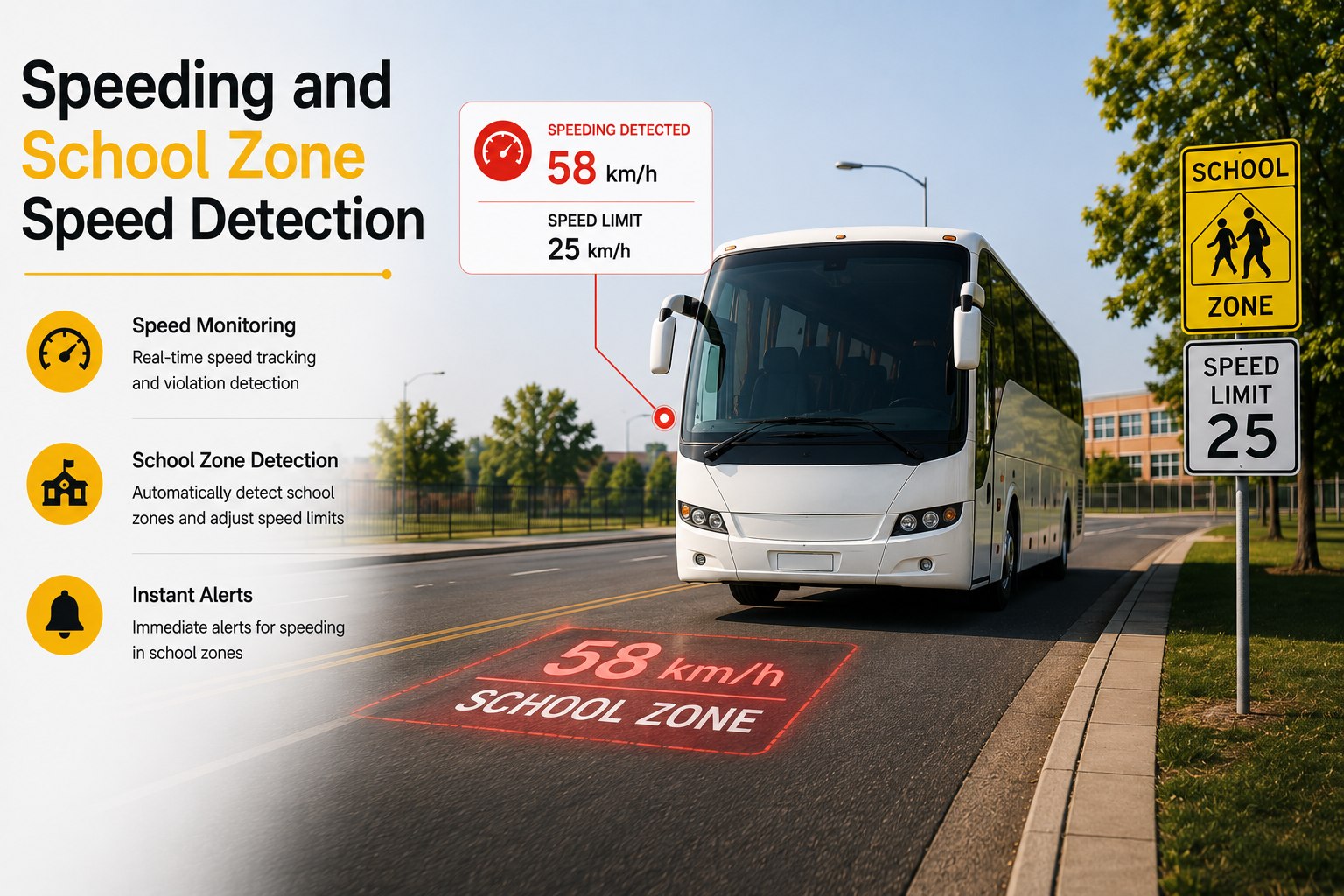
A bus doing 28 in a 20 mph school zone doesn't look like reckless driving on paper — until it's the district's own bus caught on a parent's phone camera. School zone speeding bus detection uses zone-aware thresholds, not just the posted road-limit, since school zones often carry a lower limit only during specific hours, and a system that ignores that distinction either misses real violations or flags routine driving as a problem. See how a speeding event becomes a coaching record in BusCMMS.
Speeding and School Zone Speed Detection
Why posted-limit and zone-aware detection aren't the same thing, what a speeding school bus does to public trust, and which route segments generate most of the violations.
Posted-Limit vs Zone-Aware: Not the Same Detection
A school zone limit often only applies during specific hours.
Many school zones drop the speed limit only during specific arrival and dismissal windows, reverting to the standard posted limit the rest of the day. A detection system that simply checks speed against the standard road sign misses violations during the lower-limit window and can also misfire outside it, flagging perfectly legal driving as a violation. Zone-aware detection ties the threshold to the actual active limit at that specific time of day, which is the only way the flagged events line up with what a citation or a coaching conversation could actually stand behind.
The Optics Problem: A Speeding School Bus Is a Public Trust Issue
One dashcam clip from a bystander can undo years of community trust.
A speeding violation involving almost any other vehicle passes unnoticed. A district or agency's own bus caught speeding through a school zone on a parent's phone or a neighborhood security camera is a different kind of event entirely — it becomes a story, a board meeting agenda item, a headline. Districts that can show a proactive detection and coaching program, rather than reacting only after a public complaint, are in a fundamentally stronger position to demonstrate the incident was already being addressed internally before anyone outside the organization noticed.
The Objection Worth Naming: Reviewed, Never Coached
A logged event that never reaches the driver is just a file.
The most common failure with speeding detection programs isn't the detection itself — it's what happens after. Events get reviewed and filed, but never turned into an actual conversation with the driver, so the underlying habit never changes and the same segment keeps generating the same violation month after month. Left unaddressed long enough, the program starts to feel like surveillance rather than a safety tool, undermining driver trust. The fix is a short, consistent loop: flagged event, brief documented conversation, within days — not a quarterly summary that sits in a drawer.
A Scenario From a Real Bus Operation
One route segment explained most of the fleet's violations.
A school district running 70 buses began tracking zone-aware speeding events by route segment rather than by driver alone. Within the first grading period, one specific downhill stretch leading into a school zone accounted for nearly a third of all fleet-wide flagged events, spread across several different drivers — a pattern that pointed to the road geometry itself rather than any individual habit. The district adjusted driver guidance for that specific segment and added a brief note to the route sheet reminding drivers of the grade transition; flagged events on that stretch dropped by more than half the following month.
We assumed we had a driver problem until we mapped the events by route instead of by name. One downhill stretch into a school zone was responsible for almost a third of our flags, and it wasn't the same driver twice. Once we knew where the problem actually was, fixing it took a route sheet note, not a disciplinary meeting.
Not sure which of your route segments generate the most speeding events? That's worth mapping. Talk to the team about a route segment review →
Compliance as a By-Product of Daily Work
The wedge BusCMMS solves that a separate binder can't.
BusCMMS is an AI-native bus fleet operations platform, and the wedge here is that compliance artefacts generate as a by-product of daily work, not as a separate exercise. A zone-aware speeding event doesn't sit in an export file waiting for someone to build a report before a state pupil-transportation inspection or a board review — it's already logged against the driver, the route, and the date, ready to pull whenever it's needed. No separate binder, no month-end scramble to reconstruct what happened.
Frequently Asked Questions
What's the difference between posted-limit and zone-aware speed detection?
Posted-limit detection checks speed against the standard road sign, while zone-aware detection ties the threshold to the actual active limit for that time of day, since many school zones only lower the limit during specific arrival and dismissal windows.
Why does a speeding school bus create more scrutiny than other vehicles?
A district or agency's own bus caught speeding through a school zone tends to draw public attention quickly, often through a parent's phone or a neighborhood camera, making it a public trust issue rather than a routine traffic matter.
How can a fleet tell if speeding events point to a route problem rather than a driver problem?
Mapping events by route segment rather than by driver alone often reveals that a small number of segments — a downhill stretch or a tight curve near a school zone — account for a disproportionate share of violations across multiple drivers, pointing to road geometry rather than individual habit.
Why do some speed detection programs fail to change driver behavior?
Events often get reviewed and filed without ever becoming an actual coaching conversation with the driver, so the underlying habit never changes and the same segment keeps generating the same violation. A short, consistent feedback loop closes that gap.
Is school zone speed monitoring required by state or federal law?
There's no single federal mandate specific to school zone speed detection technology. State pupil-transportation inspection rules and state stop-arm enforcement statutes set relevant compliance expectations, and specific requirements vary by state.