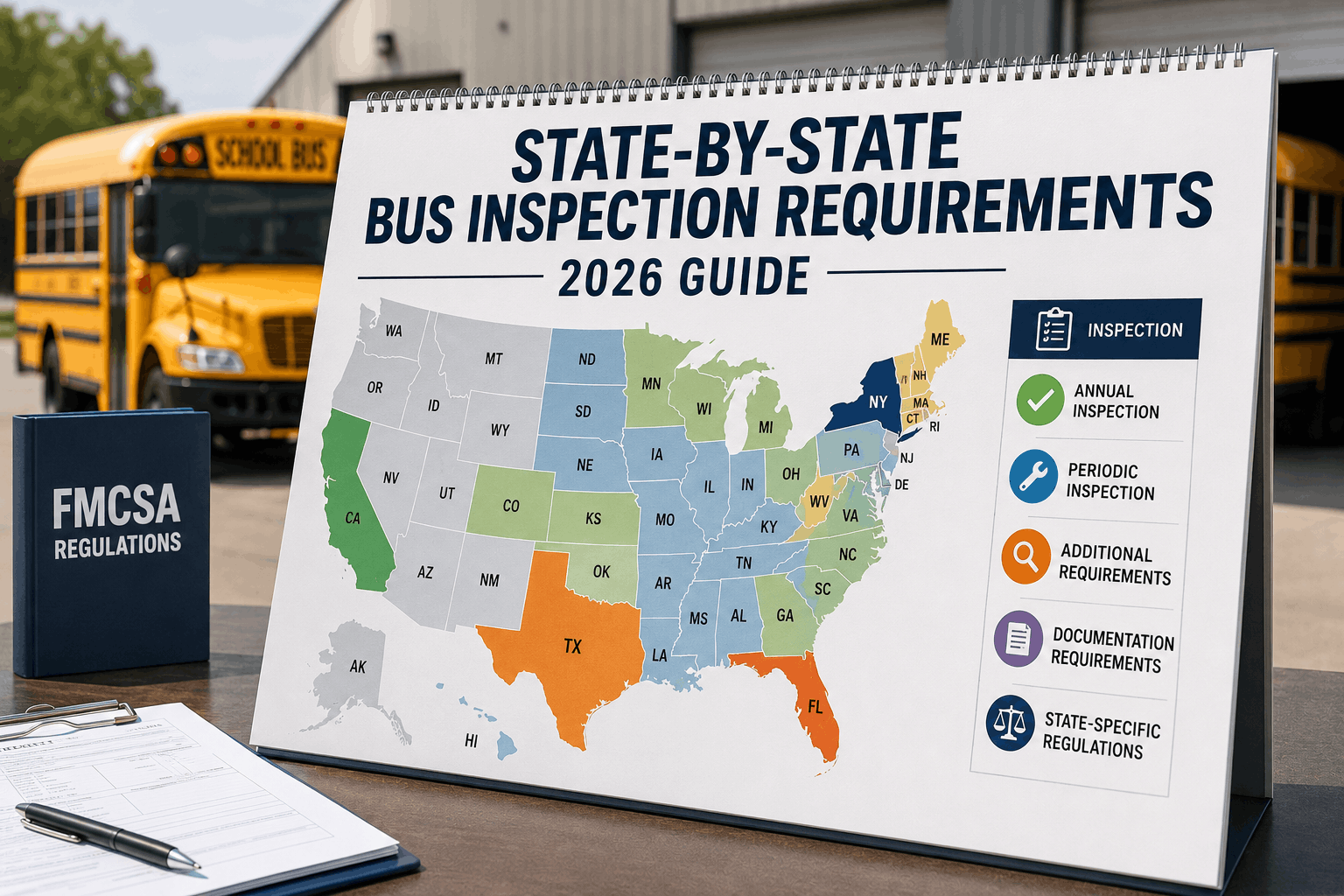
You're managing a 60-bus fleet across four states: California, Texas, New York, and Florida. Federal FMCSA regulations set the minimum baseline — annual vehicle inspections, daily DVIRs, maintenance records. But each state layers on requirements beyond federal minimums. California's historical 90-day periodic inspection requirement for buses over 26,000 lbs has been modified effective January 1, 2025, under Assembly Bill 3278. New York has its own inspection protocols enforced by the State Police. Texas has different weight limits and permitting requirements than Florida. A bus that fully complies with one state's regulations could be citation-vulnerable in another simply because you didn't understand the state overlay. Multi-state fleet compliance in 2026 means understanding that federal regulations establish a floor, not a ceiling. Your responsibility is every state that your buses operate in. This guide breaks down the unique requirements in California, Texas, New York, and Florida — the four highest-complexity states for bus operators — plus the framework for understanding requirements in states you might operate through but not headquarter in.
State-by-State Bus Inspection Requirements 2026: Multi-State Operator Guide
Federal FMCSA sets the floor. California, New York, Texas, and Florida build on top with unique inspection cycles, emissions rules, permitting, and enforcement. Complete breakdown by state for multi-state operators.
What FMCSA Requires for All Buses (Nationwide)
The federal foundation for all US bus operations is 49 CFR Parts 396 (Vehicle Inspection, Repair and Maintenance) and 396.17 (Annual Inspection). Every bus operating in the United States must have: an annual vehicle inspection performed by a qualified inspector covering all Appendix A items (brakes, steering, suspension, tires, lights, frame, coupling, etc.), with the sticker displayed on the vehicle and the report on file; daily driver vehicle inspection reports before and after each day's operation documenting any defects and required corrective action; maintenance records showing PM services completed with parts and labor documented; and emergency exit, push-out window, and emergency lighting inspections every 90 days per 49 CFR 396.3. These are non-negotiable baseline requirements that apply in every state. Understanding state-specific requirements means understanding what sits on top of these federal requirements.
Federal Requirements (All States)
Inspection Requirements + CARB Emissions Compliance + 2025 Regulatory Changes
Updated Effective January 1, 2025: Assembly Bill 3278 modified California's periodic inspection requirements for commercial vehicles. Buses under 26,001 lbs GVWR are no longer subject to the quarterly 90-day periodic inspection requirement. Buses over 26,000 lbs GVWR remain subject to more frequent inspection schedules. California still enforces strict CARB (California Air Resources Board) compliance and emissions standards across all weight categories.
California's vehicle inspection and emissions requirements remain among the most rigorous in the nation. Any bus over 26,000 lbs GVWR operating in California must have: compliance with California's current periodic inspection schedule (consult CARB and CHP for current cycle timelines post-AB 3278), CARB compliance documentation proving the vehicle meets California emissions standards, California biennial smog certification for applicable vehicles, and CARB Clean Truck Check documentation if operating in ports of entry. Buses under 26,001 lbs GVWR benefit from the 2025 rule change but remain subject to federal annual inspections and CARB emissions compliance.
For multi-state fleets, understanding your vehicle's GVWR and the post-2025 California requirements is critical. A bus that fails a California inspection must be out of service until repairs are completed and the inspection is retaken. The enforcement is aggressive: California's Highway Patrol and local enforcement agencies conduct roadside inspections with particular focus on heavy vehicles. A bus that operates in California cannot afford compliance gaps — meaning California fleets must maintain accurate GVWR classifications and stay current on all required inspections per current state regulations.
Note on Inspection Costs: Inspection fees vary by facility and region; operators should contact California-licensed inspection facilities for current pricing. Specific fee ranges should be verified with individual service providers rather than relying on generalizations.
California Multi-State Bus Fleet Requirements (Updated 2025)
Note: Assembly Bill 3278 (effective Jan 1, 2025) eased requirements for vehicles under 26,001 lbs GVWR. Verify your fleet's GVWR classification and current inspection schedule with California CHP or a CARB-certified inspector.
State Police Enforcement + Focused Safety Audits
New York enforces federal FMCSA standards but adds aggressive roadside enforcement through the New York State Police (NYSP) Commercial Vehicle Enforcement Bureau. NYSP conducts targeted safety enforcement at fixed inspection stations and through roving highway patrols on major corridors (I-87, I-90, I-495). New York does not have a separate state inspection requirement beyond federal annual inspections, but the enforcement intensity is significantly higher than most states. Violations found during New York roadside inspections feed into your national safety record and trigger FMCSA focused audits with higher frequency than carriers in less-aggressively-enforced states.
For multi-state fleets, the New York consideration is not a separate inspection requirement you've missed — it's that New York enforcement is so frequent and rigorous that any compliance gap will be caught during a roadside inspection. A bus with an expired CDL medical certificate, an overdue annual inspection, or a DVIR defect that wasn't repaired will get caught by NYSP with near certainty if it's operating in New York. Violations documented during roadside inspections are cited according to federal penalty schedules; operators should consult the FMCSA Enforcement and Penalties Guide for current penalty amounts.
New York Multi-State Bus Fleet Requirements
Note: Violations found in New York feed directly into FMCSA database and increase your likelihood of federal focused audits. Refer to FMCSA penalty schedules for current fine amounts.
No State Emissions Testing + Business-Friendly Enforcement
Texas enforces federal FMCSA standards without adding state-specific inspection requirements. Texas does not require state emissions testing for commercial vehicles (unlike California), making it substantially more compliance-friendly than California. However, Texas Department of Public Safety (DPS) conducts aggressive roadside enforcement on high-volume corridors (I-10, I-20, I-35, I-45, I-30) and during CVSA Brake Safety Week enforcement pushes (August annually). The Texas Motor Carrier Act governs intrastate operations — if you have a Texas-based terminal or operate regularly intrastate, additional compliance obligations may apply beyond federal interstate requirements.
For multi-state fleets, Texas is the easiest of the major-traffic states in terms of state-specific compliance: no additional inspections, no emissions testing, no state overlay on top of federal minimums. The caveat is that Texas still enforces federal requirements aggressively, and the sheer traffic volume on major Texas corridors means your buses will encounter roadside inspection stations frequently. A bus that is federally compliant will pass; a bus with federal compliance gaps will get cited according to FMCSA penalty schedules and will accumulate CSA points that affect your safety record nationally.
Texas Multi-State Bus Fleet Requirements
Note: CVSA Brake Safety Week enforcement (August) focuses heavily on Texas corridors — ensure all brake systems are current before August operations
Federal Enforcement + High-Traffic Corridor Risk
Florida enforces federal FMCSA standards without state-specific inspection overlays. Florida Highway Patrol (FHP) and FHP Commercial Vehicle Enforcement (CVE) conduct roadside inspections using CVSA North American Standard procedures — the same inspection protocol used in all states. However, Florida's major corridors (I-95, I-75, I-4, I-10) carry exceptionally high traffic volume, and FHP has a focused enforcement program. Florida does not have separate state emissions requirements for buses, and registration/permitting follows federal USDOT rules without state addition.
For multi-state fleets, Florida is operationally straightforward: comply with federal FMCSA and you comply with Florida. The enforcement risk is not state-specific but route-specific — I-95 and I-75 are among the most-inspected corridors in the nation, so buses operating those routes will encounter roadside inspection stations with high frequency. FHP CVE is also one of the most active CVE programs in the United States, so a bus with federal compliance gaps will almost certainly be caught during interstate operations in Florida.
Florida Multi-State Bus Fleet Requirements
Note: I-95 carries some of the highest inspection frequency in the nation — expect frequent roadside stops if operating that corridor
Illustrative Example (Not a Documented Case Study):
"We started with a 40-bus fleet based in Texas. When we expanded to operate in California and New York, we didn't understand the state-specific requirements — we thought federal compliance meant national compliance. We encountered compliance challenges in California due to emissions and inspection requirements we hadn't anticipated. This experience highlighted the importance of mapping out state requirements properly and implementing a CMMS that tracks inspection dates separately by state. A system that handles the complexity — knowing each bus's operating states and scheduling inspections accordingly — prevents compliance violations. The lesson: proper multi-state compliance tracking prevents violations that would impact your safety record nationally."
This example illustrates common compliance challenges in multi-state fleets. For specific penalty information, consult the FMCSA Enforcement and Penalties Guide.
Operating in multiple states means tracking federal minimums plus each state's overlay. A robust CMMS allows you to configure state-specific requirements for each location, track different inspection cycles per state, and schedule inspections accounting for state deadlines. A bus operating in California must be tracked according to current state requirements (accounting for AB 3278 changes). That same bus operating in Texas gets only the federal annual inspection scheduled. The system handles the complexity — you just execute. For current information on state-specific requirements, consult official state transportation authorities and the FMCSA website for federal standards.
Multi-State Compliance Doesn't Have to Be Complex
Federal minimums + California emissions + New York enforcement + state-by-state tracking + compliance deadlines by location — all managed in one CMMS. BusCMMS knows every state's requirements and schedules inspections automatically.
What changed in California with Assembly Bill 3278 (effective Jan 1, 2025)?
Assembly Bill 3278 modified periodic inspection requirements for commercial vehicles in California. Vehicles under 26,001 lbs GVWR are no longer subject to the quarterly 90-day periodic inspection requirement. Vehicles over 26,000 lbs GVWR remain subject to state inspection requirements. All vehicles continue to be subject to federal annual inspections and CARB emissions compliance. Verify your specific vehicle classifications with California CHP or a CARB-certified inspector.
Do all buses in our fleet need to meet every state's requirements, or only buses that operate in that state?
Only buses that operate in a state must meet that state's requirements. A bus based in Texas but operating primarily in Texas with occasional visits to Oklahoma doesn't need California's emissions compliance — unless you regularly dispatch it to California, in which case it does.
If a bus fails a roadside inspection in one state, does that show up on my safety record nationally?
Yes — every violation found during a roadside inspection feeds into the national FMCSA database and appears on your carrier profile. A violation in New York follows your fleet across all 50 states and affects your CSA scores, insurance rates, and FMCSA audit risk nationally.
What are the penalties for failing to meet state inspection requirements?
Penalties vary by state and violation type. Consult the FMCSA Enforcement and Penalties Guide for federal penalty schedules. State-specific penalties should be verified with the relevant state transportation authority (California CHP, NYSP, Texas DPS, or Florida FHP).
How does CARB emissions compliance work for California? Do all buses need it?
CARB (California Air Resources Board) certification applies to buses that operate in California, regardless of where they're registered. If your fleet operates a bus in California even infrequently, that bus must have valid CARB certification. Current requirements and certification procedures should be verified through the California Air Resources Board website.
Does BusCMMS track inspection requirements by state automatically?
Yes — you configure the states where each bus operates, and BusCMMS automatically applies the correct inspection frequency and deadlines for that state. A bus flagged as operating in California gets scheduled according to current state requirements; the same bus in Texas gets only the federal annual inspection. The system tracks and alerts based on state requirements.
If I operate a fleet in five different states, do I need separate CMMS systems for each state?
No — one centralized CMMS with multi-state configuration is better than separate systems. BusCMMS manages all state requirements in a single platform with location-specific rules, giving you visibility across all states while respecting each state's unique requirements.
What's the difference between federal annual inspection, state inspection, and roadside inspection?
Federal annual inspection is scheduled annually at a certified shop and covers Appendix A items. State inspection is additional (like California's periodic inspection). Roadside inspection is enforcement — if a vehicle is found to be non-compliant during roadside enforcement, it gets cited and put out-of-service. All three are tracked separately in BusCMMS.
Do I need separate insurance coverage for California or New York, or does national coverage apply?
Commercial bus insurance covers you nationwide and in all states. However, violations found in any state (California, New York, Texas, Florida) affect your safety record nationally and influence your insurance renewal rates. Compliance in all states matters for insurance.