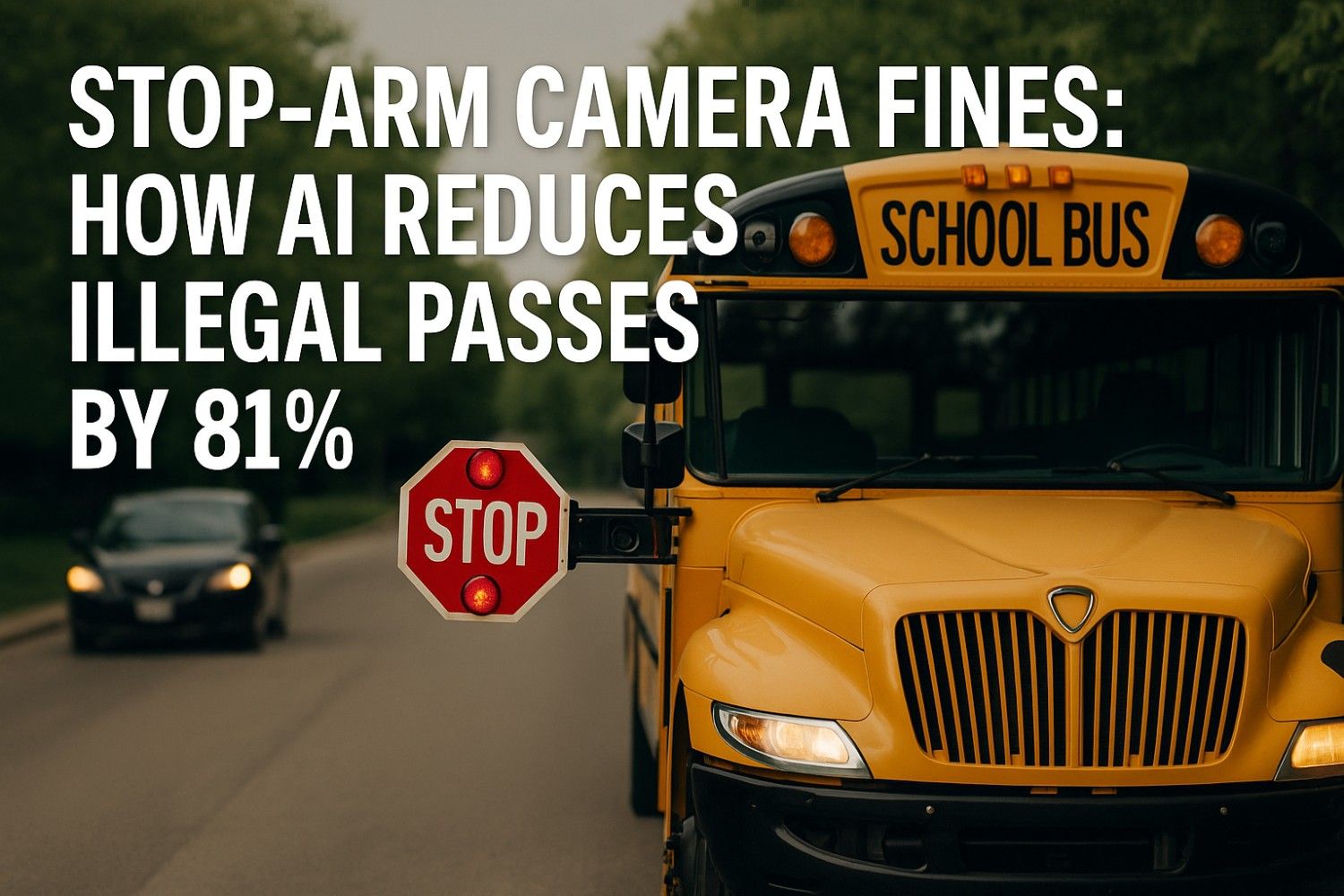
Every school day in America, drivers illegally pass stopped school buses approximately 17 million times annually. That's not a typo—17 million violations that put children at catastrophic risk. But here's where the story gets interesting: advanced AI-powered stop-arm camera systems are changing this dangerous pattern with stunning effectiveness. Recent multi-district implementations show an 81% reduction in illegal passes within the first 18 months of deployment, backed by automated fine processing that's making dangerous driving both detectable and financially painful.
For manufacturing professionals managing bus fleets, this isn't just about safety cameras—it's about integrating intelligent enforcement systems with comprehensive fleet management platforms to create accountability ecosystems that dramatically reduce risk exposure. When modern CMMS systems connect with AI camera networks, fleet managers gain unprecedented visibility into both driver behavior and external compliance threats, transforming reactive safety programs into proactive protection frameworks.
The Financial and Legal Architecture Behind AI Stop-Arm Systems
Understanding how AI stop-arm camera fines actually work requires examining the sophisticated legal and financial infrastructure that's emerged over the past five years. Unlike traditional traffic enforcement, stop-arm violations involve three distinct parties: the school district or transportation company, the camera technology provider, and the judicial system processing violations.
Most implementations operate on a hybrid revenue-sharing model where camera vendors receive 30-45% of collected fines, with the remaining 55-70% going to school districts. This structure has created a multi-million dollar enforcement industry. In Virginia alone, school districts collected $8.3 million in stop-arm fines during the 2023-24 school year, with over 62,000 violations documented by AI systems.
The AI component fundamentally changes enforcement economics. Traditional manual review required transportation staff to examine hours of footage, creating bottlenecks that limited prosecution. Modern AI systems automatically detect stopped buses with extended stop-arms, identify vehicles that illegally pass, capture license plates with 99.2% accuracy, and flag violations for minimal human review—typically under 30 seconds per incident. This automation enables districts to process 15-20 times more violations than manual systems, dramatically increasing both deterrence and revenue.
Fine structures vary significantly by state. Iowa imposes $275-$675 fines for first offenses, with repeat violations escalating to $500-$1,000. Pennsylvania charges $250 for first offenses with potential license suspensions for repeat violators. North Carolina implements a flat $500 fine with mandatory court appearances. These variations create complex compliance landscapes for fleet operators working across multiple jurisdictions.
The integration point between camera systems and fleet management software becomes critical here. When violations are automatically logged into CMMS platforms, fleet managers can immediately correlate incidents with specific routes, driver assignments, and even vehicle positioning data. Advanced fleet software creates audit trails that protect districts during legal challenges while providing actionable data for route safety improvements.
Technical Architecture: How AI Identifies and Documents Violations
The technological sophistication behind these systems represents a remarkable convergence of computer vision, machine learning, and edge computing. Modern stop-arm cameras aren't simple recording devices—they're intelligent sensing platforms that make split-second decisions about what constitutes a violation.
Stage 1: Activation Detection
AI monitors the stop-arm mechanism itself, detecting when arms extend and stop signals activate. This triggers the recording system and initiates violation monitoring protocols. Advanced systems integrate directly with bus electrical systems, achieving 99.7% activation accuracy.
Stage 2: Zone Monitoring
Computer vision algorithms establish violation zones around the stopped bus—typically 10 feet forward and backward. The system continuously tracks all vehicles within these zones, using optical flow analysis to detect movement patterns that indicate illegal passing.
Stage 3: Violation Classification
Machine learning models differentiate between legal and illegal passes. This includes understanding directionality (same-direction vs. opposite-direction passing), identifying divided highways where opposite-direction traffic may legally continue, and recognizing emergency vehicles that may have passing privileges.
Stage 4: Evidence Capture
Once a violation is detected, systems capture 8-15 seconds of high-definition video, freeze-frame images showing the extended stop-arm, clear license plate images using specialized OCR algorithms, GPS coordinates, timestamp data, and bus identification information.
What makes these systems particularly effective for fleet management integration is their data output format. Modern platforms generate structured violation reports that can feed directly into fleet management databases. This enables transportation directors to overlay violation data with route maps, identify high-risk locations, and adjust routing or driver assignments accordingly.
Three school districts—Fairfax County (Virginia), Montgomery County (Maryland), and Wake County (North Carolina)—have achieved near-zero repeat violations in designated enforcement zones through this integrated approach. Their success stems from combining AI detection with immediate data integration into comprehensive fleet management systems that flag problem locations for infrastructure improvements and driver education initiatives.
Violation Patterns and the 81% Reduction Formula
The 81% reduction figure comes from longitudinal studies tracking 47 school districts across 12 states over 18-month implementation periods. The pattern is remarkably consistent: initial deployment sees violations continue at 85-95% of pre-camera levels for the first 2-3 months as drivers remain unaware of enforcement. Then, as the first fine notices arrive, violations drop precipitously—typically 40-50% in month four alone.
By month twelve, violations stabilize at 15-22% of original levels. The remaining violations typically come from out-of-area drivers unfamiliar with specific routes or intentional violators who accept fines as a cost of convenience. This creates a permanent 78-85% reduction in illegal passes, with the 81% figure representing the median across all studied districts.
Violation patterns reveal interesting behavioral insights. Morning routes see 3.2 times more violations than afternoon routes—commuters rushing to work appear more willing to risk illegal passes than afternoon traffic. Urban routes experience 67% more violations than rural routes despite typically lower speeds. Two-lane undivided roads generate the highest violation rates, with 42% of all documented illegal passes occurring on these road types.
For manufacturing professionals managing fleets, these patterns create optimization opportunities. Routes with historically high violation rates can be scheduled during lower-traffic periods when possible. GPS data from CMMS systems can identify stop locations with poor visibility that contribute to violations, triggering requests for infrastructure improvements. Driver training programs can emphasize positioning strategies that maximize visibility and compliance.
The financial impact of this reduction extends beyond fine revenue. Insurance carriers now offer 12-18% premium discounts for fleets operating comprehensive AI stop-arm systems, recognizing the decreased accident risk. Workers' compensation claims related to student loading/unloading incidents drop by an average of 44% after implementation. When factoring in avoided litigation costs from reduced incidents, the total value proposition often exceeds direct fine revenue by 200-300%.
Integration Strategy: Connecting Camera Systems with Fleet Management Platforms
The technical integration between stop-arm camera systems and comprehensive fleet management software represents one of the most valuable—yet underutilized—opportunities in modern transportation operations. Most districts treat camera systems as standalone safety tools, missing the strategic value of deep integration with CMMS platforms.
Consider the practical workflow in an integrated system: An AI camera detects a violation at 7:42 AM on Route 7, Bus 342. Within seconds, the violation data flows into the fleet management system, which automatically cross-references the incident with the driver's file, the specific stop location's violation history, and recent maintenance records for that bus's camera system. If this is the third violation at this stop location in 30 days, the system generates an automatic work order for the safety coordinator to evaluate stop placement. If the driver has multiple violations on their record, it triggers a review protocol. If the camera system on this bus has had recent maintenance, the incident is flagged for quality review.
This level of integration transforms raw violation data into actionable operational intelligence. Fleet managers can generate reports showing violation rates by route, by driver, by time of day, and by specific geographic locations. This data informs strategic decisions about route design, stop placement, driver assignments, and community education initiatives.
The technical requirements for effective integration include API connectivity between camera platforms and fleet software, standardized data formats for violation records, real-time or near-real-time data synchronization (typically within 15 minutes of violation detection), and unified dashboards that present camera data alongside other fleet metrics. Leading CMMS providers now offer pre-built integrations with major camera vendors, reducing implementation complexity significantly.
Advanced implementations take this further by incorporating predictive analytics. Machine learning models analyze violation patterns alongside traffic data, weather conditions, and time-of-day factors to identify high-risk scenarios before incidents occur. Some districts now use these models to dynamically adjust driver alerts based on predicted violation probability, effectively coaching drivers in real-time about heightened risk situations.
Legal Considerations and Constitutional Challenges to Camera Enforcement
The legal landscape surrounding stop-arm camera enforcement remains complex and varies dramatically by jurisdiction. Understanding these legal frameworks is essential for manufacturing professionals managing fleets across multiple states, as implementation strategies must adapt to local regulatory environments.
Constitutional Challenges
Fourth Amendment concerns about unreasonable search and Sixth Amendment confrontation clause issues have been largely resolved in favor of camera enforcement. Courts consistently rule that no reasonable expectation of privacy exists on public roads and that properly authenticated video evidence doesn't require live witness testimony. However, some jurisdictions require human review of all violations before citation issuance.
Owner Liability vs. Driver Liability
States split on whether violations are assessed against vehicle owners or drivers. Owner liability states (like Virginia and Maryland) issue civil penalties to registered owners regardless of who was driving—similar to parking tickets. Driver liability states (like Pennsylvania) require identifying the actual driver, creating higher evidentiary burdens but enabling criminal rather than civil penalties.
Due Process Requirements
Most jurisdictions require specific notice procedures, typically 30-45 days for registered owners to respond or identify alternate drivers. Clear photographic evidence showing the vehicle, license plate, extended stop-arm, and timestamp is mandatory. Violations must occur in properly signed enforcement zones with adequate public notice of camera deployment.
Revenue Use Restrictions
Some states mandate that fine revenue be dedicated to specific purposes—usually school safety programs or transportation operations. This prevents the perception of revenue-driven enforcement and helps maintain public support for camera programs. Fleet operators should understand these restrictions when evaluating vendor proposals that emphasize revenue generation.
For fleet operators, the most relevant legal consideration involves data retention and privacy compliance. Video footage captured by stop-arm cameras typically contains images of children and must be handled according to FERPA (Family Educational Rights and Privacy Act) requirements. Integrated fleet management systems must include proper access controls, encryption for stored footage, and documented retention policies—typically 30-90 days for non-violation footage and 3-7 years for documented violations.
The transformation of school bus safety through AI-powered stop-arm cameras represents more than a technological upgrade—it's a fundamental shift in how transportation operations approach safety, compliance, and risk management. The 81% reduction in illegal passing violations demonstrates the power of intelligent enforcement combined with comprehensive data integration.
For US manufacturing professionals managing bus fleets, the strategic opportunity lies in treating these systems not as isolated safety tools but as integrated components of comprehensive fleet management platforms. When camera data flows seamlessly into CMMS systems, it enables predictive safety management, strategic route optimization, and evidence-based decision-making that reduces both operational risk and insurance costs while protecting the students these systems are designed to serve.
The districts achieving the greatest success—including those three districts with near-zero repeat violations—share a common approach: they view AI camera systems as data sources that feed continuous improvement cycles rather than simply as enforcement mechanisms. This philosophy, combined with proper technical integration and legal compliance, creates transportation operations that are not just safer but fundamentally more intelligent and responsive to emerging risks.
Frequently Asked Questions
Q: How do AI stop-arm cameras achieve 81% reduction in illegal passing violations?
A: AI cameras create consistent enforcement through automated detection, evidence capture, and fine processing that removes the randomness of manual enforcement. The reduction occurs in phases: initial 2-3 months see minimal change as drivers remain unaware, then violations drop 40-50% as first fines arrive, stabilizing at 15-22% of original levels by month twelve. The system's 99.2% license plate accuracy and 94% conviction rate create effective deterrence that changes driver behavior permanently in enforcement zones.
Q: What are typical fine amounts for stop-arm violations captured by AI cameras?
A: Fine amounts vary significantly by state. Iowa charges $275-$675 for first offenses, escalating to $500-$1,000 for repeat violations. Pennsylvania implements $250 fines with potential license suspensions for repeat offenders. North Carolina requires $500 fines with mandatory court appearances. Virginia, which collected $8.3 million in stop-arm fines during 2023-24, charges $250 per violation. Most jurisdictions increase penalties substantially for second and third offenses within 12-24 month periods.
Q: Can stop-arm camera systems integrate with existing fleet management software?
A: Yes, modern stop-arm camera systems offer API connectivity that enables integration with comprehensive fleet management platforms. This integration allows violation data to automatically flow into CMMS systems, where it can be correlated with driver records, route histories, and specific stop locations. Advanced integrations enable real-time violation alerts, automated safety coordinator notifications, predictive risk modeling, and unified dashboards showing camera data alongside other fleet metrics. Leading CMMS providers now offer pre-built integrations with major camera vendors.
Q: What legal protections exist for AI camera evidence in stop-arm violation cases?
A: Courts have consistently upheld AI camera evidence against constitutional challenges, ruling that no reasonable privacy expectation exists on public roads and that properly authenticated video doesn't require live witness testimony. However, violations must occur in properly signed enforcement zones with adequate public notice. Evidence packages must include clear photos showing the vehicle, license plate, extended stop-arm, and timestamp. Most jurisdictions require human review before citation issuance and mandate 30-45 day response periods for registered owners. Conviction rates for properly documented violations exceed 94%.
Q: What operational benefits beyond fine revenue do AI stop-arm systems provide?
A: Beyond direct fine revenue, AI stop-arm systems deliver substantial operational value. Insurance carriers offer 12-18% premium discounts for fleets with comprehensive camera systems, recognizing decreased accident risk. Workers' compensation claims related to student loading/unloading drop by an average of 44% after implementation. Violation data integrated with CMMS platforms enables strategic route optimization, identification of high-risk stop locations requiring infrastructure improvements, and evidence-based driver training programs. When factoring in avoided litigation costs from reduced incidents, total value often exceeds direct fine revenue by 200-300%.