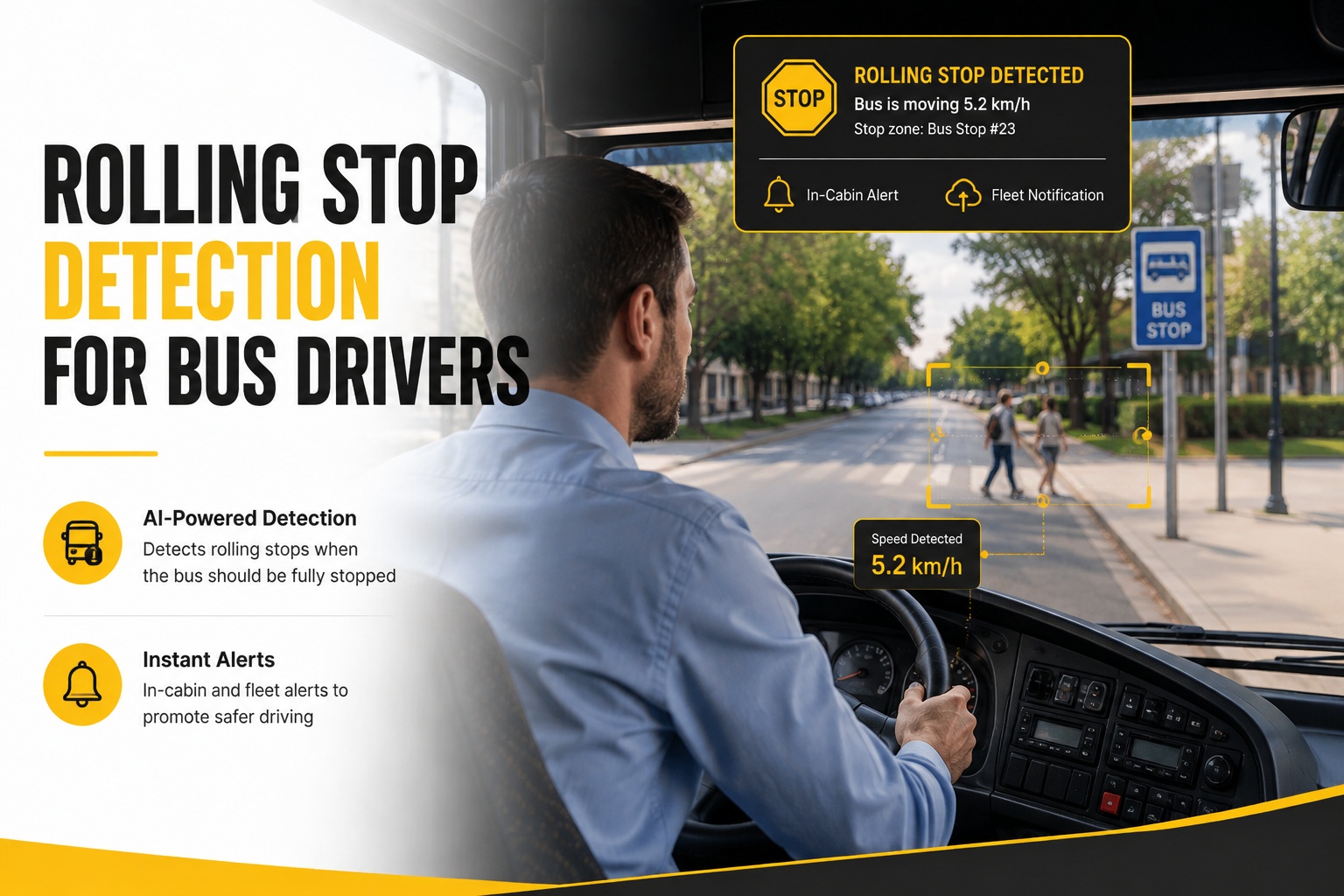
A rolling stop — slowing but not fully stopping before proceeding — is easy to miss on paper but easy to prove on video, and for a school bus specifically, it carries more liability than the same violation in a passenger car. Rolling stop detection uses AI to identify when a bus's wheels never reach a full stop at a stop sign or intersection, flagging the exact moment rather than waiting for a citation or a complaint to surface it. See how a rolling stop event reaches a work order in BusCMMS.
Rolling Stop Detection for Bus Drivers
Why a rolling stop means something different on a bus than on a car, how to map violations to specific intersections instead of specific drivers, and when the fix is a route change rather than a coaching conversation.
Detecting an Incomplete Stop
Detection logic works from wheel speed and position data cross-referenced against known stop-sign or stop-arm locations: did the bus's speed actually reach zero, and for how long, before proceeding. A momentary slow-roll through 3-4 mph that never truly reaches zero reads differently on video than a driver who might claim they stopped "close enough." About 480,000 yellow school buses cover roughly 4.4 billion miles a year (School Transportation News safety resources, retrieved Aug 2026), and at that scale, a rolling stop habit that seems minor on any single trip adds up to a lot of intersections crossed without a genuine full stop.
Why This Carries Outsized Liability on a Bus
The same rolling stop that draws a routine citation for a passenger car carries different weight when the vehicle is a school bus, especially at a rail crossing or a stop where the bus itself is required to come to a complete stop by law, not just yield right of way. A rolling stop by a bus in front of following traffic, or through a crossing where children are boarding or exiting nearby, creates a liability exposure that's disproportionate to the apparent minor nature of the violation — which is exactly why a district's insurance carrier and legal counsel tend to treat these events as more serious than a typical moving violation.
Route Redesign as a Mitigation, Not Just Driver Coaching
When rolling stop events cluster heavily at one intersection across multiple drivers, that pattern points to the intersection itself rather than any individual habit — a sightline obstruction, a downhill approach that makes a full stop feel unnecessary, or a stop sign positioned awkwardly relative to the actual hazard. In these cases, the most effective fix isn't more coaching, it's a route adjustment: approaching from a different direction, requesting a sign relocation from the local jurisdiction, or flagging the intersection to the district's route planning team for review. Coaching individual drivers at a genuinely problematic intersection treats a road design issue as a behavior issue, and it won't hold.
The Objection Worth Naming: Footage Overwritten Before Review
Here's the failure that quietly undermines a rolling stop program's usefulness: a complaint or citation reference surfaces days after the event, and by the time someone goes looking for the specific clip, the standard retention window has already overwritten it. This isn't a detection failure — the system may have correctly flagged the event in real time — it's a retention policy gap. Flagged rolling stop events need an automatic retention hold that pulls the clip out of the normal overwrite cycle immediately, so a delayed inquiry doesn't run into a dead end just when the footage is needed most.
Not sure which intersections on your routes generate the most rolling stop events? That's worth mapping. Talk to the team about an intersection review →
One Intersection, Three Drivers, the Same Pattern
A school district running 55 buses noticed rolling stop alerts clustering around one specific rural intersection on a downhill approach, generated by three different drivers rotating through that route over a semester. Individual coaching hadn't reduced the pattern. Once the transportation director mapped the events by location instead of by driver, the shared cause became obvious: a fast downhill grade combined with a stop sign set back from the actual intersection line. The district worked with the local road authority to add advance warning signage and adjusted the route to approach from a lower-grade side street; rolling stop events at that location dropped to nearly zero within two months, regardless of which driver was on the route.
"We coached three different drivers for the same intersection before realizing it wasn't a driver problem at all. Once we saw it was one location doing all the damage, fixing it took a route change, not another training session."
Transportation Director · 55-bus school district fleetOne Asset Timeline, Not a Separate Camera Log
BusCMMS is an AI-native bus fleet operations platform, and the wedge here is one chronological asset timeline per bus — inspections, defects, repairs, parts, fuel, and camera events all in a single record, not scattered across a maintenance system and a separate camera vendor's portal. A rolling stop event doesn't just get logged and forgotten; it sits on the same timeline as that bus's DVIR history and route assignments, so a transportation director reviewing a pattern sees the full picture — vehicle, route, and driver — in one place.
Frequently Asked Questions
Updated August 2026How does AI detect a rolling stop versus a full stop?
Detection cross-references wheel speed and position data against known stop-sign or stop-arm locations, checking whether the bus's speed actually reached zero and for how long before proceeding, rather than relying on a driver's account of having "basically stopped."
Why does a rolling stop carry more liability for a bus than a car?
A rolling stop at a location where the bus is legally required to fully stop — such as a rail crossing — or one that occurs near boarding or exiting students, creates a liability exposure disproportionate to how minor the violation looks on paper, which is why insurers and legal counsel often treat these events more seriously than a routine moving violation.
What does it mean when rolling stop events cluster at one intersection?
A cluster of events at one location across multiple drivers usually points to the intersection itself — a sightline issue, a downhill grade, or a poorly placed sign — rather than a shared driver habit, and often responds better to a route or signage change than to additional coaching.
Why does footage sometimes go missing when a rolling stop is investigated?
A complaint or citation reference can surface days after the event, by which point the standard retention window may have already overwritten the clip. Flagged rolling stop events need an automatic retention hold to pull that specific clip out of the normal overwrite cycle right away.
Is rolling stop detection required by federal regulation for buses?
No single federal mandate governs rolling stop detection technology. 49 CFR 396 maintenance records and district or agency policy set the general compliance bar, leaving adoption of monitoring systems to each operation's own safety program.