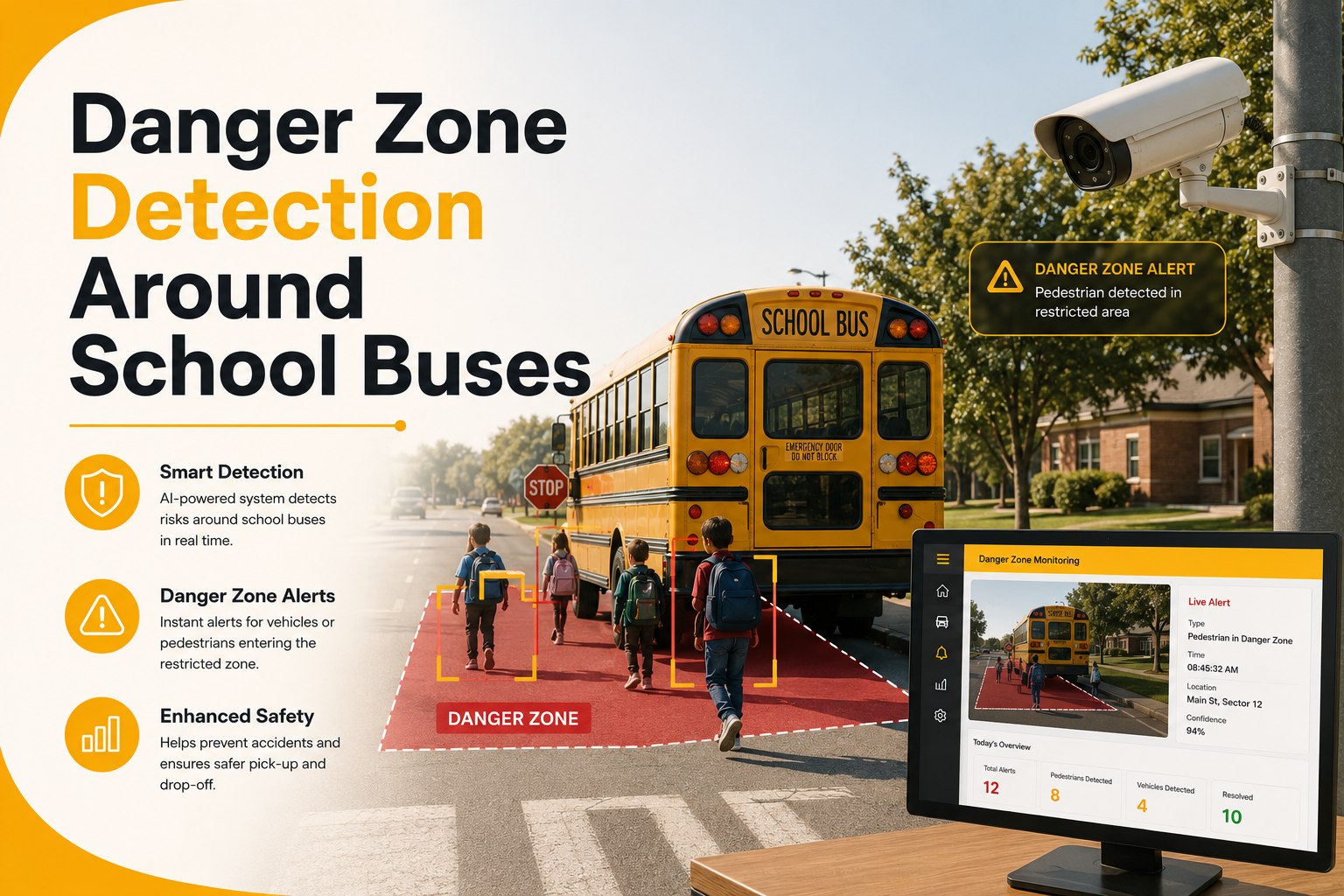
The danger zone is the 10-foot radius around a school bus — front, rear, and both sides — where a student is invisible to the driver and most at risk of being struck. School bus danger zone detection uses AI to spot a student still inside that blind area before the bus moves, alerting the driver in real time rather than relying on mirrors alone. See how a danger zone alert lands on the bus's asset timeline in BusCMMS.
Danger Zone Detection Around School Buses
The geometry of the danger zone on all four sides, how detection alerts a driver before the bus moves, and why review without coaching changes nothing.
Why This Fleet's Scale Makes the Blind Area a Real Risk
Millions of daily boarding-and-departure moments, each one a danger zone crossing.
About 480,000 yellow school buses carry roughly 26 million students every school day and cover some 4.4 billion miles a year — the largest passenger fleet in the United States (School Transportation News safety resources, retrieved Aug 2026). Nearly every one of those students crosses through a danger zone twice a day, once boarding and once departing. A driver relying on mirrors alone is working with a known blind spot at exactly the moment the bus is about to move — detection exists to close that specific gap, not to replace the driver's judgment.
Detecting a Student Before the Bus Moves
The alert has to happen before acceleration, not after.
Detection systems watch all four zones continuously while the bus is stopped and the door is open, looking specifically for a student still present in the blind area as the driver prepares to pull away. The alert needs to reach the driver before the bus begins moving — a warning that fires as the bus is already accelerating is too late to matter. Effective systems tie this directly to door state and gear position, so the alert window is active exactly when risk is highest, not running constantly as background noise the driver learns to ignore.
The Objection Worth Naming: Review Without Coaching Changes Nothing
A logged event that never reaches the driver is just a file.
The most common failure in danger zone programs isn't a detection gap — it's a process gap. Events get reviewed and filed, but never converted into an actual coaching conversation with the driver involved. When that happens, driver behavior never changes, the same near-miss pattern keeps recurring, and the program starts to feel like surveillance rather than a safety tool, which erodes driver buy-in fast. The fix isn't more detection — it's a short feedback loop: flagged event, brief review with the driver, documented conversation, done within days, not filed away for a quarterly report nobody reads.
A Scenario From a Real Bus Operation
A repeated pattern that only surfaced once coaching was added.
A school district running 90 buses had danger zone detection installed fleet-wide for over a year, generating a steady stream of logged events that the safety office reviewed weekly and filed. A new safety director pulled twelve months of data and found the same three drivers accounted for a disproportionate share of front-zone alerts — a pattern nobody had acted on because the events were being reviewed, not coached. After introducing a simple rule — any driver with two front-zone alerts in a month gets a fifteen-minute video review session — that group's alert rate dropped by more than half within the following semester.
We had a year of data sitting in a folder before anyone noticed the same drivers kept showing up in the front-zone alerts. Once we started actually sitting down with drivers and showing them the clip, it stopped feeling like we were watching them and started feeling like we were training them. That shift alone cut our repeat events by half.
Not sure if your danger zone events are actually reaching a coaching conversation? That gap is worth closing. Talk to the team about a program review →
One Asset Timeline, Not a Separate Camera Log
The wedge BusCMMS solves that a standalone camera vendor can't.
BusCMMS is an AI-native bus fleet operations platform, and the wedge here is one chronological asset timeline per bus — inspections, defects, repairs, parts, fuel, and camera events all in a single record, not scattered across a maintenance system and a separate camera vendor's portal. A danger zone alert doesn't just get logged and forgotten; it sits on the same timeline as that bus's DVIR history and work orders, so a safety director reviewing a bus's record sees the full picture in one place.
Frequently Asked Questions
What exactly is the school bus danger zone?
The danger zone is roughly the 10-foot radius around a school bus — front, rear, and both sides — where a student is outside the driver's direct line of sight and at highest risk of being struck, particularly while boarding or departing.
How does AI danger zone detection actually alert the driver?
The system monitors all four zones while the bus is stopped with the door open, and fires an alert to the driver if a student is still detected in a blind area before the bus begins moving, tied to door state and gear position so it activates exactly when risk is highest.
Why do some danger zone camera programs fail to change driver behavior?
The most common failure is a process gap, not a detection gap: events get reviewed and filed but never converted into an actual coaching conversation with the driver, so the same near-miss pattern keeps recurring and the program starts to feel like surveillance instead of training.
Which side of the bus has the most danger zone incidents?
The front zone and the loading-door side tend to see the highest activity, since most boarding and departure crossings happen there, but rear and far-side zones still require independent detection since blind-area incidents happen on all four sides.
Is danger zone detection required by federal or state law?
There's no single federal mandate requiring danger zone detection specifically. All 50 states prohibit passing a stopped school bus, and a growing number authorize automated stop-arm enforcement under state-specific enabling legislation tracked by NCSL, but danger zone camera systems themselves are typically a district or agency policy choice.