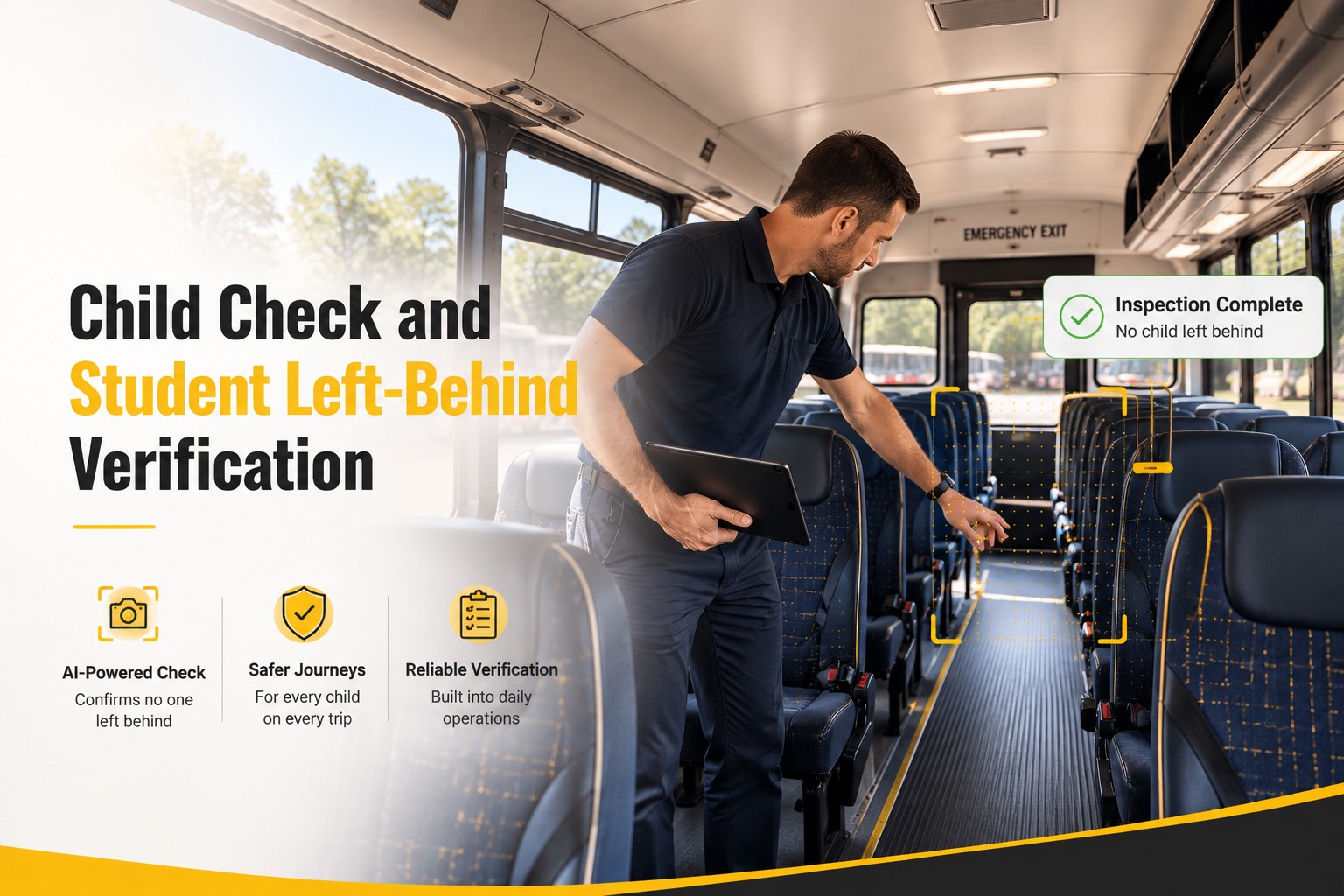
Child check verification confirms a driver actually walked the full length of the bus after the route ends and checked every seat, aisle gap, and wheelchair bay — not just that an alarm was silenced. Child check school bus programs pair a physical alarm with a synced camera clip, so a district can prove the sweep happened, not just that the reminder went off. See how a sweep, alarm, and clip land in one record in BusCMMS.
Child Check and Student Left-Behind Verification
Why the alarm alone can't prove a sweep happened, what the escalation chain does in the five minutes after a sweep gets skipped, and what a district's audit record actually needs to hold up.
Why the Post-Route Sweep Is Non-Negotiable
A missed child check isn't a paperwork problem. It's the scenario every transportation director dreads: a bus parked in the yard, engine off, and a student still in a seat. Nationally, unattended-child incidents on stopped vehicles trend upward every summer, which is exactly why most states now require a documented, alarm-triggered sweep instead of leaving it to a driver's memory at the end of a long route. The alarm itself is only half the system — a buzzer that sounds when the driver reaches the back of the bus proves they walked back there, not that they looked in every seat, under every seat, and in the wheelchair bay. That's the gap a camera-confirmed sweep closes.
How Camera Confirmation Turns an Alarm Into an Audit Record
A child-check alarm tells you a driver walked to the back of the bus. A camera clip tells you what they actually did once they got there. When the two are tied together in BusCMMS's inspection workflow, every sweep produces three things automatically: the alarm timestamp, a short video clip of the walk-through, and a driver-confirmed "bus clear" entry logged against that specific route and bus number. That's the record a state auditor or a parent's attorney will ask for — not "we have an alarm system," but the specific clip, on the specific date, for the specific bus.
What the Audit Record Actually Needs to Contain
State pupil-transportation inspection rules generally expect a district to show, on demand, that a check-for-occupants procedure exists and was followed — not just that a policy document exists in a binder. For a program to hold up, the record for each route needs the bus number, route, and driver tied to the specific sweep; the alarm timestamp and the confirmed clear; a camera clip of the physical walk-through; any escalation entries, including delayed or missed sweeps; and a signed-off pattern report a supervisor can review weekly, not just after an incident. This is also where BusCMMS's mobile inspection tools earn their keep — the check happens on the same device the driver already uses for the pre-trip and post-trip DVIR, so the sweep isn't a separate app or a separate habit to build.
Addressing the "This Is Just Surveillance" Objection
This is the objection every safety director hears from drivers, and it's fair if the camera footage only ever gets reviewed after something goes wrong. A child-check program that just stacks up clips nobody watches until an incident happens isn't a safety program — it's a liability folder, and drivers can tell the difference. The fix isn't fewer clips, it's turning the clips that show a gap — a rushed sweep, a missed row — into a short coaching conversation the same week, not a punitive review months later. Drivers who see the system catch a real near-miss and turn it into a five-minute correction, rather than a write-up, treat the sweep as a safety net instead of a trap.
Not sure if your current child-check alarm data is paired with any camera confirmation? That gap is worth closing. Talk to the team about a program review →
A Backpack, a Sleeping Student, and a Sweep-Pending Flag
A mid-sized district running an after-school activity route had a driver finish a run 20 minutes later than usual, tired, at the end of a double shift. The child-check alarm sounded at the back of the bus, but the driver's "clear" confirmation never came through — the bus sat in the yard, flagged as sweep-pending. Dispatch got the alert within two minutes, called the driver, and had them walk the aisle again on camera. A backpack and a sleeping student in the last row. The clip and the escalation log became the record the district used both to correct the immediate situation and to retrain that driver on end-of-route fatigue — not to punish, but to adjust the route schedule that had put them in that position.
"The alert fired, we called him back, and there was a kid asleep in the last row. Two minutes was the difference between a training conversation and a very different phone call. That's the whole reason the escalation chain exists."
Dispatcher · Mid-sized school district fleetRelated Reading
For the broader picture of how camera-based events fit into daily operations, see the AI video safety hub, or look at how illegal passing detection and rolling stop detection use the same camera-confirmation approach for other high-stakes moments on a route.
Frequently Asked Questions
Updated August 2026What is a child check on a school bus?
A child check is a required post-route walk-through where the driver physically inspects every seat, the aisle, and wheelchair areas to confirm no student is left on the bus, typically triggered and confirmed by an in-bus alarm system.
How does camera confirmation improve a child-check alarm?
The alarm proves a driver walked to the back of the bus. A synced camera clip proves what they actually did once they got there, giving the district a verifiable record instead of relying on the driver's word alone.
What happens if a driver skips or delays the sweep?
A well-built system flags the bus as "sweep pending" immediately, alerts a dispatcher or supervisor, and requires the driver to complete and log the check before the bus is moved again, with the delay itself recorded for review.
Do state rules require a documented child-check process?
Most states have pupil-transportation administrative rules requiring a documented post-trip inspection procedure, and many mandate a physical child-check alarm on new buses. Requirements vary by state, so districts should confirm the specific rule and effective date with their state pupil-transportation office.
Does recording every sweep feel like surveillance to drivers?
It can, if footage only gets reviewed after an incident. Programs that use clips for quick, same-week coaching rather than after-the-fact punishment tend to see drivers treat the sweep as a safety net rather than monitoring.