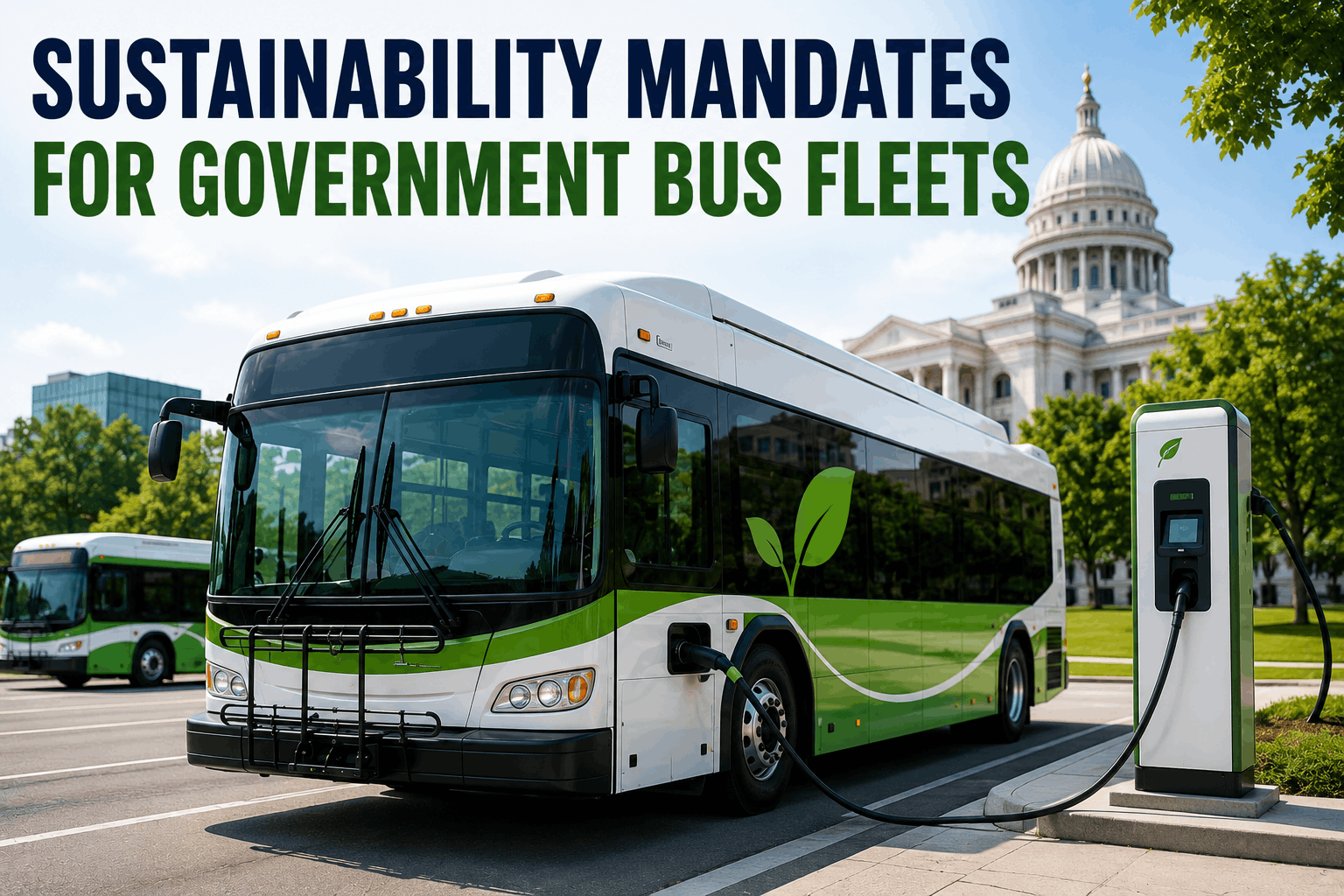
Public transit agencies face increasing green mandates. California requires 100% zero-emission buses by 2040. Federal grants increasingly favor electrification. EPA emissions rules continue tightening. Government fleets can no longer ignore the transition. The challenge: electric buses cost more upfront, battery replacement is expensive, and charging infrastructure requires major planning. Yet lifecycle costs can favor electrification through lower fuel and maintenance costs. This guide covers emissions mandates, electrification requirements, incentive programs, total cost of ownership analysis, and how to plan fleet electrification on budget constraints.
Green mandates are reshaping public transit. Learn compliance requirements and electrification costs for government fleets.
Federal and state mandates are accelerating electrification. Key regulations and programs include:
Evaluating battery electric buses purely on capital expenditure can distort planning. Over a standard municipal transit lifespan, reductions in fuel, fluid maintenance, and brake wear can offset part of the upfront premium.
| Cost Category | Clean-Diesel Baseline | Battery Electric Bus Projection | Net Savings / Delta |
|---|---|---|---|
| Initial Vehicle Procurement | $480,000 | $920,000 | Higher upfront EV cost |
| Mid-Life Powertrain Overhaul | $65,000 | $180,000 | Higher mid-life EV battery cost |
| Energy / Fuel Expenses | $380,000 | $115,000 | Operational gain |
| Scheduled Parts & Lubrication | $145,000 | $35,000 | Maintenance gain |
| Brake System Overhauls | $72,000 | $18,000 | Regenerative braking savings |
| Net Projected Lifecycle TCO | $1,142,000 | $1,268,000 | Gap narrows before incentives |
Incentives, grants, local energy rates, battery warranty terms, and depot charging strategy can shift the lifecycle balance significantly.
Procuring electric buses without charging infrastructure planning creates deployment risk. Grid hookups, civil engineering, and utility upgrades can take longer than vehicle manufacturing timelines.
Ideal for overnight sequential charging. Requires smart-charging software to control power draw and avoid peak-demand spikes.
Designed for opportunity charging at transit hubs or end-of-line terminals. Useful for routes that need fast mid-day charging.
A multi-bus yard may require major electrical service upgrades, dedicated switchgear, and early utility coordination.
Unlike combustion engines, battery electric buses must use battery energy for cabin conditioning and battery thermal control. Extreme weather can reduce practical route range.
Auxiliary HVAC Drain: Extreme heat or cold can reduce available route range due to passenger cabin heating or cooling demand.
Depot Grid Pre-Conditioning: Buses should pre-condition cabin and battery temperature while plugged in to reduce early-route battery drain.
Topography Mapping: Route planning should consider hills, stop frequency, regenerative braking potential, and seasonal energy demand.
The human side of fleet transition is critical. Diesel mechanics need training before working on high-voltage electric drivetrains and charging infrastructure.
Shop staff must understand arc-flash boundaries, high-voltage isolation, PPE, and safe handling of electric bus drivetrains.
Technicians must learn to interpret battery health, thermal alerts, charging logs, insulation faults, and cloud-based diagnostics.