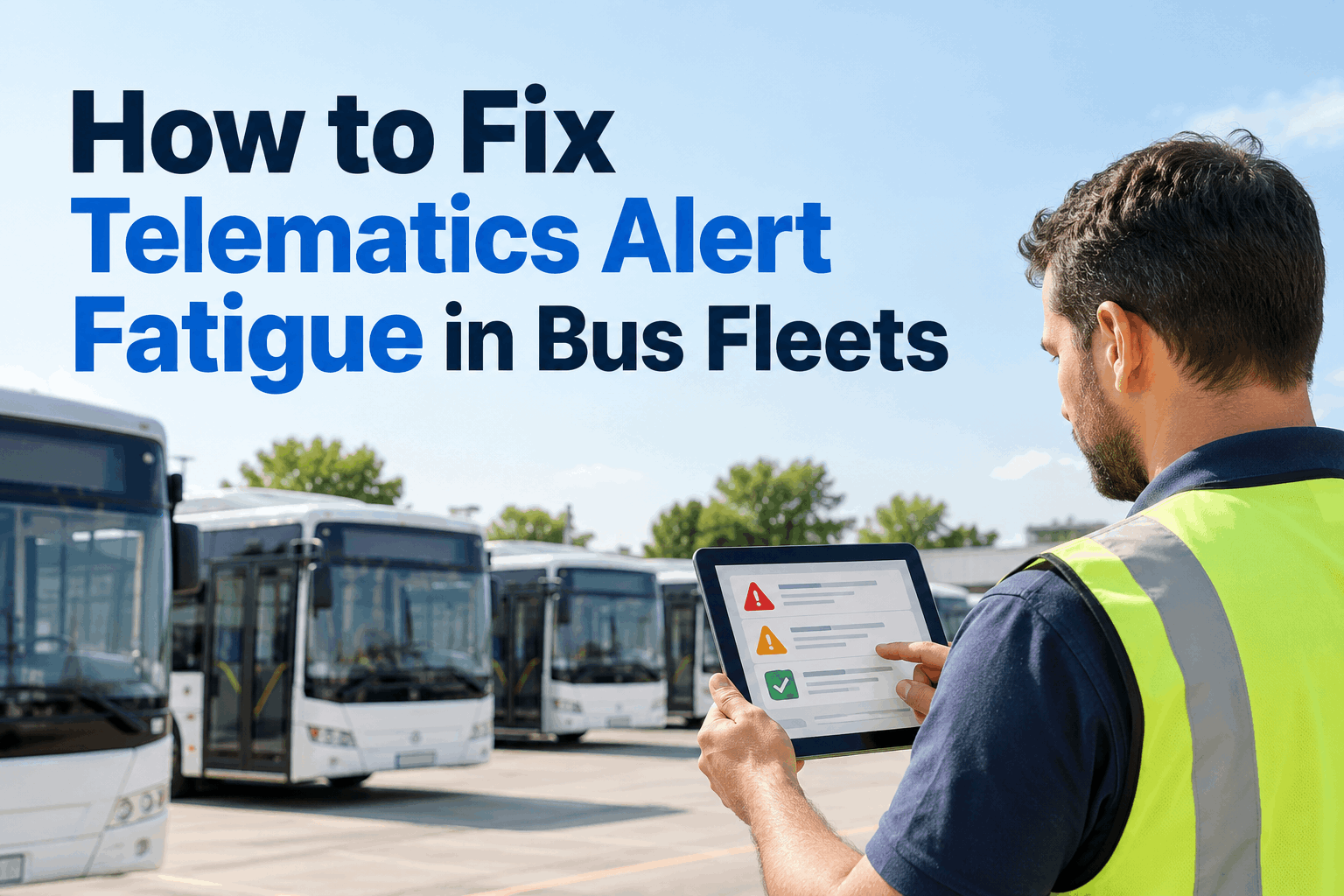
Your phone buzzed 40 times before lunch — idling warnings, a geofence ping, low-fuel notices and buried in there, one real fault code on a bus that needed the shop. By Thursday that bus is on the shoulder. That is telematics alert fatigue, and it is fixable. You can see how triaging telematics alerts surfaces the one that matters.
How to Fix Telematics Alert Fatigue in Bus Fleets
When every telematics notification pings with the same urgency, people stop reacting to all of them — and the real fault gets buried with the noise. Fixing telematics alert fatigue is not about turning alerts off. It is about filtering the noise, triaging by severity, and turning the alerts that matter into tracked work orders someone actually owns.
Why Telematics Alerts Get Ignored in the First Place
Alert fatigue is a system-design problem, not a discipline problem. Your team is not lazy for tuning out the forty-first notification of the morning — they are reacting rationally to a stream that treats a parked-vehicle speeding glitch the same as a failing brake. Four things turn a useful telematics feed into noise.
Sheer volume
Every rule you switch on adds notifications. A modest fleet can generate hundreds a week — far more than anyone can read, let alone act on.
No prioritization
A routine idling notice and a critical fault code arrive with the same ping. When everything looks urgent, nothing does.
False positives
A speeding event logged while the bus was parked, a duplicate fired five times — every false alarm trains people to trust the next alert a little less.
No owner or next step
An alert with no assigned person, no deadline, and no defined action is just a notification — easy to see, easy to swipe away, impossible to track.
The danger is not the noise itself — it is what the noise does to the signal. Research on vehicle warnings is blunt about it: once people learn that most alerts are nuisances, they start discounting the later ones too, including the real one. That is how a fault code dismissed on Monday becomes a breakdown on Thursday. You can start free and give every alert a severity and an owner.
What Your Alert Stream Actually Looks Like
Break a week of telematics alerts into what they really are, and the problem is obvious: the vast majority is low-value noise, and the handful that should stop a bus is a thin sliver buried at the end. The job is not to see more alerts — it is to find that sliver fast.
Proportions are illustrative of a typical mixed alert stream — your exact split depends on which rules are switched on. The pattern holds everywhere: critical alerts are a tiny fraction, which is precisely why they get lost.
The Fix: Filter, Triage, and Route Every Alert
Fixing alert fatigue means giving every incoming alert a job to do. Instead of landing on one phone with equal weight, each alert is classified by severity and routed to the right response — suppressed, logged, or turned into a work order with an owner. Here is the triage logic.
The win is trust: when the only alerts that reach a person are the ones with a real action attached, people start responding to them again. A buzz on the phone means something once more. You can book a demo and see fault-code triage routing alerts to work orders.
How BusCMMS Cuts Telematics Alert Fatigue
The telematics box keeps generating alerts — that is its job. What changes is the layer between it and your team. BusCMMS sits on your telematics feed and does four things to turn the flood into a short, trusted list.
Filters out the noise
Duplicate alerts, nuisance geofence pings, and notices with no defined response are suppressed before they ever reach a phone — so what is left is worth reading.
Ranks by severity
Every alert is classified — critical, high, advisory — so a brake fault never shares a line with an idling notice, and the urgent ones rise to the top.
Turns real faults into work orders
A fault code that matters becomes a work order with the bus, the component, and an owner already attached — not a notification someone has to remember to act on.
Closes the loop
Each alert that becomes work is tracked to completion, so nothing is just acknowledged and forgotten — the loop closes, and the record proves it did.
The result is a team that trusts its alerts again, because the ones that reach them are real and already halfway to resolved. That is the difference between a telematics feed that creates work and a maintenance system that manages it — worth seeing on your own alert stream in a short walkthrough of alert triage.
Honestly, we had turned the telematics notifications off on half the phones in the shop — there were too many to mean anything. Which of course meant we missed a real one and paid for it. Once the alerts started coming in ranked, with the junk filtered out and the real faults already opened as work orders, people turned notifications back on. Now a ping actually means go look at a bus.
Fixing Telematics Alert Fatigue: The Short Version
Fatigue is a design problem
People tune out alerts because the system treats a glitch and a brake fault the same — not because they are careless.
The critical alert is a sliver
Most of the stream is noise and duplicates; the alert that should stop a bus is a tiny fraction, which is why it gets lost.
Filter, triage, route
Suppress the noise, rank by severity, and send each alert to the right response — ground, work order, log, or nothing.
Work orders rebuild trust
When real faults arrive as owned, tracked work orders, a ping means something again — and nothing slips through.
Telematics alert fatigue is not a reason to run fewer alerts — it is a reason to run them through something smarter than a notification setting. Filter the noise, triage by severity, and turn the alerts that matter into tracked work orders, and your fleet gets the early warning telematics promised without the flood that made everyone stop listening. You can start free and turn your alert flood into a short, trusted list.
Telematics Alert Fatigue: Common Questions
What is telematics alert fatigue?
Telematics alert fatigue is what happens when a fleet's tracking and diagnostic systems generate so many notifications — idling notices, geofence pings, duplicate warnings, fault codes — that the people receiving them stop reacting. Because routine and critical alerts arrive with the same urgency, the brain starts treating all of them as background noise. The real danger is that a genuine fault gets dismissed along with the nuisance alerts, turning an early warning into a breakdown.
Why do fleet managers ignore telematics alerts?
Not out of carelessness — out of self-defense against volume. When a system fires hundreds of alerts a week and treats a parked-vehicle glitch the same as a failing brake, there is no way to tell signal from noise at a glance, so people tune out. Research on vehicle warnings confirms it: once people learn that most alerts are false or trivial, they discount the later ones too. It is a system-design problem, which is why the fix is better filtering and prioritization, not telling people to pay closer attention.
How do you reduce telematics alert overload without missing real faults?
You filter, triage, and route. Filtering suppresses duplicates, nuisance alerts, and notices with no defined response. Triage classifies what remains by severity, so critical alerts rise above advisory ones. Routing sends each alert to the right action — a critical fault grounds the bus, a real fault code opens a work order with an owner, an advisory is logged, and noise is suppressed. Done right, you see fewer alerts and catch more real faults, because the signal is no longer buried.
How does fault code triage help with alert fatigue?
Fault code triage is the core of the fix. Instead of every diagnostic code pinging a phone, each is classified by how serious it is and what response it needs. A severe code becomes an immediate, high-priority work order; a minor or recurring one is logged and watched for a trend; a known-nuisance code is suppressed. That turns a raw stream of codes into a ranked, actionable list, so the shop works the faults that matter in order instead of scrolling past them.
Can BusCMMS filter and prioritize my telematics alerts?
Yes. BusCMMS connects to your telematics feed, suppresses duplicate and low-value alerts, ranks the rest by severity, and turns real fault codes into work orders with the bus, component, and an owner attached. The alerts that reach your team are the ones with a genuine action behind them, and each is tracked to completion so nothing is just acknowledged and forgotten. It keeps this alongside your preventive maintenance and inspections on one bus-specific dashboard, so alert management is part of how the whole fleet is run.