Your Samsara dashboard shows Bus #33 has a fault code. Your Geotab map shows Bus #19 idled for 47 minutes at Jefferson Elementary. Your Zonar EVIR shows Bus #27's stop arm light is dim. Three platforms. Three dashboards. Three data streams. Zero work orders. The telematics captured the problem. Nobody fixed it. Because GPS tracking without a maintenance system is just expensive surveillance — you know exactly where the bus broke down, but you didn't prevent it from breaking down. 78% of fleets plan to increase telematics spending in 2026. The question isn't whether to invest in telematics. It's whether the data actually reaches your mechanic. We compared the 5 leading bus fleet telematics providers on the criteria that matters most: what happens after the data is captured.
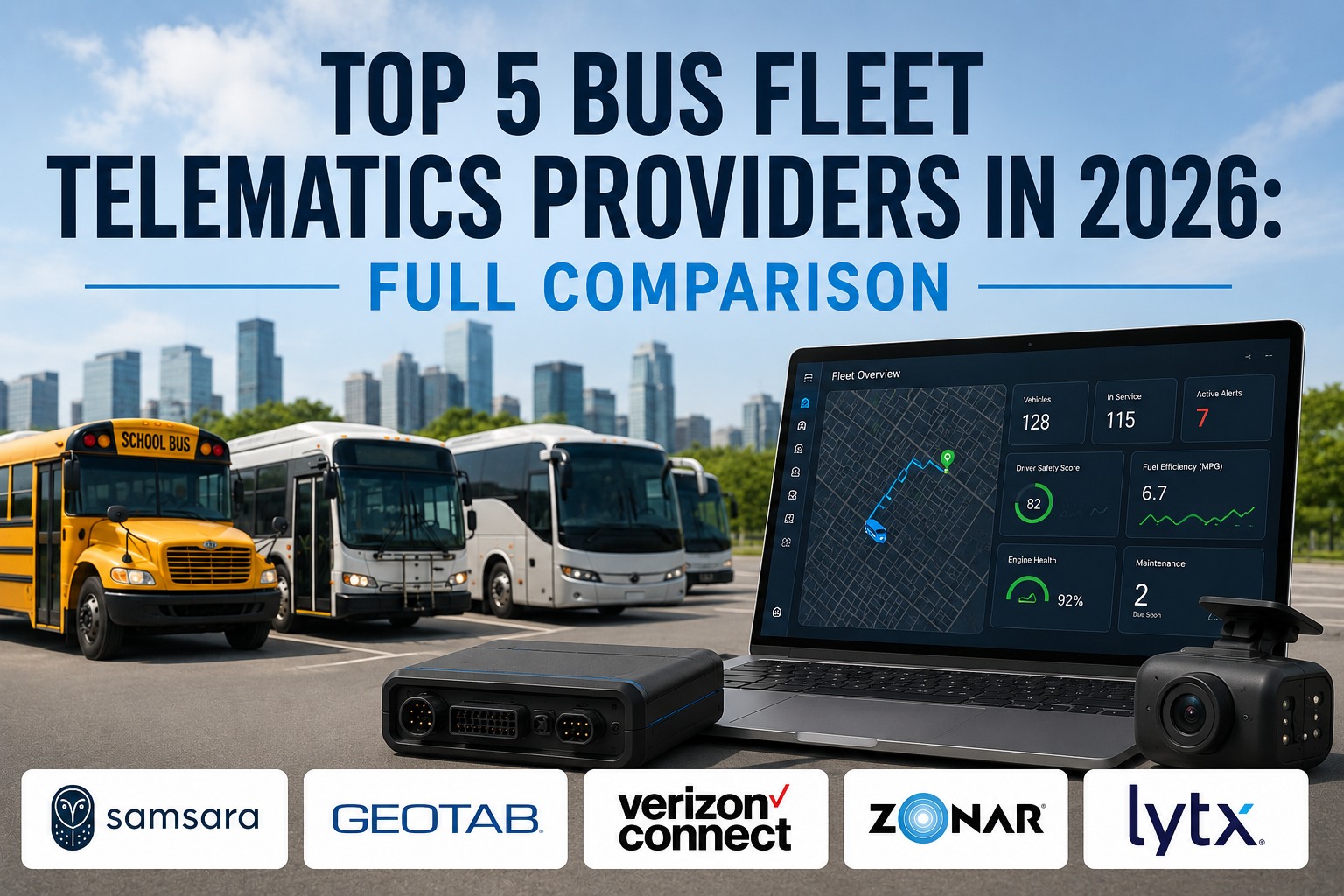
Top 5 Bus Fleet Telematics Providers in 2026: Full Comparison
Samsara, Geotab, Verizon Connect, Zonar, and Lytx — compared on GPS accuracy, bus-specific features, CMMS integration, AI capabilities, and cost for school districts and transit agencies.
The Data Gap Most Fleets Have
GPS captures fault code
Data hits telematics dashboard
Nobody creates a work order
Bus breaks down on route
BusCMMS closes the gap: fault code → work order → repair — automatically
The 5 Providers Compared — Ranked for Bus Fleets
Every provider does GPS tracking well. The differences show up in bus-specific features, AI capability, CMMS integration depth, and what the platform costs a 50-bus school district. Here's how they stack up:
Samsara
Best Overall TelematicsUnified IoT platform with AI dashcams, real-time GPS, fault code streaming, driver safety scoring, and the richest API ecosystem. 84% user satisfaction — highest in the industry.
Strengths
AI dashcams detect unsafe driving, distraction, and near-miss events
Fault codes stream in real time — DTC to dashboard in seconds
Native BusCMMS integration — fault codes auto-create work orders
Limitations
Hardware + subscription = $20–50/vehicle/mo — expensive for districts
Maintenance module is secondary — needs BusCMMS for full CMMS depth
Complexity can overwhelm smaller operations without dedicated admin
Hardware ~$99–$149/vehicle + $20–50/vehicle/mo
Geotab
Best Open Data PlatformWorld's largest commercial telematics provider with 4.5M+ connected vehicles, 75+ data parameters, and 430+ marketplace integrations. The richest vehicle data of any platform.
Strengths
75+ data parameters per vehicle — deepest diagnostic data available
Open platform with 430+ marketplace integrations including BusCMMS
EV battery health monitoring for electric bus fleets
Limitations
Dashcam is add-on (Lytx or Surfsight) — not built-in like Samsara
MyGeotab interface has a learning curve — not as intuitive as Samsara
Requires separate CMMS for maintenance workflows
$15–25/vehicle/mo + hardware · Reseller pricing varies
Zonar Systems
Best for Student TransportationRFID-verified EVIR inspections, Z Pass student ridership tracking, and tamper-proof compliance records. The most school bus-specific telematics provider on the market.
Strengths
RFID-verified inspections prove driver physically touched each checkpoint
Z Pass student ridership tracking with parent notifications
99% customer retention — highest in the school bus segment
Limitations
Proprietary ecosystem — limited third-party CMMS integration
Quote-based pricing with hardware requirements
Maintenance features are basic — needs external CMMS for depth
Quote-based · Typically $10–20/bus/mo + hardware
Verizon Connect
Best Enterprise InfrastructureEnterprise fleet tracking backed by Verizon network infrastructure. Strong compliance tools, workforce management, and scheduling modules.
$20–40/vehicle/mo · Multi-year contracts typical
Lytx
Best AI Video SafetyIndustry leader in AI-powered video telematics. Unmatched dashcam technology with MV+AI event detection, risk scoring, and structured driver coaching workflows.
Quote-based · Typically $25–45/vehicle/mo + camera hardware
See how BusCMMS connects to your telematics provider — book a demo
The Piece Every Telematics Provider Is Missing: CMMS
All 5 providers track location, driver behavior, and vehicle diagnostics. None of them are a CMMS. None manage work orders, PM schedules, parts inventory, per-bus cost tracking, or DOT compliance documentation. Telematics answers "where is the bus and what's wrong?" CMMS answers "what do we do about it?"
Telematics Does
GPS location and route tracking
Fault code detection (J1939/J1708)
Driver behavior and safety scoring
Dashcam and video evidence
Odometer and engine hour streaming
Idle time and fuel consumption data
+
BusCMMS Does
Fault codes → automatic work orders
Odometer → auto-triggered PM schedules
Digital DVIRs with defect-to-repair routing
Per-bus cost tracking and replacement alerts
DOT compliance and audit-ready reporting
Parts inventory and vendor management
Already have telematics? BusCMMS connects to it.
BusCMMS integrates natively with Samsara, Geotab, and Verizon Connect — fault codes auto-create work orders, odometer readings auto-trigger PM, idle time feeds fuel reports. Connect in one afternoon. Zero custom development.
No telematics yet? BusCMMS works without it.
BusCMMS is a standalone CMMS. Your drivers enter odometer readings during DVIRs. Your mechanic logs work orders on their phone. PM schedules trigger from mileage, calendar, or engine hours — entered manually or synced from GPS. You don't need telematics to start. Add it later and the integration activates instantly.
The best bus fleet setup in 2026 pairs a telematics provider (for real-time data) with BusCMMS (for maintenance action). But if your district isn't ready for telematics yet — BusCMMS delivers digital DVIRs, work order management, PM scheduling, per-bus cost tracking, and DOT compliance as a standalone system. Start with BusCMMS today. Add telematics when budget allows. The integration activates in one afternoon — and every data point your GPS captures immediately becomes a maintenance action.
Have GPS? Connect it. Don't have GPS? Start without it — sign up now
Telematics Captures the Problem. BusCMMS Fixes It. Or Start Without GPS — BusCMMS Works Standalone.
Already have Samsara or Geotab? Connect it — fault codes become work orders, odometer triggers PM, idle time feeds reports. All automatic. No telematics yet? BusCMMS runs independently with digital DVIRs, work orders, PM scheduling, cost tracking, and DOT compliance. Start today. Add GPS later. The integration activates instantly.
"We had Samsara on every bus for 2 years. Incredible GPS data, great dashcams, fault codes streaming 24/7. But nobody was acting on the maintenance alerts — they just sat in the Samsara dashboard. When we connected BusCMMS, every fault code became a work order. Every odometer reading triggered PM schedules. Our mechanic started getting repair tickets 30 seconds after a fault fired instead of finding out when the bus broke down. Same Samsara data. Completely different outcome."
78% of fleets are increasing telematics spending in 2026. If you're investing $20–50/vehicle/month in GPS and not connecting it to a CMMS, you're paying for data nobody uses. Every fault code sitting in a dashboard is a breakdown waiting to happen. BusCMMS integration takes one afternoon to set up. The ROI shows in the first prevented breakdown.
The telematics market in 2026 is mature — all 5 providers deliver solid GPS tracking, driver monitoring, and fault code capture. The differentiation isn't in the data anymore. It's in what happens after. Samsara and Geotab generate the richest vehicle data in the industry. But neither manages work orders, PM schedules, parts inventory, or DOT compliance at the depth a bus fleet requires.
The winning stack for school districts and transit agencies: pick your telematics provider based on what you value most (Samsara for AI cameras, Geotab for data depth, Zonar for student tracking, Lytx for video safety) — then connect it to BusCMMS for maintenance, compliance, and cost tracking. If you don't have telematics yet, start with BusCMMS standalone — digital DVIRs, PM scheduling, work orders, and compliance reporting work without GPS. When you add telematics later, the integration activates in one afternoon and every data point immediately becomes a maintenance action.
All 5 telematics providers — Samsara, Geotab, Zonar, Verizon Connect, and Lytx — capture excellent vehicle data. None are a CMMS. If you have telematics, connect it to BusCMMS and turn every fault code into a work order, every odometer reading into a PM trigger. If you don't have telematics yet, BusCMMS works standalone — digital DVIRs, PM scheduling, work orders, cost tracking, and DOT compliance. Start where you are. The platform scales with you.
Connect your telematics to a CMMS that acts on it — book a demo
With GPS or Without — BusCMMS Runs Your Maintenance.
Have Samsara or Geotab? Connect and automate — fault codes to work orders, odometer to PM triggers. No telematics yet? BusCMMS works standalone with digital DVIRs, PM scheduling, work orders, cost tracking, and compliance. One platform. Every bus covered. Start in one afternoon.
Do I need both telematics and a CMMS?
They serve different functions but BusCMMS does not require telematics. Telematics (Samsara, Geotab, Zonar) tracks where buses are, monitors driver behavior, and captures fault codes. BusCMMS manages maintenance — work orders, PM scheduling, digital DVIRs, parts inventory, per-bus cost tracking, and DOT compliance. BusCMMS works as a complete standalone system — your drivers enter odometer readings during DVIRs and your mechanic logs work orders on their phone. When you add telematics, BusCMMS connects natively and automates what was previously manual: fault codes auto-create work orders, odometer readings auto-trigger PM, and idle time feeds fuel reports. Better together — but BusCMMS delivers full value on its own.
Which telematics providers does BusCMMS integrate with?
BusCMMS integrates natively with Samsara and Geotab — the two largest commercial telematics platforms. Fault codes stream into BusCMMS and auto-create work orders. Odometer readings auto-trigger PM schedules. Idle time feeds fuel reports. Zero custom development required. If your fleet uses Zonar or another provider, BusCMMS can receive data through API connections.
How much does bus fleet telematics cost?
Samsara: $20–50/vehicle/mo + hardware ($99–149). Geotab: $15–25/vehicle/mo + hardware (reseller pricing). Zonar: $10–20/bus/mo + hardware (quote-based). Verizon Connect: $20–40/vehicle/mo (multi-year contracts). Lytx: $25–45/vehicle/mo + camera hardware. For a 50-bus district, annual telematics costs range from $9,000 to $30,000 depending on provider and features. Add BusCMMS for the maintenance layer.
Which provider is best for school bus fleets?
Zonar is the most school bus-specific with RFID-verified inspections and Z Pass student tracking. Samsara is the most capable overall with AI dashcams and the strongest BusCMMS integration. Geotab offers the deepest data parameters and best value. The best choice depends on your priority: student tracking (Zonar), AI safety (Samsara), or data depth (Geotab). All three pair with BusCMMS for maintenance.
How long does telematics + CMMS integration take?
BusCMMS native integration with Samsara or Geotab takes one afternoon to set up: connect your telematics account, map your buses, and fault codes start flowing. PM triggers activate from the first odometer sync. Most fleets are fully connected within 24 hours. No custom development, no IT department, no hardware installation beyond what your telematics provider already installed.