Last month, 3 buses in your fleet broke down on routes. Your mechanic spent 45 minutes finding Bus #37's brake records for a DOT inspector. You approved $22,000 in emergency repairs that a $200 PM inspection would have prevented. And somewhere in your office, a spreadsheet with 47 tabs is pretending to be a maintenance management system. These aren't growing pains — they're symptoms. And they are costing your fleet $6,000–$9,600 every single month.
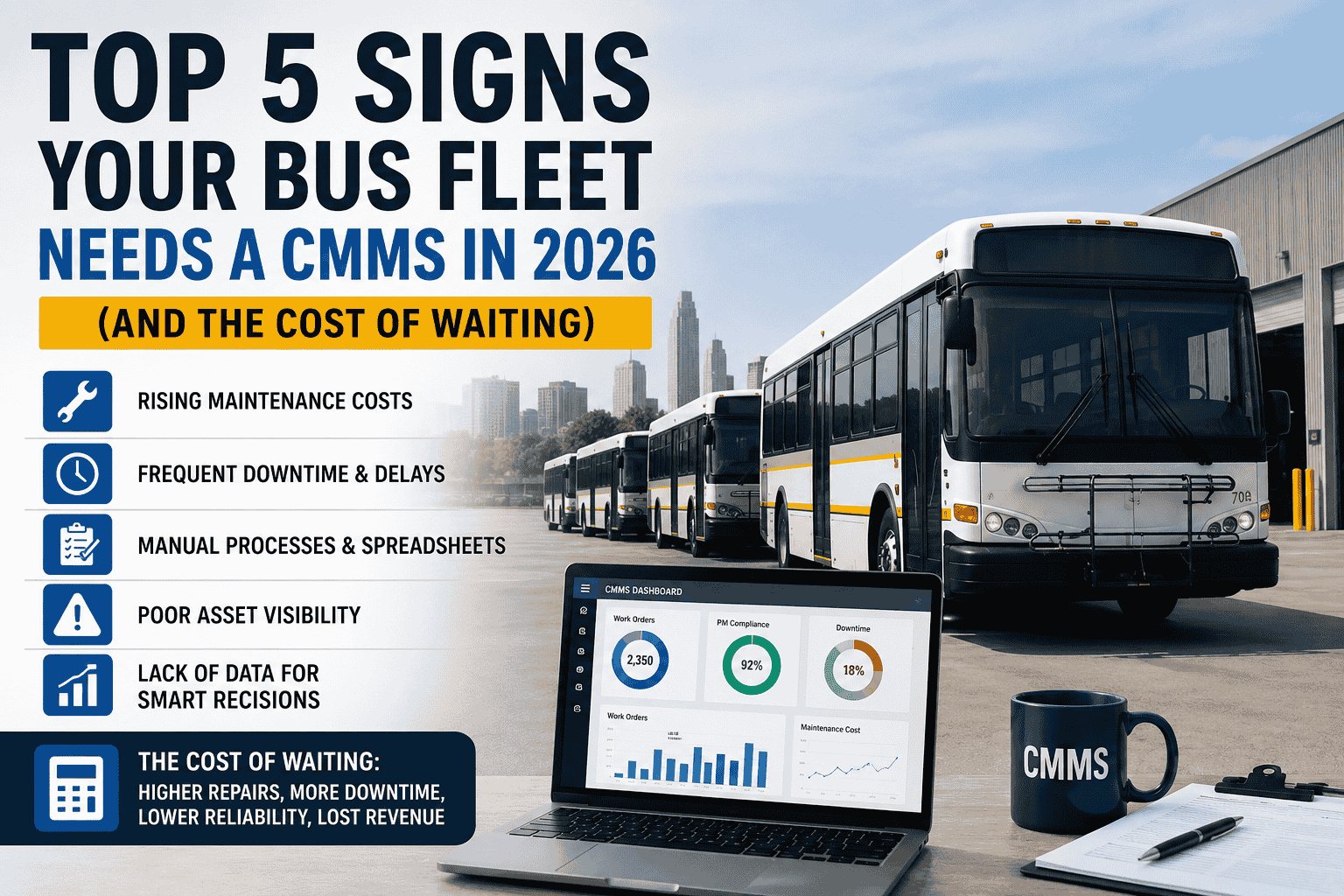
Top 5 Signs Your Bus Fleet Needs a CMMS (And the Cost of Waiting)
Count how many signs you recognize. If it's 3 or more, your fleet is bleeding money that stops the day you switch.
Your Fleet's Diagnosis
Count your signs as you scroll. The number tells you how urgently you need to act.
of bus fleets in 2026 track maintenance manually — spreadsheets, paper, or memory
reactive repairs cost compared to the same fix caught during scheduled PM
of fleets achieve full CMMS payback within the first 12 months
in direct + indirect costs per bus grounded from unplanned downtime
Manual vs CMMS: What Changes Overnight
Without CMMS
With BusCMMS
You're Reacting to Breakdowns Instead of Preventing Them
The Symptom
Buses break down on routes. Your shop is always in crisis mode. PM schedules exist on paper but get skipped because something's always more urgent. More than half your maintenance is unplanned.
What It Costs
Reactive repairs cost 4–5x more than planned. A $200 PM catches a $50 belt before it becomes a $3,000 roadside breakdown + $1,500 towing. Fleets below 50% planned maintenance spend 35–45% more annually.
BusCMMS Fix
Multi-trigger PM — mileage, engine hours, calendar. Whichever fires first auto-generates the work order. No forgotten PMs. Fleets hit 80–85% planned maintenance within 90 days.
You Can't Pull a Bus's History in Under 60 Seconds
The Symptom
DOT inspector asks for Bus #37's brake records. Your mechanic disappears into filing cabinets for 30–45 minutes. Records are misfiled, missing, or the spreadsheet row was deleted.
What It Costs
DOT fines: $1,500–$16,000 per violation. Out-of-service orders ground buses. Admin wastes 10+ hrs/week filing and searching records a CMMS generates automatically.
BusCMMS Fix
Every inspection, work order, part, and labor hour — timestamped per bus. Search any history in 30 seconds. Audit report in 2 minutes. Digital DVIRs with automatic retention.
You Don't Know Your Cost Per Mile — or Cost Per Bus
The Symptom
You know total spend. You don't know which buses cost the most, which routes cause the most wear, or when to replace vs repair. Budget season is guesswork. Board questions have no data behind them.
What It Costs
Fleets pour $15,000–$20,000/year into buses worth $8,000. Buses over 10 years = 12% of miles but 33% of maintenance spend. Without per-bus data, you can't make replacement decisions.
BusCMMS Fix
Per-bus cost tracking from day one. Cost-per-mile auto-calculates. Replacement alerts at $0.60–$0.75/mile. Budget reports by bus, system, route — instant and defensible.
Drivers Report Defects That Never Get Fixed
The Symptom
Driver reports a check engine light on the DVIR. Paper gets filed. Nobody creates a work order. Three weeks later, the bus breaks down. The defect-to-repair pipeline has gaps bigger than buses.
What It Costs
Every unfixed defect grows. The check engine light becomes a $4,200 head gasket. The brake squeal becomes a $3,000 rotor job. Downtime: $448–$760/day per bus out of service.
BusCMMS Fix
Driver flags defect on digital DVIR → auto-creates prioritized work order → assigned, timestamped, tracked. Bus flagged until repair certified. Zero paper gaps. Zero forgotten defects.
Your Spreadsheet Has Become a Full-Time Job
The Symptom
Someone spends 10–15 hours/week updating a 47-tab spreadsheet. Formulas break. Rows get overwritten. No mobile access. One accidental delete from disaster. It started as a tracker — now it's a liability.
What It Costs
At $25/hr, maintaining the spreadsheet costs $13,000–$19,500/year. And it still can't auto-generate work orders, send PM alerts, track inventory, or produce audit reports.
BusCMMS Fix
One dashboard replaces 47 tabs. PMs auto-schedule. Work orders auto-generate. Parts auto-decrement. Reports auto-produce. The admin who maintained the spreadsheet now manages the fleet.
The Cost of Waiting: Every Month Without a CMMS
Every month without a CMMS costs your 50-bus fleet $6,100–$9,600. BusCMMS costs a fraction of one month's waste.
How Many Signs Did You Count?
3 or more = your fleet is past the tipping point. Every month costs $6,000–$9,600 in avoidable waste. BusCMMS deploys in 2–4 weeks. Savings start month one. Free 14-day trial. No credit card.
"We checked all 5 boxes. Every one. Our spreadsheet had 52 tabs. We'd lost 3 DOT records. Two buses were 8,000 miles past PM. We spent $14,000/month on reactive repairs for 44 buses. Within 90 days of BusCMMS: PM compliance went from 40% to 87%. Reactive repairs dropped 62%. We found $11,000 in missed warranty claims. The admin who spent 15 hours/week on the spreadsheet now spends 2 hours on reports that are 10x more useful."
Every sign you recognized is costing you money right now. Not next quarter. Right now. The CMMS deploys in 2–4 weeks. Savings start month one. The cost of the software is less than what you lose in a single breakdown.
The 5 signs aren't independent — they're a cascade. Missed PMs cause breakdowns. Breakdowns create emergency repairs you can't track. Defects go unfixed because the paper pipeline has gaps. The spreadsheet can't keep up, so records vanish. One feeds the next. A CMMS breaks the cascade at every point. BusCMMS is purpose-built for bus fleets — pre-loaded DVIRs, fuel-type PM templates, native telematics integration. Deploys in 2–4 weeks. Free 14-day trial.
If your fleet shows 3+ signs, manual tracking is costing you $73,000–$115,000/year. BusCMMS stops the bleeding — automated PM, digital DVIRs, per-bus cost tracking, instant compliance reports, one dashboard replacing your spreadsheet. Deploys in 2–4 weeks. 47% of fleets achieve ROI within 12 months.
The Cost of Waiting Is Higher Than the Cost of Starting.
Free 14-day trial. No credit card. 2–4 week deployment. Pre-loaded bus PM templates. Digital DVIRs. Auto work orders. Per-bus cost tracking. One dashboard. Every bus. Start today.
How do I know if my fleet actually needs a CMMS?
If more than 50% of maintenance is unplanned, you spend 10+ hrs/week on spreadsheets, can't find bus history in 60 seconds, or have DOT compliance gaps — you need one. Fleets showing 3+ signs lose $73,000–$115,000/year in avoidable costs.
How long does BusCMMS take to implement?
2–4 weeks: import vehicles, configure PM schedules, set up DVIRs, load parts, train team. Most run inspections within 48 hours. Full PM automation live in 2 weeks.
What ROI can I expect?
47% of fleets hit positive ROI within 12 months. Typical: 25–35% lower maintenance costs, 40% fewer breakdowns, 20%+ technician productivity gains. 50-bus fleet saves $30,000–$43,000/year. ROI in 4–8 months.
Can I keep my spreadsheet while testing BusCMMS?
Yes, but you won't want to. BusCMMS imports via CSV — vehicles, history, schedules. Within a week most teams stop using the spreadsheet because BusCMMS does everything it did plus auto-schedules, auto-generates work orders, tracks parts, and produces reports.
Is BusCMMS built specifically for bus fleets?
Yes — the only CMMS built exclusively for buses. Pre-loaded school bus DVIRs (stop arms, crossing gates, emergency exits), fuel-type PM schedules (diesel, propane, electric, CNG), DOT compliance calendars, and native Samsara/Geotab integration. No configuration needed.