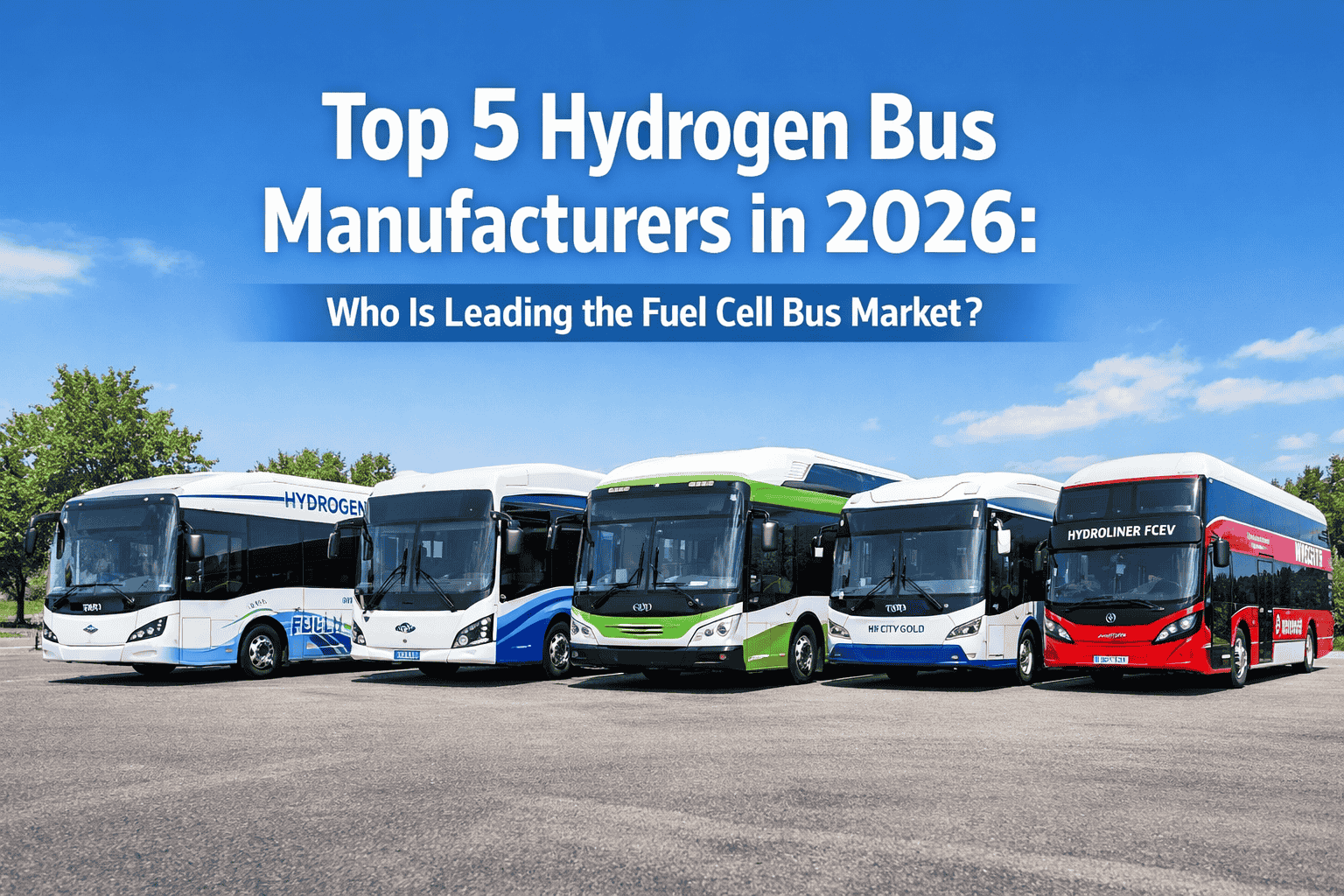
The fuel cell bus market is accelerating—projected to reach $2.98 billion by 2030 with a 21.6% CAGR. But with multiple manufacturers competing for market share, which hydrogen buses actually deliver? We analyzed real-world deployments, range performance and total cost of ownership to rank the top 5 hydrogen bus manufacturers you should know in 2026.
The Rankings: Top 5 Hydrogen Bus Manufacturers
Urbino 12/18 Hydrogen • Poland
Dominant market share with 425+ buses delivered. Largest order: 130 units to Bologna. First manufacturer to win Bus of the Year for both battery, and hydrogen buses.
Elec City FCEV / Universe FCEV • South Korea
Best-in-class range with 2026 Universe. Secured 2,000-bus domestic order. Testing at Saudi Arabia's NEOM project (2,080m elevation, 24% grades).
Xcelsior CHARGE FC • USA/Canada
Proven platform with 22,000+ Xcelsior buses delivered. New 4-tank extended range option adds 120 miles. Conquered San Francisco's 16% grade hills.
H2.City Gold • Japan/Portugal
Only manufacturer offering compact 10.7m hydrogen bus. Toyota fuel cell pedigree with new CRRC platform. Expanded lineup unveiled at Busworld 2025.
Streetdeck Hydroliner 2.0 • United Kingdom
World's first hydrogen double-decker. Hydroliner 2.0 delivers 5% more capacity with lower costs. Europe's fastest-growing bus manufacturer.
Head-to-Head Comparison
| Manufacturer | Top Range | Refuel Time | Best For |
|---|---|---|---|
| Solaris | 600 km | ~20 min | European urban transit |
| Hyundai | 960 km | ~15 min | Long-distance/intercity |
| New Flyer | 490 mi | 6-20 min | North American transit |
| CaetanoBus | 400 km | ~9 min | Compact urban routes |
| Wrightbus | 1,030 km | ~10 min | UK/double-decker markets |
Choosing the right hydrogen bus depends on your specific routes, infrastructure, and operational needs. Longer routes favor Hyundai's range leadership, while urban operators may prefer Solaris's proven platform.
Managing a mixed fleet of diesel, electric, and hydrogen buses? Start your free trial to track maintenance costs across all powertrain types—or book a demo to see fleet-wide TCO analysis in action.
The Economics: What Does Hydrogen Actually Cost?
12-Year TCO Per Bus (Estimated)
*Hydrogen TCO highly dependent on local H2 price ($4-12/kg) and infrastructure availability.
Hydrogen vs. Electric: When Does H2 Make Sense?
Choose Hydrogen When:
- Routes exceed 250+ km daily
- Rapid refueling essential (under 15 min)
- Extreme cold climate operations
- Limited depot charging capacity
- Green hydrogen locally available
Choose Electric When:
- Routes under 200 km daily
- Overnight charging feasible
- Electricity rates under $0.15/kWh
- Lower TCO priority
- Established charging infrastructure
The hydrogen vs. electric debate isn't about one winning—it's about matching technology to use case. Many fleets are deploying both: battery-electric for predictable urban routes and hydrogen for longer-range operations. Learn how to track costs across mixed fleets with modern CMMS tools.
What's Coming: 2026-2027 Pipeline
Ready to Evaluate Hydrogen for Your Fleet?
Whether you're tracking existing diesel costs or modeling a zero-emission transition, accurate data makes the difference. See how fleet maintenance software provides the TCO visibility you need.
Frequently Asked Questions
Which hydrogen bus has the longest range in 2026?
Hyundai's 2026 Universe FCEV leads with an industry-best 960 km range per fill. Wrightbus's GB Kite Hydroliner has demonstrated up to 1,030 km in testing. Solaris Urbino 18 achieves approximately 600 km.
How much does a hydrogen bus cost compared to diesel or electric?
Hydrogen buses typically cost $1.0-1.3 million before incentives—about 2x diesel ($280K) and 40% more than battery-electric ($400-475K). Rapid refueling and range advantages may justify the premium for specific operations.
Who is the market leader for hydrogen buses?
Solaris dominates the European market with 58% share in H1 2025 and 425+ buses delivered. In North America, New Flyer leads with 220+ Xcelsior CHARGE FC units deployed. Hyundai leads in Asia with 1,000+ Elec City FCEV units sold.
How long does it take to refuel a hydrogen bus?
Hydrogen buses refuel in 6-20 minutes depending on tank size and station capacity—comparable to diesel and far faster than battery charging. This makes hydrogen attractive for continuous service operations.
What's the maintenance cost for hydrogen buses?
Hydrogen bus maintenance averages $0.35/mile—lower than diesel ($0.52/mile) but higher than battery-electric ($0.24/mile). Fuel cell stacks require replacement at 15,000-20,000 hours ($150K-200K). Schedule a demo to see how CMMS tracks these costs.