The sticker price on a bus video system — the cameras and the recorder — is the smallest part of what it actually costs. Over five years, storage, connectivity, software licensing, and maintenance quietly stack up until the "hidden" recurring costs rival the hardware you thought was the whole bill. This page breaks the true five-year total cost of ownership into every line item, so you budget the real number, not the quote.
Five-Year TCO for Bus Video Systems
See every cost — cameras, storage, connectivity, software, maintenance — and run the whole system in BusCMMS, the hardware-agnostic platform that lowers what a video program really costs.
- 6Cost line items
- 5 yrThe horizon that matters
- HiddenRecurring > hardware
- Installation
- Storage
- Connectivity
- Software / licensing
- Maintenance
The 6 Line Items in a Bus Video System's True Cost
A complete bus video system cost has six components. Miss any one when you budget and the program comes in over — usually because the recurring items were never counted. Here's the full stack.
Cameras & recorder
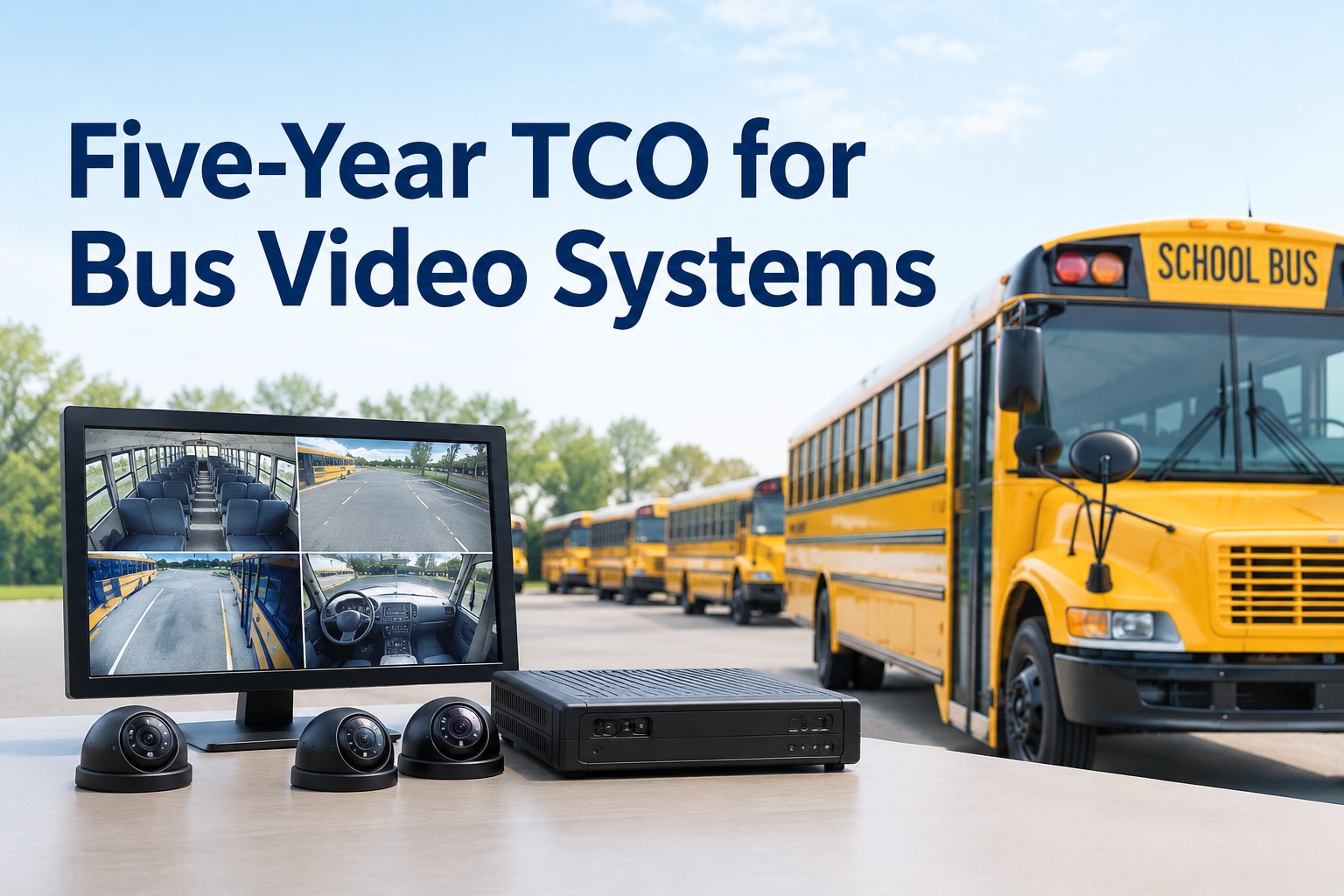
The hardware — interior, road, and door cameras plus the DVR/MDVR. Real deployments often run roughly $1,500–$1,900 per bus for a multi-camera set.
UpfrontInstallation
Fitting each bus — often around $350 per vehicle, and labour can be 50–70% of a project's cost. Frequently underestimated.
UpfrontStorage
Local SD/HDD is cheap but overwrites; cloud storage enables remote access but recurs — large fleets can spend six figures a year on cloud archiving.
RecurringConnectivity
Cellular data plans or depot Wi-Fi to move footage. Per-bus data plans across a fleet add up to a real recurring line nobody quotes upfront.
RecurringSoftware & licensing
The platform that manages footage and events — often sold on 1–3 year licences. Renewal terms drive a big share of the five-year total.
RecurringMaintenance & repair
Cameras fail, cables wear, units drift out of alignment. Keeping the system actually working over five years is an ongoing cost, not a one-time buy.
RecurringNotice the split: two items are upfront, four recur every year. That's the whole trap of judging a video system by its quote — the quote captures the two, and the four are what actually determine the five-year total. The rest of this page follows the money across all five years, and it's exactly the kind of full-picture view BusCMMS is built to give. You can book a walkthrough to see cost tracking per bus and system.
A 5-Year Cost Picture (Illustrative)
Here's how the six line items behave over five years for a hypothetical small fleet. The figures are made-up placeholders to show the shape of TCO — the pattern, not the price. Watch how the recurring rows keep charging long after the hardware is paid for.
The lesson is in the two columns. Year 1 looks like a hardware purchase; years 2 through 5 are almost entirely recurring — storage, connectivity, licensing, and rising maintenance. A district that budgets only for Year 1 is blindsided in Year 2. Model all five years, and the "cheap" system with expensive recurring costs often loses to a slightly pricier one with lean ongoing fees. Building that model per bus is exactly what starting free with cost visibility is for.
The Hidden Multipliers That Blow Up a Budget
Some costs don't just recur — they scale in ways a first-year quote never hints at. These are the four that most often turn a "reasonable" video system into a budget headache by Year 3.
Cloud storage scales with fleet & retention
Every added bus and every extra day of retention multiplies storage cost. Districts have spent six figures a year on cloud archiving alone — the single most underestimated line.
Per-bus connectivity adds up fleet-wide
A modest cellular plan per bus looks small — until you multiply it by the whole fleet, every month, for five years.
Licence renewals reset the meter
A 1–3 year licence expires, and renewal pricing may not match the intro deal. The five-year cost depends heavily on terms you sign once.
Vendor lock-in forces rip-and-replace
A closed system that only works with one vendor's software can force a full hardware swap later — the most expensive hidden cost of all.
The common thread is that these multipliers reward one decision made early: choosing an open, hardware-agnostic approach and a storage/retention policy sized to actual need. That's where a platform-first strategy quietly beats a hardware-first one on five-year cost — you avoid the lock-in, right-size the recurring lines, and keep the option to change hardware without changing everything. That flexibility is core to how BusCMMS is built, and it's worth a demo to see how it avoids lock-in.
Your 5-Year TCO Worksheet
Want the real number for your fleet? Work through these seven questions with each vendor before you sign — they surface the recurring costs quotes leave out.
- Q1
What's the per-bus hardware + installation cost, all in, with nothing itemised separately later?
- Q2
Is storage local or cloud, and if cloud, what's the annual cost at our fleet size and retention window?
- Q3
What's the connectivity/data cost per bus per month, multiplied across the whole fleet?
- Q4
What's the software licence term and renewal price — not just Year 1, but Years 2–5?
- Q5
What does maintenance and repair cost over five years, and who's responsible for it?
- Q6
Is the system hardware-agnostic, or does the software lock us to one vendor's cameras?
- Q7
Who owns the footage and data, and can we export it if we switch vendors?
Add Q1 once and Q2 through Q5 times five, factor Q6 and Q7 as risk, and you have a real five-year TCO — not a Year-1 quote dressed up as a total. The vendors who answer all seven cleanly are usually the ones with the lower true cost; the ones who dodge Q2, Q4, or Q6 are where the surprises hide. You can start free and track these costs per bus as you evaluate.
How BusCMMS Lowers Bus Video TCO
TCO isn't just measured — it can be reduced by the right platform choices. Here's where BusCMMS moves the five-year number down rather than up.
Hardware-agnostic
Works with the cameras and MDVRs you already own or choose — no lock-in, no forced rip-and-replace, no swap-everything bill later.
One platform, not many tools
Camera events, inspections, and maintenance on one record — instead of separate systems each carrying their own licence and cost.
Catches failing hardware early
A dead camera or drifting unit surfaces as a maintenance flag, so you fix small issues before they become expensive replacements.
Cost visibility per bus
Track what each bus's video and maintenance actually cost, so you model TCO on real data and defend the budget with evidence.
That's the role BusCMMS plays. BusCMMS is the AI-native, hardware-agnostic bus fleet operations platform that runs camera events, inspections, and maintenance on one bus record — so you avoid vendor lock-in, consolidate tools that would each carry their own cost, catch failing hardware before it turns into a replacement, and track what your video system actually costs per bus. No page can quote your exact five-year TCO — that depends on your vendors and choices — but the platform you build the program on should lower the number, not pad it. To model it for your fleet, book a walkthrough and bring your current quotes.
The Bottom Line on Bus Video System Cost
A bus video system's true cost is a five-year story, not a one-time quote. Cameras and installation are the visible tip; storage, connectivity, software licensing, and maintenance are the recurring bulk that decides the real total — and the decisions that control them, especially avoiding vendor lock-in and right-sizing storage, are made at purchase. Budget only Year 1 and you'll meet the rest of the bill by surprise.
Model all five years, ask the seven worksheet questions, and choose a platform that lowers recurring cost instead of adding to it. That's how a video program stays affordable across its life — and it's exactly what BusCMMS is built to support: hardware-agnostic, consolidated, and transparent on cost per bus. If you're ready to see the real number for your fleet, start free and model your TCO on your own buses. And treat every figure here as illustrative — confirm actual costs with your vendors before you budget.
What does a bus video system actually cost?
A complete bus video system has six cost components: cameras and recorder, installation, storage, connectivity, software and licensing, and maintenance. Real deployments often run roughly $1,500 to $1,900 per bus for a multi-camera hardware set, with installation frequently around $350 per bus, but hardware and installation are only the upfront portion. Storage, connectivity, software licensing, and maintenance recur every year and often exceed the hardware over a five-year horizon. The true cost is a five-year total, not a one-time quote, so always model all five years. These figures are illustrative industry ranges, not a specific quote.
Why is five-year TCO higher than the initial quote?
Because the initial quote usually captures only the two upfront items, cameras and installation, while four costs recur every year: storage (especially cloud), connectivity or data plans per bus, software licence renewals, and ongoing maintenance and repair. A quote that looks cheap in Year 1 can become the most expensive option by Year 3 once those recurring lines and any licence-renewal pricing kick in. Modelling all five years reveals the real total and often reorders which system is actually cheapest.
What are the biggest hidden costs in a bus video system?
The four most underestimated are cloud storage that scales with fleet size and retention window (districts have spent six figures a year on archiving alone), per-bus connectivity that adds up across the whole fleet every month, software licence renewals that may not match the introductory price, and vendor lock-in that can force a full hardware rip-and-replace later. Choosing an open, hardware-agnostic system and sizing your storage and retention to actual need are the two decisions that most reduce these hidden multipliers.
Does cloud or local storage cost less over five years?
It depends on your needs. Local storage on SD cards or hard drives is cheap upfront but typically overwrites older footage and requires physically retrieving clips. Cloud storage recurs every year and scales with fleet size and how long you retain footage, but it enables remote access and preserved evidence. For a large fleet with long retention, cloud can become a major recurring line, so the right answer comes from sizing retention to what you actually need rather than defaulting to maximum cloud retention. Model both against your five-year requirement.
How does BusCMMS reduce total cost of ownership?
BusCMMS is hardware-agnostic, so it works with the cameras and MDVRs you already own or choose and avoids the forced rip-and-replace that comes with locked-in systems. It consolidates camera events, inspections, and maintenance onto one platform instead of several tools that each carry a licence, catches failing hardware early as a maintenance flag so small issues don't become expensive replacements, and tracks video and maintenance cost per bus so you can model TCO on real data. The result is a five-year number that comes in lower and a budget you can defend line by line.