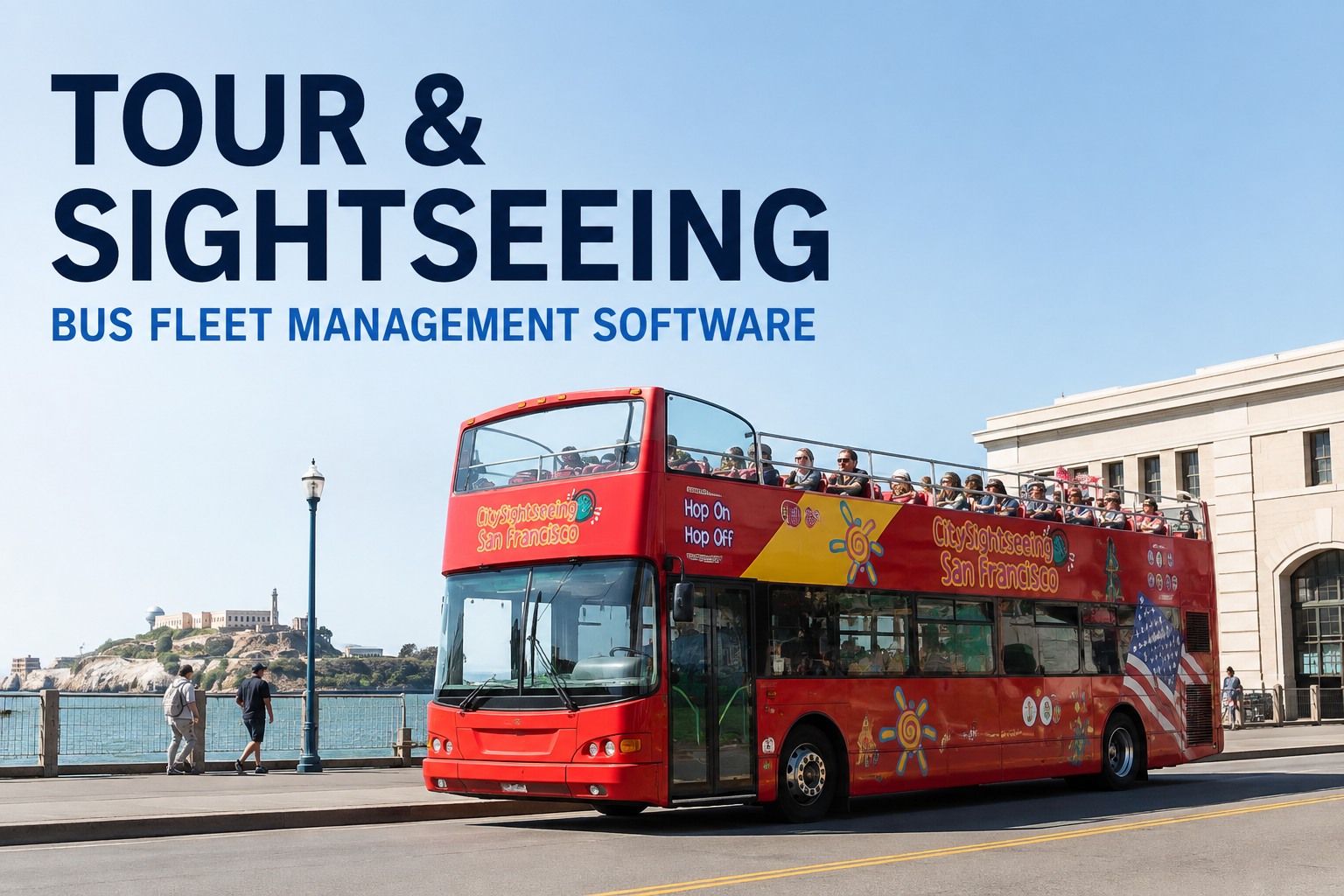
It’s the second Saturday in July and you’re running 34 buses across the downtown loop. A driver just radioed in a scrape from a low-hanging branch on the harbor route. One of your double-deckers has a slow-developing brake pull the shop hasn’t looked at in three days because the season doesn’t allow downtime. Somewhere on a laptop there are 40 camera events from the last 48 hours nobody has watched. That’s the operational reality of running a sightseeing bus fleet in peak season — and it’s what the right fleet software actually fixes. Book a 20-minute demo to see BusCMMS running on a tour fleet the size of yours.
Fleet Software Built for Tour & Sightseeing Buses
BusCMMS brings maintenance, inspections, camera events, and passenger incidents into one asset-centered platform — built around open-top, double-decker, and motorcoach vehicles instead of retrofitted from trucking software.
- 3Event types tracked
- 1Bus asset record
- 0Spreadsheets needed
Why Sightseeing Fleets Need Bus-First Software
A sightseeing fleet isn’t a trucking operation with different graphics. Your buses run scheduled loops with 40+ passenger turnovers a day. Some of them have no roof. Some of them are 13 feet 6 inches tall and share downtown streets with 12-foot bridges. Peak season doesn’t give you a maintenance window. Generic fleet software wasn’t written for any of that.
-
Open-Top
Weather exposure, upper-deck safety items, seasonal cleaning cycles, and passenger visibility events during loading.
-
Double-Decker
Low-clearance hazard tracking, upper-deck defects, dedicated inspection intervals, and staircase safety items.
-
Motorcoach
Long-haul PM cycles, lavatory and HVAC service, undercarriage cargo, and charter-contract mileage tracking.
Three vehicle types — three different PM cycles, three different inspection templates, three different failure profiles. One fleet, one platform, one asset record per bus. Book a demo to see per-vehicle-type PM logic on one dashboard.
Low-Clearance and Route Hazard Documentation
Bridge strikes on double-decker sightseeing buses aren’t hypothetical — they’re a documented pattern with a well-known cost. Network Rail runs a “Wise Up, Size Up” campaign for a reason. A 2019 STA incident in Spokane pulled the agency’s entire double-decker fleet out of service after one 13.5-foot bus struck a 12-foot viaduct. Fleet software can’t drive the bus. What it can do is make sure that every driver report, camera event, near-miss, and route hazard on your fleet lives against the specific vehicle it happened on — not in a paper logbook a manager reads next week.
- CAMERATree-branch strike, upper deck front right, 14:22
- DRIVER“Low branch flagged near Pier 39 — recommend reroute”
- INSPECTIONUpper-deck safety rail scratched, minor cosmetic damage
The value isn’t just documenting the event. It’s having a queryable history when an insurance carrier, a state regulator, or a corporate contract holder asks what your operator did about the risk. Book a demo to see hazard-event linkage on the vehicle record.
Seasonality and the Maintenance Window
Tour operators live in two seasons — peak, where every bus needs to be revenue-ready by 8 AM, and shoulder or off-season, where every bus needs to be caught up on the maintenance that peak wouldn’t allow. The trick is knowing what to work on in November so you’re not scrambling in July. That’s where a maintenance history per vehicle actually earns its keep.
Revenue Mode
- Same-day defect triage
- Minimum downtime per bus
- Passenger incident response
- Camera event queue review
Prep Mode
- Full PM catch-up per vehicle
- Recurring-defect remediation
- Upper-deck safety recertification
- Contract-inspection compliance
Without a system, off-season prep gets driven by the loudest complaint from the last shift. With one, you’re working from a ranked list of every deferred defect, recurring failure pattern, and inspection due date across the entire fleet — sorted by risk. Sign up free to see the deferred-defect and PM catch-up view on your data.
A Camera Event Becomes a Closed Work Order
Here’s the differentiator on a real bus. Say you run 35 vehicles, mixed open-top and double-decker. Overnight, your camera system logs 27 events. In a generic setup, they sit in a portal. In BusCMMS, AI triage groups them by vehicle and route context before your maintenance manager opens a laptop.
Unit 07 · Low-Clearance Camera Event
- 01
Detection
Overhead-obstacle event on Unit 07, harbor route, coincident with driver defect note about branch strike.
- 02
Correlation
System groups the camera event, driver report, and inspector’s pull-in note as the same incident on the same asset.
- 03
Prioritization
Route flag opened, Unit 07 held from morning double-decker rotation until upper-deck rail damage inspected.
- 04
Closure
Rail cleared, cosmetic touch-up logged, route hazard note appended to the bus record for future assignments.
Same event, three sources, one bus record. Every closure writes back to the maintenance history that supports insurance, contract, and internal audit questions later. Book a demo to walk this exact workflow on your fleet.
A Tour Operations Manager’s View
That’s the practical difference tour operators describe once they move off spreadsheets and disconnected tools — the correlation work stops living in people’s heads. Book a demo to see the unified bus record and camera-to-work-order flow live.
Evaluation Checklist for Tour Operators
Here’s the rubric a working tour operations manager would build for evaluating fleet software — focused on what matters in July, not on the demo call.
Vehicle-type-specific PM
Separate cycles for open-top, double-decker, and motorcoach on one dashboard.
Camera event integration
Video events surface by priority and route to the bus record — not a separate portal.
Route hazard logging
Driver reports, near-misses, and inspection notes tied to the specific vehicle and route.
Deferred-defect tracking
A ranked view of every peak-season deferral for off-season catch-up planning.
Contract-inspection records
Queryable maintenance history for insurance, corporate contracts, and audit response.
2 to 4 week rollout
Live before the season starts, not the season after. Weeks, not quarters.
Note on regulation: applicability of FMCSA rules like 49 CFR Part 396 depends on your operating authority, vehicle classification, and whether service crosses state lines — sightseeing and tour operators should verify federal, state, and local requirements for their specific operation. What’s not conditional is that documented maintenance and event history is the foundation any of those frameworks expect.
What is sightseeing bus fleet management software?
Sightseeing bus fleet management software is the platform tour and sightseeing operators use to manage vehicle maintenance, inspections, defects, work orders, camera events, and passenger incidents across open-top, double-decker, and motorcoach vehicles. Unlike generic trucking fleet software, it’s organized around bus-specific workflows — passenger service schedules, route-specific hazards like low clearances, seasonal peak and off-peak cycles, and the integration of camera and video events with the vehicle’s maintenance record.
What software is best for managing tour bus maintenance?
The best fit for tour bus maintenance is a platform built specifically for passenger buses rather than a generic fleet or asset-management tool. BusCMMS handles preventive maintenance scheduling (separate cycles for open-top, double-decker, and motorcoach), corrective work orders from failed inspections or camera events, parts and inventory tracking, and a complete maintenance history per bus — all connected so a manager can see a vehicle’s recurring defect patterns and pending PM in one place.
Can fleet software manage double-decker and open-top buses?
Yes. BusCMMS treats each vehicle type as a distinct asset class with its own inspection template, PM cycle, and defect profile. Double-decker vehicles get upper-deck safety items and low-clearance event tracking; open-top buses get weather-exposure and upper-deck cleaning intervals; motorcoaches get long-haul PM logic. All three run on the same dashboard with one asset record per bus, so a mixed fleet doesn’t require three separate systems.
Can BusCMMS connect bus camera events with maintenance work orders?
Yes. BusCMMS uses AI to triage camera and telematics events by significance instead of leaving managers to scroll raw video. When events cluster on a specific bus, or a camera flags an overhead-obstacle contact, tree-branch strike, or hard-braking pattern, the system connects the event to the vehicle’s record, cross-references driver reports and inspection notes, and can auto-generate or recommend a follow-up work order.
What should tour operators look for in bus fleet management software?
Look for vehicle-type-specific PM cycles (open-top, double-decker, motorcoach), camera event integration into maintenance workflows, route hazard logging tied to the vehicle, deferred-defect tracking for off-season catch-up, queryable maintenance history for insurance and contract inspection questions, and a go-live measured in weeks rather than months. Software alone doesn’t handle every regulatory obligation — the operator owns compliance with FMCSA, state, and local rules for their specific service — but the right platform provides the documented maintenance and event history those frameworks rely on.