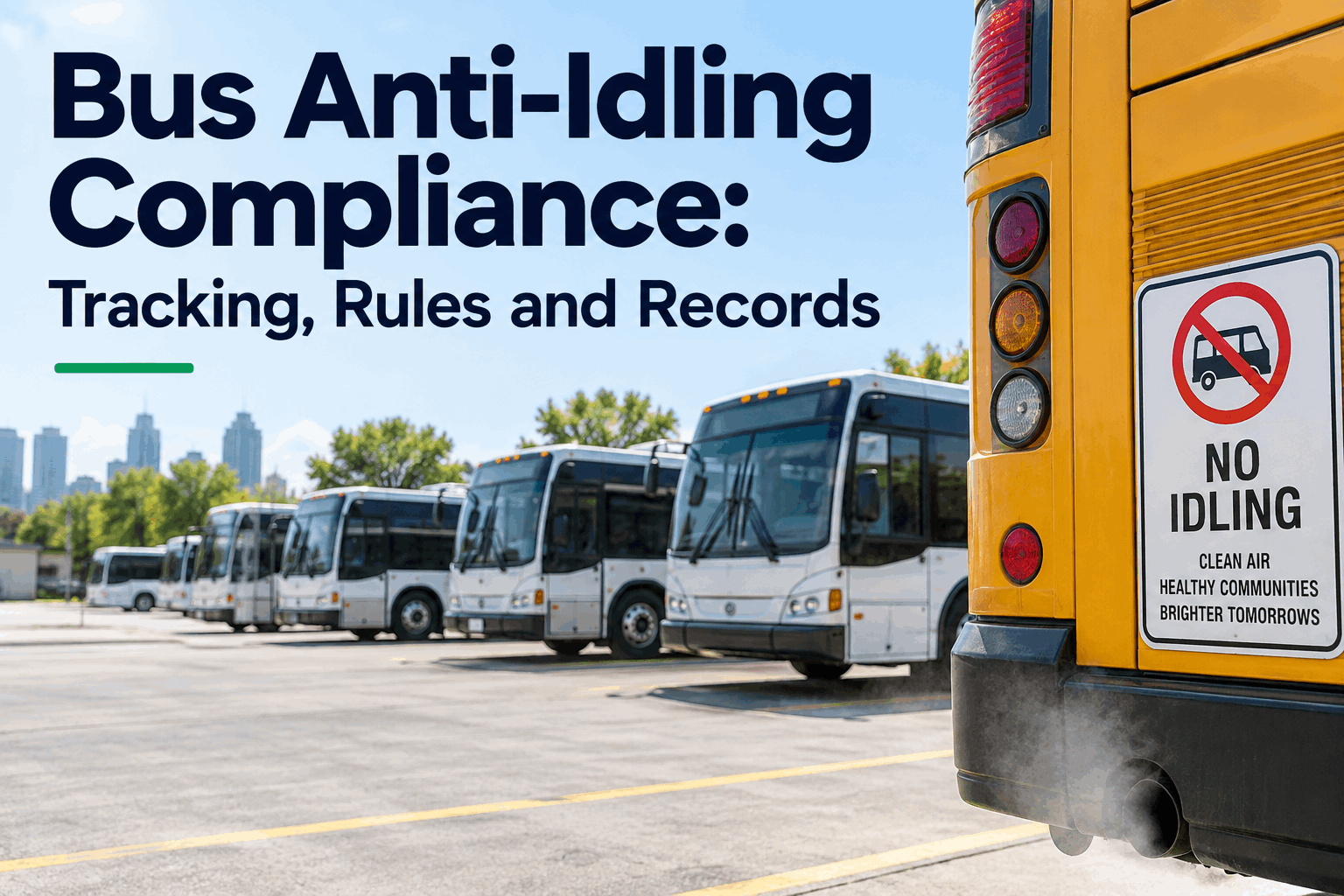
A DEEP inspector shows up at the bus yard. The district gets a Notice of Violation for 30 school buses idling a combined 418 minutes on two separate days. The settlement is $24,225 and a mandate to install telematics-based idle tracking. Every fleet manager reading this knows it could just as easily be their yard. This guide covers bus anti-idling compliance — state and municipal limits, the real enforcement cases, the fuel and emissions math, and how to build the idle-time record that turns an inspection from a stressful surprise into a routine document handoff.
Bus Anti-Idling Compliance: Tracking, Rules and Records
State idle-time limits, real enforcement cases, and the record system that proves compliance before an inspector asks.
- 3-5 minTypical limits
- $33KRecent EPA fine
- 0.8-1.2Gal/idle hour
Why Bus Anti-Idling Compliance Is a Real Fleet Manager Problem
Every fleet manager knows the rule casually: don't let the bus idle. What most do not know is that dozens of states and hundreds of municipalities have codified specific idling limits, that police in several states have ticketing authority for school bus idling over the limit, that state environmental agencies conduct yard inspections, and that the EPA has settled several six-figure enforcement cases against bus operators in the last few years. This is not a soft-hazard topic. It is an active enforcement area.
EPA guidance notes that engine manufacturers generally recommend no more than 3 to 5 minutes of idling, and state anti-idling regulations broadly reflect that range. Warmup, forced regeneration, and legitimate operational needs are typically carved out — but the burden of proof falls on the fleet to show the idle was legitimate. Without records, "our driver was warming it up" is not a defense; it is an assertion.
The compliance angle sits on top of two other reasons to care. Fuel waste: large diesel vehicles burn roughly 0.8 to 1.2 gallons per idle hour according to state clean-air program guidance. Multiplied across a fleet with routine 15-30 minute idle spells, that is real fuel spend with zero routes covered. And engine wear: excessive idling accelerates carbon buildup, fouls emissions aftertreatment, and shortens component life. Compliance is the headline, but the fuel-and-engine case is what actually pays the software back. Book a walkthrough to see per-bus idle tracking with jurisdiction-configured thresholds.
The Fuel Math: What Idle Time Actually Costs
Before the compliance case, the fuel case. State clean-air program figures put large diesel idle consumption at roughly 0.8 to 1.2 gallons per hour. School buses run at the lower end of that range. Here is what a typical mid-size fleet spends on idling annually if nothing changes.
The savings scale with fleet size. A 200-bus transit agency running longer routes and layovers can see the same math produce six-figure annual savings. And every gallon of diesel avoided is roughly 22 pounds of CO2 not emitted, which matters both for corporate sustainability reporting and for the community air-quality metrics that state environmental agencies watch. Sign up free and pull your first per-bus idle report within a week.
The Enforcement Reality: Two Real EPA Cases
The best way to understand the compliance stakes is to look at what has actually happened. Two recent EPA enforcement cases against bus operators in the Northeast tell the whole story — both settled, both mandated telematics-based idle tracking as part of the remedy.
Autumn Transportation · Hartford, CT
North Reading Transportation · Methuen, MA
Both cases share the same pattern: an inspector or citizen observed idling at a yard or school, the state referred it to EPA, and the remedy required exactly the kind of records that a modern fleet CMMS produces as a byproduct of normal operations. The fleets that ended up in these settlements did not have those records. The fleets that do have them typically resolve inspection questions in minutes.
State Compliance at a Glance
Anti-idling rules vary by state and often by locality within a state. Below is what several major jurisdictions require for school and transit buses. This is not a substitute for reviewing the specific regulation for your state and municipality, but it shows the shape of the landscape.
Two patterns stand out. First, school zones almost always have tighter limits than the general rule. Second, dozens of municipalities layer additional ordinances on top of state limits — NYC, Boston, Philadelphia, San Francisco, Denver, Salt Lake, and many others have local rules that override the state minimum. A compliant fleet needs to know which limit applies where its buses actually operate, not just where they are garaged. Book a demo to see idle-time thresholds configured by route jurisdiction.
How an Idle Event Should Move Through the System
A proper anti-idling program does not just watch idle time — it produces four artifacts for every relevant event: a captured event, a threshold evaluation, a driver-and-supervisor notification, and a permanent audit record. Four stages, all automatic, all traceable.
Telematics pulls engine-on / zero-speed events. Every idle segment logged with bus, driver, location (GPS), start time, and duration. Runs continuously in the background — no driver action required.
Each event compared against the configured threshold for that bus and location (state limit / school-zone limit / operational carve-out). Exempt events (warmup below freezing, forced regen, wheelchair-lift cycle) tagged for review, not violation.
Exceedances above the threshold flagged. Driver gets a courteous notification on their next punch-in; supervisor sees the pattern in the weekly dashboard. Not punitive on first event — coaching signal on recurring pattern.
Every event and every exceedance permanently stored with timestamps, GPS, driver, and duration. Exportable in CSV or PDF for state DEP/DEQ inspection, EPA inquiry, or internal compliance reporting.
Stage 04 is what turns compliance from a hope into a defense. The Autumn Transportation and North Reading Transportation settlements both required exactly this: a permanent, timestamped, exportable record of idle time by bus. Fleets that already have it treat inspections as a document handoff. Fleets that don't spend weeks reconstructing history from driver interviews and paper logs.
The Compliance Evidence Pack: What an Inspector Actually Wants
When a state inspector or EPA reviewer asks for anti-idling records, six elements make the response airtight. Anything less becomes a conversation about what you can't show them.
- ✓Written anti-idling policy · adopted, dated, distributed to all drivers
- ✓Driver training records · every driver acknowledged and dated
- ✓Idle time log per bus · date, driver, location, duration, exceedance flag
- ✓Exceedance report + response · what happened, who was coached, what changed
- ✓Signage installed · "No Excessive Idling" at yard entries and driver areas
- ✓Periodic yard walk-through record · supervisor sign-off on visual compliance
The last two items — signage and walk-throughs — are the ones fleets forget. Both are cheap, both are visible signs of program intent, and both were explicitly required in the North Reading Transportation settlement. Skip either one and the case that the fleet was actively managing idling gets weaker. Include them and it gets airtight.
How BusCMMS Runs Idle Tracking and Compliance Records
The features below turn idle-time compliance from an anxious quarterly project into a background function of the fleet operating system. Pulled straight from the telematics feed, evaluated against your jurisdictional configuration, and exported in the format an inspector actually asks for.
-
Idle Event Capture
Every engine-on / zero-speed event pulled from Samsara, Geotab, or configured telematics. Bus, driver, GPS, timestamp, duration — automatic.
-
Jurisdictional Thresholds
Configure the state limit, school-zone limit, and any local ordinance thresholds per route or zone. Evaluation applies the tightest relevant rule.
-
Exceedance Flagging
Events over threshold surface on the supervisor dashboard. Legitimate carve-outs (cold-weather warmup, forced regen, lift cycle) tagged automatically.
-
Driver & Route Analytics
Idle-time-per-bus, per-driver, per-route rolling trends. Targets coaching to the drivers and routes that need it — not everyone.
-
Audit-Ready Export
One-click CSV or PDF export of idle-time records with dates, buses, drivers, GPS, and durations — matches what state DEP/DEQ inspectors ask for.
-
Fuel Waste Dashboard
Idle gallons and dollar cost per bus, per driver, per month. Turns the compliance program into a clear business case for the board.
Because BusCMMS already integrates with the major telematics providers most bus fleets use (Samsara and Geotab in particular), the raw idle-event data is already available — the platform adds the jurisdictional evaluation layer and the compliance record layer on top. No new hardware, no new sensors, no separate anti-idling app.
The Practitioner View: What a Real Inspection Actually Looked Like
The story is quiet on purpose. The best compliance outcome is the one nobody hears about — the inspection that ends before lunch, the case that never becomes a case. Every one of the required elements from the enforcement settlements above was already in place, running as background operations. The visit was routine because the fleet was ready. Sign up free and export your first month of idle-time records in one click.
The Bottom Line on Bus Anti-Idling Compliance
Anti-idling compliance is not a soft-hazard topic. It is an actively enforced area with real fines, mandated remedies, and permanent record requirements. It is also one of the highest-ROI programs a bus fleet can run — because the same tracking that satisfies inspection demands also cuts real fuel spend by 30-50% and improves engine life. The four elements that make the whole thing work are a written policy, driver training, jurisdictional-threshold idle tracking, and an exportable evidence record. All four run automatically in a proper fleet CMMS, and all four are exactly what an EPA settlement will require after the fact if they are not in place beforehand. Book a walkthrough to see the full compliance workflow on a bus fleet like yours.
What are typical bus anti-idling limits in the US?
Most state limits fall in the 3-5 minute range for commercial and passenger diesel vehicles, with school-zone or school-bus-specific rules often being tighter. Connecticut and New Jersey use a 3-minute general limit; Massachusetts, New York, California, and Colorado use 5 minutes. New York City tightens to 3 minutes within school zones; California adds specific restrictions within 100 feet of schools; Connecticut has a school-bus-specific 3-minute statute enforceable by police. Dozens of municipalities layer additional ordinances on top. EPA guidance notes engine manufacturers generally recommend no more than 3-5 minutes of idling. Always verify the specific rule for your state and the localities where your buses actually operate.
How much fuel does a bus actually waste while idling?
State clean-air program figures put large diesel vehicle idle consumption at roughly 0.8 to 1.2 gallons per hour, with school buses at the lower end of that range. For a 60-bus fleet averaging 45 minutes of idle per bus per school day, that works out to roughly 36 gallons of fuel wasted daily, 6,500 gallons per school year, and around $26,000 in annual fuel spend at $4 per gallon — all of it burned with zero routes covered. A structured idle-reduction program typically cuts this by 30-50%, so $8,000-$13,000 in annual savings on a mid-size fleet is realistic, plus the emissions benefit (roughly 22 pounds of CO2 avoided per gallon of diesel not burned).
What happens when a fleet is cited for excessive idling?
Recent EPA settlements against Northeast bus operators show the pattern. Autumn Transportation in Hartford, Connecticut paid $24,225 after inspectors observed 30 school buses idling a combined 418 minutes over two inspection days; remedies included mandated telematics-based idle tracking, driver training, anti-idling signage, and supervised facility lots. North Reading Transportation in Methuen, Massachusetts paid $33,000 for alleged violations of federally enforceable Massachusetts idling limits; remedies included driver training, signage, periodic yard walk-throughs, block heater installation on nearly 200 buses, and district notification of the anti-idling policy. Both cases required exactly the records a modern CMMS produces as a byproduct of normal operations — the fleets that were fined did not have them.
What records should a bus fleet keep to prove anti-idling compliance?
Six elements together make a defensible compliance record. A written anti-idling policy that is adopted, dated, and distributed to all drivers. Driver training records with each driver's acknowledgment and date. An idle-time log per bus showing date, driver, location, duration, and any exceedance flag. An exceedance report tied to the response taken (coaching, retraining, etc.). Signage installed at yard entries and driver areas ("No Excessive Idling"). Periodic yard walk-through records signed off by a supervisor confirming visual compliance. Together these six match every element the recent EPA settlements required as post-violation remedies — putting them in place beforehand is far cheaper than doing so under a consent order.
How does BusCMMS handle anti-idling compliance?
BusCMMS captures every idle event from integrated telematics (Samsara, Geotab, and others), including bus, driver, GPS location, timestamp, and duration. Jurisdictional thresholds are configured per route or zone so the correct state, school-zone, or municipal limit applies. Exceedances are flagged automatically with legitimate carve-outs (cold-weather warmup, forced regen, wheelchair-lift cycle) tagged for review rather than counted as violations. Driver and route analytics surface where coaching is needed. Audit-ready CSV or PDF exports match what state DEP/DEQ inspectors ask for. A fuel waste dashboard translates idle gallons and dollar cost per bus into the business case for the board. All of it runs on the telematics feed most fleets already have — no new hardware required.