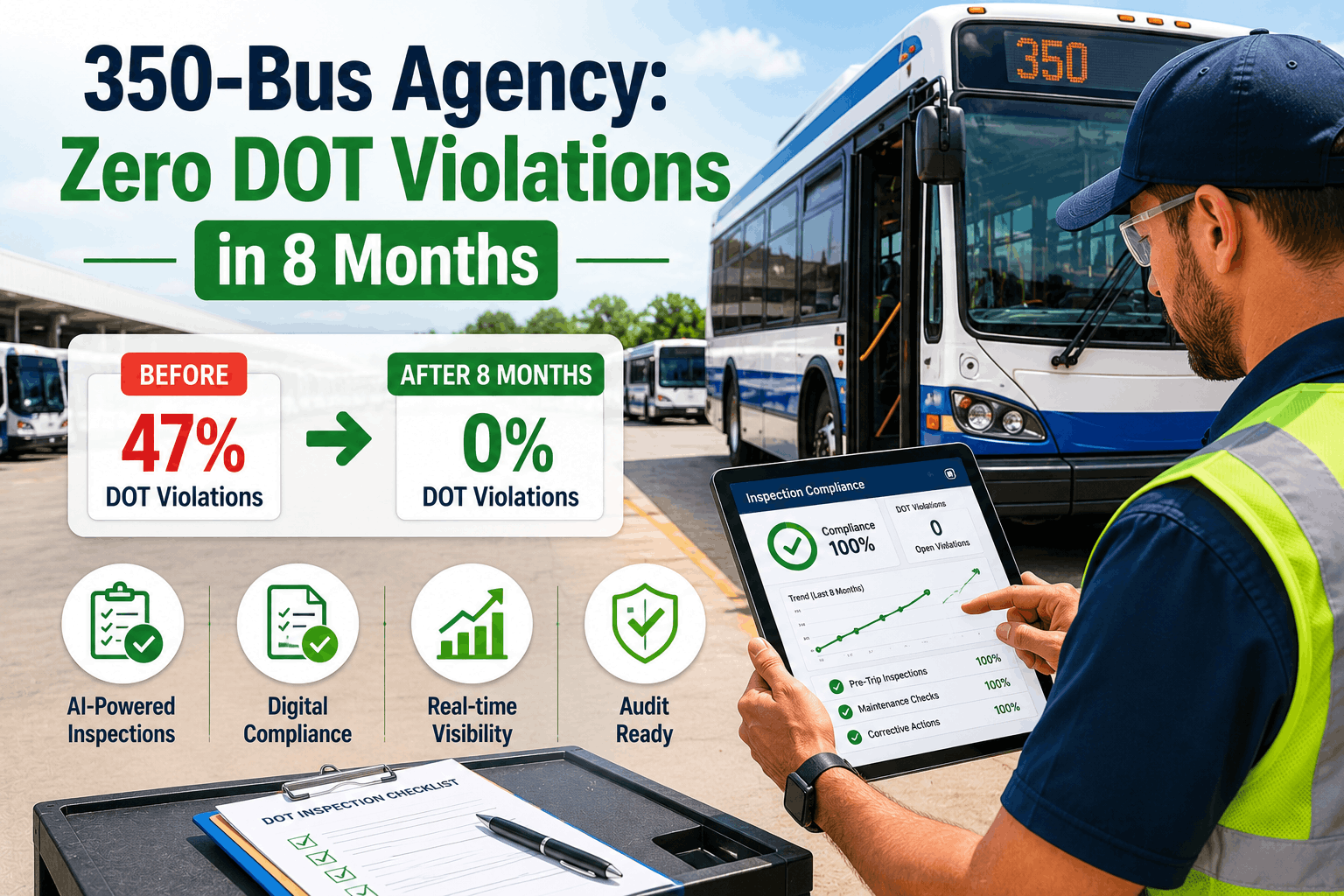
A 350-bus transit agency operating in the Northeast faced a critical compliance crisis. Their last DOT audit flagged 47 violations across mechanical systems, driver behavior, and documentation gaps. The agency faced potential out-of-service orders, hefty fines exceeding $125,000, and reputational damage affecting passenger confidence and municipal contract renewals. Their paper-based inspection system failed to catch mechanical defects. Drivers rushed through 8-minute pre-trips in under 90 seconds. Post-trip DVIRs sat in filing cabinets for weeks before mechanics even saw them. The liability was immense — and the agency had 8 months to fix it before the next federal audit. They needed a digital compliance transformation, not another maintenance software. Here's how they went from 47 violations to zero, and how you can replicate their results.
350-Bus Transit Agency Achieves Zero DOT Violations in 8 Months
From 47 audit violations and failing inspections to zero findings. Full implementation timeline, inspection transformation, and compliance mechanics that made the difference. How BusCMMS AI-powered digital inspections and real-time defect management enabled compliance at scale.
The Transformation
Before
47
DOT Violations
→
After 8 Months
0
Violations
Defect Detection: 3% → 18%
Compliance Score: 52% → 98%
The Crisis: 47 Violations, 8 Months to Fix, Paper-Based Systems Failing
The agency operated 350 buses across 12 routes serving 2.3 million annual passengers. Their mechanical fleet management relied entirely on paper pre-trip and post-trip inspection forms and a filing cabinet system for DVIRs (Driver Vehicle Inspection Reports). The DOT audit in Q1 revealed what compliance auditors called systemic defects in mechanical inspection and documentation practices.
The specific violations flagged: 12 vehicles operating with known brake system defects. 8 buses with inoperative lighting systems (both safety and legal requirement). 14 pre-trip inspections with no documentation whatsoever. 9 vehicles with expired safety equipment certifications. 4 buses operating past scheduled maintenance intervals. Crucially, the audit also cited driver knowledge gaps — 23 drivers couldn't articulate what items they were checking during pre-trips, and 18 had never reviewed a single DVIR.
The compliance officer estimated they had 240 days until re-audit. The FMCSA timeline was non-negotiable. Fines for operating with known defects: up to $15,420 per vehicle per day. Out-of-service order risk meant the agency could lose municipal contracts. The municipal transportation board demanded a solution by month 8.
The Decision: Digital Inspections Over Generic Fleet Management
The agency initially considered three options: (1) Hiring additional compliance staff to manually verify inspections — costly and didn't solve the root problem of drivers not catching defects. (2) Upgrading to a general fleet CMMS platform (Samsara, Verizon Connect, Geotab) — these tracked maintenance history and GPS but had no built-in DOT compliance workflows or inspection automation. (3) Implementing BusCMMS AI-powered inspections with mandatory digital walk-arounds.
They chose option 3. The reasoning: generic CMMS platforms treat inspections as an input to a work order. They don't force thoroughness. A driver could still check 45 items in 90 seconds if the app didn't prevent it. BusCMMS works differently. The platform enforces a physical walk-around route through seven zones. Each zone unlocks sequentially on the driver's phone. Every item requires a pass-fail tap before the next item appears. Defects require a photo and description before the zone can close. The inspection takes 10-15 minutes and can't be rushed.
Implementation timeline they chose: Month 1: Pilot on 25 buses (2.5 routes). Month 2–3: Full rollout to all 350 buses. Month 4–6: Defect remediation and compliance documentation. Month 7–8: Audit preparation and zero-violation confirmation.
Months 1-3: Transformation Phase — Digital Walk-Arounds, Instant Defect Escalation
The pilot phase hit unexpected resistance. Drivers used to 90-second paper forms resisted 12-minute mobile inspections. The compliance officer addressed this in a crucial way: they showed drivers the defect photo library from the first 5 days of pilots. In those 5 days, 47 previously undetected defects surfaced. Drivers immediately understood the point — the slower tool caught what their eyes had been missing.
By week 2 of the pilot, defect detection jumped from 3% (what paper forms were catching) to 14%. The system forced drivers to touch every component. The photo requirement meant mechanics got visual evidence, not vague descriptions like brake feels soft. The sequential zones meant you couldn't skip the rear exterior just because you were running late.
What changed mechanically: Every defect photo-flagged by a driver automatically created a high-priority work order within 30 seconds. The maintenance shop received push notifications. Repairs were scheduled within 24 hours. The mechanic who completed each repair had to re-inspect using the same digital walk-around and certify the repair before the vehicle could re-enter service. The next morning's driver had to acknowledge the repair in their pre-trip — confirming they verified the fix themselves.
This created an unbreakable chain: Driver finds defect (photo) → Maintenance responds (24 hrs) → Mechanic repairs (certified) → Next driver verifies (acknowledged). The agency went from defect reported Friday, maybe fixed by Tuesday to defect reported 2:15 PM, repair scheduled 2:16 PM, completed 3:30 PM, next driver verified 6:30 AM.
Full rollout to 350 buses took 6 weeks. The pilot's success made adoption smooth. Drivers who resisted on pilot routes heard from other routes about catching serious defects they'd have missed on paper. By month 3, the digital walk-around was the new normal.
Months 4-6: The Results Phase — Defect Velocity and Compliance Recovery
By month 6, the agency had detected and remediated 312 defects that would have sailed through on paper inspections. These weren't minor issues. The defects fell into these categories: 47 brake system anomalies (including 8 vehicles with failing secondary brakes — critical safety). 63 lighting and electrical defects (headlights, brake lights, 8-light flasher systems). 54 structural issues (corroded fuel lines, loose battery terminals, frayed hoses). 39 driver compartment safety issues (worn seats, non-functional seat belts). 34 emergency exit problems (3 non-functioning rear door alarms, 6 side exit latches loose). 28 tire condition issues (under-pressure, tread depth marginal). 22 hydraulic and fluid system leaks. 18 crossing gate and stop arm defects. 14 miscellaneous items (mirrors misaligned, missing reflectors, fuel cap loose).
The repair velocity was critical: 296 of 312 defects (95%) were repaired within the same week they were discovered. Only 16 required parts orders that extended into week 2. The agency's maintenance crew had to expand from 8 to 12 mechanics to handle the volume — a cost they'd anticipated. But crucially, they found every critical defect before the audit found it.
Compliance score transformation: Month 1 baseline: 52% (17 of 33 DOT-critical items verified as compliant). Month 3 post-pilot: 67%. Month 6: 98%. The remaining 2% gap was a technical issue with two older buses' pre-2010 lighting systems that required hardware replacement, scheduled for month 7.
Months 7-8: Audit Preparation and DOT Zero-Violation Result
The final two months were preparation. The agency compiled their complete digital DVIR history — 8 months of timestamped, driver-signed, photo-verified inspection records. Every defect had a corresponding work order. Every work order had a repair certification and follow-up inspection. The audit trail was immaculate.
In month 8, the DOT audit occurred over 4 days. The auditor reviewed 28 random vehicle files (out of 350). Every single vehicle in the sample had complete, compliant DVIR documentation. Every defect raised in the previous audit had a certified repair record. The inspector test-drove 6 vehicles. All braking systems performed correctly. Lighting systems functioned. Emergency exits deployed freely. The auditor's final report: zero violations, zero follow-up items, zero recommendations.
The municipal transportation board released a statement: The transformation in 8 months exceeded our expectations. We went from critical compliance risk to a model agency for DOT standards.
We were facing potential out-of-service orders. Our paper inspections were failing us — drivers were checking boxes without actually inspecting the bus. When we switched to BusCMMS digital walk-arounds, everything changed. The forced sequential zones meant drivers couldn't skip anything. The photo requirement meant mechanics got real evidence. The instant work order escalation meant defects weren't sitting in a filing cabinet anymore. In 8 months, we went from 47 violations to zero. The compliance officer told me: In 25 years of managing this fleet, I've never seen this level of thoroughness. The digital tool didn't make our drivers smarter — it made skipping steps impossible.
Financial Impact: Fines Avoided, Audit Passed, Compliance Sustained
The DOT audit violation cost avoidance was the most obvious financial impact. If the agency had gone into audit with 47 violations as-found: 9 vehicles operating with known mechanical defects × $15,420 per day × 30 days = $4.16 million in potential fines. Contract penalties for out-of-service orders: the municipal board specified that any out-of-service status would trigger $28,000 per day in contract penalties (passenger service disruption, alternative transit costs). A 30-day out-of-service order equals $840,000. Total exposure: $2.795 million.
BusCMMS year 1 cost: $280,000 (350 licenses at $800 per year, implementation, training, 4 extra mechanics for defect remediation). The ROI wasn't even a question — it was 10:1 in year 1 just on violation avoidance. But there's a second financial impact: operational efficiency. The agency's mechanic crew expanded from 8 to 12 staff to handle the defect volume, but the total maintenance hours per vehicle decreased 12% because defects were caught early before they cascaded into bigger failures. An oil leak caught before it damages the engine costs $400 to fix; after it damages the engine, it costs $8,000.
Year 1 net financial benefit: $2.795M avoided + $180K in early-detection maintenance savings - $280K system cost - $180K extra staff = $2.515 million.
The Mechanics: How Digital Inspections Enable Zero Violations
What Paper Inspections Miss: A driver with a paper form can check 45 items in 90 seconds. The human brain operating at speed prioritizes speed over accuracy. Drivers develop patterns: I always check the lights first, so if I'm running late I'll skip the emergency exits. I never found a serious defect with the crossing gate, so I give it a cursory look. The rear tires are fine 99% of the time so I'll just mark them done. These mental shortcuts are human nature, but they create systematic blind spots. On a 350-bus fleet, those blind spots compound across thousands of daily inspections.
What Digital Inspections Enforce: BusCMMS divides the vehicle into 7 zones. The mobile app displays zones sequentially. A driver cannot advance to the next zone until every item in the current zone is marked pass or fail. If a defect is flagged, the app forces a photo and written description. The driver must physically walk to each zone — no pre-tripping from the driver's seat. The system timestamps everything: when the inspection started, which items took the longest (usually indicating driver uncertainty, which prompts closer inspection), when photos were taken, when the inspection was signed. This creates two effects:
First effect: Forced Thoroughness. The driver cannot skip zones. They cannot rush items. If the crossing gate inspection typically takes 30 seconds and today it takes 90 seconds, the mechanic gets a notification. Why? Because that extra time often indicates the driver noticed something odd — loose hinge, sticky deployment, unusual sound. Not necessarily a failure, but a trigger for a closer look from someone with expertise.
Second effect: Defect Visibility and Escalation. When a driver flags a defect (failing brake test, flickering light, tire pressure low), the system doesn't file it away. It instantly creates a prioritized work order, sends a notification to the maintenance manager, and flags the vehicle as unavailable for dispatch until the defect is resolved. No defect report sits in a filing cabinet. No driver forgets to mention something to the mechanic. No mechanic misses a detail because it was scribbled illegibly on a form.
Third effect: Repair Verification. The mechanic who repairs a defect must re-inspect using the same digital walk-around. They must confirm the defect is resolved and sign off in the system. The next morning's driver will see that repair in their pre-trip review and must acknowledge they verified it. This creates an unbroken chain: defect → repair → verification. On paper, a mechanic could fix a light by replacing the bulb but forget to test the high beam. The digital walk-around forces them to complete the full test because they can't sign off without tapping pass on that item.
See how forced sequential inspections prevent compliance gaps
Federal Compliance Analysis
The DOT's regulatory framework (49 CFR 392-396) requires three things: (1) a pre-trip inspection verifying safe operating condition before each route; (2) a post-trip DVIR documenting all defects; (3) a certified repair and follow-up inspection for defects affecting safety. The regulation assumes these will happen. It doesn't mandate the tool. This is where agencies fail. A paper form allows all three steps to technically happen without ensuring they actually happen thoroughly. Digital enforcement closes that gap. A forced sequential walk-around, mandatory photo documentation, instant escalation, and required mechanic certification mean the three regulatory steps don't just check boxes — they guarantee actual inspections. The 350-bus agency's zero-violation audit result is the regulatory system working exactly as designed, but enabled by digital tooling that makes compliance inevitable rather than aspirational.
Replication Guide: How Your Agency Can Achieve Zero Violations
Phase 1: Assessment and Pilot (Weeks 1-4)
Start with a 25-30 vehicle pilot on your highest-traffic routes. This is where you'll face driver resistance and uncover workflow challenges without risking system-wide disruption. Deploy the digital walk-around alongside your existing paper system for 2 weeks to allow drivers to acclimate. On week 3, go digital-only for the pilot routes. The defect detection will spike immediately — expect 3-4x your current paper defect rate. This is not a problem. It's the point. Prepare your maintenance team for volume. You'll need additional mechanic hours during phase 2.
Phase 2: Full Rollout (Weeks 5-12)
Expand to all routes. Train all drivers on the 7-zone walk-around format. Emphasize that the 12-15 minute duration is not excessive — it's the correct baseline. Shorter inspections are shortcuts, not efficiency. Brief your mechanics on the incoming defect volume and establish repair SLAs: critical safety items (brakes, lights, emergency exits) within 24 hours; medium priority within 72 hours; low priority within 2 weeks. Assign a compliance coordinator to monitor daily metrics: defect detection rate, repair closure rate, inspection duration by driver (to catch drivers still rushing), DVIR completeness.
Phase 3: Compliance Hardening (Weeks 13-24)
Focus on the remaining defects and documentation gaps. By this phase, your defect detection should be at 12-18%. You're now remediating the backlog of long-standing issues your paper system missed. Mechanics should be caught up on the volume surge from phases 1-2. Documentation should be bulletproof: every repair has a certified follow-up inspection. Every follow-up is timestamped and driver-acknowledged.
Phase 4: Audit Preparation (Weeks 25-32)
If you're on a 12-24 month audit cycle, you're now within 4-8 weeks of your next audit. Compile your complete DVIR history. Sort by vehicle, by date, by defect category. Run an internal audit: pick 20 random vehicles and verify their files are complete and compliant. Any gaps you find now are gaps you can fix before the DOT auditor finds them. Do a test drive of 5-10 sample vehicles. Verify every defect found in your digital system was actually repaired. Nothing surprises an auditor more than a defect marked resolved in the system but clearly still present in the vehicle.
Critical Questions About DOT Compliance and Digital Inspections
Is digital DVIR documentation accepted by DOT auditors?
Yes. The 2020 eDVIR rule mandates electronic DVIR submission for most commercial fleets. Timestamped, driver-signed digital DVIRs with photo evidence are considered superior to paper because they're tamper-proof and complete. The DOT auditor's perspective: digital equals accountability.
How long does it take to see zero-violation results?
The 350-bus agency achieved zero violations within their 8-month audit window. Defect detection improved within weeks. Full compliance maturity typically takes 6-8 months if you're in an active violation state, 3-4 months if you're just preventing future violations. Your audit cycle determines the urgency.
What if drivers resist switching from paper to digital?
Resistance is normal and brief. Show drivers the defect photos from your first week of digital inspections. When they see what they were missing on paper, resistance vanishes. Frame it as a safety tool, not a surveillance tool. The pilot phase (3-4 weeks) is where you build confidence.
What maintenance staffing increase is required?
The 350-bus agency went from 8 to 12 mechanics (50% increase) because digital detected 312 defects that paper missed. Your increase depends on your current undetected defect backlog. A typical 100-bus fleet adds 1-2 mechanics during the remediation phase. Once caught up (month 6-9), you can normalize staffing down by 10-20% because early detection prevents catastrophic failures.
Will implementing BusCMMS guarantee zero violations?
The system enforces compliance, but outcomes depend on your execution. If you rush drivers through inspections, skip the repair verification step, or ignore escalated defects, you can still miss items. The 350-bus agency succeeded because they committed to the process: 12-15 minute inspections, mandatory photos for defects, 24-hour repair windows, driver verification of repairs. The system is the enabler, but culture is the multiplier.
What if our buses are older and repairs are expensive?
Older buses will show more defects, which is exactly why digital detection is critical. It's cheaper to fix 12 items now than discover 2 of them have escalated into catastrophic failures. The 350-bus agency's ROI was dominated by fines avoided. Your financial justification is similar: defects caught early cost less than fines or out-of-service orders.
How does BusCMMS differ from generic fleet management platforms?
Generic CMMS platforms (Samsara, Verizon) track maintenance history and GPS but don't enforce inspection discipline. They're reactive (you schedule maintenance). BusCMMS is proactive (it forces daily inspections that surface defects before they become critical). The 350-bus agency tested generic platforms first — they had all the right features on paper but zero enforcement mechanism for actual thoroughness in the inspection itself.
Can we implement this ourselves with a custom mobile app?
Technically yes, but the 350-bus agency explored this option. Building inspection logic (7-zone sequence, photo enforcement, auto-escalation, repair verification, audit reporting) takes 6-9 months and costs $200K-$400K. BusCMMS already has these workflows dialed in. The cost and time trade-off almost never favors custom development for inspections specifically.
Your Agency's Zero-Violation Timeline Starts Now
The 350-bus Northeast agency transformed from 47 violations to zero in 8 months using digital walk-arounds, instant defect escalation, and mandatory repair verification. Your compliance maturity timeline depends on your current violation state and audit window. A compliance assessment call takes 20 minutes. You'll walk away knowing your path to zero violations, your timeline, and your financial exposure if you remain on paper.
The Bottom Line
A 350-bus transit agency facing 47 DOT violations, potential out-of-service orders, and $2.8 million in financial exposure transformed their compliance state in 8 months. The tool wasn't complicated: digital walk-arounds that force thoroughness, mandatory photo documentation of defects, instant escalation to maintenance, and certified repair verification. No hidden complexity. No vaporware. The mechanical system of digital enforcement is simple, and the results are measurable: zero violations, 312 early-detected defects, $2.5 million net financial benefit, and a compliance culture where thoroughness is inevitable rather than aspirational. Your agency's transformation timeline is shorter than you think — 8 months from violation to zero is achievable if you implement the system with discipline.
Zero Violations. Real Outcomes. Your Audit Timeline.
Digital walk-arounds. Mandatory enforcement. Photo-verified defects. Instant escalation. Certified repairs. Driver-acknowledged follow-ups. The full compliance stack that took the 350-bus agency from 47 violations to zero. Replicable, measurable, and audit-ready.