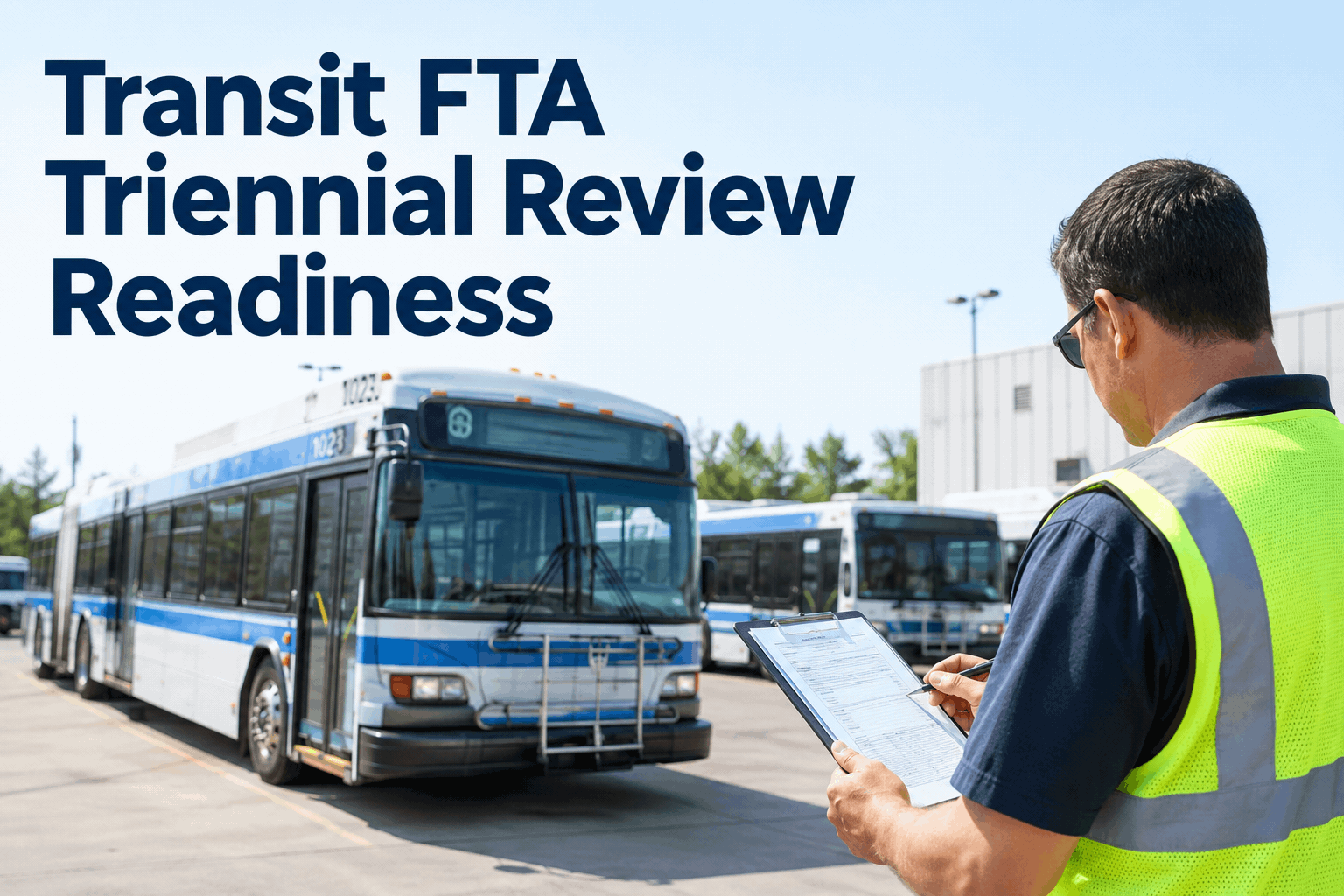
Every three years, FTA sends a reviewer to ask one deceptively simple question: can you prove your fleet, facilities, and equipment are maintained the way your own plan says they are? Agencies that document as they go answer it in an afternoon. Agencies that don't spend weeks pulling together a maintenance history that should have taken minutes to export — and the single most common finding reviewers cite has nothing to do with a broken bus. It's a maintenance plan that doesn't hold up on paper. See how audit-ready records stay current in a demo.
Transit FTA Triennial Review Readiness
The Triennial Review happens whether your records are ready or not. Organized maintenance plans, inspection histories, and work order documentation turn it from a scramble into a formality — and the gap between the two is almost always what you tracked along the way, not what you fixed.
The Finding FTA Keeps Citing, Review After Review
A facility and equipment maintenance plan that's missing or doesn't hold up to review has been among FTA's most-cited Triennial Review findings for years running — and it topped the list outright in FY17. It's rarely that maintenance wasn't happening. It's that the plan, and the records behind it, couldn't prove it on the day a reviewer asked.
Vehicle maintenance tends to be centralized and easy to document. Facilities and equipment are where records get thin — different intervals, different owners, often no single person responsible for keeping the plan current.
What a Compliant Maintenance Plan Must Cover
Reviewers check for a written plan that sets out periodic inspections and preventive maintenance for every category your agency operates — not just the buses.
- A written PM schedule covering every revenue vehicle, by mode
- Facility maintenance intervals, documented separately from vehicle PM
- Equipment maintenance intervals, covering anything FTA-funded, not just rolling stock
- A record showing ADA accessibility features are inspected and kept in good working order
- One person or role assigned to keep the plan current, not left to whoever remembers
- Inspection and PM completion records that match the plan's stated intervals
The plan is the document a reviewer reads first. The records are what prove it's real. Sign up free and start building that record this week.
Deficiency Risk: Where Agencies Get Flagged
These gaps show up most often in the maintenance review area, based on FTA's own published findings.
No facility or equipment maintenance plan
Vehicle PM is documented, but facilities and equipment have no written plan at all — or one that hasn't been updated since the last review.
Plan and practice don't match
The written plan sets an interval, but the service records show a different one — or no record at all for several cycles.
No one owns the plan
Without a named coordinator, updates slip through the cracks between departments and nobody notices until a reviewer asks.
ADA equipment maintenance undocumented
Lifts, ramps, and securement systems need their own maintenance evidence — general vehicle PM records don't cover it.
Building an Audit-Ready Evidence Trail
You don't assemble this the month before a review. You build it continuously, so there's nothing left to assemble.
Write the plan in full
Cover vehicles, facilities, equipment, and ADA accessibility features — the categories reviewers check by name.
Log every service as it happens
Date, what was done, and who did it — recorded at the time of service, not reconstructed from memory later.
Track facilities and equipment separately
Don't let non-vehicle maintenance ride along inside the vehicle PM log — it needs its own visible schedule and history.
Export the full trail before the reviewer arrives
A complete record, pulled in minutes, is what turns "can you prove it" into a non-issue.
Expert Review: Binders & Spreadsheets vs. Audit-Ready CMMS
Agencies cited for a maintenance plan finding almost never lacked the maintenance — they lacked a record that reviewers could follow in one sitting.
Swipe sideways to see all columns.
The agencies that stop getting the same finding twice are the ones whose evidence was captured automatically, not reconstructed under deadline. Book a demo to see that record-keeping on your own fleet.
The Bottom Line
The Triennial Review isn't graded on how well your fleet runs — it's graded on whether you can prove it. A written plan, backed by inspection and PM records that actually match it, is what closes FTA's most-cited maintenance finding before it's ever written up. Build the record continuously, and the review becomes something you pass through, not something you brace for.