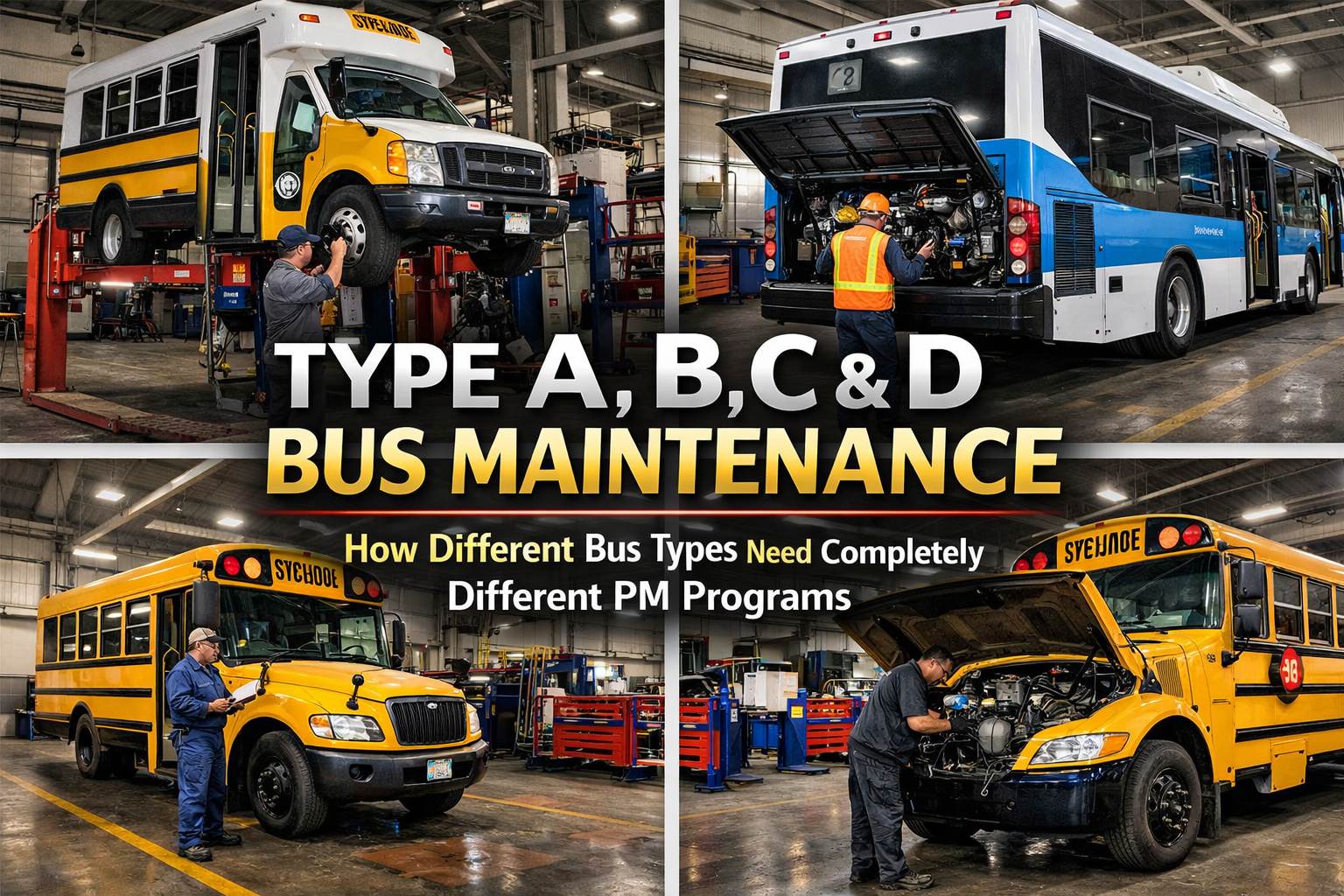
Type A, B, C & D Bus Maintenance: How Different Bus Types Need Completely Different PM Programs
Someone on your team built one PM schedule. It covered oil changes, brake inspections, tire rotations, and fluid checks — then applied it to every bus in the fleet. It looked complete. What it actually was, is a compliance failure in slow motion. A Type A cutaway runs on a Ford E-450 van chassis with hydraulic disc brakes. A Type D transit bus carries a rear-mounted Detroit DD8 with a full air system requiring daily drain valve checks. Applying the same PM template to both is like using one maintenance schedule for a pickup truck and an 18-wheeler. This guide gives you the exact PM framework every bus type actually needs — and shows how one CMMS manages all four from a single dashboard.
The One-Size-Fits-All PM Problem
Fleets running mixed bus types on a single PM schedule report Type A vehicles failing at twice the rate of Type C buses. The cause is almost always mismatched intervals — brake service timed for air systems being applied to hydraulic systems, or oil intervals calibrated for a Cummins B6.7 being used on a Ford V10. The vehicle always pays the price.
The Four Bus Types — What You're Actually Maintaining
Every PM program starts with understanding the chassis architecture. The four bus types are defined by engine placement, brake system, GVWR, and chassis origin — and each produces a completely different maintenance profile for your shop.
TYPE A
Cutaway / Minibus
Chassis
Ford E-450, GM Express, RAM ProMaster
GVWR
Up to 14,500 lb (A-1) / 14,500+ lb (A-2)
Engine
Gas V10 or light diesel — ahead of windshield
Brakes
Hydraulic disc — NOT air brakes
Capacity
10–30 passengers
Special needs · Small routes · Activity transport
TYPE B
Stripped Chassis Bus
Chassis
Stripped / purpose-built front-section chassis
GVWR
10,000+ lb
Engine
Partially in cab beside driver; door behind front axle
Brakes
Hydraulic or air — depends on chassis & GVWR
Capacity
10–30 passengers
Smaller districts · Rural routes · Specific needs
TYPE C
Conventional School Bus
Chassis
IC Bus CE, Blue Bird Vision, Thomas Saf-T-Liner C2
GVWR
21,500 – 29,500 lb
Engine
Cummins B6.7 or Detroit DD — fully in front of windshield
Brakes
Full air brakes — daily drain valves required
Capacity
54–78 passengers
General daily routes · Most common U.S. school bus type
TYPE D
Transit-Style Bus
Chassis
Direct-mount transit chassis — FE or RE configuration
GVWR
25,000 – 36,000 lb
Engine
Beside driver (FE) or behind rear wheels (RE) — flat front
Brakes
Full air brakes — larger reservoir, more complex
Capacity
72–90 passengers
Longer routes · High capacity · Transit-style operations
The chassis architecture defines everything downstream: brake system type, engine access difficulty, fluid specifications, service intervals, and technician skill requirements. A mixed fleet is not four variations of the same vehicle — it is four different maintenance programs running under one roof. Sign up for BusCMMS to build separate PM templates for every bus type in your fleet.
PM Intervals at a Glance — All Four Types Side by Side
This is the visual proof that one schedule cannot cover four bus types. Each row is a service task. Each column shows the correct interval — or whether that task even exists — for that bus type.
Service Task
TYPE A
TYPE B
TYPE C
TYPE D
ENGINE & FLUIDS
Oil & Filter Change
5,000 mi severe duty / van chassis
5,000–7,500 mi chassis-dependent
7,500–15,000 mi Cummins B6.7 spec
7,500–15,000 mi Cummins / Detroit DD
Air Filter Inspection
15,000 mi earlier on urban routes
15,000 mi
15,000–30,000 mi
15,000–30,000 mi
Coolant System Flush
3 years / 60,000 mi
3 years / 60,000 mi
3 years / 60,000 mi
3 years / 60,000 mi
BRAKE SYSTEM
Daily Pre-trip Brake Check
Pedal feel + fluid level hydraulic — no air drain
Pedal feel or air build-up depends on brake type
Air build-up test + drain moisture valves every single day
Air build-up + multiple tank drains more tanks than Type C
Brake Fluid Replacement
Every 3 years TIME-BASED — not mileage
Every 3 years if hydraulic
Not applicable no brake fluid
Not applicable no brake fluid
Slack Adjuster Check
Not applicable hydraulic system
Only if air brakes
Every 15,000 mi measure stroke — do not assume
Every 15,000 mi more adjusters than Type C
Air Dryer Cartridge Replacement
Not applicable no air system
Only if air brakes
30,000–45,000 mi
30,000–45,000 mi
TRANSMISSION & DRIVETRAIN
Transmission Fluid & Filter
30,000–60,000 mi Ford TorqShift 5R110W
30,000–50,000 mi chassis-dependent
25,000 mi severe Allison 2500/3000 spec
25,000 mi severe Allison — larger capacity
EMISSIONS & AFTERTREATMENT
DPF / DEF / SCR Inspection
Not applicable gas engine or light diesel
Varies by engine spec
25,000 mi log regen frequency
25,000 mi larger system, stricter monitoring
TYPE-SPECIFIC ITEMS
Wheelchair Lift Service
Every service interval cycle test, lube, hydraulic check
If equipped
Rarely equipped
Varies by config
Engine Access Labor (per service)
Standard van hood, easy access
Standard front engine cab access
Standard front hood, school bus access
+30–45 min/event rear compartment only
Critical difference / Type-specific requirement
Not applicable to this bus type
Standard interval applies
Every orange cell in the matrix above is a place where a single generic PM template either incorrectly assigns a service task, skips a required inspection, or uses the wrong interval. Fleets that move from a single PM template to type-specific programs report 25–40% lower total maintenance costs and 85% fewer unplanned breakdowns. Book a demo to see how BusCMMS builds this matrix into automated PM templates for each bus type.
Stop Running Every Bus on the Same PM Schedule
BusCMMS builds separate PM templates for Type A, B, C, and D buses — right intervals, right checklists, automatic service triggers for each vehicle type. One dashboard. Four PM programs. Zero missed inspections.
When a single PM schedule is applied across all bus types, these are the three systematic failures that cause compliance risk, accelerated wear, and avoidable roadcalls. Every mixed fleet experiences at least one of them.
01
Missing Time-Based Brake Fluid Replacement on Type A
Air brake PM programs do not include brake fluid replacement because air systems have no hydraulic fluid. When a Type A PM template is copied from a Type C program, the brake fluid interval simply does not exist. Type A hydraulic brake fluid absorbs moisture over time regardless of mileage — the correct interval is every 3 years. After 3 years of use, untreated fluid causes internal corrosion in calipers and cylinders that fails silently until the brakes do not stop the bus.
Result: Hydraulic brake failure — entirely preventable with a calendar-triggered service event missing from most templates
02
Wrong Oil Change Interval Applied to Van-Chassis Type A
A Cummins B6.7 in a Type C bus can run 7,500–15,000 miles between oil changes on a synthetic interval. A Ford V10 gas engine in a Type A bus should be changed every 5,000 miles under severe duty conditions — and stop-start school routes qualify as severe duty by every major OEM definition. Fleets running Type A buses on a Type C oil interval are extending service by 2,500–10,000 miles beyond spec, accelerating engine wear on a van chassis that is already working harder per passenger-mile than the heavy-duty Type C platform it is incorrectly sharing a schedule with.
Result: Premature engine wear — the Type A engine is the most expensive component on a vehicle that does not have the structural durability of a Type C chassis
03
Type D Rear-Engine Labor Budget Built for a Type C
Every routine service on a Type D rear-engine bus requires working through a rear access compartment — oil changes, belt inspection, coolant service, air filter replacement. Fleet managers consistently report 30–45 additional minutes of labor per service event compared to a Type C front-engine bus. A mixed fleet of 10 Type C and 5 Type D buses serviced quarterly will accumulate over 300 unbudgeted labor hours per year if the Type D labor premium is not factored into PM planning. Most maintenance budgets built on Type C assumptions consistently underestimate Type D service cost by 20–30%.
Result: Chronic Type D under-servicing as technicians prioritize easier-access vehicles, and budget shortfalls that defer necessary maintenance
Expert Review: How BusCMMS Manages Four PM Programs From One Dashboard
The operational challenge in a mixed fleet is not knowing what each bus type needs — it is executing four different PM programs consistently, tracking compliance separately for each type, and proving to auditors that every vehicle received the correct service. Here is how that works in practice.
01
Vehicle Tagged at Creation → Correct Template Assigned Automatically
Each vehicle is created in BusCMMS with its bus type (A, B, C, or D). The system assigns the matching PM template automatically — no manual selection per work order. Type A vehicles receive hydraulic brake intervals and wheelchair lift checklist items. Type C and D vehicles receive air brake protocols, DPF tracking, and Cummins or Detroit-specific service specs. A technician opening a Type A inspection sees a checklist built for a van chassis. Opening a Type D inspection shows expanded air tank drains, rear-engine access items, and turbocharger inspection checkpoints.
Type A templateType C templateType D templateAuto-assigned on VIN entry
02
Dual Triggers — Mileage and Time-Based Running Simultaneously
Type A brake fluid replacement triggers on calendar time (36 months) — not mileage. Type C oil changes trigger on odometer mileage. Type D rear-engine service can trigger on engine hours if telematics data is connected. BusCMMS runs all triggers simultaneously for each vehicle and fires the work order on whichever occurs first. The Type A bus that sits all summer still gets its brake fluid reminder in September when 3 years have elapsed. The Type D bus that runs summer camp routes still gets its oil change alert at 7,500 miles regardless of calendar date.
Mileage triggerCalendar / time triggerEngine hours triggerFirst-to-occur fires
03
Compliance Dashboard Sorted by Bus Type — Auditor-Ready in Seconds
One dashboard shows PM compliance status for every bus type — filterable by type, sortable by overdue interval, exportable by class. An auditor asking for all Type C brake inspection records from the last 12 months generates a report in seconds. A director asking which Type A buses are overdue on wheelchair lift service sees the answer without calling the shop. Four PM programs fully visible and separately reported from a single screen — with no risk of a Type A task appearing on a Type D work order.
Filter by bus typeOverdue alerts by classExport compliance reportsAudit-ready records
04
Type D Labor Premium Built Into Work Order Time Estimates
BusCMMS allows type-specific labor time estimates per PM task. A routine oil change work order for a Type C bus auto-populates with a standard 45-minute estimate. The same task on a Type D rear-engine bus auto-populates with 75–90 minutes. Maintenance managers see actual versus budgeted labor by bus type on a single report — finally showing the true cost differential between front-engine and rear-engine vehicles, and giving procurement teams the data they need to account for the Type D labor premium in the next fleet budget cycle.
Type-specific labor estimatesActual vs. budgeted by classProcurement cost data
BusCMMS builds and manages separate PM templates, inspection checklists, and service intervals for every bus type in your mixed fleet — automatically applying the right program to the right vehicle every time, with no manual configuration per work order.
Can a Type A bus use the same PM schedule as a Type C school bus?
No — and the differences are significant enough to cause compliance failures if the same template is applied to both. Type A buses run on commercial van chassis with hydraulic disc brakes, shorter oil change intervals (5,000–7,500 miles versus 7,500–15,000 miles for Cummins-powered Type C buses), and time-based brake fluid replacement requirements every 3 years that simply do not exist in air brake PM programs. They also frequently include wheelchair lift service items entirely absent from Type C templates. Applying a Type C schedule to a Type A vehicle will extend oil change intervals beyond spec, miss brake fluid replacement entirely, and skip lift maintenance — all of which create both safety and compliance risk.
What is the correct oil change interval for a Type C school bus with a Cummins B6.7?
The Cummins B6.7 maximum interval is 15,000 miles or 6 months with full synthetic oil under normal duty conditions. However, school bus operation — frequent stops, short routes, cold starts, and idling — qualifies as severe duty in most manufacturer specifications. Most school districts run 5,000–7,500 mile intervals on Type C buses to account for duty cycle intensity. The Cummins Insite diagnostic system can provide oil life monitoring data to help fleet managers optimize their specific interval based on actual operating conditions rather than a fixed calendar or mileage-only schedule.
Why does brake fluid need to be replaced on a schedule for Type A buses but not Type C or D?
Type C and D buses use air brake systems, which have no hydraulic brake fluid — the brake actuation force is transmitted pneumatically. Type A buses use hydraulic disc brakes derived from their van chassis, which contain DOT-spec glycol-based brake fluid. This fluid is hygroscopic, meaning it actively absorbs moisture from the atmosphere over time. After approximately 3 years, the moisture content in degraded brake fluid can reach levels that lower its boiling point, reduce braking effectiveness under sustained use, and cause internal corrosion in brake calipers and master cylinders. The 3-year replacement interval is time-based regardless of mileage — a bus that only runs 5,000 miles per year still needs its brake fluid replaced on schedule.
Why does a Type D rear-engine bus cost more to maintain per service event than a Type C?
Engine access is the primary driver. On a Type C conventional bus, the engine sits in front of the windshield under a large hood that opens for standard technician access. On a Type D rear-engine bus, all powertrain service requires working through a rear access compartment — repositioning equipment, working in a confined space, and often raising the vehicle to reach components that would be accessible from standing height on a Type C. Fleet managers tracking labor time consistently report 30–45 additional minutes per routine service event on Type D RE buses. On a 5-bus Type D fleet serviced quarterly, this adds 300+ unbudgeted labor hours per year that are invisible in a Type C-based PM budget.
How does BusCMMS manage different PM schedules for a mixed fleet with Type A, C, and D buses?
Each vehicle in BusCMMS is tagged with its bus type classification on creation. The system automatically assigns the matching PM template — Type A vehicles receive hydraulic brake intervals, wheelchair lift service items, and calendar-triggered brake fluid replacement. Type C vehicles receive air brake protocols, Cummins service intervals, and DPF tracking. Type D vehicles receive rear-engine labor notes, expanded air system checks, and engine-hours-based triggers. Service alerts trigger automatically on mileage, engine hours, or calendar time depending on the specific task. Compliance reports generate by bus type for audit readiness. Everything runs from a single dashboard without manual configuration per work order.