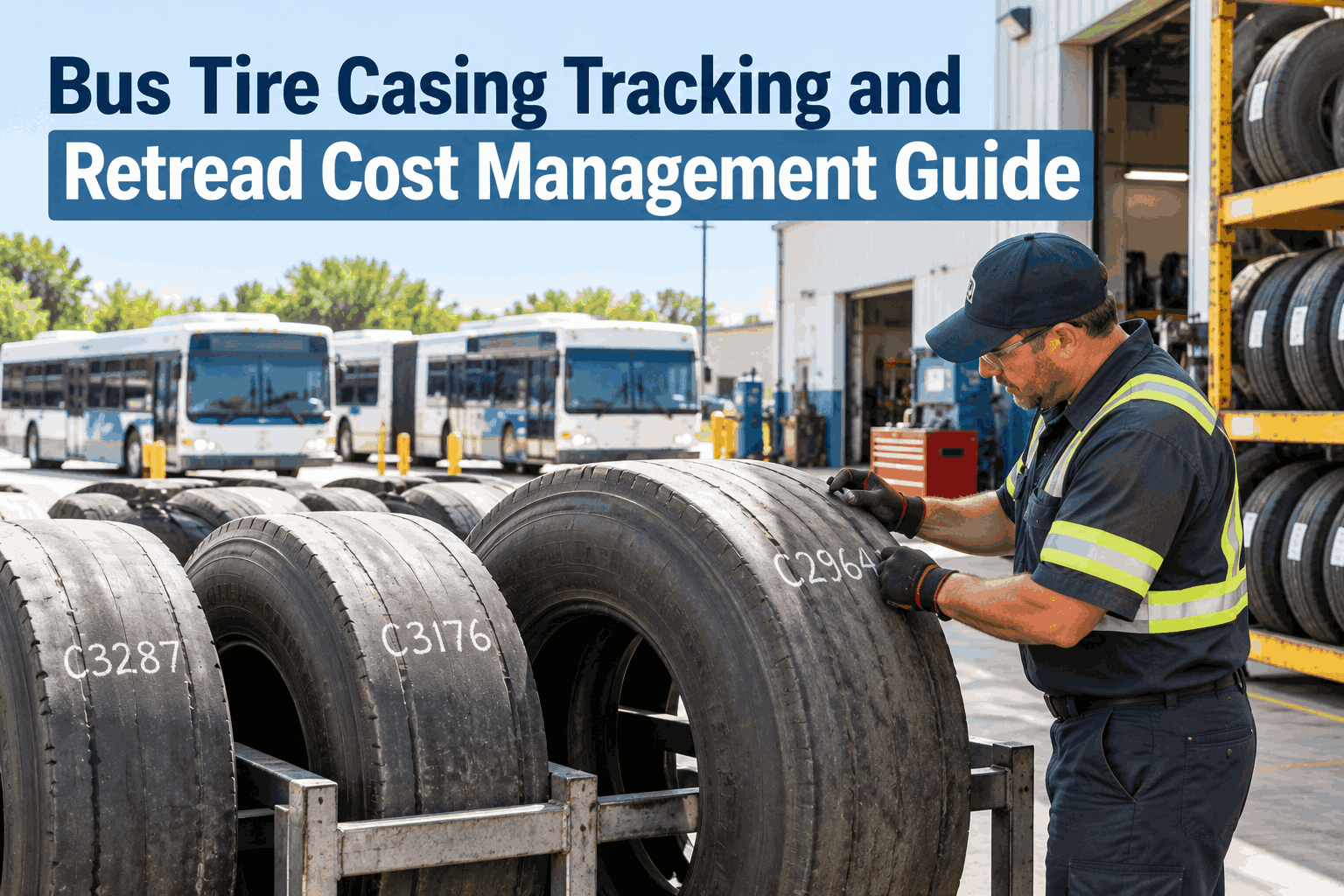
A bus tire casing is the most valuable part of the tire — the structural body that can carry two, sometimes three tread lives if you take care of it. Yet most fleets treat casings like they're disposable: scrap a good one too early, sink money retreading a dead one, and lose track of which casing has how many lives left. Bus tire casing tracking fixes that by treating every casing as a serialized asset with a lifespan and a cost you follow across its whole life — which is where the real tire savings on a fleet actually hide.
Bus Tire Casing Tracking & Retread Cost Management
A casing can carry two or three tread lives — if you track it. Here's how casing tracking and a real retread program turn your most valuable tire asset into your biggest tire saving.
Why Untracked Casings Bleed Money
Tires are one of a bus fleet's biggest recurring costs, and the casing is where the leverage lives — retreading a casing you already own is far cheaper than buying new rubber. But that only works if you know each casing's history. When casings aren't tracked, the savings leak out in four predictable ways, none of which shows up as an obvious problem until the tire budget does.
Good Casings Scrapped Early
A casing with a retread life still in it gets tossed because nobody knew its history. You throw away the cheapest tire life you had — and buy a new tire you didn't need.
Dead Casings Over-Retreaded
Push a casing past its safe retread count and you spend money retreading a body that fails early — or worse, on the road. On a passenger bus, that's a safety exposure, not just waste.
No Cost Per Casing
Without tracking a casing's total cost across its lives, you can't tell which casings and brands actually deliver the lowest cost per mile — so you keep buying on sticker price instead of true value.
Casings Lost at the Retreader
Send casings out to retread with no serial-level record and some never come back — or come back as someone else's. Untracked casings walk off, and you eat the loss without ever knowing.
The common thread is that a casing is an asset, but an untracked one is invisible — and invisible assets get wasted. The fleets that control tire cost aren't buying cheaper tires; they're squeezing every safe life out of the casings they already own, which requires knowing exactly what each casing is and where it stands. That's the whole case for casing tracking, and it pairs directly with the new-versus-retread math laid out in the bus tire cost guide. Book a demo to see casing history tracked serial by serial.
What Bus Tire Casing Tracking Actually Means
Casing tracking means treating each casing as a serialized asset — a numbered item with its own record — rather than lumping all tires into one bucket. Every casing gets a history you can pull up: where it's been, how many lives it's used, and what it's cost. These are the things worth recording against each one.
Serial & Identity
A unique ID per casing — brand, size, DOT serial — so it's a specific tracked object, not one of a nameless pile. Everything else hangs off this identity.
Retread Count & Cap
How many times it's been retreaded and the safe limit for that casing. This is what stops a good casing being scrapped early — or a spent one being pushed too far.
Location & Status
Where the casing is right now — on a bus and which position, in stock, or out at the retreader. This is what stops casings vanishing when they leave your yard.
Lifetime Cost & Miles
Total spent on the casing across new plus every retread, against the miles it's delivered — the true cost-per-mile that tells you which casings are actually worth owning.
Put together, these four turn a casing from an anonymous piece of rubber into a managed asset with a running P&L. The moment a casing has a serial, a retread count, a location, and a lifetime cost attached, every decision about it gets easy: retread or scrap, chase it or write it off, buy that brand again or don't. This is really an inventory-and-asset discipline applied to tires, the same rigor a good parts inventory system brings to everything else in the storeroom. Sign up free and give every casing a tracked identity.
Running a Retread Program That Pays
Casing tracking is the foundation; a retread program is what you build on it. The goal is simple — capture every safe tread life a casing can give, and no more. Four steps turn scattered retreading into a program that reliably lowers tire cost per mile.
Serialize Every Casing
Give each casing a tracked identity the day it enters the fleet. Without a serial-level record, nothing else in the program works — you can't manage lives you can't tell apart.
Set Retread Caps by Casing
Define the safe number of retreads for each casing type and inspection condition. The cap protects safety and stops both mistakes at once — scrapping too early and retreading a casing that's done.
Track Casings Through the Retreader
Log each casing out to retread and back in by serial, so none go missing and every retread cost lands against the right casing. This closes the biggest leak — casings lost off-site.
Scrap by Data, Not Guess
Retire a casing when its history and condition say it's done — not on a hunch or because it's convenient. Data-based scrap timing is what captures the last safe life without gambling on an unsafe one.
The discipline that ties these together is treating the casing's whole life as one continuous record rather than a series of disconnected events. When a casing comes back from its second retread, you should be able to see instantly that it's on its final safe life and plan accordingly — not rediscover its history from a faded sidewall stamp. That continuity is exactly what a tracking system provides and a clipboard can't, and it's the same lifecycle thinking behind tread-depth lifecycle tracking, applied one level up at the casing. Book a walkthrough to see a retread program run by serial number.
The Economics: Why Every Captured Life Drops Cost Per Mile
The reason casing tracking pays is pure arithmetic. A new tire spreads its full price over one tread life. Each retread adds a fresh tread life for a fraction of that price on a casing you already own — so the cost per mile falls with every life you capture. Here's the shape of it across a casing's lives.
That falling curve is the entire business case, and it explains why a scrapped-early casing hurts so much: you paid new-tire cost per mile and walked away before the cheap lives kicked in. It also explains the safety guardrail — the curve only works while the casing is sound, so the retread cap isn't a limit on savings, it's what keeps the savings real instead of gambling on a failure. Tire cost per mile is one of the biggest levers on overall fleet cost, which is why it features in nearly every serious cost-per-mile reduction plan. Track casings and you pull that lever on purpose. Sign up free and see cost per mile by casing across its lives.
How BusCMMS Tracks Casings and Manages Retread Cost
Casing tracking demands a serial-level record that follows each casing on the bus, in stock, and out at the retreader — something no clipboard or spreadsheet survives for long. BusCMMS tire management makes casings first-class tracked assets, so the retread program runs on real data and the savings are captured, not estimated.
-
Serialized Casing Records
Every casing gets a unique tracked identity with brand, size, and history — the foundation that turns anonymous rubber into a managed asset you can make decisions about.
-
Retread-Cycle Tracking
Record each retread against the casing and count it toward the safe cap — so a good casing gets every life it has and a spent one gets retired before it fails.
-
Off-Site & Location Status
Log casings out to the retreader and back by serial, so none go missing and you always know whether a casing is on a bus, in stock, or off-site — closing the biggest casing leak.
-
Lifetime Cost Per Casing
Sum new plus every retread cost against the miles delivered, giving true cost per mile per casing — so you buy the brands and casings that actually earn their keep.
-
Scrap & Safety Alerts
Flag when a casing hits its retread cap or condition limit, so scrap timing is driven by data and a spent casing never quietly goes back on a passenger bus.
-
Tire & Position Integration
Casing records tie into tread tracking, rotations, and DVIR checks, so the whole tire program — casing, tread, and position — lives in one connected system, not scattered logs.
The reason a purpose-built bus platform matters for casings specifically is that a casing outlives any single tire fitment — it moves between buses, positions, and off-site retread trips over years, and tracking that journey needs a system built to follow a serialized asset through its whole life. A generic tool that logs "tires" as a lump can't tell you a specific casing is on its final safe life or that three casings never came back from the retreader. Because BusCMMS records casings as tracked assets against real buses and costs, the retread savings become visible and bankable — and it's typically live in two to four weeks. BusCMMS reports fleets meaningfully cutting tire spend once casings are tracked and retreading runs as a managed program.
A Parts Manager's Take
That's casing tracking in one story: the savings didn't come from cheaper tires, they came from finally seeing the casings the fleet already owned — capturing the lives being thrown away and plugging the ones walking off. The rubber didn't change; the visibility did.
The Bottom Line on Bus Tire Casing Tracking
Bus tire casing tracking is one of the highest-return moves in tire cost control, because the casing is the asset and every safe tread life you capture from it drops your cost per mile. Untracked, casings bleed money four ways — good ones scrapped early, dead ones over-retreaded into a safety risk, no cost-per-casing to buy smart, and casings lost at the retreader. The fix is to treat each casing as a serialized asset with a real history: give it an identity, track its retread count against a safe cap, know its location on the bus or off-site, and follow its lifetime cost against the miles it delivers. Build a retread program on that foundation — serialize, cap, track through the retreader, and scrap by data — and you capture every safe life a casing has and no more, which is exactly where the falling cost-per-mile curve pays off. None of it survives on a clipboard, because a casing outlives any single fitment and moves through the fleet for years; it takes a system built to follow a serialized asset through its whole life. Do that, and you cut tire spend without buying a single different tire — you just finally use what you already own. Book a walkthrough to build casing tracking on a fleet like yours.