University Shuttle Fleet Software 2026 | 99% Uptime for Campus
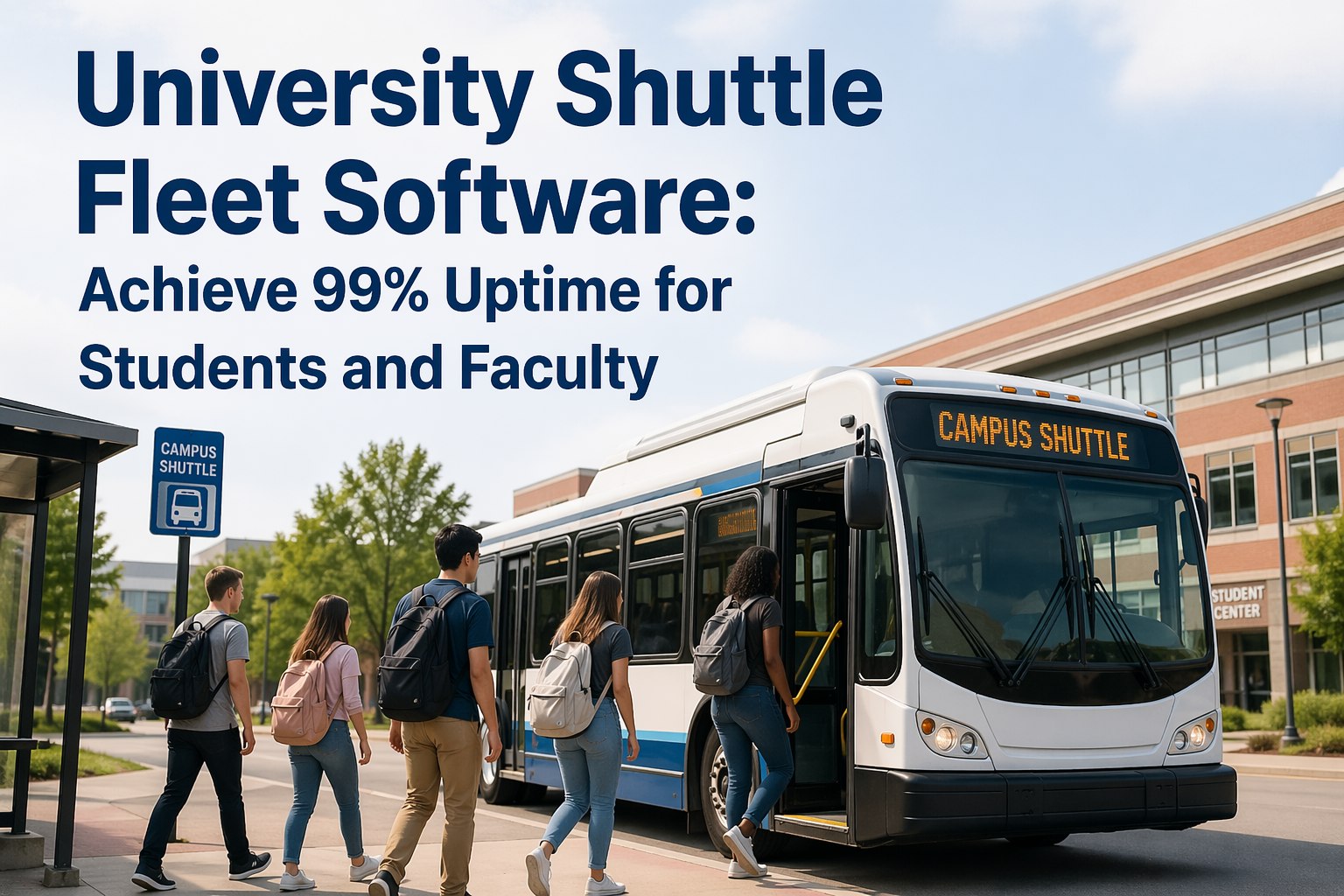
University shuttle fleet software uptime is not just an operational metric — it is a student satisfaction score, a faculty retention signal, and a campus safety obligation all rolled into one number. A grounded shuttle at 8:47 AM means a student misses a 9:00 AM exam. A cancelled evening route means a staff member walks across an unlit campus at midnight. University transportation directors manage one of the most scrutinised fleets in public service — operating at peak intensity for 9 months, staffed by part-time drivers, and evaluated daily by 20,000 people who have somewhere to be. This guide shows exactly what university shuttle fleet software does differently from generic fleet tools, why preventive scheduling and mobile inspections are the two levers that drive 99% uptime, and how Bus CMMS is used by campus transportation teams to manage all of it without adding headcount.
1 breakdown
can cancel 4–6 routes and strand hundreds of students
9 months
peak operating window — no margin for unplanned downtime
20,000+
daily passengers — every route missed is a campus reputation event
99%
fleet uptime achievable with preventive scheduling + mobile inspections
Why University Shuttle Fleets Are Harder to Maintain Than You Think
Campus shuttle operations look simple from the outside: fixed routes, predictable ridership, daytime hours. The reality that transportation directors live is very different. University shuttle fleets face five compounding challenges that generic fleet management tools — designed for trucking or logistics — were never built to handle.
Most university shuttle drivers are part-time students or hourly staff. Pre-trip inspection rates on paper-based systems fall to 40–60% on irregular shift days. Digital guided inspections with mobile prompts raise completion to 95%+ because the form tells the driver what to look for and requires a photo before submission.
Paper inspection completion: 40–60% on irregular shifts
02
No Dedicated Maintenance Staff — Repairs Get Scheduled Around Other Work
Many university fleets share a mechanic with facilities management or grounds. Without a work order system that flags defects immediately, a reported brake noise sits in a paper log for days. Auto-routing work orders to the mechanic's phone the moment a driver reports an issue cuts average repair response from 3.2 days to under 4 hours.
Avg paper-based repair response: 3.2 days
03
Semester Peaks Create Burst Demand With Zero Flexibility
The first two weeks of semester, finals, and homecoming events can triple normal ridership. A bus that is down for a missed service during these windows cannot be replaced — the fleet is running at 100% capacity. Preventive maintenance scheduled during semester breaks keeps every vehicle road-ready before demand spikes.
Demand triples in first 2 weeks of semester — zero spare capacity
04
ADA Compliance Is Non-Negotiable — Lift and Ramp Failures Carry Immediate Exposure
Under ADA Title II, universities must provide equivalent transportation access for students with disabilities. A wheelchair lift that fails mid-semester triggers an ADA complaint, not just a maintenance issue. Lift and ramp operational status must be logged at every pre-trip — and work orders for lift failures must be treated as critical priority.
ADA Title II: lift failures = federal compliance exposure
05
Budget Scrutiny Every Cycle — No Unplanned Costs Allowed
University transportation budgets are approved annually and rarely adjusted mid-year. A single emergency engine repair can consume 30–40% of an annual maintenance budget. Preventive maintenance programmes reduce unplanned repair costs by 25–40%, turning reactive crisis management into a predictable line item the provost's office can plan around.
Emergency repair: can consume 30–40% of annual maintenance budget
How Bus CMMS Achieves 99% Uptime on Campus Shuttle Fleets
Preventive Maintenance Scheduling by Mileage or Calendar
Every vehicle gets a PM schedule based on either mileage intervals or calendar dates — whichever comes first. Oil changes, brake checks, tire rotations, and transmission service are all scheduled automatically. Alerts fire 14 days before each due date so your mechanic has time to book service during a low-ridership window — not during exam week.
Planned maintenance costs 3–5× less than reactive emergency repairs
02
Mobile Pre-Trip Inspections With Photo Documentation
Drivers complete a guided 11-area FMCSA checklist on their phone before every shift — including ADA lift and ramp status, passenger door operation, and interior safety checks. Each defect requires a photo before the report can be submitted. No photo, no sign-off. This creates an irrefutable record and catches issues before they become breakdowns at 8 AM.
Mobile completion rates reach 95%+ vs. 40–60% for paper forms
03
Real-Time Defect Alerts to Mechanic's Phone
The moment a driver reports a defect — brake noise, lift malfunction, warning light — a work order is created and sent directly to the mechanic on duty. No paper trail. No end-of-day pile. The mechanic acknowledges, repairs, and certifies the fix before the next driver takes the wheel. For ADA lift failures, work orders are automatically flagged as Priority 1.
Repair response drops from 3.2 days (paper) to under 4 hours
04
Fleet Uptime Dashboard With Per-Vehicle Status
Transportation directors see every vehicle's status at a glance: available, in service, awaiting repair, or in scheduled maintenance. Open work orders, upcoming PM due dates, and inspection completion rates are all visible from one screen. Before the first route departs each morning, you know exactly which buses are ready and which are not.
Full fleet status visible in under 30 seconds — no calls to mechanics
Built for Campus Operations. Deployed in Under a Week.
See How Bus CMMS Keeps Campus Shuttles at 99% Uptime — Without Adding Headcount
Preventive scheduling, mobile inspections, real-time defect alerts, and fleet uptime dashboard — all included. University transportation teams typically deploy in 3–5 days. No IT department required. No hardware to install.
The Campus Maintenance Calendar — When to Service, When to Never Take a Bus Down
Timing preventive maintenance to the academic calendar is the single most impactful operational decision a university transportation director makes each year. Bus CMMS auto-schedules service windows based on your academic calendar settings, ensuring buses are serviced during the maintenance windows below — not during the blackout periods when every bus is needed. See how Bus CMMS auto-schedules your fleet around your academic calendar — book a 20-minute demo.
Period
Timing
Fleet Demand
Maintenance Action
Summer Break
May – August
Low — 20% ridership
Full PM on all vehicles. Major repairs. Tire rotation. Brake rebuild. Oil changes. Annual DOT inspections. Pre-semester readiness check.
Semester Start
Aug 15 – Sep 7
Critical — 100% capacity
No planned downtime. All vehicles must be road-ready. Only emergency repairs. Daily mobile inspections every route.
Regular Semester
Sep – Nov / Jan – Apr
High — 75–90% ridership
Routine PM on one vehicle at a time. Schedule mid-week when ridership is lowest (Tue/Wed mornings). Max 1 bus offline per day.
Finals & Exams
Nov / Apr–May (2 wks)
Critical — 100% capacity
No planned downtime. Emergency only. Pre-finals inspection burst — all vehicles checked 5 days before finals begin.
Winter Break
Mid-Dec – Jan
Low — minimal service
Second major PM window. Address any deferred repairs. Prepare vehicles for spring semester. Update DOT compliance records.
DOT & ADA Compliance — What University Shuttle Fleets Must Track
University shuttle fleets that carry nine or more passengers or use vehicles over 10,001 lbs are subject to full FMCSA commercial vehicle regulations — the same rules that apply to commercial bus operators. Many university transportation departments discover this compliance exposure only when an audit arrives. Bus CMMS tracks every deadline automatically.
Daily DVIR
49 CFR §396.11
Pre-trip and post-trip inspection required for every vehicle before each route. Must cover all 11 FMCSA inspection areas including ADA accessibility equipment. 3-signature chain enforced digitally.
Bus CMMS: Mobile guided checklist — auto-enforced
90-Day Emergency Exit Inspection
49 CFR §396.3
All emergency exits, push-out windows, and emergency door alarms must be inspected every 90 days. Bus-specific requirement — frequently missed on spreadsheet systems.
Bus CMMS: Auto-scheduled per vehicle, 14-day advance alert
Annual DOT Inspection
49 CFR §396.17
Full Appendix A inspection required every 12 months. Records retained 14 months. Most recent inspection sticker or report kept on vehicle at all times.
Bus CMMS: Due date tracking, 30-day alert, record storage
ADA Accessibility Equipment
ADA Title II + 49 CFR
Wheelchair lifts, ramps, kneeling systems, and securement devices must be inspected at every pre-trip. Lift failures must be prioritised as critical work orders — not queued with routine maintenance.
Bus CMMS: ADA lift item in every inspection, Priority 1 auto-flag
Purpose-Built for Campus Transportation Operations
Give Your Students and Faculty the 99% Uptime They Expect — Starting This Semester
Bus CMMS handles preventive scheduling, mobile inspections, real-time defect alerts, DOT compliance tracking, and ADA lift monitoring — all in one platform. University transportation teams deploy in under a week with no IT support required.
Does FMCSA and DOT compliance apply to university shuttle fleets?
Yes. University shuttle fleets that operate vehicles designed to carry nine or more passengers for compensation, or commercial vehicles over 10,001 lbs, are subject to FMCSA commercial vehicle regulations under 49 CFR Parts 390–396. This includes daily pre-trip inspections under §392.7, Driver Vehicle Inspection Reports under §396.11, the 90-day emergency exit inspection under §396.3, and annual DOT inspections under §396.17. Many university transportation departments are not aware of this exposure until an FMCSA compliance review. Bus CMMS tracks all of these deadlines automatically and maintains the documentation required to pass any audit.
What does 99% fleet uptime actually mean for a 12-bus campus fleet?
99% uptime across a 12-bus fleet means a maximum of approximately 43 total vehicle-downtime days per year — or an average of 3.6 days per vehicle. When downtime is planned (scheduled PM during summer break and winter break), 99% uptime is achievable with a structured preventive maintenance programme. The problem for most campus fleets is that downtime is unplanned — emergency repairs during semester, buses grounded by defects discovered at 7 AM, or vehicles out of service because inspections were not completed and a defect was missed. Bus CMMS prevents unplanned downtime by scheduling maintenance in advance and catching defects through daily mobile inspections before they become roadside failures.
How does Bus CMMS handle ADA compliance for campus shuttle fleets?
Bus CMMS includes ADA accessibility equipment as a required item in every pre-trip inspection checklist — wheelchair lifts, ramps, kneeling systems, and securement device checks are all prompted in the mobile walkaround. If a driver reports a lift malfunction, the resulting work order is automatically flagged as Priority 1 and sent immediately to the mechanic on duty. Universities have significant legal exposure under ADA Title II for accessibility equipment failures that prevent students with disabilities from using shuttle services — Bus CMMS ensures these failures are caught, documented, and repaired before the next route departs.
How long does it take to deploy Bus CMMS for a university shuttle fleet?
Most university transportation teams are fully operational on Bus CMMS within 3–5 business days. Day one involves setting up your fleet account and importing vehicle data. Days two and three cover driver and mechanic app training — approximately one hour per role. Days four and five involve configuring the preventive maintenance schedule aligned to your academic calendar and activating the compliance tracking for DOT inspections and 90-day exit checks. No IT department is required. Drivers use existing smartphones. There is no hardware to install. Bus CMMS provides direct onboarding support throughout the setup process.
Can Bus CMMS handle both the maintenance and compliance requirements of a university fleet?
Yes — Bus CMMS is a combined CMMS and compliance platform purpose-built for bus fleets. It handles preventive maintenance scheduling (by mileage or calendar), digital DVIR with the full 3-signature chain, 90-day emergency exit scheduling, annual DOT inspection due date tracking, ADA equipment status monitoring, defect-to-work-order automation, fuel tracking, and fleet uptime dashboards — all in one account. University transportation directors do not need separate maintenance software and separate compliance tracking tools. Everything is connected: a defect reported on a morning inspection becomes a work order, gets repaired and certified, is acknowledged by the next driver, and becomes part of the permanent vehicle compliance record accessible for any audit.