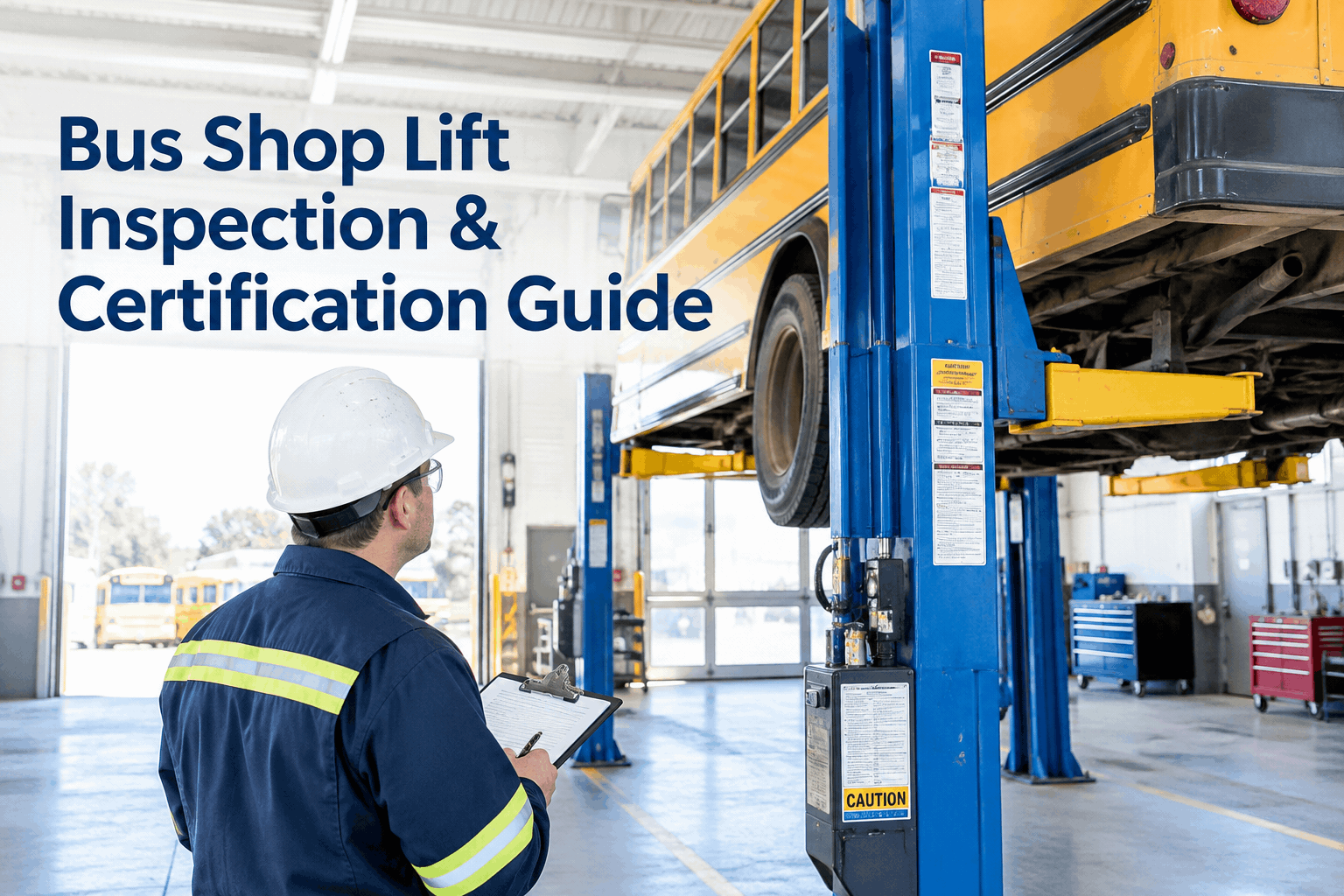
This is about the hoists your technicians stand under every day — not the wheelchair lift on the bus itself. A shop vehicle lift that hasn't seen its annual certified inspection is a liability sitting in plain sight, and it's one of the easiest records to lose track of because nobody's riding it to work every morning.
SHOP LIFT INSPECTION & CERTIFICATION
Every Hoist in the Shop, Tracked Like the Equipment It Is
Daily checks, periodic maintenance, and annual certified inspections scheduled per lift — with the record to prove it.
Buses get a PM schedule because nobody forgets they exist. The lift a technician stands under every shift often doesn't — it's permanent, it's always there, and that's exactly why its annual certification is the record most likely to quietly lapse. Put your lifts on the same schedule as your fleet — start free.
Two Different "Lifts," Two Different Inspection Programs
It's worth clearing this up first, because the terms get mixed up constantly: a shop vehicle lift (the hoist that raises a bus off the ground for service) and a wheelchair lift (the accessibility platform on the bus itself) are completely different pieces of equipment with completely different inspection requirements.
SHOP VEHICLE LIFT
The hydraulic hoist, post lift, or in-ground lift used to raise a bus for maintenance. Inspection and certification generally follow ANSI/ALI ALOIM standards, including daily operator checks and an annual inspection by a qualified lift inspector.
WHEELCHAIR LIFT
The accessibility platform on an accessible bus, governed by separate ADA and FTA requirements under 49 CFR Part 38. This guide is about the shop equipment, not this one — see BusCMMS's dedicated wheelchair lift compliance guide for that topic.
The Three-Tier Lift Inspection Cycle
A shop lift inspection program runs on three overlapping cycles, and the one most likely to slip is the one with the longest gap between checks.
Daily — Operator Pre-Use Check Visual and functional check before the lift is used, performed by whoever operates it that shift.
Periodic — Preventive Maintenance Lubrication, cable and hydraulic checks, and wear-point inspection per the manufacturer's recommended interval.
Annual — Certified Inspection A full inspection by a qualified lift inspector, commonly expected under ANSI/ALI ALOIM standards — the tier most often left to lapse.
Do You Know Which of Your Shop Lifts Is Overdue for Certification?
See how BusCMMS tracks every shop lift as its own asset — daily checks, PM cycles, and annual certification dates — flagged the moment one comes due.
A shop lift isn't a fixture — it's equipment with a service life, a maintenance history, and a safety certification that expires. Most shops track buses this way without thinking twice. The lift deserves the same roster entry. Add your lifts as tracked assets — start free.
Bay 1 — 2-Post Lift
Last annual cert: Mar 14, 2026
Current
Bay 2 — In-Ground Lift
Last annual cert: Nov 24, 2025
Due in 18 days
Bay 3 — 4-Post Lift
Last annual cert: Sep 02, 2025
Overdue
Bay 4 — Mobile Column Set
Last annual cert: Jun 18, 2026
Current
Illustrative example. Once lifts are tracked as assets, a view like this takes seconds instead of a walk around the shop checking stickers.
Lift identification — bay, make, model, and capacity, so every record attaches to one specific unit, not "the lift."
Inspection tier and date — daily, periodic, or annual, logged separately so the longer cycles don't hide behind a daily check that always gets done.
Inspector name or certification credential — especially for the annual inspection, where qualification matters.
Any deficiency found and its resolution — a noted issue should route to a repair work order, not just sit as a comment on the inspection form.
Next due date, set automatically — the lift's inspection cycle resets itself the moment the current one closes.
Expert Perspective: The Equipment That Hides in Plain Sight
Shop lifts are some of the most-used, least-tracked equipment in a bus maintenance operation. A technician stands under one every day without a second thought, but when I ask to see the current certification sticker and the record behind it, I get a blank look more often than I'd expect. It's not negligence — it's that the lift never shows up on anyone's radar the way a bus does. Nobody schedules it for a route, nobody notices if it's "due." The fix is simple: put the lift on the same kind of asset record as everything else in the shop, with its own inspection cycle and its own due dates. Once it's on that list, it stops being invisible.
Conclusion: Track the Lift the Way You Track the Fleet
Shop lifts don't move, don't have VINs, and don't show up on a route sheet — which is exactly why their inspection records are some of the easiest to lose track of in an otherwise well-run shop. Treating each lift as a tracked asset, with its own daily, periodic, and annual inspection cycle, closes a gap that's invisible until someone asks for the certification record. Walk through lift tracking with a BusCMMS specialist — book a demo. If you can't say right now which of your shop's lifts is closest to its certification deadline, that's the clearest sign it's time to put them on a system. Start your free BusCMMS account and add your first lift today.
Give Every Shop Lift Its Own Inspection Record
BusCMMS tracks shop vehicle lifts as assets — daily checks, periodic maintenance, and annual certification dates, flagged automatically before they lapse.
It's the inspection of the hydraulic or mechanical hoist used to raise a bus for maintenance — distinct from the wheelchair lift on the bus itself — typically covering daily operator checks, periodic maintenance, and an annual inspection by a qualified lift inspector.
How often does a shop vehicle lift need to be certified?
Many shops follow an annual certification cycle performed by a qualified lift inspector, commonly aligned with ANSI/ALI ALOIM standards, alongside daily pre-use checks by the operator. Requirements can vary, so confirm specifics with your lift manufacturer or an ALI-certified inspector.
Who can perform an annual lift certification inspection?
Typically a qualified, trained lift inspector — many shops use an ALI-certified inspector specifically, since that credential is recognized under the relevant national safety standards.
Is a shop vehicle lift the same as a bus wheelchair lift?
No. A shop vehicle lift is the hoist used to raise a bus for service, governed by ANSI/ALI standards. A wheelchair lift is the accessibility platform on an accessible bus, governed by separate ADA and FTA requirements — two different pieces of equipment with two different inspection programs.
How long does it take to start tracking shop lifts in BusCMMS?
Most shops add their first lift as a tracked asset the same day they sign up. A full multi-bay rollout with historical certification dates typically takes a couple of weeks.