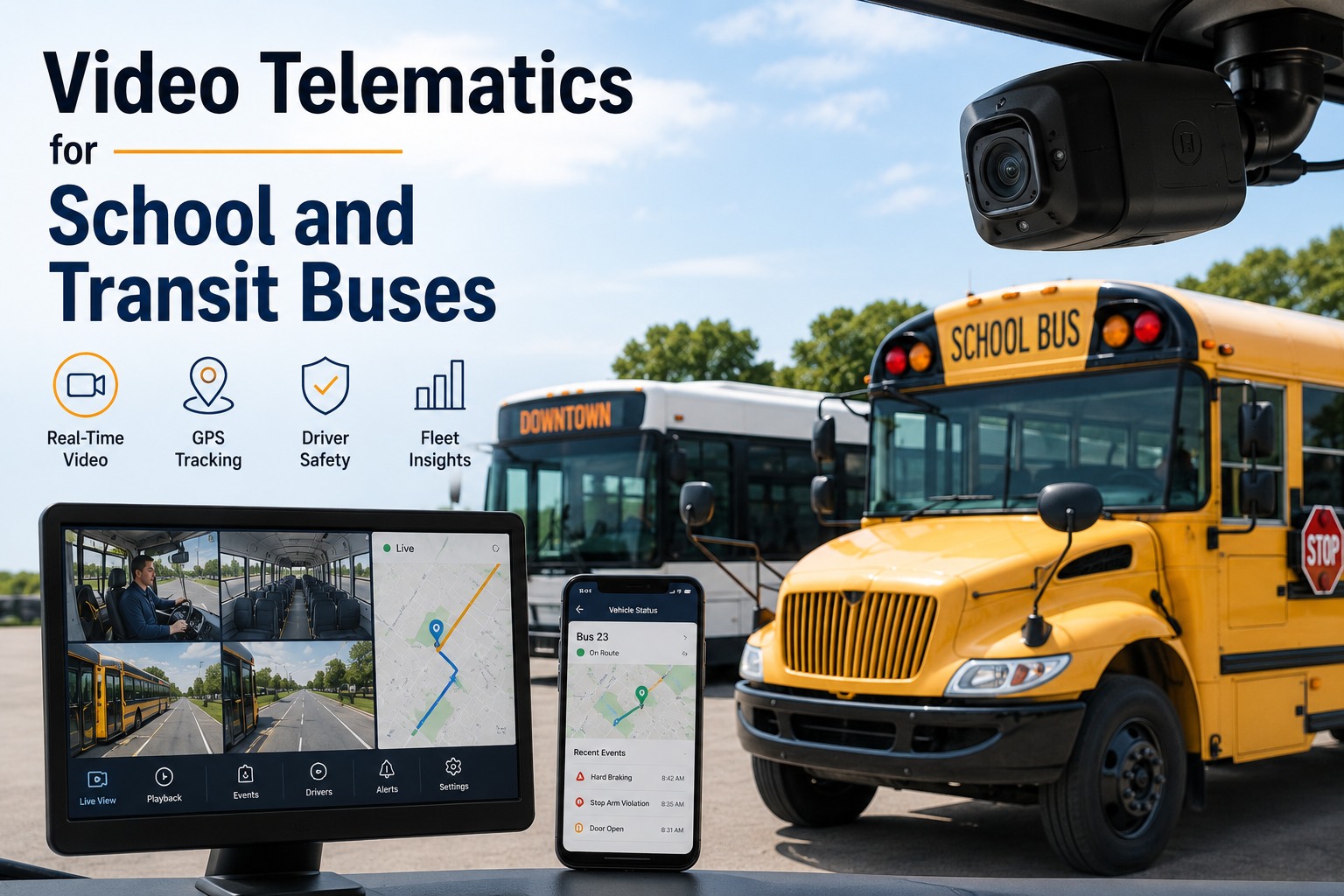
Your GPS telematics dashboard tells you a bus was doing 38 in a 30 zone on Route 6 at 7:52 AM. What it can't tell you is whether that was a driver reacting to a kid darting into the street, or just a heavy foot on a downhill stretch. That gap is exactly what bus video telematics closes — it pairs the GPS event with the actual footage, so a flagged incident comes with context instead of just a number on a report. GPS-only telematics tells you something happened. Video telematics tells you what happened and why it matters.
How video telematics differs from GPS-only telematics
GPS telematics has been standard on bus fleets for years — location, speed, harsh-brake,and harsh-turn events, idle time, route adherence. It's useful, and most districts already have it running through a provider like Samsara or Geotab. But GPS data on its own answers "what" without answering "why." A harsh-brake event could mean a driver caught off guard by a car running a red light, or it could mean the driver was following too close. The GPS log looks identical either way.
Video telematics adds the missing layer: the same event, now with a clip attached automatically, so a supervisor reviewing it can actually see the road, the driver's reaction, and the context — without pulling footage manually from a separate camera system hours or days later. That distinction matters most exactly where the stakes are highest: a stop-arm violation, a danger-zone lingerer, a near-miss at an intersection. No single federal mandate requires video telematics on buses specifically — the compliance bar here is set by 49 CFR 396 maintenance record requirements and district policy, not a video-specific rule — which means the decision to adopt it is entirely about whether it solves a real operational problem for your fleet, not a box you're required to check. You can see the difference directly on a BusCMMS video telematics walkthrough using footage and GPS data from your own routes.
Event-based versus continuous recording — and why the choice affects your storage bill
This is the practical decision most districts get wrong on the first pass, usually because nobody explained the tradeoff before the contract got signed. Continuous recording captures everything, all the time, on every bus. It sounds thorough, but it means storing hours of footage of an empty road for every minute that actually mattered — and it's the single biggest driver of storage cost and bandwidth strain when footage needs to sync from a bus that spent the day out of cellular range.
Event-based recording flips that: the camera or AI unit captures a short clip only when something crosses a threshold — a harsh brake, a stop-arm violation, a danger-zone entry — plus a few seconds before and after for context. That's a fraction of the storage footprint, it syncs faster once the bus reaches wifi, and it means your review queue contains things worth reviewing instead of hours of nothing. Most fleets end up running a hybrid — event-based as the default with continuous recording reserved for a short buffer window around known high-risk zones like the stop-arm area — but it's worth asking any vendor directly which model they run by default, since that answer affects both your monthly bandwidth costs and how fast footage actually reaches you after an incident.
Book a walkthrough of the unified camera and maintenance record.
See how BusCMMS reads events from the MDVR or AI camera you already own — no need to replace hardware you've already invested in.
What to integrate first on a mixed-age bus fleet
Almost no fleet is buying video telematics onto a blank slate. You've got buses running MDVRs from three different manufacturers, a few newer units with AI-based detection, and probably at least one older bus still on a basic DVR that only local-stores footage until someone pulls the card. Ripping all of that out to standardize on one camera brand is expensive and, more importantly, unnecessary — the value isn't in the camera hardware, it's in whether the events those cameras generate reach one place.
The practical sequence that tends to work: start with whichever buses already have AI-capable cameras, since those units are already generating structured event data rather than raw footage you'd have to review manually. Connect that feed first, prove the work-order and coaching loop actually functions on real routes, then expand to the MDVR-only units, where events might need a lighter-touch integration or manual flagging until hardware gets replaced on its normal refresh cycle. Trying to integrate everything simultaneously on a 60-bus mixed fleet is how these projects stall — a phased rollout gets you a working proof point on ten or fifteen buses before asking for budget to cover the rest.
The failure that shows up after the hardware's already installed
Here's the objection worth addressing head-on: a district installs video telematics, the system starts generating flagged events, and six months later nobody can say who's actually reviewing them. The cameras record everything and nothing changes, because no one named an owner for the review queue before go-live. This isn't a hardware problem — the cameras did their job. It's an operational gap that shows up after the technology is already paid for.
Before flipping video telematics on fleet-wide, name the person by title who reviews flagged events, how often, and what happens when a pattern repeats. If a vendor can't answer clearly how their system routes an event to that person, that's worth treating as a red flag during evaluation, not something to figure out after the contract's signed. Tying video events into the same platform as your maintenance and compliance records at least makes sure events land somewhere with an assigned owner instead of a standalone dashboard.
A scenario from a real bus operation
A transit agency running 48 buses had GPS telematics through Geotab for years, but harsh-brake events were reviewed maybe once a month, if at all — there wasn't enough context in a GPS log alone to justify the time. After adding video telematics on the 20 newest buses in the fleet, the same harsh-brake events started arriving with a ten-second clip attached. Within the first month, reviewing those clips surfaced that a specific intersection was generating a disproportionate share of hard-brake events across multiple drivers, not one driver's habit — a visibility issue at the intersection itself, reported to the city. GPS data alone had shown that intersection as noisy for over a year. It took video context to show why.
Not sure where to start on a mixed-age fleet?
Get the checklist districts use to decide which buses to connect first and what to ask any camera vendor before signing.
The bottom line on bus video telematics
Bus video telematics earns its value the moment a flagged event comes with enough context that someone can actually act on it — not just a speed reading or a brake alert sitting in a log nobody reviews. Pick event-based recording as your default, integrate the AI-capable cameras you already have before considering a hardware overhaul, and name a real owner for the review queue before turning the system on. Do those three things, and video telematics stops being a compliance nice-to-have and starts being the reason a mechanical issue gets caught before it becomes a road call. See how a bus-specific operations platform ties video telematics into the same record as your maintenance history, instead of running it as a standalone system.
Updated August 2026
Frequently asked questions
What's the actual difference between GPS telematics and video telematics?
GPS telematics tracks location, speed, and flags events like harsh braking based on sensor data alone. Video telematics adds a video clip to that same event automatically, so a reviewer can see what actually happened — a driver reacting to a hazard versus following too close — instead of inferring it from a number on a report.
Is there a federal mandate requiring video telematics on school buses?
No single federal mandate governs video telematics specifically. The compliance bar for bus maintenance records is set by 49 CFR 396, and districts adopting video telematics do so based on operational and safety value rather than a video-specific federal requirement.
Should a fleet use event-based or continuous video recording?
Most fleets are better served by event-based recording as the default, since it captures a short clip only when a threshold is crossed, keeping storage costs and sync times manageable. Continuous recording captures far more footage than needed and creates real bandwidth strain, particularly for buses that spend time outside cellular range.
Do we need to replace our existing cameras to add video telematics?
Not necessarily. A hardware-agnostic platform can read events from the MDVR or AI camera system a fleet already owns, rather than requiring a full rip-and-replace. This matters most for mixed-age fleets where buses run different camera hardware from different manufacturers.
What went into effect with the FMCSA eDVIR final rule?
The FMCSA eDVIR final rule, Docket FMCSA-2025-0115 (91 FR 7893, published February 19, 2026), took effect March 23, 2026, and writes explicit electronic-DVIR authorization into 49 CFR 396.11 and 396.13, formally supporting electronic inspection records alongside paper-based ones.