An 18-month-old bus throws a transmission fault. The engine is still well inside its OEM warranty term, but when you pull the service history, one PM landed 900 miles past the manufacturer's maximum interval. That single gap is enough for the manufacturer to argue the failure wasn't maintained to spec — and a six-figure repair becomes yours to pay. The fix isn't more paperwork after the fact; it's building the schedule to the manufacturer's actual numbers from the day the bus arrives. See how interval tracking works on a real fleet in a demo.
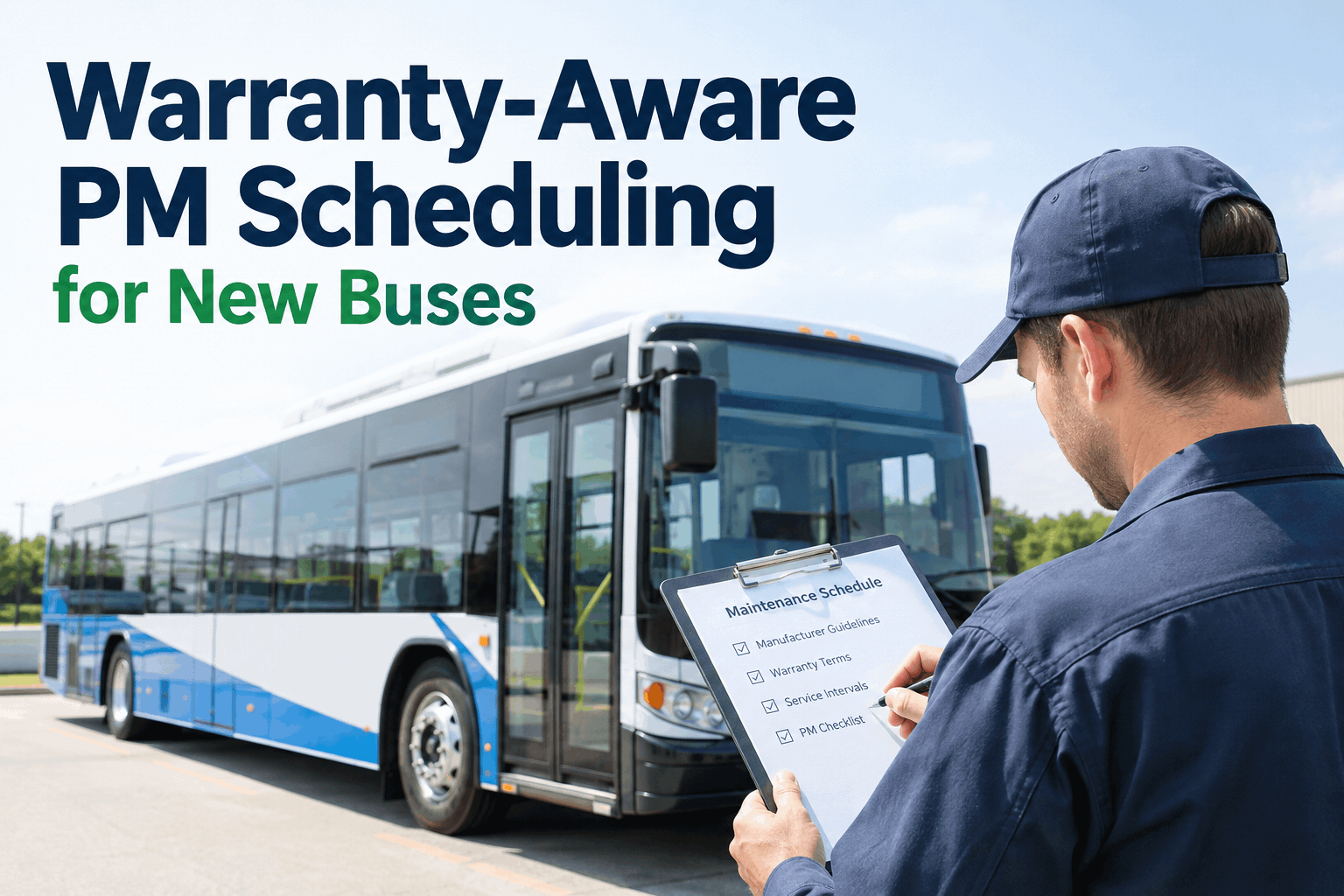
Warranty-Aware PM Scheduling for New Buses
A new bus's warranty is only as strong as the PM schedule behind it. Service it to the manufacturer's maximum interval and the warranty does its job. Drift past that line even once, and the coverage you already paid for can turn into a repair bill.
Why New Bus Warranties Live or Die on the Schedule
Manufacturers rarely deny a claim because the part was faulty. They deny it because the maintenance behind it doesn't hold up — a rounded interval, a record with a gap, a component term nobody was tracking separately.
Setting Up a Warranty-Safe PM Schedule in 4 Steps
Do this once, at delivery, and the schedule protects itself for the life of the warranty.
Pull the OEM's exact intervals
Go straight to the manufacturer's service manual for this specific model — not a rounded number from the last fleet or a generic shop default.
Load it per vehicle, not fleet-wide
A shared schedule hides the fact that different models and model years carry different maximum intervals under the same roof.
Separate component warranty terms
Engine, transmission, and major systems often run their own clocks. Track each one, not just a single headline warranty date.
Set an alert before the maximum, not after
A warning a few hundred miles ahead of the OEM's cutoff gives the shop time to act — a warning after the fact just documents the miss.
Most agencies have steps 1 and 2 covered. It's step 3 and 4 — component-level tracking and advance alerts — that a spreadsheet struggles to hold onto. You can sign up free and load this schedule for your next new bus.
Interval Risk by Vehicle System
Not every system carries the same scheduling risk. Here's where warranty-aware tracking matters most on a new bus.
Swipe sideways to see all columns.
Specific intervals vary by manufacturer and model year, so always confirm against the OEM manual for the exact figures that apply to your fleet.
Is Your PM Program Warranty-Safe? Run the Checklist
Run this against your next new bus delivery. Tick every box and a scheduled PM never becomes the reason a claim gets denied.
- Manufacturer intervals are loaded per vehicle, not copied from a template
- Every PM is logged with date, odometer, and technician at the time of service
- Component terms (engine, transmission, fareboxes) are tracked separately from the vehicle
- Someone is alerted before a vehicle crosses its maximum interval, not after
- Records can be exported the same day a claim needs to be filed
- A documented recovery procedure covers flagging, filing, and following up on claims
Six boxes, and the first three are where most denied claims are won or lost. Sign up free and load your fleet's manufacturer intervals before your next delivery.
Expert Review: Manual Tracking vs. Warranty-Aware Scheduling
Agencies that move warranty scheduling off spreadsheets and paper logs report the same shift: fewer disputed claims, and far less time spent reconstructing records when a manufacturer asks for proof.
Swipe sideways to see all columns.
The pattern holds across fleets of every size: the agencies with the fewest denied claims are the ones whose interval data was captured automatically, not reconstructed after the fact. Book a demo to see that comparison on your own fleet data.
The Bottom Line
A new bus's warranty is worth protecting with the same discipline you'd apply to any other fleet asset — arguably more, since the cost of a denied claim lands squarely on the agency's budget. Warranty-aware PM scheduling isn't about doing more maintenance; it's about doing the maintenance the manufacturer already requires, on time, with a record that proves it. Get the intervals right at delivery, and the warranty takes care of the rest.