A wheelchair lift that fails to deploy is not a maintenance inconvenience. Under 49 CFR Part 37, it is a civil rights violation. Federal law requires public transit entities to establish regular and frequent maintenance checks of vehicle lifts (49 CFR 37.163), remove any bus with an inoperable lift from service before its next service day, and provide alternative accessible transportation within a defined timeframe when a passenger is stranded mid-service. BusCMMS's own research found that at one transit agency, 63% of a 259-bus fleet had inoperable wheelchair lifts -- a finding that triggered immediate federal enforcement action and mandatory corrective measures. Civil penalties for ADA accessibility violations begin at $75,000. The regulatory expectation is clear: lift maintenance is not optional equipment upkeep. It is a federally mandated civil rights obligation with inspection interval requirements, documentation standards, and strict out-of-service protocols that FTA auditors verify during compliance reviews. This guide covers every wheelchair lift inspection requirement -- daily pre-service checks, weekly cycling tests, quarterly servicing intervals, and annual certification items -- with the complete checklist for each frequency and the ADA legal framework behind every requirement.
ADA Legal Framework: Wheelchair Lift Inspection Requirements
Federal regulations governing bus wheelchair lift maintenance in the USA
49 CFR 37.163Requires public entities to establish a system of regular and frequent maintenance checks of lifts sufficient to determine if they are operative. Drivers must report any lift failure by the most immediate means available.
49 CFR 37.163(d)When a lift is discovered inoperative, the entity shall take the vehicle out of service before the beginning of the vehicle's next service day and ensure the lift is repaired before the vehicle returns to service.
49 CFR 37.165Lift and securement use requirements. Personnel must use the lift when requested by a passenger with a disability. The lift shall be used to board and alight from the vehicle -- operators may not require wheelchair users to use alternate means.
49 CFR Part 38Accessibility specifications: lifts must accommodate a minimum 600-lb capacity and a minimum clear platform area of 30" x 48". Both inboard and outboard wheelchair facing must be permitted.
Exception: 49 CFR 37.163(e)If no spare vehicle is available, a vehicle with an inoperable lift may operate a maximum of 3 days (areas over 50,000 population) or 5 days (smaller areas) with documented justification. This exception is not a loophole -- it requires immediate repair effort and written documentation.
Lift Failure Consequence Cascade
Daily lift checks skipped or incomplete
Wear develops in seals, pivot pins, or hydraulics
Lift fails mid-service -- passenger cannot board or exit
ADA complaint filed -- FTA investigation opened
Civil penalty from $75,000 + corrective action plan
BusCMMS daily lift checklist prevents this at step 1
Custom Checklists -- BusCMMS 2026
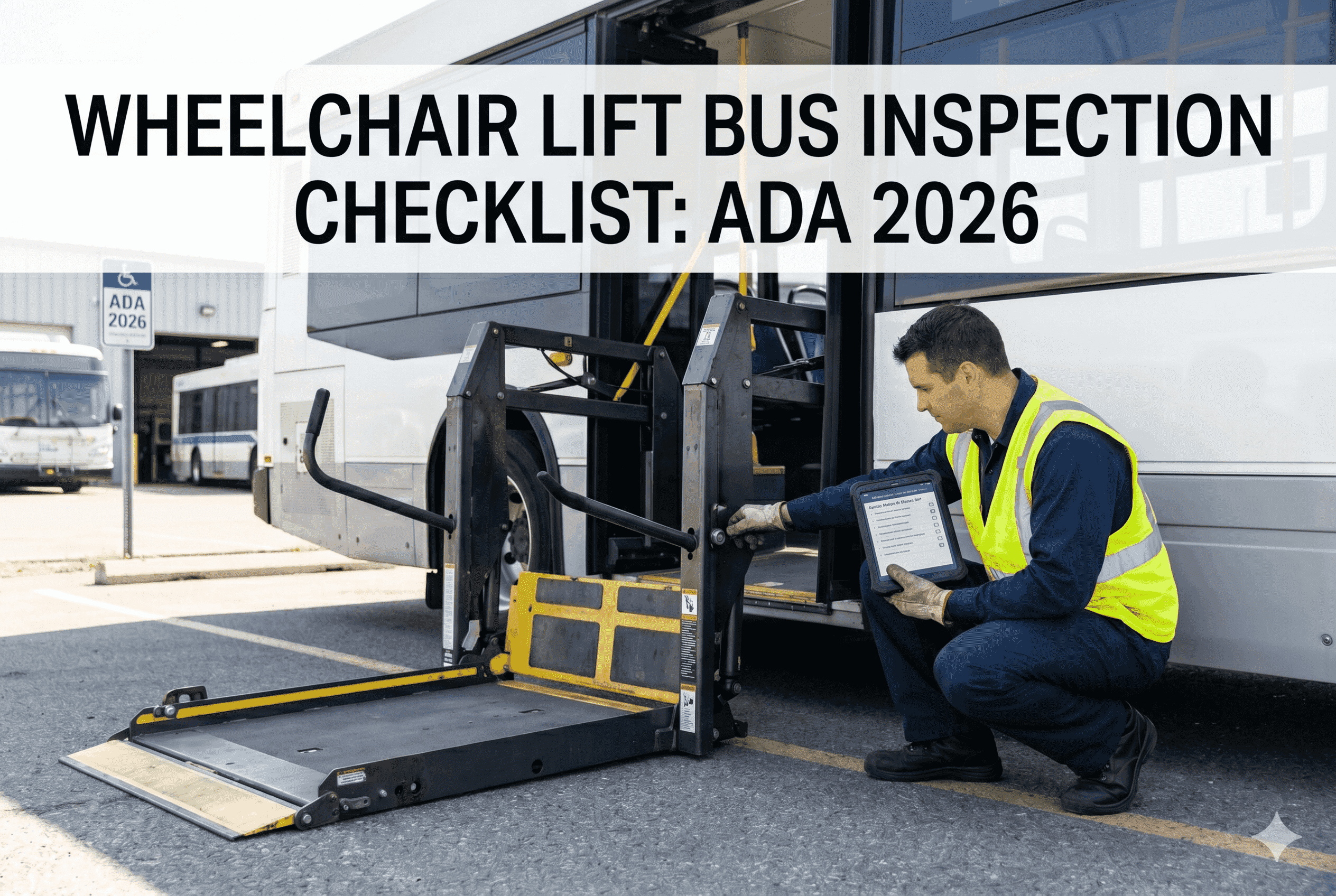
Wheelchair Lift Bus Inspection Checklist: Complete ADA Compliance Guide 2026
Daily, weekly, quarterly, and annual wheelchair lift inspection checklists with ADA regulation citations. Build each inspection frequency as a custom checklist in BusCMMS -- automated scheduling, digital completion records, and FTA-ready documentation.
Conducted by maintenance staff -- more thorough than daily pre-service check. Identify developing issues before they become operational failures.
5 items
FTA Auditors Verify Lift Maintenance Documentation. BusCMMS Generates It Automatically.
BusCMMS custom checklists log every lift inspection with timestamp, technician ID, and any defect notes. Daily, weekly, quarterly, and annual lift inspection records are stored indefinitely and exportable in under 60 seconds for any FTA compliance review. No filing cabinets, no lost paper logs.
Mechanical servicing by qualified lift technician. Follow manufacturer maintenance schedule for specific lubrication types and torque specifications.
8 items
ANNUAL
Annual Comprehensive Lift Certification
Full inspection and documentation review by qualified lift technician. Coincides with annual DOT vehicle inspection. Results retained with vehicle maintenance records.
6 items
Out-of-Service Rules: When a Failed Lift Grounds the Bus
Under 49 CFR 37.163(d), when a lift is discovered inoperative -- whether during pre-service inspection or mid-route -- the vehicle must be taken out of accessible service before the next service day. There is no grace period for deciding whether to address it. The regulation also requires:
Immediate action required
Driver reports lift failure to dispatch immediately per 49 CFR 37.163(c). If a passenger with a disability is waiting or stranded, alternative accessible transportation must be provided. The 30-minute response timeframe applies as FTA best practice.
Exception: No spare available
If no accessible spare vehicle is available, the vehicle may operate a maximum of 3 days (population over 50,000) or 5 days (smaller areas) per 49 CFR 37.163(e). This exception requires documented justification and active repair effort -- it is not a blanket allowance to defer lift repairs.
BusCMMS dispatch hold
BusCMMS custom lift checklists integrate with dispatch -- when a daily lift pre-service check is failed or not completed, a dispatch hold flag is applied to the vehicle automatically. The bus cannot be assigned to an accessible route until the lift is repaired and the inspection is recompleted and passed.
BusCMMS Customer
"We had an FTA accessibility compliance review and they asked for 12 months of lift inspection documentation for our entire fleet. With BusCMMS, I pulled every daily lift check, every quarterly service record, and every lift deployment log in about 4 minutes. The reviewer said it was the most complete lift maintenance documentation she had seen in a transit compliance review. Before BusCMMS, we were on paper logs and I would not have been able to produce half of what they asked for."
Expert Verdict: Why General CMMS Platforms Fall Short on ADA Lift Compliance
General CMMS platforms manage work orders and PM schedules across multiple asset types. They do not have pre-built wheelchair lift inspection checklists meeting 49 CFR 37.163 requirements, no ADA-specific dispatch hold logic for failed lift inspections, and no integration between lift inspection results and accessible vehicle routing. BusCMMS Custom Checklists allow transit agencies to build daily, weekly, quarterly, and annual wheelchair lift inspection checklists that automatically schedule, track completion, integrate with DVIR, apply dispatch holds on failed inspections, and generate FTA-ready documentation -- all within a platform built specifically for bus fleet operations. A general CMMS can track that a lift work order was created. BusCMMS ensures the lift was inspected before every service day and the documentation is available for any compliance review.
Every Wheelchair Lift. Every Service Day. Every Inspection Documented.
BusCMMS Custom Checklists build ADA lift inspection workflows that run automatically -- daily pre-service checks scheduled every operating day, quarterly servicing alerts 30 days in advance, dispatch holds on any vehicle with a failed or incomplete lift inspection, and FTA-ready documentation exportable in under 60 seconds.
Frequently Asked Questions: Wheelchair Lift Bus Inspection 2026
What does 49 CFR 37.163 require for bus wheelchair lift maintenance?
Section 37.163 requires public transit entities to establish a system of regular and frequent maintenance checks of lifts sufficient to determine if they are operative, ensure drivers report lift failures immediately by the most available means, and remove any vehicle with an inoperative lift from service before its next service day. If no accessible spare is available, limited exceptions allow up to 3 days of continued operation (population over 50,000) or 5 days (smaller areas) with documented justification and active repair effort.
What are the minimum ADA specifications for a bus wheelchair lift?
Under 49 CFR Part 38, wheelchair lifts on transit buses must have a minimum design load of 600 pounds, a minimum clear platform area of 30 inches x 48 inches, and must permit both inboard and outboard wheelchair user facing. Handrails are required on both sides of the platform. These are minimums -- many modern lifts are built to higher specifications, and the transit agency is obligated to accommodate wheelchairs up to the lift's actual rated capacity.
How often should a bus wheelchair lift be inspected?
FTA best practice under 49 CFR 37.163 requires daily pre-service lift cycling and inspection (not just visual -- the lift must be physically deployed and stowed) before every day of revenue service. In addition, weekly thorough operational checks, quarterly mechanical servicing and lubrication per the manufacturer maintenance schedule, and an annual comprehensive inspection including load test and hydraulic pressure test should be conducted and documented. BusCMMS Custom Checklists automate all four inspection frequencies independently per vehicle.
What happens if a wheelchair lift fails during bus service?
Under 49 CFR 37.163(c), the driver must report the failure immediately by the most available means. If a passenger with a disability is stranded, the agency must provide alternative accessible transportation -- FTA best practice cites a 30-minute response timeframe. The vehicle must be removed from accessible service before the next service day, and the lift must be repaired before the vehicle returns to service. Systematic lift maintenance failures constitute ADA civil rights violations with civil penalties starting at $75,000.
Can a bus with an inoperable wheelchair lift continue to operate?
Only under the narrow exception in 49 CFR 37.163(e): if no accessible spare vehicle is available, a vehicle with an inoperable lift may operate a maximum of 3 days (areas with population over 50,000) or 5 days (smaller areas) with documented justification showing that repair is being actively pursued. This is not a general allowance to defer lift repairs -- it requires written documentation, active repair effort, and cannot be used as routine practice. FTA auditors specifically look for repeated use of this exception as a sign of inadequate maintenance programs.
Are there ADA lift inspection requirements for school buses?
ADA Title II and 49 CFR Part 37 apply primarily to public transportation entities (transit agencies, paratransit providers) rather than to school bus transportation, which is governed separately. However, school districts that receive federal funding and operate special education transportation with lift-equipped buses are subject to Section 504 of the Rehabilitation Act requirements, which have parallel maintenance obligations. School buses operating on public transit contracts are subject to the full 49 CFR Part 37 requirements.
What documentation do FTA auditors request during wheelchair lift compliance reviews?
FTA compliance reviewers typically request: daily pre-service inspection logs showing lift was checked before each day of service, records of any lift failures and the response (repair timeline, alternative transport provided), quarterly and annual servicing records, driver training documentation for ADA lift operation, and any complaints received related to lift availability. BusCMMS generates all of these record types automatically from daily checklist completion and exports any date range in under 60 seconds for FTA audit production.
How does BusCMMS handle lift inspection scheduling and documentation?
BusCMMS Custom Checklists allow transit agencies to create separate daily, weekly, quarterly, and annual wheelchair lift inspection templates, each scheduled automatically at the correct frequency per vehicle. Daily lift inspections appear in the driver's pre-service workflow alongside the standard DVIR. Failed inspection items automatically create work orders and apply dispatch holds. All inspection records are stored indefinitely with technician ID, timestamp, and any defect notes -- exportable for FTA compliance reviews without manual assembly.