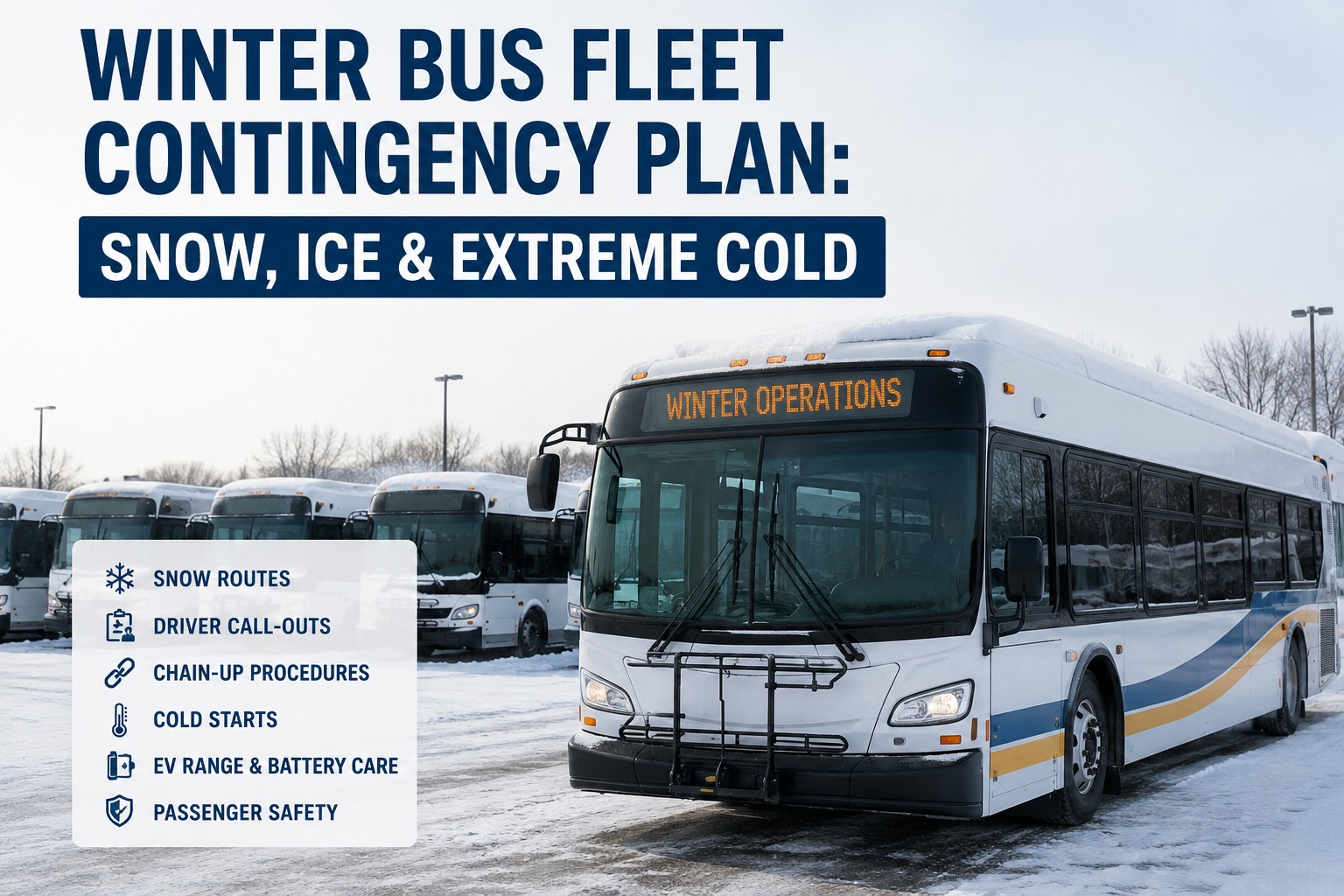
It is 4:30 AM Monday. You are at your kitchen table with a coffee and the forecast just changed overnight. Freezing rain by 6 AM, temperatures dropping to minus 12, and the plows will not clear the county roads before first run. The decision you make in the next 15 minutes affects 6,000 students, 60 drivers, and 42 buses. This is a playbook built for that exact moment -- not a generic winter driving tips article. Ice / Cold / Snow trifecta thresholds, T-minus countdown checkpoints, cold-start failure mapping, EV range degradation, and the driver call-out cascade every fleet supervisor should have printed and taped to the office wall by October 1st. See BusCMMS run winter contingency templates on your fleet → book a 20-min demo.
The Winter Storm Decision Card
Point at the forecast condition. Read the threshold trigger. Follow the response. This is a 60-second decision tool, not a 200-page emergency operations manual.
- Freezing rain / ice glaze→ NO-GO
- Wind chill below -20°F→ MODIFY
- Snow > 4 inches→ DELAY
- Cold & dry, above -10°F→ MANAGE
The trifecta hazards do not respond to willpower. Ice is unmanageable regardless of how good your drivers are. Extreme cold breaks buses regardless of how new the fleet is. Snow is a volume problem the plows either solve or do not. Match your decision to the physics -- not to the pressure to keep the schedule.
The Winter Trifecta: Ice vs Cold vs Snow
Three fundamentally different problems. Three different responses. Treating them as one thing is why fleets get in trouble.
Every experienced fleet supervisor learns this the hard way: winter is not one hazard. It is three separate hazards that require completely different playbooks. Ice is a physics problem no amount of cautious driving can defeat. Extreme cold is a mechanical and human safety problem. Snow is a manageable logistics problem the plow trucks either handle or do not. Reading the forecast correctly starts with knowing which of the three you are looking at, because a 6-inch snow forecast with no ice is a very different decision than a half-inch of freezing rain.
ICE / FREEZING RAIN
EXTREME COLD
SNOW ACCUMULATION
The 60% of winter incidents come from fleets treating a Tier 1 ice event like a Tier 3 snow event. Read the forecast for what it is. See BusCMMS load trifecta-specific route protocols per bus → book a demo.
The T-Minus 48 Hour Countdown Timeline
What disciplined fleets do at each checkpoint before the first flake falls. Miss T-24 and T-6 and you are running the storm reactively.
The difference between a fleet that runs a storm cleanly and a fleet that gets buses stuck on side roads at 7 AM is decisions made in the 48 hours before the event. Six specific checkpoints. Each one takes 15-30 minutes if done in sequence. Skip one and the compression at zero hour becomes chaos.
- T-48h
Forecast confidence check
Pull three forecast sources (National Weather Service, one commercial provider, one local meteorologist). Note timing and severity spread. High agreement = plan firm. Wide spread = watch mode.
- T-24h
Fleet readiness sweep
All buses top-tank on fuel. Winter-grade diesel confirmed. All block heaters tested. Batteries load-tested on any bus that shrugged on cold-crank last week. Air tanks drained.
- T-12h
Threshold call · go/no-go decision
The trifecta call goes here. Superintendent notified. Parent notification drafted. Driver call-out cascade activated with tomorrow's status. This is the moment the decision has to be made even if the forecast is still hedging.
- T-6h
Yard preparation · overnight plug-in
All buses connected to block heaters if temps forecast below 0°F. Yard walked and salted. Chains staged if needed. Substitute driver list confirmed and reachable.
- T-2h
Cold-start window opens
Techs start buses in staggered waves 90 minutes before first run. Extended idle to full operating temperature. Any no-start pulled from route immediately. Substitute bus assignments confirmed.
- T-0
First run departs on modified schedule
Route changes communicated to every driver. Passenger pickup timing adjusted. Real-time dispatch monitoring active. Substitute buses on standby. Weather updates pushed to drivers every 30 minutes.
The Cold Start Failure Map
A real 2024 case: a 110-bus transit fleet had 23 no-starts during a polar vortex morning. Every single failure traced back to one of five components.
Northern Transit Cooperative in Minneapolis lost 23 of 110 buses to no-start conditions during the 2024 polar vortex. After rebuilding their winter inspection discipline around a five-component pre-freeze checklist, they hit 96% first-start success at minus 15 degrees the following winter. Every cold-start failure in a diesel bus fleet comes from one of these five components. Know which one owns the failure and you know which one to inspect before the next event.
Battery cold-crank amp drop
A battery at 100% charge delivers 65% of rated cranking amps at 0°F, and 40% at -20°F. Any battery that struggled last week fails this week.
Diesel fuel gelling
Standard #2 diesel gels below 15°F. Winter-blend #1 diesel resists to -30°F but you have to have switched over in October.
Air brake moisture freeze
Water in air tanks freezes into the lines. Bus will not build air pressure at start. Also freezes the parking brake modulator.
Block heater failure
Block heater burns out or the cord damages over years of plug-in cycles. Bus sits at ambient temp overnight. Even a good battery cannot spin a cold engine at -20°F.
Glow plug failure (older diesels)
Older direct-injection diesels rely on glow plugs to preheat combustion chamber. One failed plug = hard start, five failed = no start.
The Northern Transit lesson: five components, tested once before the freeze, monitored monthly through winter. 23 no-starts became 4 no-starts on the same fleet. Sign up free and load the 5-component pre-winter checklist per bus →
EV Bus Winter Reality Check
If your fleet has electric buses, winter is a completely different math problem. Range drops. Charging slows. Cabin heat becomes a battery cost.
Every EPA Clean School Bus Program grant recipient is now dealing with what diesel operators never had to think about: cold weather range degradation. A Type C electric bus rated for 120 miles per charge at 70°F delivers roughly 84 miles at 20°F, and 70 miles at 0°F. That is not a battery defect. That is chemistry. Cold slows lithium-ion reaction rates, and cabin heaters draw 6-8 kilowatts continuously in single-digit weather. Two things happen if a fleet does not plan for this: buses run out of range mid-route, and depot charging cannot keep up overnight.
Range planning that ignores the temperature curve strands buses mid-route. The math is different in winter and the schedule has to reflect it. See BusCMMS run winter EV range calculations per route → book a demo.
The Driver Call-Out Cascade
Who calls whom, in what order, on what timeline. The single biggest source of storm-morning chaos is unclear communication.
A cancellation or delay is only half the decision. The other half is getting the message from the fleet supervisor to 60 drivers, 5,000 parents, 12 building principals, and a district superintendent inside 90 minutes -- reliably, without dropped links, without a driver showing up at 5:30 AM to a locked yard. The four-tier cascade below is what leading fleet operations use to get the message out cleanly every time.
Fleet supervisor notifies leadership
Superintendent, director of transportation, and building principals get the call/text first. This is the moment the decision is locked. No changes after this point without leadership sign-off.
Parents and community notified
Text message system, email blast, district website update, local news, radio, district social media. Multi-channel so no family misses it. Message templates prepared in advance for cancel / delay / route-modify scenarios.
Driver call-out to full roster
Automated call system or phone tree to every driver. Confirmation required from each driver on shift status. Substitute drivers notified with lead time to make arrival window. Bus assignments confirmed.
Final route confirmation to drivers
Any route modifications pushed to driver tablets or radios. Weather update, road condition report, chain requirement. Passenger pickup timing adjustments. Real-time dispatch monitors the run.
Every hour of the cascade has a defined deliverable. Skip a tier and you get the 5:30 AM phone call from a driver standing at a locked yard. See BusCMMS run automated driver cascade with response tracking → book a demo.
Winter of 2024 taught us hard lessons. We had 23 of our 110 buses fail to start during a polar vortex morning. Batteries, block heaters, air brake moisture -- every failure category we now inspect for. We built a pre-freeze checklist for the following October, ran it against every bus by first snowfall, and monitored the five components monthly through winter. This year at minus 15°F we hit 96% first-start success. Four no-starts across 110 buses instead of 23. Same fleet, same weather, different discipline. The checklist made the difference.
Where BusCMMS Fits Winter Contingency
Six capabilities purpose-built for fleets running winter contingency plans -- not generic weather notification tools.
Trifecta Threshold Templates
Ice, extreme cold, and snow each carry different route protocol templates. Threshold triggers auto-load the correct playbook per event severity.
T-48h Countdown Workflow
Six checkpoints from T-48h to T-0 load as scheduled tasks. Fleet readiness sweep at T-24h. Threshold decision recorded at T-12h.
5-Component Pre-Winter Inspection
Battery load test, diesel switchover, air tank service, block heater test, glow plug scan. Per-bus completion tracking before first freeze.
EV Winter Range Calculator
Per-route range projection at 32°F, 20°F, 0°F, -20°F. Auto-flags routes that exceed cold-weather range for EVs assigned to them.
4-Tier Driver Cascade
Automated notifications at T-12h, T-8h, T-4h, T-1h. Confirmation tracking per driver. Substitute pool auto-notified when primary opts out.
Winter Event Log & After-Action
Every storm event logged. Bus performance by temperature, route modifications, driver call-out response times. Board-ready reporting for the next budget cycle.
23 no-starts to 4 no-starts on a 110-bus fleet, same polar vortex, one winter apart. That is the ROI of running a real contingency playbook. See how →
Frequently Asked Questions
What weather conditions should trigger a bus fleet cancellation vs a delay?
The winter trifecta framework works cleanly for this. Ice or freezing rain forecast in the run window is a Tier 1 hazard that triggers a cancellation regardless of duration -- tire friction approaches zero on glazed pavement, school buses have a high center of gravity that magnifies tipping risk, and no amount of cautious driving overcomes the physics. Extreme cold with wind chill below -20°F is a Tier 2 hazard that triggers modified operations rather than cancellation: warm-up windows, indoor waiting for students at stops, driver check-in cadence, but buses can safely run if mechanically prepared. Snow accumulation above 4 inches or ongoing heavy snowfall is a Tier 3 hazard that typically triggers a delay to allow plows time to clear main routes, then a run on modified routing that skips hills and cul-de-sacs. Buses actually have advantages over cars in pure snow conditions -- heavy weight plus high ground clearance equals better traction than lighter vehicles. The mistake fleets make is treating a Tier 1 ice event like a Tier 3 snow event and running anyway.
What is the T-minus 48 hour countdown for a winter storm event?
Six checkpoints separate a disciplined winter response from a chaotic one. T-48h is forecast confidence check: pull three forecast sources and note the agreement spread. T-24h is fleet readiness sweep: all buses top-tank on fuel, winter-grade diesel confirmed, block heaters tested, batteries load-tested on any bus that struggled on cold-crank last week, air tanks drained. T-12h is the go/no-go decision moment: superintendent notified, parent notification drafted, driver call-out cascade activated. T-6h is yard preparation: buses connected to block heaters if temps forecast below 0°F, yard walked and salted, chains staged, substitute driver list confirmed. T-2h is the cold-start window: techs start buses in staggered waves 90 minutes before first run, extended idle to full operating temperature, any no-start pulled from route. T-0 is first-run departure: route changes communicated, passenger pickup timing adjusted, real-time dispatch monitoring active, weather updates pushed every 30 minutes. Missing T-24 or T-6 compresses everything at zero hour and creates chaos.
Why do diesel buses fail to start in cold weather and how do you prevent it?
Five components cause virtually every cold-start failure in a diesel bus fleet. Battery cold-crank amp drop is the highest failure rate -- a battery at 100% charge delivers only 65% of rated cranking amps at 0°F and 40% at -20°F. Load-test every battery before first freeze and replace anything below 70% capacity. Diesel fuel gelling is the second highest failure rate -- standard #2 diesel gels below 15°F and winter-blend #1 diesel resists to -30°F, so the fuel supplier switchover must happen before October 15th. Air brake moisture freeze happens when water in air tanks freezes in the lines, blocking pressure build-up -- prevention is daily air tank drain and Bendix air dryer cartridge replacement every 3 years. Block heater failure means the bus sits at ambient temperature overnight and even a good battery cannot spin a cold engine below -10°F -- weekly block heater function tests October through March prevent this. Glow plug failure on older direct-injection diesels causes hard starts (one failed) or no-starts (five failed) -- diagnostic scan at pre-winter PM and replace as a set. Northern Transit Cooperative in Minneapolis reported cutting 23 no-starts on a 110-bus fleet to 4 no-starts the following winter using this exact five-component pre-freeze checklist.
How much range do electric buses lose in cold weather?
Roughly 30-40% at 0°F and up to 58% at -20°F, based on typical Type C electric school bus performance. A bus rated for 120 miles at 70°F conditions delivers approximately 100 miles at 32°F, 84 miles at 20°F, 70 miles at 0°F, and around 50 miles at -20°F. Two things cause this: cold slows lithium-ion battery reaction rates (chemistry, not defect), and cabin heaters draw 6-8 kilowatts continuously in single-digit weather. Winter protocol for EV fleets: pre-condition battery while still plugged in at the depot (draws heat energy from the grid, not from the battery), assign shortest routes to EV buses during cold snaps, keep a minimum 25% state-of-charge reserve for the return trip, and plan depot overnight charging around slower cold-weather charge acceptance rates. Range planning that ignores the temperature curve strands buses mid-route -- and stranding an EV school bus with students on board in single-digit weather creates a life-safety incident, not just a maintenance issue.
How does BusCMMS help manage winter fleet contingency planning?
BusCMMS loads trifecta-specific route protocol templates for Ice, Extreme Cold, and Snow -- threshold triggers automatically load the correct playbook when a fleet supervisor enters the event severity. The T-48h countdown workflow runs as six scheduled tasks with the fleet readiness sweep at T-24h and the threshold decision logged at T-12h. The five-component pre-winter inspection (battery load test, diesel winter switchover, air tank service, block heater test, glow plug scan) tracks per-bus completion status before first freeze. EV winter range calculator projects available range per route at 32°F, 20°F, 0°F, -20°F and auto-flags routes that exceed cold-weather range for the EVs assigned to them. The 4-tier driver cascade sends automated notifications at T-12h, T-8h, T-4h, T-1h with per-driver confirmation tracking, and the substitute driver pool auto-notifies when a primary opts out. Every storm event is logged with bus performance by temperature, route modifications made, and driver call-out response times -- board-ready reporting for the next budget cycle. Northern Transit Cooperative reported cutting cold-morning no-starts from 23 to 4 on a 110-bus fleet after adopting this exact discipline in BusCMMS.