The best Zonar alternative for a bus fleet depends on what your operation actually needs beyond verified pre-trip inspections — typically deeper maintenance management, simpler implementation, AI-prioritized event workflows, or a single record where inspections, defects, work orders, and vehicle history all live together. Zonar built its reputation on EVIR — the tag-scan verified inspection system that put it on more than 100,000 school and transit vehicles across North America. In 2026 the buyer calculus around that specific model changed: FMCSA’s eDVIR final rule under docket FMCSA-2025-0115, effective March 23, 2026, explicitly authorized electronic DVIRs across 49 CFR §396.11 and §396.13, removing the regulatory ambiguity Zonar’s tag-based verification was originally designed to solve. This guide walks the real alternatives, the workflow gaps, and the specific capability an integrated bus operations platform brings that a verified-inspection platform can’t. Talk to the BusCMMS team about a pilot on ten buses.
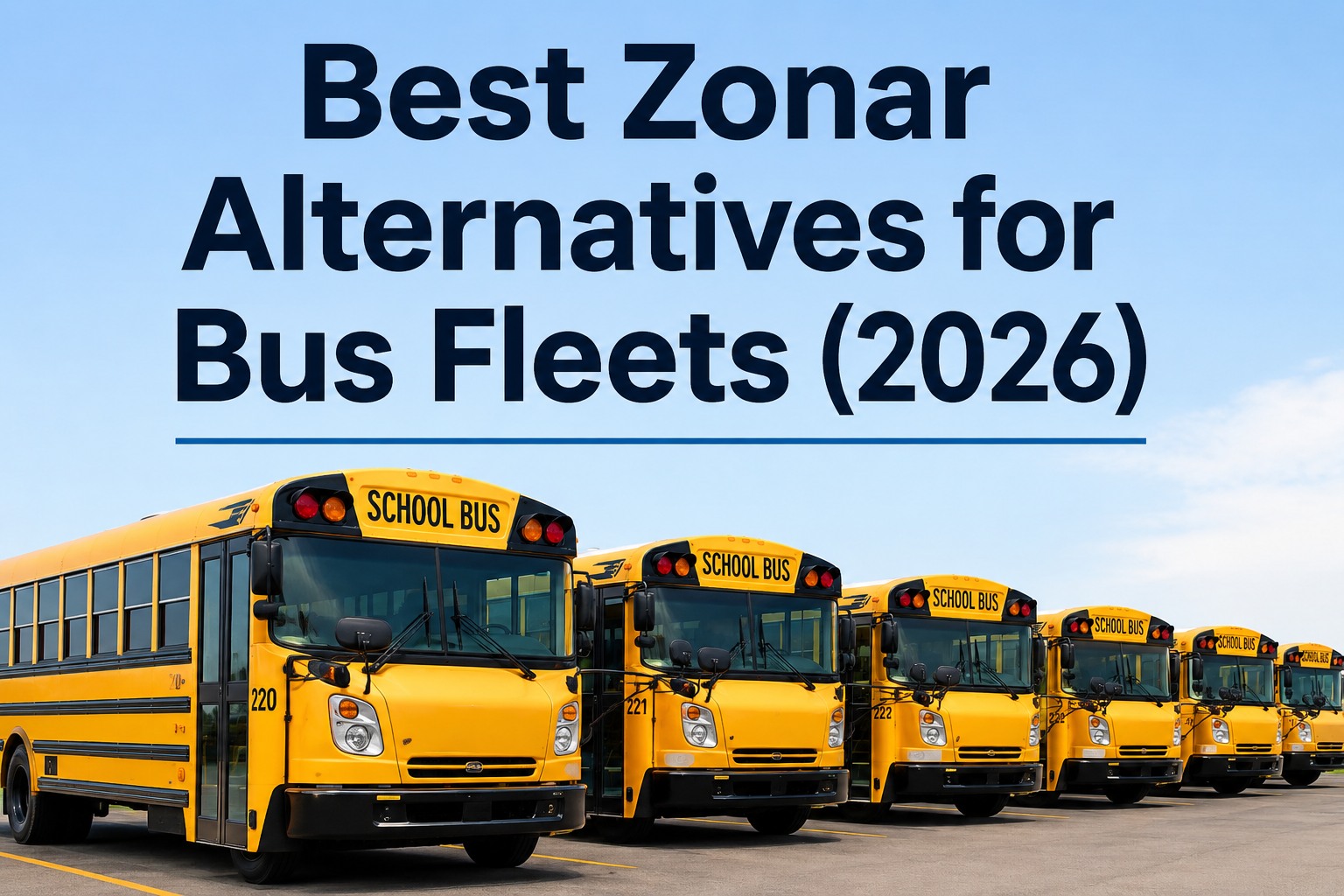
Best Zonar Alternatives for Bus Fleets (2026)
Compare Zonar EVIR against modern digital DVIR platforms, maintenance-first systems, and unified bus fleet operations software — and understand what changed for the whole category when FMCSA made electronic DVIRs explicitly compliant in March 2026.
- Pre-2001
Paper Clipboards
Handwritten forms, no verification, storage in filing cabinets
- 2001-2025
Tag-Verified EVIR
RFID/NFC scans at each inspection point, hardware on every bus, verified visual coverage
- Mar 23, 2026
Modern eDVIR + CMMS
FMCSA-2025-0115 explicitly authorizes electronic DVIRs. Photo, timestamp, GPS — no tag hardware needed
Where Zonar Runs Deep — and Where Alternatives Compete
Zonar earned its place in pupil transportation for a real reason. Verified visual inspection via tag scanning solved a genuine compliance problem when it launched in 2001, and two decades later the K-12 domain fit — child-check configurations, sanitization workflows, EV charging integration through partnerships with ChargePoint and Highland Electric — is genuinely deep. Any honest evaluation has to start with what Zonar is actually strong at before talking about where alternatives fit. Then the comparison gets interesting.
- Verified Visual Inspection
- K-12 Domain Fit
- Child-Check Workflow
- Full CMMS & Work Orders
- Implementation Speed
- Hardware-Agnostic Setup
- Contract Flexibility
The pattern is clear. Zonar wins on the verified inspection workflow it invented and on the K-12 depth accumulated across two decades. Alternatives compete where verification isn’t the buyer’s core problem anymore — on maintenance depth, setup speed, hardware flexibility, and contract shape. The rest of this guide walks the specific alternative shapes worth evaluating and the regulatory shift that made the comparison genuinely new in 2026. Book a walkthrough to see the maintenance-integrated model in action.
What the March 2026 FMCSA Rule Actually Changed
Any 2026 evaluation of Zonar alternatives has to start with the regulatory ground the whole category is now standing on. FMCSA’s eDVIR final rule fundamentally changed what “compliant inspection” means — and by extension, what buyers should actually be paying for in the inspection platform they choose.
FMCSA eDVIR Final Rule
- Docket
- FMCSA-2025-0115
- Published
- February 19, 2026 (Federal Register)
- Effective
- March 23, 2026
- CFR Sections
- 49 CFR §396.11 and §396.13
- What it does
- Adds explicit language authorizing electronic creation, signatures, and storage across the full three-signature DVIR chain (driver, mechanic, next driver).
Two important things this rule does not say. First, it does not require tag-scan verification or any specific inspection technology — a photo, timestamp, and digital signature on a mobile eDVIR meet the compliance bar without RFID or NFC hardware. Second, it does not eliminate existing verified-inspection systems — they remain fully compliant and still solve real problems for operations that want physical-touch verification, particularly districts with historical audit concerns or written policies requiring specific inspection-point contact. The rule broadens the compliant field; it does not narrow it. What the rule does change is the shopping question. Before March 2026, buyers evaluating verified-inspection platforms could reasonably ask “is this the safest compliance path?” After March 2026, that same buyer can reasonably ask “is the hardware overhead still worth the trade-off against a modern eDVIR platform that ties inspections directly to work orders?” That’s a legitimately new evaluation. Book a walkthrough to see eDVIR + CMMS on one platform.
The Real Zonar Alternatives Worth Evaluating in 2026
Zonar alternatives fall into three functional camps depending on which part of Zonar’s footprint you’re actually trying to replace. Verified-inspection replacements (Seon, Safety Vision) if you’re staying with the tag or hardware verification model. Generalist telematics replacements (Samsara, Motive) if telematics-plus-cameras is your center of gravity and inspections are secondary. And integrated bus operations platforms (BusCMMS) if you want inspections, maintenance, work orders, defects, and camera events to live on one bus record. Pick the camp that matches the actual gap you’re trying to close.
-
Seon (Safe Fleet)
FILLS: School-bus MDVR + inspection
Long-standing school-bus mobile DVR vendor with camera-first heritage. Fits districts wanting bus-specialized hardware and cameras as the primary safety layer rather than the verification workflow itself.
-
Samsara
FILLS: Unified telematics + cameras
Strong on telematics and AI cameras on one platform. Bus-specific inspection depth is lighter than Zonar. Fits mixed operations that also run non-school routes and want one telematics platform across everything.
-
Motive
FILLS: ELD + digital DVIR + telematics
Strong ELD compliance depth with modern digital DVIR workflow. Fits contractor fleets running mixed school-bus and other for-hire operations where FMCSR compliance depth matters.
-
BusCMMS
FILLS: eDVIR + maintenance + one record
Digital DVIR with photo and GPS meets the March 2026 FMCSA rule head-on, then flows into the same bus record as work orders, PM, defects, parts, and camera events. Hardware-agnostic, no tag installation, purpose-built for bus operations.
Notice what an evaluation like this actually cuts. A district running Zonar EVIR plus a separate CMMS plus a separate camera system is running three vendors on the same 100 buses. Every one of the alternatives above changes at least one line of that stack — and the maintenance-first camp changes two or three. That’s the number worth putting on the whiteboard: not per-bus price, but subscription lines and admin logins per bus. Book a walkthrough to model the consolidation on your fleet.
Migrating Off Zonar — A 4-Phase Path That Actually Works
One reason districts hesitate on Zonar renewal decisions is switching cost anxiety — specifically the “can we actually get off this platform without breaking daily operations” question. The answer, when the migration is done right, is yes. The path below is the shape most successful transitions follow.
Zonar → Integrated Platform in 4 Phases
- P1
Baseline & Pilot (Weeks 1-4)
Ten buses on the alternative platform running in parallel with EVIR. Baseline inspection completion rates, defect capture, and admin time on both.
- P2
Data Export & Migration (Weeks 5-8)
Pull historical inspection, defect, and PM records from Zonar. Import into the new platform’s bus records. Verify continuity of maintenance history before cutover.
- P3
Staged Cutover (Weeks 9-14)
Roll out fleet-wide in yard groups. Drivers train on the new digital DVIR (typically 20-30 minutes each). Shop workflow moves to the new work order system.
- P4
Optimize & Retire (Weeks 15+)
Zonar contract wound down on natural renewal date. Tag hardware removed on scheduled PM visits. New workflows optimized against baseline metrics.
The variable that most affects success isn’t technical — it’s scheduling. Districts that time the migration to align with Zonar contract renewal windows avoid double subscription costs entirely. Districts that time it to align with summer maintenance breaks pilot with lower risk because buses aren’t on active routes, and the shop is already touching every coach for annual PM anyway. Both windows work; the wrong one is trying to cut over mid-school-year in the middle of AM route pressure. Sign up free to start a low-risk pilot on your own fleet.
A Transportation Director’s Zonar Renewal Decision
That’s the honest pattern showing up in 2026 Zonar renewal cycles. Not dissatisfaction with the product itself. Not a competitor undercutting on price. But the underlying question of whether a verified-inspection specialist and a separate maintenance platform is still the right architecture when a modern integrated platform can hold both on one bus record, meet the March 2026 FMCSA rule, and cost less in total. When the answer to that question tips, the renewal decision gets easier than most directors expect. Book a walkthrough to see the integrated model against your current stack.
Zonar Alternative Evaluation Checklist
Six questions worth answering before your Zonar renewal — each cuts the alternative field faster than a feature comparison.
What are you actually replacing?
Verified inspection workflow, telematics, cameras, or all three? The answer determines which alternative camp fits.
Do you still need tag verification?
After the March 2026 FMCSA rule, photo + timestamp + GPS on a mobile eDVIR is fully compliant. Tag verification is optional, not required.
Where do defects and work orders live?
If the answer is “separate CMMS,” you’re running two platforms for the same bus. The integrated model consolidates that.
How much hardware do you own?
Tag installations, telematics units, cameras — hardware-agnostic alternatives don’t require rip-and-replace. Existing MDVR or camera hardware stays.
When does the current contract renew?
The migration path aligns cleanly with renewal windows and summer breaks. Mid-school-year cutovers are the failure mode to avoid.
Can you run a 90-day parallel pilot?
Ten buses on the alternative, existing platform running everywhere else. Compare inspection completion, defect capture, and admin time on real data.
This page is fleet-management and software buyer guidance — not legal or procurement advice. Vendor product features, pricing, and contract terms change frequently; regulatory citations reflect the FMCSA final rule under docket FMCSA-2025-0115 as of the effective date of March 23, 2026. Verify current regulatory requirements with counsel and current vendor specifications directly with each provider before making a purchasing decision. Book a walkthrough to work the checklist against BusCMMS live.
What is the best alternative to Zonar for a bus fleet?
There is no single best Zonar alternative — it depends on which part of Zonar’s footprint you’re replacing. Fleets replacing the verified inspection workflow specifically often evaluate Seon (Safe Fleet) or Safety Vision, which serve the K-12 mobile DVR and inspection space. Fleets wanting unified telematics plus cameras evaluate Samsara. Fleets prioritizing ELD compliance depth for mixed operations evaluate Motive. Fleets that want inspections, defects, work orders, PM, and camera events on one bus record — without the two-platform reconciliation problem — evaluate BusCMMS.
What is Zonar EVIR and is it still required for FMCSA compliance?
EVIR (Electronic Verified Inspection Reporting) is Zonar’s tag-scan inspection system, launched in 2001 and now on more than 100,000 vehicles across North America. It uses RFID or NFC tags at each inspection point on a bus to verify the driver physically walked the coach. EVIR is not required for FMCSA compliance. As of March 23, 2026, FMCSA’s final rule under docket FMCSA-2025-0115 explicitly authorizes electronic DVIRs at 49 CFR §396.11 and §396.13 — digital reports with photo, timestamp, and GPS meet the compliance bar without tag-scan verification. EVIR remains a valid choice for districts wanting physical-touch verification; it is not the only compliant path.
How did the March 2026 FMCSA rule change bus fleet inspection software choices?
The eDVIR final rule under FMCSA-2025-0115, effective March 23, 2026, added explicit language to 49 CFR §396.11 and §396.13 authorizing electronic creation, signatures, and storage of Driver Vehicle Inspection Reports across the full three-signature chain. Electronic DVIRs were permissible under 49 CFR §390.32 since 2018, but the previous language left interpretive ambiguity. The 2026 rule removes that ambiguity. For buyers evaluating Zonar and its alternatives, the effect is that hardware-based verification (RFID/NFC tags) is no longer the safest compliance path by default — a modern eDVIR with photo, timestamp, and GPS is fully compliant, which broadens the alternative field considerably.
How does BusCMMS compare to Zonar for a school district?
Zonar and BusCMMS solve different core problems. Zonar built its business around verified visual inspection with tag-scan hardware and has deep K-12 domain expertise across a two-decade history. BusCMMS is a bus-specific fleet operations platform where digital DVIRs meeting the March 2026 FMCSA rule live on the same chronological bus record as work orders, preventive maintenance, defects, parts, and camera events. Districts running Zonar plus a separate CMMS often evaluate BusCMMS to consolidate those platforms onto one record. Hardware-agnostic ingestion means existing cameras and telematics investments aren’t wasted in the transition.
Is switching from Zonar disruptive to daily bus operations?
Not when the migration is timed correctly. Successful transitions follow a four-phase path: a 4-week 10-bus parallel pilot, data export and historical import over the next 4 weeks, staged cutover across yards over 6 weeks, then optimization and Zonar contract wind-down. Total elapsed time is typically 3-4 months. Districts that align the cutover with Zonar contract renewal windows avoid double-subscription costs entirely. Districts that align it with summer maintenance breaks reduce risk by piloting when buses aren’t on active routes. Mid-school-year cutovers under AM route pressure are the failure mode to avoid.