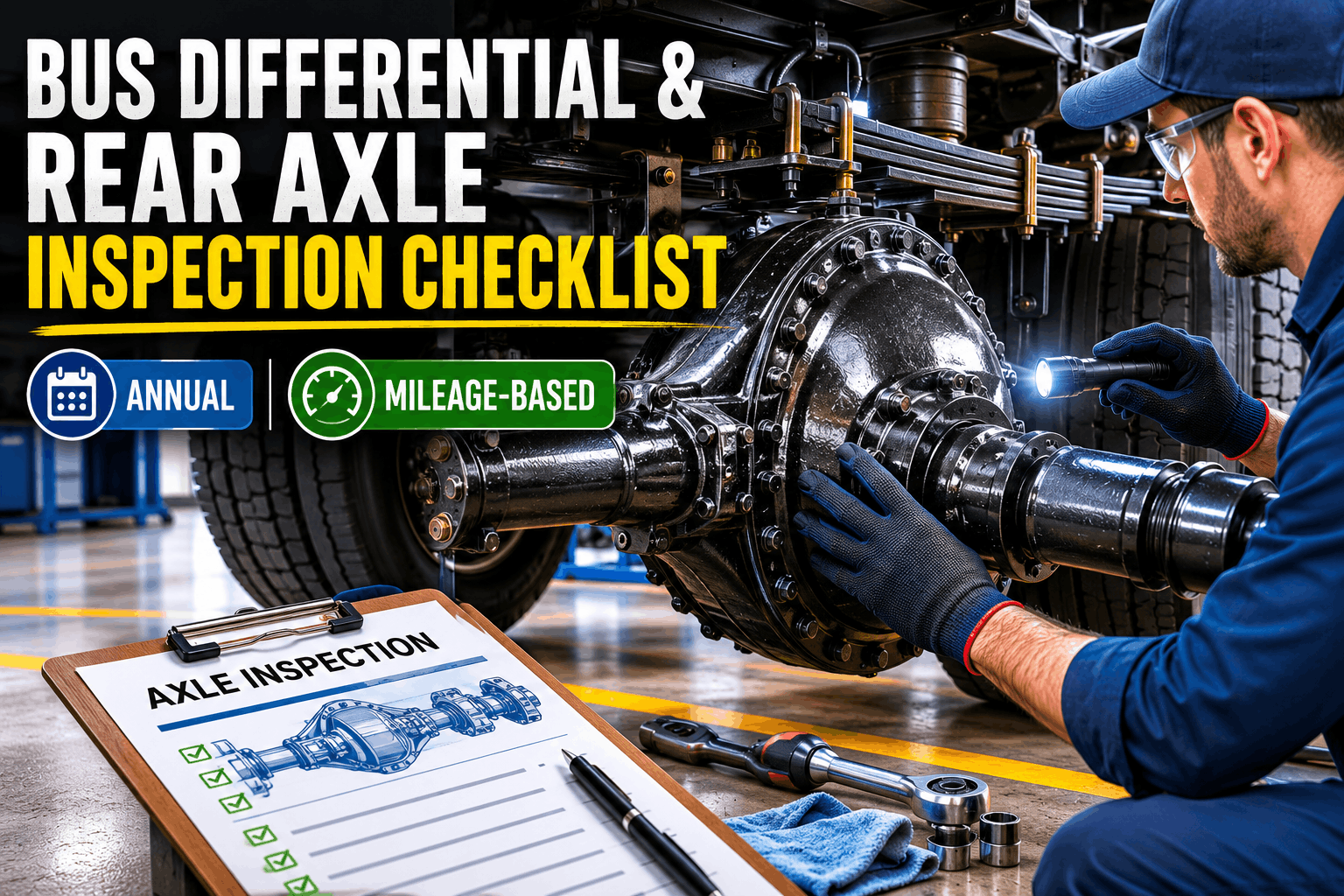
The rear axle and differential assembly on a transit or school bus operates under some of the most demanding load and thermal conditions in the entire drivetrain — carrying gross vehicle weight through thousands of stop-and-go cycles every operating day. Yet bus differential inspection and bus rear axle checklist procedures are among the most commonly deferred service items in U.S. school and transit fleets — partly because drive axle failures do not announce themselves with the same urgency as brake or engine faults, and partly because the service intervals are mileage-based rather than calendar-based and get lost without automated PM tracking. A failed differential or seized wheel bearing does not produce a warning light. It produces a roadside event, a tow, and a repair bill that averages $6,000–$14,000 depending on the extent of gear and bearing damage. This checklist covers annual and mileage-based bus drivetrain inspection service points, fluid specifications, wear limits, FMCSA compliance requirements, and the digital workflow that ensures no interval is missed. Start your free trial to run this checklist as a digital work order in BusCMMS — with mileage-triggered scheduling and technician sign-off built in.
Run This Checklist as a Digital Work Order — With Auto-Scheduling
BusCMMS auto-generates differential and rear axle PM work orders at your mileage triggers, pre-loads this checklist for technician sign-off, and retains every completed record for FMCSA audit — all in one platform built for bus fleets.
Service Intervals: Bus Differential & Rear Axle PM Schedule
Differential and rear axle service intervals vary by manufacturer specification and operating conditions. High-cycle urban and school bus routes — typically 100+ stops per day — accelerate lubricant degradation and bearing wear beyond standard over-the-road intervals. Always reference the OEM service manual for your specific axle model. The intervals below represent standard differential service interval benchmarks for school and transit bus fleets in the United States.
New or rebuilt axle break-in fluid change. Metal particles from gear seating contaminate factory fill — drain and replace with spec lubricant before normal PM intervals begin.
Full differential fluid drain and fill with specified gear lubricant. Magnetic drain plug inspection for metal debris. Breather vent clean or replace. Whichever comes first — mileage or annual.
Wheel bearing end-play measurement and repack or replacement as required. Axle shaft seal inspection and replacement if seeping. Pinion seal check. Brake spider and ABS tone ring inspection.
Complete disassembly inspection of ring and pinion gear, carrier bearings, spider gears (full-float axles), U-joints, and differential case. Replace to manufacturer wear limits. Full documentation required.
Bus Differential & Rear Axle Inspection Checklist
Complete all applicable sections at the indicated service interval. Each item requires a technician sign-off with date and mileage. FMCSA 49 CFR 396.3 requires that inspection records be retained for 12 months. Use BusCMMS to capture sign-off digitally with timestamps for every line item — audit-ready without paper file management.
Differential Fluid Specifications: Common Bus Axle Reference
| Axle Model | Common Application | Fluid Spec | Capacity (approx.) | Change Interval |
|---|---|---|---|---|
| Dana/Spicer S135 | School bus, transit | SAE 75W-90 GL-5 | 7.5 qts | 25,000 mi / annual |
| Meritor RT-40 | Transit, coach | SAE 75W-90 GL-5 | 9–12 qts | 25,000 mi / annual |
| Meritor RS-23 | School bus, paratransit | SAE 80W-90 GL-5 | 6 qts | 25,000 mi / annual |
| Eaton DS-404 | Heavy transit | SAE 75W-90 LS | 10–14 qts | 30,000 mi / annual |
| ZF AV-132 | Low-floor transit | ZF-TE-ML-05 | 8 qts | Per ZF spec (varies) |
FMCSA Compliance: What Rear Axle Inspections Must Document
Under FMCSA 49 CFR 396.3, motor carriers operating school and transit buses must maintain vehicles in safe operating condition and retain inspection records for a minimum of 12 months. Rear axle and differential service does not have a standalone FMCSA inspection form — but axle-related defects are covered under the annual vehicle inspection requirements (49 CFR 396.17) and roadside inspection criteria. The following axle conditions are FMCSA out-of-service criteria under the North American Standard Out-of-Service Criteria (OOSC) used by roadside inspectors:
Missing, broken, or cracked torque rods, track rods, radius arms, or similar axle positioning components. Any loose or missing fastener securing these components is an immediate OOS condition.
Any hub with wheel bearing failure evidenced by audible noise during operation, heat at the hub cap, or visible wheel wobble. Loose hub cap bolts on full-float axles are also OOS under OOSC Section 6.
Axle seal leakage contaminating brake drums, linings, or disc rotors is an immediate OOS brake violation under 49 CFR 393.47. A weeping inner axle seal that goes uninspected routinely advances to a brake contamination violation.
Any U-joint with detectable looseness, visible cracking at the trunnion cups, or missing retaining clips is an OOS condition under OOSC Section 4. A failed driveshaft at highway speed is a catastrophic safety event.
How BusCMMS Automates Bus Differential & Axle PM Scheduling
Differential and axle bearing inspection intervals are mileage-based — which means they are the first service items to fall through the cracks when odometer readings are manually tracked or calendar schedules are used as a proxy. BusCMMS generates differential PM work orders automatically when each bus reaches its configured mileage threshold, using GPS-synced odometer data from Samsara or Geotab telematics. The pre-loaded checklist for each axle type appears in the technician's mobile work order — with sign-off fields, fluid specification reference, and measurement entry fields for end-play and torque values. Completed records are retained automatically for FMCSA audit. No paper, no manual scheduling, no missed intervals. Book a demo to see how differential PM scheduling looks in a live fleet environment.
We had two rear axle failures in one school year — both traced back to missed differential fluid changes because we were tracking mileage manually in a spreadsheet. After moving differential PM to BusCMMS mileage triggers, we have not had a single axle-related roadside event in 18 months across a 58-bus fleet.
Frequently Asked Questions: Bus Differential & Rear Axle Inspection
How often should bus differential fluid be changed?
Standard interval for most school and transit bus rear axles is 25,000 miles or annually, whichever comes first. High-cycle stop-and-go routes may warrant shorter intervals — check your OEM axle specification for severe duty recommendations, and always change the break-in fluid at 3,000–5,000 miles on a new or rebuilt axle.
What does milky differential fluid indicate?
Milky or foamy differential fluid indicates water intrusion — most commonly through a worn or damaged axle housing vent (breather) that is allowing water to be drawn in during thermal cycling, or a compromised pinion or axle seal. Water-contaminated gear oil loses its load-carrying capacity rapidly and leads to accelerated ring, pinion, and bearing wear.
What wheel bearing end-play is acceptable on a transit bus?
Acceptable end-play for tapered roller bearings on most bus rear axles is 0.001 to 0.005 inches — always verify against the OEM specification for your specific axle model. End-play below 0.001 inches indicates pre-load that causes bearing heat and rapid wear; end-play above 0.010 inches is typically an FMCSA out-of-service condition under roadside inspection criteria.
Is axle fluid a leaking seal an FMCSA out-of-service condition?
Axle seal leakage that has contaminated brake linings or drums is an immediate FMCSA out-of-service condition under 49 CFR 393.47. A seeping seal that has not yet contaminated brakes is a maintenance defect requiring repair before the next scheduled service — not necessarily an immediate OOS, but an inspector will note it and expect corrective documentation.
How do you inspect a U-joint for wear without removing the driveshaft?
With the drivetrain stationary and transmission in neutral, apply rotational force to the driveshaft by hand while holding the companion flange fixed — any detectable circumferential lash at the U-joint indicates trunnion bearing wear requiring replacement. Also check for axial looseness by pushing and pulling along the driveshaft axis at the U-joint location.
What gear lubricant does a Dana Spicer S135 axle require?
The Dana Spicer S135 and similar single-reduction axles used on school and transit buses typically specify SAE 75W-90 GL-5 gear lubricant at approximately 7.5 quarts capacity. Always verify the spec plate on the axle housing and reference the current Dana service manual — lubricant specifications can vary by production date and application.
Can BusCMMS auto-schedule differential service by mileage?
Yes. BusCMMS generates differential and rear axle PM work orders automatically when each bus reaches its configured mileage threshold, using GPS odometer sync from Samsara or Geotab. The pre-loaded checklist for your specific axle type populates in the technician's mobile work order with sign-off fields, and completed records are retained automatically for FMCSA compliance.
How long does a rear axle differential inspection take for a school bus?
A standard 25,000-mile differential fluid and visual inspection typically takes 45–90 minutes per bus including drain, fill, seal check, and U-joint lubrication. A 50,000-mile service with hub removal for bearing inspection runs two to three hours per bus. A 100,000-mile full disassembly inspection should be planned as a two-day shop event per axle with parts availability confirmed before scheduling.
Never Miss a Differential Service Interval Again
BusCMMS auto-generates rear axle and differential PM work orders at your mileage triggers, pre-loads technician sign-off checklists, and retains every completed record — giving your fleet DOT-compliant axle maintenance documentation without manual tracking.