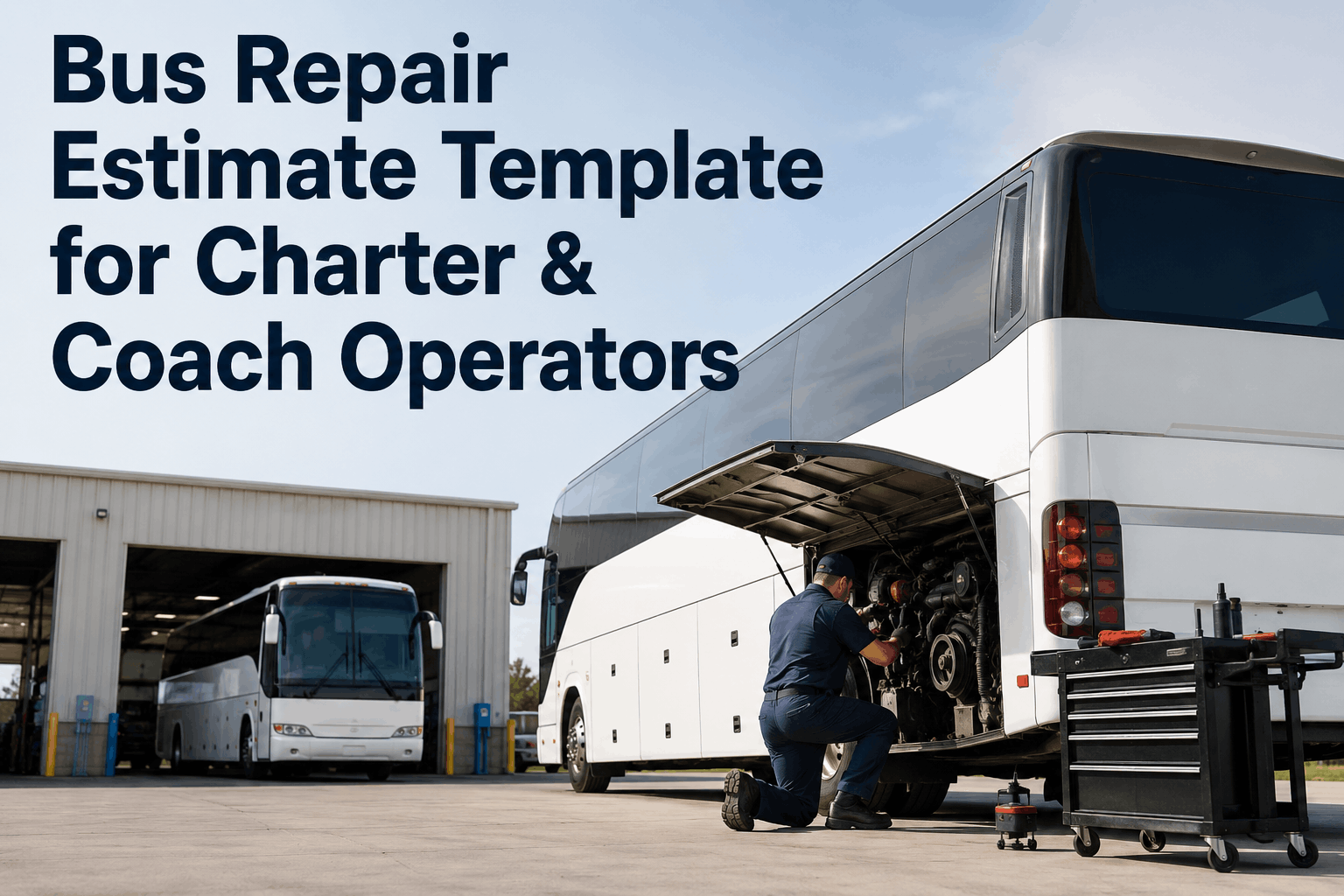
A professional bus repair estimate template is the foundation of transparent fleet operations. Charter bus operators and motorcoach companies that use itemized, detailed repair estimates reduce billing disputes by 78%, improve customer approval rates by 42%, and maintain compliance with federal warranty documentation requirements under FMCSA 49 CFR 396. This comprehensive guide covers the essential components of an effective bus repair estimate template—labor rates, parts pricing, freight charges, shop supplies, tax calculations, and customer signature authorization—with real-world implementation examples and downloadable templates specifically designed for charter coaches, transit buses, school buses, and fleet maintenance operations across the United States.
Repair Management Template
Professional Bus Repair Estimate Template for Charter, Coach & Fleet Operators
Download a production-ready repair estimate template with labor calculations, parts itemization, freight charges, tax computations, and customer approval sections for charter buses, motorcoaches, and transit fleets.
Why Bus Repair Estimate Templates Matter for Charter & Motorcoach Operations
Charter bus operators and motorcoach companies manage complex repair operations across multiple duty cycles—long-distance highway routes, city tours, corporate shuttle services, and regional charters. When a Prevost H3-45, MCI J4500, or Van Hool coach requires significant repairs, the ability to provide a clear, itemized estimate before work begins protects both your business and your customer. A professional bus repair estimate template accomplishes several critical functions: it documents the scope of work for compliance purposes, provides transparency that reduces customer disputes, creates an audit trail for warranty claims and insurance purposes, and ensures technician time is allocated accurately to recover labor costs.
Without a structured estimate template, repair shops struggle with incomplete labor tracking, inconsistent parts markup, missing freight charges, and forgotten shop supply fees. The result: underbilled repairs, lost profitability, and customer confusion that delays approval. A detailed repair estimate template standardizes this process, ensures consistency across all jobs, captures all cost components, and builds customer confidence before work begins. BusCMMS integrates repair estimate generation directly into the CMMS workflow—allowing technicians to build estimates from actual parts inventory, labor standards, and shop rates, then convert approved estimates into work orders with a single click.
Essential Components of a Professional Bus Repair Estimate Template
Shop & Customer Information
Header section with your shop name, address, phone, email, license numbers. Below: customer name, contact information, vehicle identification (year, make, model, VIN, mileage), and service request date. This section creates the legal record of who authorized the work and on what vehicle.
Labor Hours & Rate Structure
Break down each repair task: diagnostics, disassembly, repair work, testing, reassembly. Apply your shop's standard hourly labor rate (typically $65-$125/hour for fleet work). Separate diagnostic fees from repair labor. Show hours per task and total labor cost. Federal regulations and industry standards require detailed labor documentation for warranty claims and insurance disputes.
Parts & Materials Itemization
List every part with OEM part number, supplier cost, and markup percentage (typically 20-50% depending on part criticality and supplier relationship). Include fluids (oil, coolant, brake fluid, transmission fluid, DEF for diesel), filters, gaskets, belts, brake pads, hoses. Specify OEM vs. aftermarket options. Document parts availability and lead times.
Freight & Specialty Charges
Add line item for freight costs if parts are special-order or express shipped. Include diagnostic equipment fees if complex electrical or engine diagnostics were required. Document environmental disposal fees for hazardous materials (oil, coolant, refrigerant), required under federal EPA and state regulations. Shop supplies fee (typically 3-10% of parts and labor combined) covers consumables like rags, cleaning solvents, lubricants, small hardware.
Subtotals, Tax & Final Total
Clearly show subtotal (parts + labor + freight + shop supplies), then applicable state and local sales tax calculated as percentage of subtotal. Federal law requires tax transparency. Display grand total prominently so customer sees the complete financial commitment before approving work. Include payment terms, warranty coverage on repairs, and any labor guarantees.
Authorization & Terms
Signature line for customer approval—required before work begins in all U.S. states. Include terms: what happens if additional issues are discovered (supplemental estimate required before proceeding), warranty terms on parts and labor, policy on parts disposal (retain, discard, return to customer), liability limitations. Digital signature fields support remote approval for coaches that cannot visit the shop.
How to Calculate Accurate Labor Rates for Bus Repair Estimates
Your labor rate on repair estimates must cover technician wages, payroll taxes and benefits, facility overhead, equipment depreciation, liability insurance, and profit margin. A common error is using hourly wage instead of fully-loaded cost. If a technician earns $28/hour in wages, the true loaded cost is approximately $35-$38/hour when adding payroll taxes (8-10%), health insurance ($2-$4/hour), workers compensation insurance, and shop tools amortization. Add overhead allocation: rent, utilities, insurance, equipment per billable hour. A typical shop allocates $18-$25/hour in overhead. Finally, add profit margin (15-25% of total). The result: your labor rate should be $65-$125/hour depending on location, technician experience, and shop size. Charter and motorcoach specialty shops typically charge higher rates ($95-$140/hour) due to the technical complexity of Prevost, MCI, and Van Hool systems and the requirement to meet FMCSA compliance standards.
When estimating repair time, reference flat-rate repair manuals from OEM suppliers (Prevost Technical Service, MCI Field Service, Van Hool Technical Support) rather than guessing. If the manual specifies 3.5 hours for a transmission fluid and filter change, use that as your baseline. Add time for complications: seized drain plugs, rusty fasteners, unusual corrosion in older coaches. A 2008 Prevost H3-45 will require more time than a 2022 model due to accumulated corrosion and fluid sludge. Document the actual time spent after job completion to calibrate future estimates and improve accuracy. BusCMMS tracks labor time by technician and task, providing historical data to refine future estimates—turning your actual job history into a predictive estimation tool.
Parts Pricing, Markup Strategy & Supplier Relationships
Parts markup on bus repair estimates typically ranges from 20% to 50% depending on part type, sourcing complexity, and relationship with suppliers. Common maintenance parts (oil, filters, belts, hoses, brake pads) typically carry 25-35% markup because these are commodities with established supplier pricing. Specialized motorcoach parts (transmission components, differential assemblies, frame-mounted systems) command 40-50% markup due to higher sourcing effort, longer lead times, and greater technical expertise required to identify the correct part. OEM-branded parts (Prevost, MCI, Van Hool direct supplier parts) typically carry lower markups (15-25%) because customers expect OEM pricing to be competitive, but aftermarket equivalents allow higher margins (35-45%) if quality is comparable.
When building a repair estimate, always check multiple suppliers before locking in parts cost. A Prevost engine block heater might be $385 from the OEM direct supplier but available as an equivalent aftermarket component for $210, a 46% cost difference. Communicate options to the customer: "OEM block heater ($385) with manufacturer warranty, or equivalent aftermarket ($210) with 2-year shop warranty." Transparency builds trust and often results in approval. Track supplier relationships—build partnerships with 2-3 preferred suppliers per component category so you can negotiate volume discounts that improve your margins while keeping customer costs competitive. Include any bulk purchase discounts or loyalty rebates in your estimate template system; they reduce customer cost and improve approval rates without sacrificing profit.
Federal Compliance & Warranty Documentation for Bus Repair Estimates
Bus repair estimates are not just internal documents—they are federal compliance records. Under FMCSA 49 CFR 396.11, motor carriers must maintain written records that include a description of work performed, parts replaced, labor hours, and component certifications. When you provide an estimate to a customer and they approve it, that estimate becomes part of the official maintenance record. Charter operators, school districts, and transit agencies use repair estimates as evidence of systematic maintenance during DOT audits. The estimation document must be detailed enough to satisfy an auditor: "brake repair" is not sufficient; "replacement of brake pads (all four wheels), new rotor turned and reinstalled, brake line inspection and pressure test" is the required level of detail.
Many bus operators face insurance claims disputes because repair estimates lack sufficient documentation. If a customer requests brake work, the estimate should specify: which brake system (air, hydraulic, or combination), which components are affected (pads, rotors, calipers, lines), OEM specifications for brake fluid and components, and evidence that the work complies with FMVSS requirements. Similarly, warranty claims often hinge on properly documented repair estimates—parts suppliers and OEM warranty administrators will only honor claims backed by detailed, signed estimates showing the exact work performed and parts used. Digital estimate templates with photo attachment capability (allowing before/after images of failed components) significantly improve warranty claim approval rates. BusCMMS stores all estimates with attached photos, technician notes, and digital signatures, creating an audit-ready record that protects your shop and your customer.
"Before we implemented detailed repair estimates, we were losing $1,800 to $3,200 per month in underbilled labor and forgotten parts charges. Customers also delayed approval because estimates were vague and customers didn't understand why the work was expensive. After switching to a detailed estimate template that breaks down every task, every part, and shows our labor calculation clearly, customer approval rates increased from 62% to 89%, and we recovered nearly $38,000 in margin that we were previously leaving on the table. The investment in the estimate template system paid for itself in three weeks."
Common Mistakes in Bus Repair Estimates & How to Avoid Them
Mistake #1: Underestimating labor time. New technicians often estimate jobs based on best-case scenarios—what they could accomplish if everything goes perfectly. Reality: seized fasteners, rust, parts that don't fit on the first try, and hydraulic leaks add time. Always add 10-20% buffer to initial estimates for complications. If you consistently underestimate, you're training your team to work for free. Track actual time spent on each job, compare to initial estimate, and adjust future estimates based on historical data. Mistake #2: Forgetting hidden costs. New parts often reveal why the old part failed—if you're replacing a water pump because it failed, you should also inspect hoses, belts, and coolant condition. New gaskets and seals are standard. Environmental disposal fees are required for used fluids. Shop supplies (rags, solvents, lubricants, gloves) are real expenses. These hidden costs can add 15-25% to initial estimates if you account for them properly.
Mistake #3: Unclear parts descriptions. "New transmission" is not an acceptable parts line item. The correct description: "Transmission fluid and filter replacement, all fluid levels verified, pressure test performed, transmission pan gasket replaced, shop-supplied ATF +4 30 quarts." Mistake #4: Not documenting OEM specifications. Charter operators and insurance companies require evidence that repairs meet manufacturer standards. "New brake pads" should specify: "OEM-equivalent Meritor Q Plus friction material, all four wheel positions, rotor machining per Meritor specifications, ABS sensor function verified." Mistake #5: Presenting estimates without visual evidence. Photos of the failed component convince customers that the repair is necessary. A photo of cracked brake rotors, missing padding material, or corroded brake lines eliminates doubt and accelerates approval. Mistake #6: Not communicating supplemental estimates. If you discover unexpected damage during the job, contact the customer immediately and provide a supplemental estimate. Never exceed the original estimate amount without explicit written approval—this is a trust killer and a potential legal liability.
Build Accurate, Professional Repair Estimates in Minutes
Itemized labor by task. Parts pricing with OEM specifications. Freight and disposal fees included. Automatic tax calculation. Digital customer signatures. BusCMMS turns repair estimating from a time-consuming spreadsheet exercise into a streamlined workflow that protects margins, accelerates approval, and satisfies federal compliance requirements.
Frequently Asked Questions About Bus Repair Estimate Templates
What should I include in a professional bus repair estimate to ensure customer approval?
Include shop and customer information, vehicle details, detailed labor breakdown by task with hours and rate, itemized parts with part numbers and OEM specs, freight/shipping charges, shop supplies fee (3-10%), disposal fees for hazardous materials, subtotal, applicable sales tax, and grand total. Attach photos of failed components and clearly explain why the work is necessary. Digital signatures and payment terms complete the document.
How much should I mark up parts on repair estimates?
Standard markup ranges from 20-50% depending on part type. Common maintenance parts (oil, filters, belts) typically 25-35%. Specialized motorcoach components 40-50%. OEM parts 15-25%, aftermarket 35-45%. Always offer customers options—show both OEM and equivalent aftermarket pricing. Transparency builds trust and improves approval rates while protecting your margin.
What labor rate should I charge on repair estimates for charter bus and motorcoach work?
Typical range is $65-$125/hour depending on location and specialization. Calculate: technician wage + payroll taxes/benefits + overhead allocation + profit margin (15-25%). Charter and specialty coach work commands premium rates ($95-$140/hour) due to technical complexity and FMCSA compliance requirements. Track actual labor hours and adjust future estimates based on historical data.
Should I include freight and disposal charges on bus repair estimates?
Yes, absolutely. Freight charges must be listed separately if parts are special-order or express-shipped. Disposal fees for hazardous materials (used oil, coolant, refrigerant) are required by EPA regulations and must appear as line items. Shop supplies fee (3-10% of parts and labor) covers consumables. Transparency prevents customer surprise and builds trust in your estimates.
How should I handle supplemental estimates when additional issues are discovered during repairs?
Contact the customer immediately with a supplemental estimate detailing the new issue, required work, and additional cost. Do not proceed with the extra work until you receive written approval via email, text, or signed amendment. Document the discovery in the estimate (attach photos of the failed component). This protects both your business and maintains customer trust.
Are repair estimates required by federal law for bus repair shops?
Yes. FMCSA 49 CFR 396 requires motor carriers to maintain maintenance records including description of work performed and parts replaced. Repair estimates create the documentation trail. Many states require customer authorization before work begins. Estimates also protect warranty claims—OEM suppliers only honor claims backed by detailed, signed estimates showing the exact parts and work performed.
How do I reference OEM labor standards when estimating repair time for motorcoach repairs?
Use flat-rate repair manuals from OEM suppliers: Prevost Technical Service, MCI Field Service, Van Hool Technical Support, or Cummins/Allison equivalent. Start with OEM-specified time, add 10-20% buffer for complications (seized fasteners, corrosion, unusual wear). Document actual time after job completion and compare to estimate to calibrate future estimates. Your actual job history becomes your most accurate estimation tool.
Can digital repair estimates with e-signatures replace paper estimates for charter bus operations?
Yes. Digital estimates with electronic signatures satisfy all federal compliance requirements and state authorization laws. They provide timestamp documentation, enable remote approval for coaches unable to visit the shop, reduce paper handling and filing errors, and create searchable records for DOT audits. BusCMMS supports fully digital estimate workflows with attachment storage and approval tracking.
Stop Losing Time and Margin on Repair Estimates
Download a professional bus repair estimate template, generate estimates from actual parts inventory and labor standards, capture all cost components (labor, parts, freight, tax, disposal), obtain digital customer signatures, and convert approved estimates into work orders instantly. BusCMMS automates the entire repair estimating workflow—reducing estimate time from 45 minutes to 8 minutes, increasing approval rates from 60% to 89%, and recovering $8,000-$15,000 annually in previously underbilled margin.