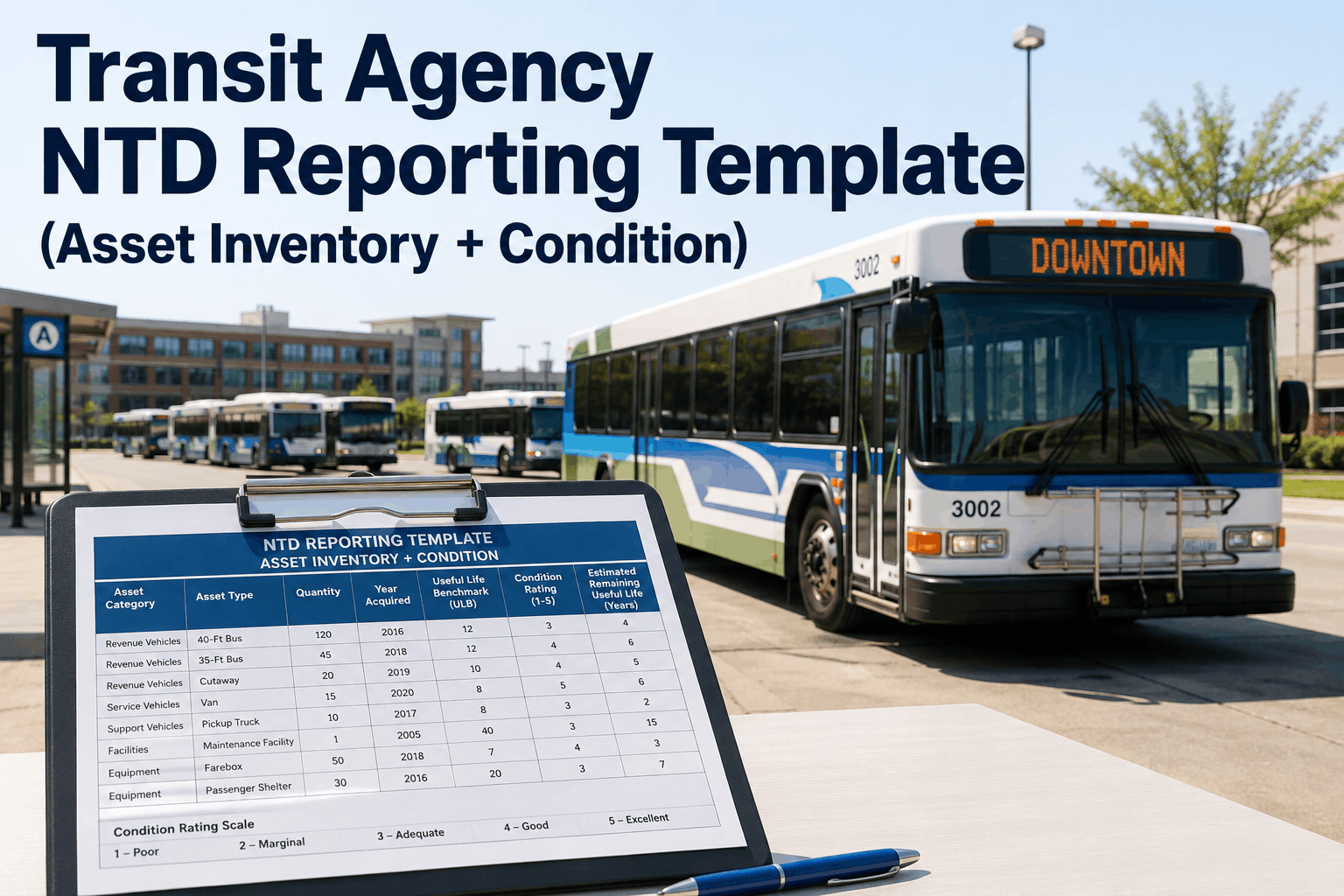
A mid-sized transit agency operating 95 fixed-route buses and 62 paratransit vehicles faced mounting pressure during its annual FTA National Transit Database (NTD) submission. The agency's asset inventory lived across three separate spreadsheets, with condition ratings entered inconsistently and useful life benchmarks only sporadically tracked. When the FTA requested supporting documentation for their A-30 report, the team spent over two weeks manually reconciling mileage records, maintenance histories, and replacement schedules. The audit found eight material discrepancies—not because assets were poorly maintained, but because the agency lacked a unified template for capturing asset condition, remaining useful life, and TAM performance data in a format ready for federal submission. After standardizing their asset inventory around an NTD-aligned reporting framework, the agency cut their submission prep time by 72% and passed their next triennial review with zero findings. True NTD compliance starts with a clean, structured asset inventory that maps directly to FTA reporting requirements.
Transit Agency NTD Reporting Template: Asset Inventory + Condition
Stop juggling fragmented spreadsheets. Standardize your asset inventory, track condition ratings, and generate FTA-ready reports in minutes.
NTD Asset Inventory Impact — 157-Vehicle Fleet
Manual Data Reconciliation Time
12–18 days scrambling
Asset Condition Rating Gaps
22% missing or inconsistent
Useful Life Tracking Accuracy
High (Manual estimate errors)
Submission Prep Time (Unified Template)
3 days or less
Asset Data Completeness Rate
100% verified fields
FTA Audit Finding Reduction
Zero material discrepancies
The NTD Reporting Challenge: Asset Inventory Gaps
Many transit agencies treat NTD reporting as a once-a-year data dump, pulling asset information from maintenance systems, procurement spreadsheets, and operator logs that were never designed to talk to each other. When the FTA requests A-30 data on asset inventory, condition ratings, and useful life benchmarks, agencies often discover that vehicle identification numbers are missing, odometer readings are inconsistent, and rehabilitation dates have been lost in email chains. A unified NTD reporting template changes this dynamic by imposing a consistent data structure on every asset record from day one. Each vehicle entry captures the required fields: asset class, manufacturer, model year, serial number, current mileage, condition rating (5-point scale), rehabilitation history, and remaining useful life projection. This structured approach transforms annual submission from a reactive fire drill into a straightforward export task.
Siloed Asset Tracking (High Risk)
Data Location
Scattered across maintenance logs, procurement files, and operator notebooks.
Submission Prep
Requires manual cross-referencing, data re-entry, and stressful reconciliation.
Data Quality
Missing rehab dates, inconsistent condition scores, and outdated mileage records.
FTA Readiness
High risk of findings due to incomplete or unverifiable asset histories.
NTD-Compliant Asset Registry
Data Location
Centrally stored in a structured, queryable asset database.
Submission Prep
One-click export of fully formatted A-30 compliant data.
Data Quality
Mandatory fields enforce completeness; condition ratings follow FTA 5-point standard.
FTA Readiness
Audit-ready records with full traceability and documented validation.
Critical NTD Asset Metrics to Track
To submit a complete and accurate NTD report, your asset inventory must capture four essential data pillars. First: Asset Identification and Classification, which includes vehicle type, manufacturer, model year, and unique fleet number. Second: Condition Assessment, using the FTA's 5-point rating scale from 1 (excellent) to 5 (failed). Third: Useful Life Benchmark, tracking the agency's adopted standards for each asset class. Fourth: Rehabilitation and Replacement History, documenting all major overhauls, mid-life rebuilds, and planned retirement dates. Consolidating these pillars into a single, structured template ensures your NTD submission is complete, defensible, and aligned with FTA TAM requirements.
NTD Asset Data Completeness Benchmarks
Unified Template Target
Spreadsheet-Based Systems
Condition Rating Accuracy
Useful Life Tracking
NTD Reporting Framework in Action: Real Compliance Success
A midwestern transit authority operating 84 buses and 43 paratransit vehicles struggled to produce a coherent asset inventory for their NTD submission. Their condition ratings were spread across three different spreadsheets maintained by different departments, with no standard protocol for when or how to update them. During their FTA triennial review, the agency received a corrective action plan citing inconsistent asset data and incomplete useful life tracking. To resolve this, they adopted an NTD-aligned asset management template that standardized data entry across all vehicle classes. The new framework required condition assessments every 6 months, automatically calculated remaining useful life, and flagged assets approaching their ULB. The result: a 94% reduction in data reconciliation time and a clean pass on their next FTA submission with zero data-related findings.
Fragmented NTD Data Management
Asset records maintained in disconnected departmental spreadsheets.
Condition ratings applied inconsistently across different vehicle types.
Useful life benchmarks not systematically tracked or updated.
Rehabilitation history scattered across maintenance and procurement files.
Result: Corrective action plans and significant staff time wasted on data reconciliation.
Unified NTD Asset Framework
All asset records standardized in a single, queryable database.
FTA 5-point condition rating enforced with clear definitions and regular updates.
Automated ULB tracking with proactive retirement alerts.
Complete rehabilitation and replacement history attached to each asset.
Result: Error-free FTA submissions, reduced audit risk, and confident decision-making.
Strategic Rollout: 90-Day NTD Asset Integration
Transitioning to an NTD-compliant asset inventory doesn't require overhauling your entire operation. A structured 90-day rollout ensures smooth adoption for your asset management, maintenance, and reporting teams. Month one focuses on data standardization: mapping existing asset records to required NTD fields and establishing clear condition rating protocols. Month two introduces the submission workflow: enabling your team to export formatted NTD reports directly from the system and validate data against FTA requirements. The final month activates automated data quality checks: flagging incomplete records, calculating remaining useful life, and generating trend reports for strategic planning. This measured approach ensures your agency is fully prepared for the next NTD submission cycle with a clean, audit-ready asset inventory.
NTD Asset Inventory Integration Timeline
Days 1–30
Days 31–60
Days 61–90
NTD Submission Ready
The Bottom Line
Treating NTD reporting as an annual data assembly exercise creates unnecessary risk and wastes valuable staff time. Moving to a structured, NTD-aligned asset inventory framework ensures that your vehicle data, condition ratings, and useful life benchmarks are always submission-ready. Rather than scrambling to reconcile spreadsheets when the FTA calls, unified platforms maintain a clean, validated asset registry that generates compliant reports with a single click. This approach reduces submission prep time, eliminates data discrepancies, and provides the strategic visibility needed for effective asset lifecycle planning. BusCMMS delivers the tools to centralize your asset inventory, enforce NTD data standards, and produce audit-ready reports that keep your agency in full compliance.
Standardize Your Asset Inventory. Eliminate NTD Data Gaps. Pass Audits.
Centralize vehicle records, condition ratings, and useful life tracking into one FTA-aligned system. Free 14-day trial.
Frequently Asked Questions
What asset data is required for FTA NTD submission?
The NTD A-30 form requires asset class, manufacturer, model year, serial number, current mileage or hours, condition rating (1–5 scale), rehabilitation history, and planned retirement date. A structured template ensures all these fields are captured consistently.
How does a centralized asset template improve NTD data accuracy?
The template enforces mandatory fields, standardized condition rating definitions, and automated calculations for remaining useful life. This eliminates manual entry errors and ensures every asset record meets FTA data quality standards.
Can the template handle assets from multiple vehicle classes and types?
Yes. The framework supports all FTA asset classes—fixed-route buses, paratransit vehicles, vans, and support vehicles—with configurable fields for each asset type while maintaining a consistent core data structure.
How does the system calculate remaining useful life for NTD reporting?
Using your agency's adopted useful life benchmarks (ULB) for each asset class, the system tracks current mileage or operating hours against the ULB, automatically projecting remaining useful life and flagging assets nearing retirement.
Is the NTD data export formatted for direct FTA submission?
Yes. The system generates A-30 compliant exports with all required fields structured exactly as the FTA expects, eliminating manual reformatting and reducing the risk of submission errors.
How often should condition ratings be updated for NTD accuracy?
FTA recommends condition assessments at least annually, but best practice is to update ratings after major inspections or rehabilitation events. The system can schedule and track these assessments to ensure timely updates.
Bring Your Asset Inventory Into a Fully NTD-Compliant, Audit-Ready Framework.
Standardize vehicle records, automate condition tracking, and generate FTA-ready reports with zero data gaps. Free 14-day trial.