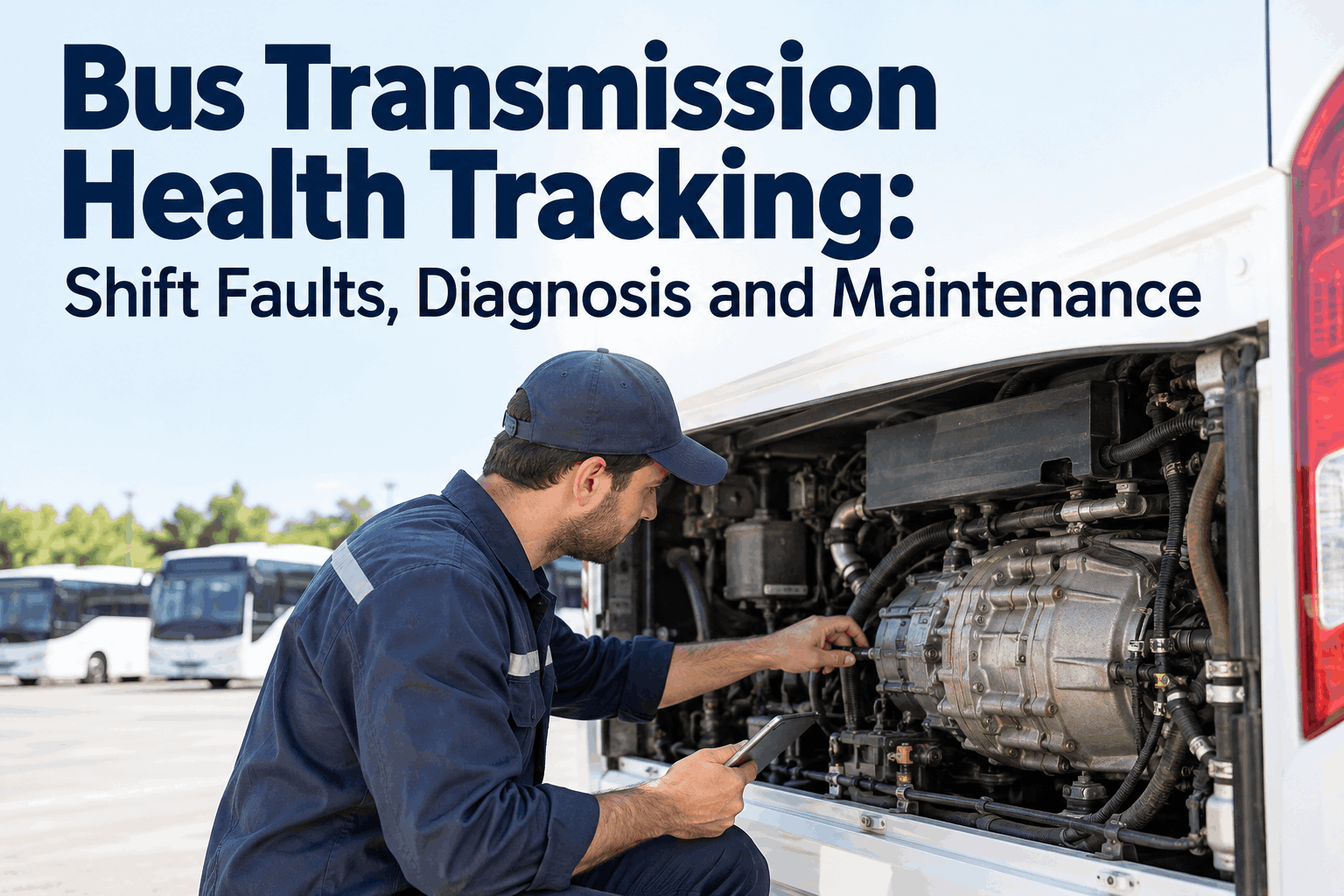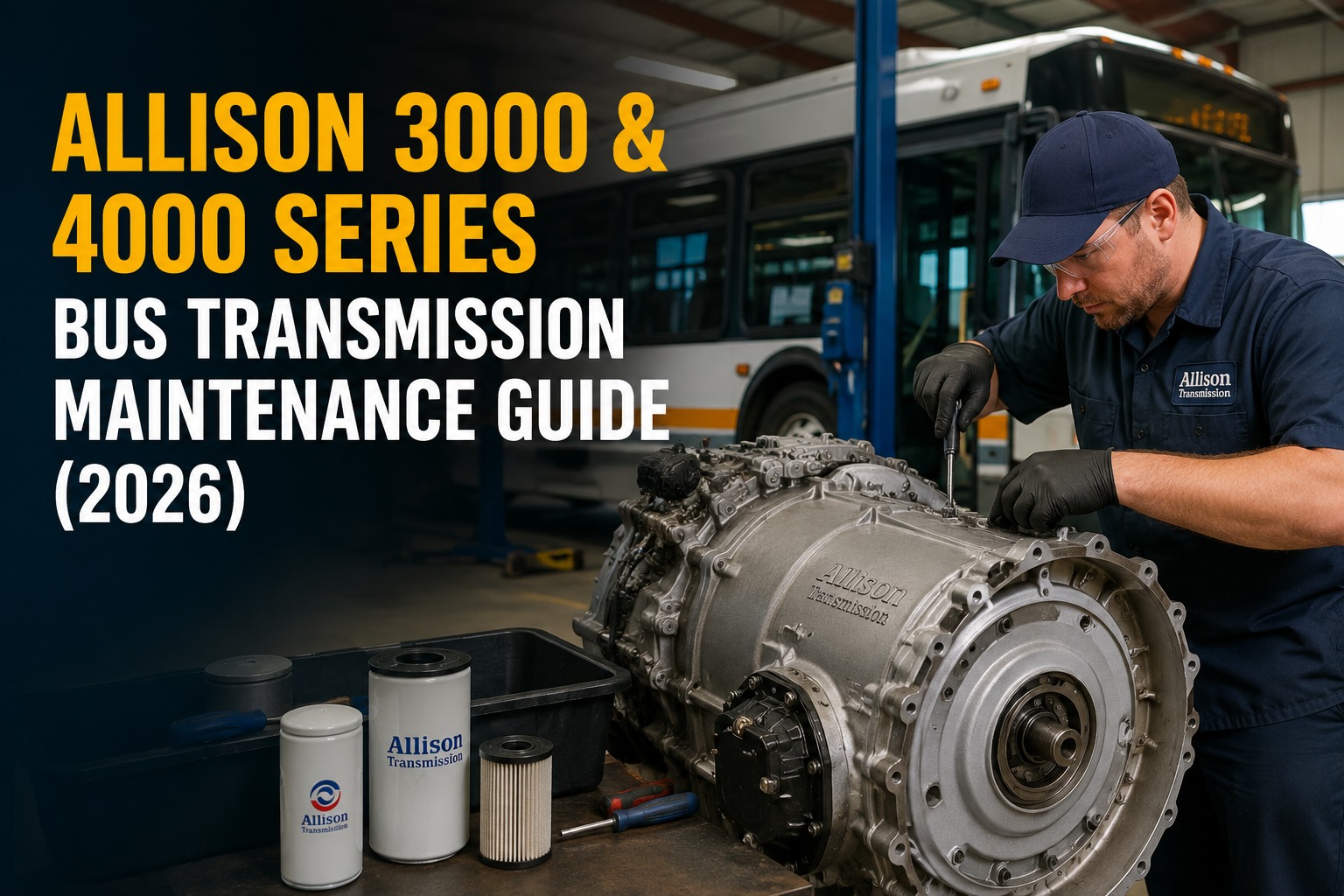
Allison's 3000 and 4000 Series automatic transmissions run under most Type C school buses, city transit fleets, and motorcoach operations in North America. Get the fluid type, vocation classification, and Prognostics setting right and the transmission will run 300,000+ miles on a single fluid change. Get any of them wrong and you are looking at fluid intervals cut by 90% and a $12,000 to $22,000 reman bill sooner than the OEM ever intended. This is the practical 2026 service guide -- the fluid matrix, vocation-adjusted intervals, Prognostics feature, and the 5 fault patterns that cover most Allison diagnostic calls. See BusCMMS track Allison transmission service per bus → book a 20-min demo.
Allison 3000 & 4000 Bus Transmission Guide
The fluid + filter matrix, vocation-adjusted intervals, Prognostics decisions, and the 5 fault patterns that cover 80% of Allison service calls.
Mid-Range Applications
- Type C school buses
- Small transit buses
- Motorcoaches (smaller)
- Class 6-7 commercial trucks
Heavy-Duty Applications
- Large transit buses
- Motorcoaches (full-size)
- Class 8 heavy-duty trucks
- Off-highway equipment
The Fluid Matrix: TES 668 vs 295 vs 389
Wrong fluid choice cuts interval by 90% and disables Prognostics. Get this right first.
Allison qualifies three main fluid specifications for 3000 and 4000 Series buses. The number matters -- TES 668 gives the longest interval, TES 295 is nearly identical, and TES 389 (legacy) forces intervals down to 25,000 miles or 12 months. Prognostics only works with TES 668, TES 295, or TES 389 (with January 2010+ TCM calibration CIN 4C or later). Any mixing between fluid grades forces the shortest interval across the whole fleet.
Latest-Generation Synthetic
Long-Life Synthetic (Legacy)
Non-Synthetic / DEXRON-VI Class
Fleets running Prognostics with TES 668 or 295 hit 300,000 miles on a single fluid change. Fleets on TES 389 change fluid 12 times before that same mileage. See BusCMMS log fluid brand per transmission to prevent mixing → book a demo.
Service Intervals by Vocation and Prognostics Setting
School buses are General. City transit is Severe. Prognostics ON changes everything.
Allison classifies duty cycle into two categories. General covers school buses, coach, delivery, and most on-highway use. Severe covers on/off-highway, refuse, city transit, and shuttle transit. City transit buses running the General interval will burn through the fluid inside 200,000 miles instead of the 300,000-mile spec. Halve the interval, or run the correct vocation classification -- the transmission does not know the difference between what is written on the PM schedule and what its clutches are actually seeing.
School Bus / Coach / Delivery
City Transit / Shuttle / Refuse / On-Off Highway
Whichever occurs first -- miles, hours, or months. Fluid analysis per SIL 17-TR-96 may extend intervals with lab data as justification. Local conditions, high-heat operation, or extreme duty may require shorter intervals than published.
Vocation classification per bus is the single most common Allison-specific PM error. Get it right once and the schedule runs itself. See BusCMMS tag vocation per bus with auto-scheduled intervals → book a demo.
Prognostics: The Feature Half Your Fleet Is Not Using
Introduced 2009. Turns fixed intervals into TCM-signaled service events based on real fluid and clutch condition.
Prognostics is a feature that has shipped on every Allison 3000/4000 Series transmission since MY2009 (starting S/N 6510822005 for 3000, 6610257671 for 4000). The TCM monitors fluid oxidation, filter differential pressure, and clutch wear -- and signals through the dash when service is actually needed instead of when a calendar says it should be. Most fleets do not use it because it requires the OEM to have wired it in, the customer to have requested it turned ON, and the fluid + filter combination to be Allison-approved.
OM — Oil Monitor
Tracks fluid oxidation and condition over time. Signals fluid change based on actual degradation, not calendar time.
FM — Filter Monitor
Tracks filter differential pressure. Signals filter change when actually restricted, not on a fixed mileage schedule.
TM — Transmission Health
Tracks clutch wear cumulatively. Surfaces trending clutch degradation before failure so overhaul can be scheduled.
Requirements for Prognostics to Work
- Fluid: Allison-Approved TES 668, TES 295, or TES 389 (MY2010+ with CIN 4C calibration)
- Filter: Genuine Allison High-Capacity filters -- NOT aftermarket
- TCM: Calibrated with Prognostics enabled (OEM wiring + customer opt-in)
- Fluid discipline: 100% same fluid grade -- any mixing forces Schedule One (TES 389 intervals)
Check every 3000/4000 in your fleet for Prognostics status via Allison DOC. Turning it on unlocks maximum interval. See BusCMMS flag Prognostics ON/OFF per bus → book a demo.
The 5 Fault Patterns That Cover 80% of Allison Diagnostic Calls
Pull DTCs via Allison DOC first. Then match the pattern below to shortcut root cause.
- 01
Delayed Engagement or Slipping
Fluid / Solenoid PackCheck first: Fluid level at operating temperature (150-220°F). Fluid condition. Filter differential pressure if Prognostics available.Common DTCs: P0730 (Incorrect Gear Ratio), P0841 (Pressure Switch Rationality)Likely cause: Low fluid, degraded fluid past change interval, or aging solenoid pack. - 02
Harsh Shifts or Shift Flare
CRITICAL · ADAPTIVE LEARNCheck first: TCM adaptive learn tables via Allison DOC. Fluid condition. Check for any recent battery disconnect that reset the learn.Common DTCs: P0871 (Shift Solenoid Fault), P0871 (Shift Solenoid Fault), P0842/P0843 (Solenoid Electrical)Likely cause: Corrupted adaptive learn tables, worn friction elements, or aging solenoid pack. Fast Adaptive Learn procedure often restores shift quality. - 03
Torque Converter Shudder or Slip
TCC / Lockup ClutchCheck first: Fluid condition (contamination is common cause). TCC solenoid electrical resistance. Verify locked-up gear engagement via DOC.Common DTCs: P0741 (TCC Stuck Off), P0742 (TCC Stuck On)Likely cause: Contaminated fluid on TCC clutch surface, worn TCC clutch, or failed TCC solenoid. - 04
Retarder Ineffective or Overheating
Retarder · P17XX SeriesCheck first: Transmission fluid temperature (retarder uses transmission fluid for braking). Cooling loop function. Retarder request signal from cab.Common DTCs: P17XX series retarder faults, U-code CAN communication faultsLikely cause: Fluid at high temperature disables retarder for protection. Failed retarder solenoid or apply valve. - 05
CHECK TRANS Lamp Will Not Clear
TCM Diagnostic SessionCheck first: Connect Allison DOC. Read active + historical DTCs. Check TCM calibration version. Verify battery voltage stable at start-up self-test.Common DTCs: P0700 (TCM MIL Request), P0715/P0720 (Speed Sensor Faults), U-codes (CAN faults)Likely cause: Wheel speed sensor gap, output speed sensor, TCM calibration outdated, or wiring/connector issue.
Every DTC logged per bus with resolution notes becomes the pattern data that solves the next case in half the time. See BusCMMS log Allison DOC sessions per bus → book a demo.
Where BusCMMS Fits Your Allison Service Program
Six ways the transmission paper trail becomes daily discipline instead of scattered notes.
Vocation Tag Per Bus
Each bus tagged General or Severe vocation. PM calendar auto-schedules fluid + filter at the correct Allison-recommended interval.
Fluid Brand Log
TES 668, 295, or 389 recorded per transmission at every service. Prevents accidental mixing that forces Schedule One.
Prognostics ON/OFF Flag
Each transmission flagged as Prognostics-enabled or disabled. Interval logic auto-adjusts. TCM CIN calibration tracked.
DTC + Allison DOC Session Log
Every diagnostic session logged with DTCs pulled, resolution notes, and adaptive learn resets. Recurring codes surface fast.
Retarder Service Tracking
Retarder-equipped buses tracked separately with cooling-loop service and fluid-temperature history. P17XX codes get context.
Filter Kit Part-Number Store
High-Capacity vs standard filter kit part numbers stored per transmission model. Right filter for the Prognostics setting.
We had 14 of our 40 transit buses on the same PM schedule as our activity buses. Same 25,000-mile fluid change. Turns out the transit buses were classified as General vocation in the previous fleet management spreadsheet -- Severe was never selected. Cut the interval on the transit buses in half after we caught it, but the damage was done on three of them -- rebuild costs came in around $14K each. Moved into BusCMMS the same quarter with vocation tag, fluid brand, and Prognostics flag per bus. Every service event now shows the correct interval automatically, and the audit trail for warranty defense is right there in the profile.
Wrong vocation on transit buses costs a $14K rebuild. Right vocation costs a filter kit. Fix it in the CMMS →
Frequently Asked Questions
What is the difference between Allison 3000 and 4000 Series transmissions?
Both are electronically controlled automatic transmissions with a lock-up torque converter and optional integral hydraulic retarder, sharing the same TCM diagnostic architecture and Allison DOC diagnostic tool. The difference is size and duty rating. The 3000 Series is a mid-range platform used in Type C school buses, small transit buses, smaller motorcoaches, and Class 6-7 commercial trucks -- with typical reman costs of $8,000 to $14,000. The 4000 Series is a heavy-duty platform used in large transit buses, full-size motorcoaches, Class 8 heavy-duty trucks, and off-highway equipment -- with typical reman costs of $12,000 to $22,000. Fluid capacity differences reflect this: the 3000 Product Family Main Filter fluid loss during change is approximately 2 quarts (1.9 liters), while the 4000 Product Family Lube Filter fluid loss is approximately 8 quarts (7.6 liters). Both series began shipping the Prognostics feature in MY2009 starting with serial numbers 6510822005 (3000) and 6610257671 (4000).
What is the Allison transmission fluid change interval for a school bus?
School buses are classified as General Vocation under Allison's duty cycle guidance -- along with coach, delivery, and most on-highway use. With Allison-Approved TES 668 or TES 295 synthetic fluid and Prognostics turned OFF or not calibrated, the recommended fluid change interval is 300,000 miles, 6,000 hours, or 48 months -- whichever occurs first. Main Filter change interval is 75,000 miles, 3,000 hours, or 36 months. Lube Filter is changed at overhaul. If the bus is running legacy TES 389 or DEXRON-VI class fluid, intervals drop dramatically to 25,000 miles, 1,000 hours, or 12 months for both fluid and filter. City transit and shuttle transit are classified as Severe Vocation -- the same TES 668 or 295 fluid interval drops to 150,000 miles, 6,000 hours, or 48 months, with Main Filter at 50,000 miles or 24 months. Prognostics turned ON extends both fluid and filter service to when the TCM actually signals need, based on real fluid oxidation and filter differential pressure monitoring.
What is Allison Prognostics and how does it work?
Prognostics is an Allison feature introduced in MY2009 that shifted fluid and filter service from fixed intervals to condition-based intervals. Instead of changing fluid every 300,000 miles regardless of actual condition, the TCM monitors fluid oxidation, filter differential pressure, and clutch wear -- and signals through the dash when service is genuinely needed. The feature has three sub-monitors: OM (Oil Monitor) tracking fluid condition, FM (Filter Monitor) tracking filter differential pressure, and TM (Transmission Health Monitor) tracking cumulative clutch wear. For Prognostics to work, four requirements must be met: the fluid must be Allison-Approved TES 668, TES 295, or TES 389 (with MY2010+ TCM calibration CIN 4C or later for TES 389); the filter must be Genuine Allison High-Capacity -- not aftermarket; the TCM must be calibrated with Prognostics enabled, which requires the OEM to have wired it in and the customer to have requested it turned ON at build; and 100% same fluid grade must be maintained -- any mixing of TES 668 and TES 295, or with TES 389, forces the transmission back to Schedule One intervals. Verify Prognostics status per transmission via Allison DOC.
What are the most common Allison 3000/4000 diagnostic trouble codes on buses?
Pull DTCs via Allison DOC first, then match to pattern. The five most common fault patterns cover roughly 80% of diagnostic calls. Delayed engagement or slipping typically shows P0730 (Incorrect Gear Ratio) or P0841 (Pressure Switch Rationality) and traces to low fluid, degraded fluid past change interval, or aging solenoid pack. Harsh shifts or shift flare typically shows P0871 (Shift Solenoid Fault) or P0842/P0843 (Solenoid Electrical) and often traces to corrupted adaptive learn tables from a recent battery disconnect -- a Fast Adaptive Learn procedure via Allison DOC frequently restores shift quality. Torque converter shudder or slip typically shows P0741 (TCC Stuck Off) or P0742 (TCC Stuck On) and traces to fluid contamination on the TCC clutch surface or a failed TCC solenoid. Retarder ineffective or overheating shows P17XX series codes and typically traces to transmission fluid at high temperature (the retarder uses transmission fluid for braking force) or a failed retarder solenoid. CHECK TRANS lamp will not clear typically shows P0700 (TCM MIL Request), P0715 or P0720 (speed sensor faults), or U-codes (CAN faults) and traces to speed sensor issues, TCM calibration outdated, or wiring/connector problems.
How does BusCMMS help manage Allison 3000/4000 transmission service across a bus fleet?
BusCMMS tags each bus with its Allison vocation classification (General for school buses, coach, delivery; Severe for city transit, shuttle transit, refuse) so the PM calendar auto-schedules fluid and filter service at the correct Allison-recommended interval -- eliminating the single most common Allison-specific maintenance error of running transit buses on General intervals. Fluid brand (TES 668, 295, or 389) is logged per transmission at every service event, preventing accidental mixing that would force the entire fleet into Schedule One intervals. Each transmission is flagged with Prognostics ON or OFF, and interval logic auto-adjusts accordingly -- the TCM calibration CIN version is tracked for the January 2010+ TES 389 Prognostics eligibility check. Every Allison DOC diagnostic session is logged with DTCs pulled, resolution notes, and adaptive learn resets, so recurring codes surface as patterns rather than as one-off tickets. Retarder-equipped buses are tracked separately with cooling-loop service and fluid temperature history for P17XX code context. High-Capacity vs standard filter kit part numbers store per transmission model so the shop pulls the correct filter for the Prognostics setting. One 40-bus Pacific Northwest transit agency reported catching 14 buses that had been running General-vocation intervals when they should have been Severe -- three had already required $14,000 rebuilds by the time the vocation mismatch was surfaced, and every subsequent service event now runs the correct interval automatically.