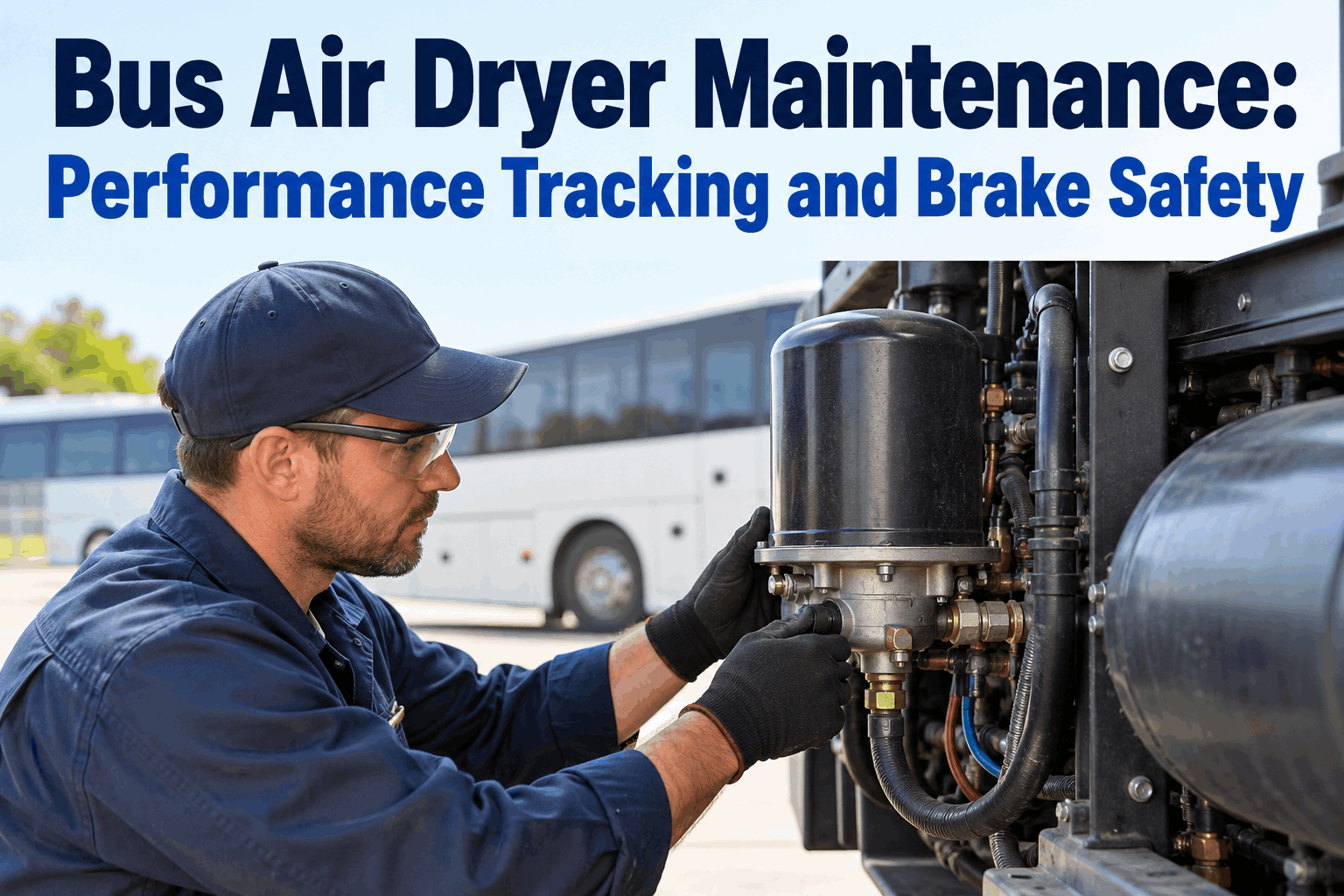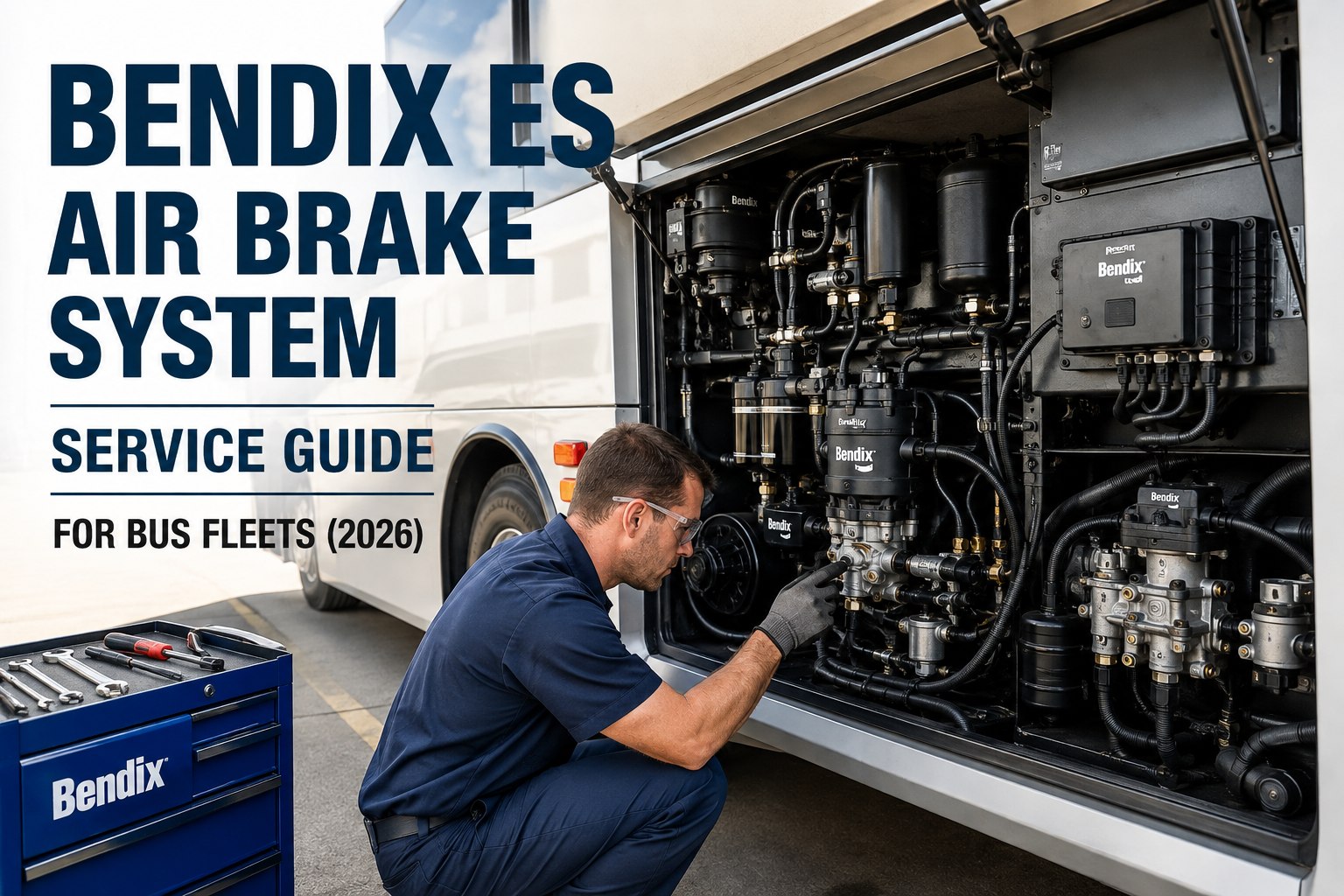
Bendix has built over 5 million AD-9 air dryers since it invented the technology, and nearly 2 million are still on the road today. Combined with the BA-921 compressor, governor, and reservoir circuit, they form the ES (Extended Service) air brake system running under most school bus, transit, and motorcoach fleets in North America. This is the practical 2026 service guide -- component overview, real Bendix cartridge service intervals by usage tier, the 5 most common diagnostic patterns, and the BASIC test workflow every bus shop should run. See BusCMMS schedule Bendix air brake service by usage tier → book a 20-min demo.
Bendix ES Air Brake System Service Guide
The 4-component circuit, the cartridge replacement matrix by usage tier, and the diagnostic patterns that keep the 2 million AD-9s still on the road doing their job.
Compressor
BA-921Builds air pressure. Coolant-cooled by the engine. 66 lbs typical.
Discharge Line
6-16 FTLast 3 feet insulated with 1/2 inch closed-cell polyethylene.
Air Dryer
AD-9 / AD-ISRemoves water + oil. 4 lbs of desiccant. Most-serviced component.
Reservoirs
30 DAYDrain interval per Table A. Weekly for high-usage transit.
The 4 Bendix ES Components Every Tech Should Know
Compressor, governor, dryer, and reservoir circuit -- with the diagnostics that touch each one.
The Bendix ES system exists to deliver clean, dry, regulated air pressure to the brake system on every bus in your fleet. Every fault -- slow build-up, spitting valves, wet reservoirs, ABS lamps that will not clear -- traces back to one of four components. Learning which component throws which symptom cuts diagnostic time from hours to minutes.
BA-921 Compressor
CHARGES THE SYSTEM- Function: Builds pressure from atmospheric to ~120 PSI
- Weight: 66 lbs standard, 55 lbs closed-room
- Torque: Cylinder head 265-292 in-lbs (30-33 N·m)
- Common symptom: Slow build-up, oil in supply reservoir
Governor (D-2, D-2A)
CONTROLS CUT-OUT- Function: Signals compressor when to load/unload
- Cut-out: ~120 PSI typical
- Cut-in: ~100 PSI (20 PSI differential)
- Common symptom: Compressor cycling, dryer purging too often
AD-9 / AD-IS Air Dryer
MOST-SERVICED COMPONENT- Function: Removes water and oil before reservoirs
- Desiccant: ~4 lbs high-capacity
- Purge cycle: 15-30 sec normal
- Common symptom: Water in reservoirs, dryer spitting
Reservoirs + Drain Cocks
STORES DRY AIR- Function: Supply, primary, and secondary tanks
- Drain interval: 30 days standard, weekly high-usage
- Test: BASIC Test Kit (P/N 5013711)
- Common symptom: Oil emulsion at drain, wet air downstream
The dryer sees more service attention than the other three combined. Get the interval right and the rest of the circuit rarely needs work. See BusCMMS track Bendix component service intervals per bus → book a demo.
Desiccant Cartridge Service Intervals by Usage Tier
Bendix's own 2022+ guidance. Match your fleet's tier before writing the interval into your PM schedule.
The single biggest maintenance error on Bendix ES systems is running one interval across the entire fleet. School buses are Standard usage. Transit buses are High usage. Motorcoach is Medium. Each tier gets a different service window, and the cost of getting it wrong is a wet reservoir feeding downstream valves that were never designed to see water.
School Bus / Delivery / Line Haul
Motorcoach / Light Transit
City Transit / Heavy Off-Road
Transit buses running Standard-interval cartridges catch up to their duty cycle inside 8-10 months. Wet air downstream costs 3-5x the extra cartridge. See BusCMMS schedule dryer service by bus and usage tier → book a demo.
The 5 Symptoms That Cover 80% of Bendix ES Faults
Pattern-match the complaint to the component. Then confirm with the appropriate Bendix test.
- 01
Slow Air Pressure Build-Up
Compressor / Governor / LeaksWhat to check: Run the Build-Up Test. Charge from 85 to 100 PSI at max governed engine speed. Anything over 40 seconds indicates a problem.
Likely cause: Air system leakage (test with soap solution), worn compressor unloader, or clogged discharge line insulation.
- 02
Water or Oil Emulsion at Reservoir Drain
CRITICAL · RUN BASIC TESTWhat to check: Bendix BASIC Test Kit (P/N 5013711). If more than one "oil unit" of water is present in the inspection cup, replace the air dryer immediately.
Likely cause: Air dryer past service interval, PuraGuard filter saturated, or compressor passing excessive oil.
- 03
Air Dryer Spitting or Continuous Purging
Purge Valve / GovernorWhat to check: Purge cycle should be 15-30 seconds. Continuous purging or spitting after governor cut-out points to purge valve or governor line.
Likely cause: Stuck purge valve, leaking check valve in dryer end cover, or governor cycling.
- 04
Compressor Cycling Between Loaded and Unloaded
Unloader LeakageWhat to check: With engine running, lower system pressure to 60 PSI and apply soap solution around cylinder head. Bubbles indicate unloader piston leak.
Likely cause: Worn unloader piston seals, leaking unloader cap, or worn governor exhaust.
- 05
ABS Warning Lamp Will Not Clear
EC-80 ECU / ACom ProWhat to check: Connect Bendix ACom Pro diagnostic software. Read fault codes from the EC-80 ABS ECU. Most common: wheel speed sensor gap out of range or modulator valve fault.
Likely cause: WSS air gap (0.006"-0.020" typical), damaged tone ring, modulator valve stuck, or low battery voltage during self-test.
Every symptom logged with the correct Bendix test result becomes evidence for warranty claims and the paper trail for next year's audit. Sign up free and log Bendix diagnostics per bus →
The BASIC Test: Bendix's Air System Inspection Cup Workflow
Five steps. Fifteen minutes per bus. The single most valuable diagnostic on the Bendix ES system.
The Bendix BASIC Test Kit (P/N 5013711) is a small acrylic cup that catches the emulsion at the reservoir drain. It answers one question directly: is the air dryer doing its job? Every bus fleet running Bendix should run this test at the recommended service interval and log the result per bus. It is the fastest way to catch a failing dryer before wet air gets into the modulator valves.
- 1
Fully charge the air system
Engine at governed speedBring system pressure to governor cut-out. The air dryer purges once at cut-out -- this is normal. Wait until purge completes before starting the test.
- 2
Position the BASIC cup at supply reservoir drain
Supply reservoir firstStart with the supply reservoir (the first reservoir after the dryer). This is where any dryer failure shows up first. Follow with primary and secondary reservoirs.
- 3
Open drain, catch approximately one cup of emulsion
CRITICAL · MEASURE THE OIL UNITLet the reservoir drain into the BASIC cup until you have about one "oil unit" of liquid. The cup has a printed chart on the label showing what acceptable vs unacceptable levels look like.
- 4
Compare to BASIC cup chart
Chart on cup labelLess than one oil unit of water + acceptable oil = return to service. More than one oil unit of water = replace air dryer immediately and check air system leakage per Test 2.
- 5
Log the result per bus
Maintenance recordEvery BASIC test result stored per bus with date, technician, and cup chart position. This log becomes the paper trail for warranty claims on Bendix components and the pattern data for tracking each dryer's remaining service life.
Fifteen minutes per bus with a BASIC cup beats replacing modulator valves at $400+ each. See BusCMMS log every BASIC test result per bus → book a demo.
Where BusCMMS Fits Your Bendix Service Program
Six ways the Bendix ES paper trail becomes daily discipline instead of scattered notes.
Cartridge Interval By Usage Tier
Each bus tagged Standard, Medium, or High. PM calendar auto-schedules dryer service at the correct interval per Bendix guidance.
BASIC Test Result Log
Every inspection cup result logged per bus with date, tech, and cup chart position. Trend visible over 12-24 months.
Build-Up Test Scheduling
85-100 PSI charge time recorded per bus. Anything over 40 seconds surfaces the compressor or leak issue in the next PM cycle.
Reservoir Drain Schedule
30-day standard or weekly high-usage drain scheduling tracked per bus. No manual calendar reminders.
ABS ECU Fault Code Log
EC-80 fault codes captured per bus with resolution notes. Recurring codes surface faster than paper work orders show.
Bendix Component Warranty Log
Every BA-921, AD-9, EC-80, and modulator's install date and warranty window tracked per bus for claim defense.
We were replacing modulator valves twice a year on the transit side. Everything else on the ES system checked out fine on paper. Turned out we had every bus on the same 24-month dryer interval -- Standard tier -- but the city transit buses are High tier. Ran BASIC tests on the transit fleet after we caught it and found six dryers past their real interval. Wet air had been reaching the modulators for months. Cut modulator failures 60% inside a year just by fixing the cartridge schedule to match usage tier. The whole conversation lives in BusCMMS now -- each bus tagged with tier, dryer service dates, and BASIC test results logged.
Wrong dryer interval on transit buses costs modulator valves. Right interval costs one cartridge. Fix it in the CMMS →
Frequently Asked Questions
What is the Bendix ES air brake system?
The Bendix ES (Extended Service) air brake system is the charging and air-treatment circuit that supplies clean, dry, regulated compressed air to the pneumatic brakes on most heavy commercial vehicles including school buses, transit buses, and motorcoaches. The core components are the BA-921 compressor (which builds pressure and is cooled by the engine coolant system), the D-2 or D-2A governor (which controls compressor cut-out around 120 PSI and cut-in around 100 PSI), a 6-16 foot discharge line (with the final 3 feet insulated in half-inch closed-cell polyethylene), the AD-9 or AD-IS air dryer (which removes water and oil before the reservoirs -- roughly 5 million AD-9s have been built with 2 million still in service), and the supply, primary, and secondary reservoirs with their drain cocks. The ABS EC-80 ECU sits downstream and manages wheel-speed sensors and modulator valves. All components communicate through the Bendix ACom Pro diagnostic software for fault code retrieval and system tests.
How often should the Bendix air dryer cartridge be replaced on a bus?
Bendix categorizes vehicle air usage into three tiers, and each tier gets a different cartridge service interval. Standard usage (5 or fewer axles; school buses; line haul; city delivery) calls for PuraGuard oil-coalescing cartridges every 24 months or 200,000 miles, with standard OEM cartridges also at 24 months. Medium usage (motorcoach; light transit; 8 or fewer axles; light off-highway) requires PuraGuard cartridges every 18 months or 150,000 miles, with standard cartridges also at 18 months. High usage (city transit; heavy off-road; 9 or more axles; heavy stop-and-go) requires PuraGuard cartridges every 12 months, standard cartridges at 12 months, and the older-truck GC Green Cartridge at 6 months. Running one interval across a mixed fleet is the single most common maintenance error -- transit buses on Standard intervals catch up to their duty cycle inside 8-10 months and begin passing wet air to downstream modulator valves that were never designed to see moisture.
How do you test a Bendix BA-921 compressor?
The primary test is the Compressor Build-Up Test. With the vehicle parked and the engine at maximum recommended governed speed, fully charge the air system to governor cut-out (the air dryer will purge once), then use the service brake pedal to lower system pressure below 80 PSI. Time how long the compressor takes to raise pressure from 85 PSI to 100 PSI. A pass is under 40 seconds. If the vehicle exceeds 40 seconds, test for and fix any air system leaks using soap solution around the cylinder head and around fittings, then re-run the build-up test. If it still fails, use the Advanced Troubleshooting Guide for Air Brake Compressors starting on page A-1 of the BA-921 service data sheet. Additional tests include the Air Brake System and Accessory Leakage Test (Test 2) and unloader piston leakage checks where system pressure is lowered to 60 PSI and soap solution is applied around the cylinder head to detect bubbles from a leaking unloader piston.
What is the Bendix BASIC test and when should I run it?
The Bendix Air System Inspection Cup (BASIC) Test uses a small acrylic cup with a printed measurement chart on the label (Bendix P/N 5013711). It catches the emulsion of water and oil at the supply reservoir drain and shows whether the air dryer is doing its job. Run it at every scheduled PM cycle on Bendix ES systems, and any time symptoms suggest wet air is reaching downstream components. The workflow: fully charge the system to governor cut-out, wait for the air dryer purge to complete, position the BASIC cup at the supply reservoir drain (do this reservoir first because dryer failures show up here first), open the drain and catch approximately one "oil unit" of liquid, then compare the emulsion to the printed chart on the cup label. Less than one oil unit of water plus acceptable oil equals return to service. More than one oil unit of water equals replace the air dryer immediately and run the full Air System Leakage Test 2. Log every BASIC test result per bus with date, technician, and cup chart position -- this becomes the evidence trail for warranty claims and the pattern data for tracking each dryer's remaining service life.
How does BusCMMS help manage Bendix ES air brake service across a fleet?
BusCMMS tags each bus with its Bendix usage tier (Standard, Medium, or High) so the PM calendar auto-schedules AD-9 or AD-IS dryer cartridge replacement at the correct 24, 18, or 12-month interval per Bendix's own guidance. BASIC Test results are logged per bus with date, technician, and cup chart position, building a 12-24 month trend visible at a glance. BA-921 compressor Build-Up Test results (85-100 PSI charge times) are recorded per bus, and any bus exceeding the 40-second threshold surfaces in the next PM cycle rather than sitting unnoticed in a paper file. Reservoir drain schedules -- 30 days standard or weekly for high-usage transit -- track per bus without manual calendar reminders. EC-80 ABS ECU fault codes captured through Bendix ACom Pro are logged with resolution notes, and recurring codes surface pattern data faster than paper work orders. Every BA-921, AD-9, EC-80, and modulator install date plus warranty window tracks per bus for claim defense. One 82-bus mixed school/transit fleet in the Great Lakes region reported cutting modulator valve failures 60% inside a year after switching their transit buses from Standard-tier dryer intervals to High-tier intervals in BusCMMS -- the entire tier-tracking conversation had been buried in a paper spreadsheet before then.